Preparing a Palm Beach County Yard for Sale: What Buyers Read Before They Reach the Door
Most advice about preparing a yard for sale is written for a climate that isn't ours. It talks about raking leaves, reseeding bare patches and clearing moss — a set of instructions that describes autumn in a temperate region and has almost nothing to do with a St. Augustine lawn in Boynton Beach in August.
The more useful question for a Palm Beach County seller isn't which improvements to make. It's narrower than that: what does this property actually present to someone approaching it, and in what order? Once that's clear, the spending decisions mostly answer themselves — including the ones worth skipping.
What the Yard Is Being Asked to Prove
Someone standing in your driveway cannot see your roof deck, your plumbing, your electrical panel or your association's reserve position. None of that is visible from outside, and none of it is settled until an inspection and a document review settle it.
So this is not a claim that the yard predicts the condition of the house — it doesn't. It's a claim about sequence. The exterior is simply the part of the property that is available to look at first, and it is available for longer than anything else, because it is being looked at before the showing starts and again on the way out.
We can't tell you what any particular buyer concludes from what they see. What we can describe is what is genuinely visible from each point along the approach — because that is the part a seller controls, and it is where preparation money either lands or misses.
The Approach Sequence
The distance between a car door and a front door isn't one vantage point. It's three, and each one makes a different set of things visible.
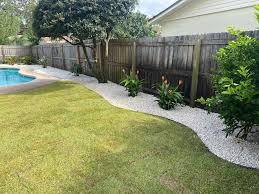
The Street Read. From the car, at a distance, before anyone has gotten out. At that range, what is legible is lines: where the lawn meets the driveway, where beds meet turf, whether the hedge holds a shape or has simply grown. An individual flower is a small object seen from fifty feet. An edge is a long continuous line, and lines survive the distance.
The Walk Read. From the car to the front door. This vantage is physical rather than visual — what is underfoot, what brushes an arm, what has to be stepped around, what the air is like passing a wet mulch bed or standing water. A path narrowed by overgrowth has to be navigated, and that is true regardless of how healthy the planting on either side is.
The Window Read. Inside, during the showing, looking out from whichever rooms hold someone's attention. This one depends entirely on sightlines from specific rooms — the dead hedge visible from the primary bedroom, the neighbour's equipment beyond the screen enclosure, the corner of the yard that only the kitchen window looks at. It is also the vantage a seller sees every day, which is exactly why it stops registering.
The analytical point is that these three vantages are not interchangeable, and work aimed at one does not improve the others. Colour and planting is Street Read work. Clearing and widening is Walk Read work. Screening and removal is Window Read work. A property whose weakness is the walk from the car does not get stronger by adding flowers at the curb, because the flowers are not visible from the position where the problem occurs.
Where does your property sit?
Stand at the curb, then walk to your own front door as though you had never been there. Then go inside and look out of the two rooms you'd expect a buyer to spend the longest in.
If the Street Read is what's weak — soft edges, an unshaped hedge, a lawn that fades into the drive — the work is mechanical and cheap, and it is mostly cutting rather than adding.
If the Walk Read is what's weak — narrow path, overgrowth at shoulder height, something underfoot — clearing is worth more than planting, and it is usually the shorter job.
If the Window Read is what's weak — the view from the rooms that sell the house — you're looking at screening or removal, which may involve someone else's approval before it involves your wallet.
Of the three, the Window Read is the one most likely to lead to a change rather than a cleanup — and changes are where the permission question lives. That distinction is worth settling before you commission anything.
Edges Do More Than Colour
The least glamorous item on a Palm Beach County pre-listing list is a clean bed edge, and it is the one we'd argue for first. An edge is a line, and a line reads at fifty feet in a way that a planting doesn't. The same is true of the driveway margin, where St. Augustine sends runners out over the concrete and blurs the boundary between lawn and hardscape.
Pressure washing belongs in the same category. Concrete, pavers and screen-enclosure framing accumulate the biological growth that a humid climate supports year-round, and the difference is legible from the street. The caution is that pressure washing can displace the joint sand in paver installations and can lift surface material on older or already-spalling concrete — worth confirming with whoever does the work rather than assuming a single setting suits every surface on the property.
The Dead Zone
Here is a pattern worth looking for specifically, because it is easy to misread as a lawn problem when it isn't one. Irrigation systems are built in zones — separate valves, each watering one section of the yard on its own schedule. When a single zone stops delivering water, whether from a broken head, a valve that no longer opens or a controller that was reprogrammed and never checked, the turf inside that zone's coverage dries out while the turf beside it carries on.
What that produces is a brown area with edges. A rectangle. A wedge. A strip that stops abruptly at a line no plant would choose for itself.
We call it the Dead Zone, and the distinction it lets you draw is the useful part: ordinary lawn stress — pests, shade, traffic, disease — tends to be irregular and blotchy, while geometry points back to the water supply rather than to the grass. That is a different diagnosis and a different repair, and replacing turf without repairing the zone reproduces the same shape a few weeks later.
The practical value is that it is cheap to check — run each zone from the controller and watch where the water actually lands — and that it has a clock attached. New sod needs weeks of consistent watering to root and knit before it stops reading as newly laid, so a zone discovered the week of listing is a zone whose repair will still be visible at the first showing. The more irrigated turf a property has facing the road, the more plainly this shows, which is an argument for checking larger lots before the photographer is booked rather than after.
Before You Commission Anything: Who Has to Say Yes
This is the step that most often turns a two-week plan into a two-month one, and it is worth resolving before any quote is accepted.
Palm Beach County contains both association-governed communities and older neighbourhoods with no association at all, and which of those a property sits in is a property-level question rather than a city-level one. Two owners a few miles apart — one in Wellington, one in Lake Worth Beach — can get completely different answers to the same question about the same fence.
Where an association governs the property, exterior changes such as a fence, a paint colour, a hardscape addition or a structure visible from the street commonly fall inside an architectural review process. What requires approval, what the standards are, and how long the review takes are all set by that community's governing documents and its review calendar, not by a general rule. Where hedging or landscaping functions as required screening under those documents, its height and its replacement can be governed as well, which makes what looks like an aesthetic decision a permission question instead.
Where there is no association, there is no committee to ask, which removes a step. It also means no shared standard is being maintained on either side of you, so the property is read on its own terms rather than against a block that looks broadly the same.
Separately from any association, some of this work is permitted work. Decking, structural additions, drainage changes and the electrical side of a hardwired lighting installation are handled by the municipality or the county rather than by an association, and the two approvals are independent — clearing one does not clear the other. Which projects require a permit is determined by the building department with jurisdiction over your address. We've written the fuller account of which projects tend to trigger which authority, and why unpermitted work has a habit of surfacing later in a transaction, in our guide to which home improvements need a permit here.
To be clear about the boundary: what your association permits is answered by your governing documents, and what your municipality or the county requires is answered by its building department. Neither determination is ours to make on their behalf. What we can offer is the sequencing — which of those questions to ask before you commission work rather than after.
Lighting, Fences and the One Addition Worth Making
Exterior lighting earns its place for a practical reason rather than an aesthetic one: any showing that runs past dusk still has to get someone from the driveway to the door, and a path that isn't legible in the dark is a Walk Read problem that only exists at certain hours. Freestanding solar fixtures aren't wired to the house and involve no electrician. A hardwired installation is electrical work with its own permitting path through the municipality or county — worth knowing before the quote arrives rather than after.
Fences are where salt air and humidity do their most visible work. Hardware corrodes, wood greys, and vinyl chalks. The judgement call is honest and simple: a fence that is structurally sound and cosmetically tired is a cleaning-and-refinishing job, while a fence with failing posts is a replacement — and in an association community, a replacement is an approval before it is a purchase.
On the question of a single feature addition — a deck, a patio, a water feature — the sequencing usually decides it. A water feature introduces standing water into the yard, which can support mosquito breeding and may be restricted outright by some governing documents. A patio or deck is a real improvement to how the space is used, but it is permitted work with a timeline attached that belongs to the building department rather than to you. If the property is going on the market this season, the option that doesn't depend on anyone else's calendar is making the existing space read well.
Sequencing: The Parts That Have a Clock On Them
Several pieces of exterior preparation cannot be compressed, and they are the ones worth starting first.
Sod needs weeks of consistent watering to root and knit, and your installer or supplier can tell you what that looks like for the variety and the season. New plantings need time to stop looking newly planted. Paint and stain need the conditions the manufacturer specifies to cure properly, which in a humid summer means watching the forecast rather than the calendar. And where architectural review applies, it runs on a submission-and-meeting schedule that belongs to the association, not to your listing date.
Two local constraints sit on top of that. Landscape irrigation across this region operates under a year-round day-of-week schedule administered by the South Florida Water Management District, and individual counties, municipalities and utilities can and do impose stricter rules — so confirm the current schedule for your specific address, along with any provisions that apply to newly laid sod or new plantings, before the work is booked rather than after. And hurricane season runs from June 1 through November 30, which bears on both tree work and the wisdom of installing anything that hasn't had time to root before storm season.
Where limbs overhang the roof, that's a conversation for a licensed arborist and, separately, for the property's insurer — not something to settle from the curb.
What This Means for Your Situation
The pattern underneath all of this is that exterior preparation in Palm Beach County splits cleanly into two piles, and sellers benefit from sorting them before spending anything.
The first pile is work that requires nobody's permission and carries no lead time: edging, cutting back, pressure washing, clearing the path, moving the hose and the ladder and the toys out of sight, and repairing an irrigation zone. This is also the pile the Street Read and the Walk Read respond to directly, which is the argument for doing it first. Most of it can be completed in the weeks before photography.
The second pile is anything that changes the property rather than maintaining it. That pile carries approvals, quotes, cure times and a real possibility of arriving late. It is worth doing when the timeline genuinely supports it, and worth declining when it doesn't — and declining it is not the same as neglecting the property.
One more thing worth saying plainly, because it comes up with owners weighing a move north: if the reason for selling is that the upkeep has stopped being worth carrying, then the Port St. Lucie corridor is worth evaluating on exactly that axis. Yard obligation is largely a function of lot size, irrigated turf area and how mature the planting is, so it is a figure to compare property by property rather than to assume from the market as a whole. That's a corridor question rather than a yard question, but for some sellers it's the real one.
When the Yard Is Ready and the Price Isn't
Preparation and pricing are separate decisions that arrive at the same moment, and it's worth being clear that the first does not underwrite the second.
A well-prepared property removes reasons to hesitate. It does not create room above what comparable sales support, and preparation spending is not recovered simply by asking more. A list price set above what the evidence supports isn't corrected by a well-kept yard — the yard's job is to make the property easier to say yes to at a supportable number, which is a different job entirely. We wrote up a worked example of what happens when those two decisions get confused, with the actual arithmetic, in our account of what testing the market actually costs a seller.
The practical takeaway: do the exterior work because it removes friction from the showing, not because it buys headroom on the price.
Frequently Asked Questions
Should I put in new sod before listing, or is that a waste of money?
It depends on why the lawn looks the way it does and how much runway you have. If the cause is a failed irrigation zone, repair the zone first — the existing turf may recover once it's watered again, and sod laid over a zone that still doesn't deliver water will fail in the same shape. If the turf is genuinely gone, sod needs weeks of consistent watering to root and knit before it stops reading as newly laid, so it only makes sense if you have that time before photography. Your installer can tell you what establishment looks like for the variety and season, and the current watering schedule for your address governs how you can water it while it establishes.
Do I need association approval to trim or replace a hedge?
That's answered by your governing documents rather than by a general rule. Routine trimming to maintain an existing shape is often treated as maintenance, while replacement — and sometimes height, particularly where the hedge functions as required screening between properties — can fall under architectural review. Check your community's architectural guidelines before the work is scheduled, and check the review calendar at the same time: where delay happens, it is usually the meeting schedule rather than the decision itself.
My backyard isn't visible from the street. Does it still matter?
Yes, but it's doing a different job. The backyard isn't part of the Street Read at all — it belongs to the Window Read, which happens from inside, looking out of specific rooms. That makes sightlines the thing to work on rather than overall tidiness: what's framed by the kitchen window, the primary bedroom window and any room with a slider is what's actually on display. A cluttered corner that no window looks at is a lower priority than a dead hedge sitting squarely in the view over the sink.
Thinking About Selling in Palm Beach County?
If you're weighing what's worth doing before a listing — and what isn't — that's a practical conversation rather than a sales one. Tell us what you're seeing from the curb, from the path and from the window that matters most, and we'll be straight with you about which pile each item belongs in.
About the Authors
Chris and Sue Kull are real estate professionals working in Palm Beach County and the surrounding South Florida market. The Street, Walk and Window vantages and the Dead Zone pattern described above are their own analysis of how a property presents from outside, offered as real estate guidance.
Nothing here is an association, permitting, insurance, arboricultural or landscaping determination; those questions belong to your governing documents, the building department with jurisdiction over your address, and the licensed professionals in each field.
You can explore additional resources, community guides and real estate tools at www.TheKullGroup.com, or reach out through our contact page.