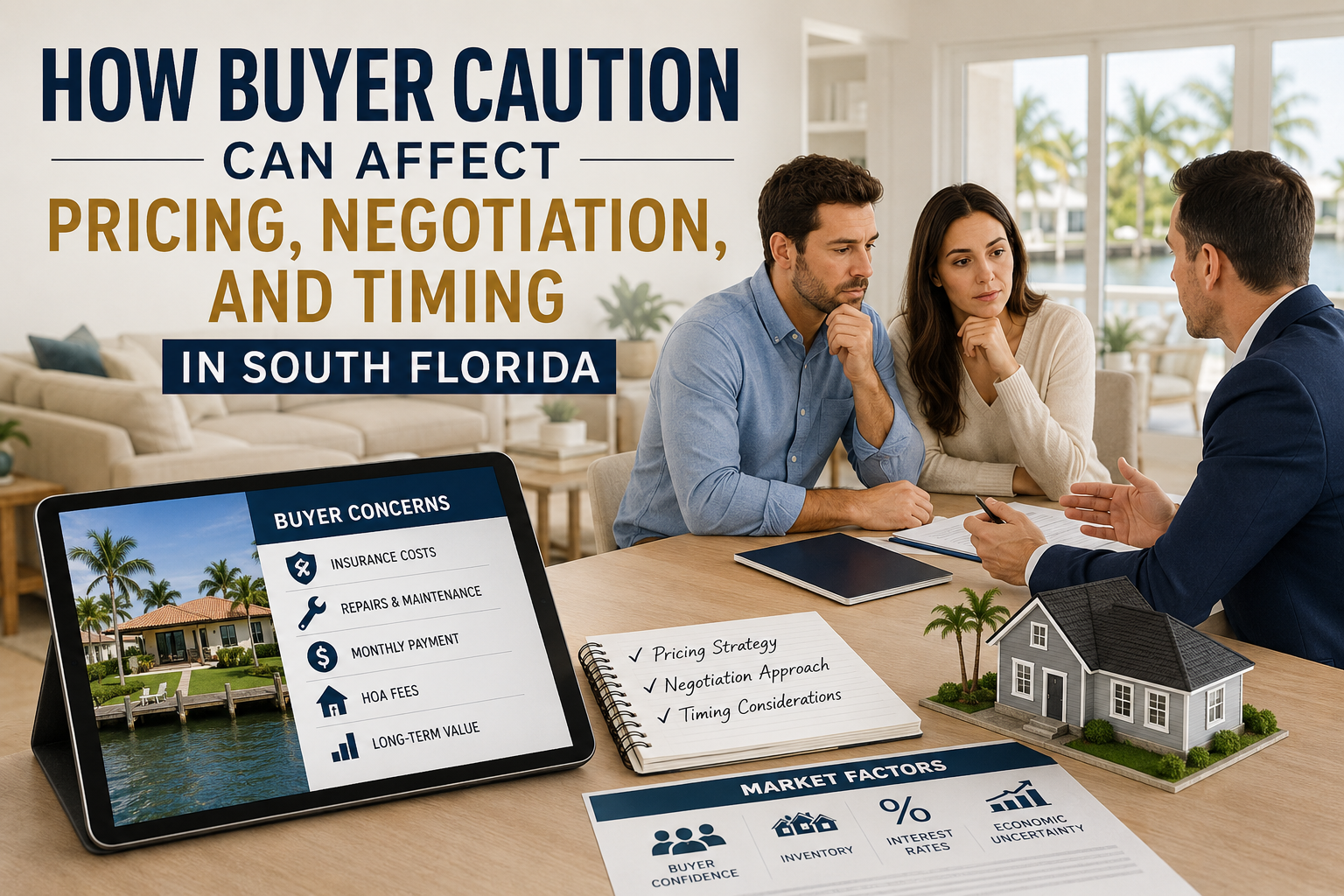
How Buyer Caution Can Affect Pricing, Negotiation, and Timing in South Florida
Buyer caution does not always arrive loudly. It often shows up in quieter ways: fewer rushed offers, longer pauses after showings, more questions about insurance, sharper inspection concerns, and hesitation around homes that once would have received quicker attention. In South Florida, that caution can affect pricing, negotiation, and timing because buyers are no longer reacting only to the house itself. They are weighing the full cost of ownership, the condition of the property, the monthly payment, the insurance picture, the HOA environment, and whether the home will still feel manageable after the excitement fades. Sellers may still see value through the lens of what their home was worth during a more aggressive market. Buyers are looking at what it will cost to live there now. That gap is where pricing pressure, negotiation tension, and timing decisions begin.
Buyer Caution Usually Starts Before the Offer
A cautious buyer does not always make a low offer right away.
Sometimes they simply wait.
They tour the home, ask good questions, compare it against three others, revisit the monthly payment, and then slow down. That delay can feel confusing to a seller who expected stronger activity, especially if the home is clean, well-located, and priced near recent comparable sales. But buyer behavior is not only shaped by comparable sales. It is shaped by risk.
In Palm Beach County and surrounding South Florida markets, buyers are often calculating more than the purchase price. Insurance costs, roof age, flood exposure, HOA fees, maintenance condition, and possible repair expenses can change how a home feels financially. A buyer may like the property and still hesitate because the numbers do not settle comfortably.
That hesitation matters.
When several buyers behave the same way, the market begins sending a message. It may not mean the property is undesirable. It may mean the price, condition, and perceived risk are not aligned clearly enough for buyers to move with confidence.
Pricing Has to Account for the Buyer’s Sense of Risk
Many sellers think of pricing as a math exercise. Recent sales, square footage, upgrades, location, and market activity all matter. But pricing also has a psychological side. A home can be technically comparable and still feel expensive if buyers believe future costs are uncertain.
That is especially true in South Florida.
A buyer looking at an older roof, dated electrical components, aging windows, visible deferred maintenance, or a high monthly HOA obligation may mentally adjust the price before an offer is ever written. The seller may see character, history, and long-term value. The buyer may see exposure.
This is where sellers sometimes lose momentum without realizing it. They price for the best version of the home’s story, while buyers price for the parts they may have to solve later.
A cautious market does not always punish every seller. It tends to punish uncertainty. Homes that clearly explain their value, condition, updates, and ownership costs are easier for buyers to understand. Homes that leave too many unanswered questions invite hesitation, and hesitation often turns into negotiation leverage.
Negotiation Becomes More Detailed When Buyers Feel Less Certain
In a more confident market, buyers may compete first and investigate later. In a cautious market, they investigate before they commit emotionally.
That changes the tone of negotiation.
Offers may include more conservative pricing, stronger inspection language, requests for credits, seller concessions, repair discussions, or longer decision windows. Buyers may focus on items that once felt minor because every unresolved issue adds to the larger question: “What will this home really cost me after closing?”
For sellers, this can feel frustrating. A buyer may love the kitchen and still object to the water heater. They may appreciate the neighborhood and still ask questions about insurance. They may be excited about the yard and still worry about drainage, trees, fencing, or storm preparation.
That does not always mean the buyer is unreasonable.
It often means the buyer is trying to make the risk feel measurable.
Strong negotiation strategy in this environment starts before the offer arrives. Sellers who understand likely objections in advance can decide what to repair, what to disclose clearly, what to document, and where they are willing to be flexible. Waiting until inspection week to discover buyer concerns can put the seller in a weaker position because the buyer has already attached emotion to uncertainty.
Timing Matters More When Buyers Are Comparing Carefully
Buyer caution can stretch the timeline.
Showings may still happen. Interest may still exist. But decisions take longer when buyers are comparing monthly costs, property condition, commute patterns, insurance quotes, and long-term comfort. A home that might have received a fast offer in a hotter market may now need more time for the right buyer to understand it.
That does not mean sellers should automatically wait longer without making adjustments.
Time on market has its own psychology. After a home sits, buyers often begin asking different questions. Why has it not sold? Is the price too high? Did inspections reveal something? Are sellers flexible? The longer those questions linger, the more negotiation pressure can build.
There is a quiet point where time stops helping and starts shaping perception.
For South Florida sellers, timing should be evaluated early. If showing feedback is consistent, if buyers are raising the same concerns, or if nearby homes are moving while yours is not, the issue may not be exposure. It may be alignment. Price, presentation, condition, and buyer confidence have to work together.
Condition and Presentation Can Reduce Buyer Hesitation
Buyer caution becomes stronger when buyers have to guess.
Guessing creates friction. A small crack becomes a question. A dated system becomes a possible future expense. A cluttered room makes the home feel less cared for. An unclear repair history leaves the buyer wondering what else may not be visible.
In South Florida, condition concerns often carry extra weight because homes face heat, humidity, storms, roof exposure, pest pressure, and moisture-related issues. Buyers know that deferred maintenance can become expensive quickly. Even when they cannot name the exact risk, they can feel the uncertainty.
Presentation helps, but not because buyers are fooled by nice staging or bright photos. Good presentation helps buyers understand the home faster. It reduces mental clutter. It makes strengths easier to recognize and weaknesses easier to evaluate in context.
Documentation matters too. Roof age, permits, warranties, inspection history, major improvements, HOA details, and insurance-related information can help buyers feel less exposed. Confidence is not created by pretending concerns do not exist. It is created by making the home easier to understand.
Understand What Your Home May Be Worth
If this topic is making you think about your own property, checking your home’s current value can help put the local market into perspective.
Check Your Home ValueThe Best Strategy Is Not Panic. It Is Alignment.
Buyer caution does not mean sellers have no leverage. It means leverage has to be earned more carefully.
A well-prepared home, priced with discipline, supported by clear information, and presented honestly can still attract serious interest. But the strategy has to reflect the buyer’s current mindset. Buyers are not just asking whether they like the home. They are asking whether the decision feels safe enough to make.
That is the part sellers sometimes miss.
A buyer may not object to price alone. They may object to price plus uncertainty. Price plus repairs. Price plus insurance. Price plus HOA dues. Price plus the feeling that the seller has not accounted for what ownership will actually require.
When the market becomes more cautious, the seller’s job is not to chase every fear. It is to remove avoidable friction and make the value easier to believe.
That can mean adjusting price. It can mean improving presentation. It can mean handling repairs before listing. It can mean being more realistic during negotiation. Sometimes it means waiting for a more aligned buyer. The right answer depends on the home, the timing, the competition, and the seller’s next move.
But ignoring buyer caution rarely makes it disappear.
FAQ
How does buyer caution affect home pricing in South Florida?
Buyer caution can make pricing more sensitive because buyers are weighing not only the purchase price, but also insurance, repairs, HOA costs, maintenance, and long-term affordability. If those concerns feel unresolved, buyers may hesitate or negotiate more aggressively.
Can cautious buyers still make strong offers?
Yes. Cautious buyers can still make strong offers when the home feels well-priced, clearly presented, properly documented, and aligned with current ownership costs. The issue is usually not caution by itself. The issue is whether the home gives buyers enough confidence to move forward.
Keep Exploring South Florida Real Estate
If you're researching market trends, comparing communities, or trying to better understand how broader real estate topics affect local decisions, reviewing more South Florida resources can help put the market into context.
About the Authors
Chris and Sue Kull are South Florida real estate professionals with more than three decades of experience helping buyers, sellers, and property owners navigate real estate decisions throughout Palm Beach County and surrounding communities.