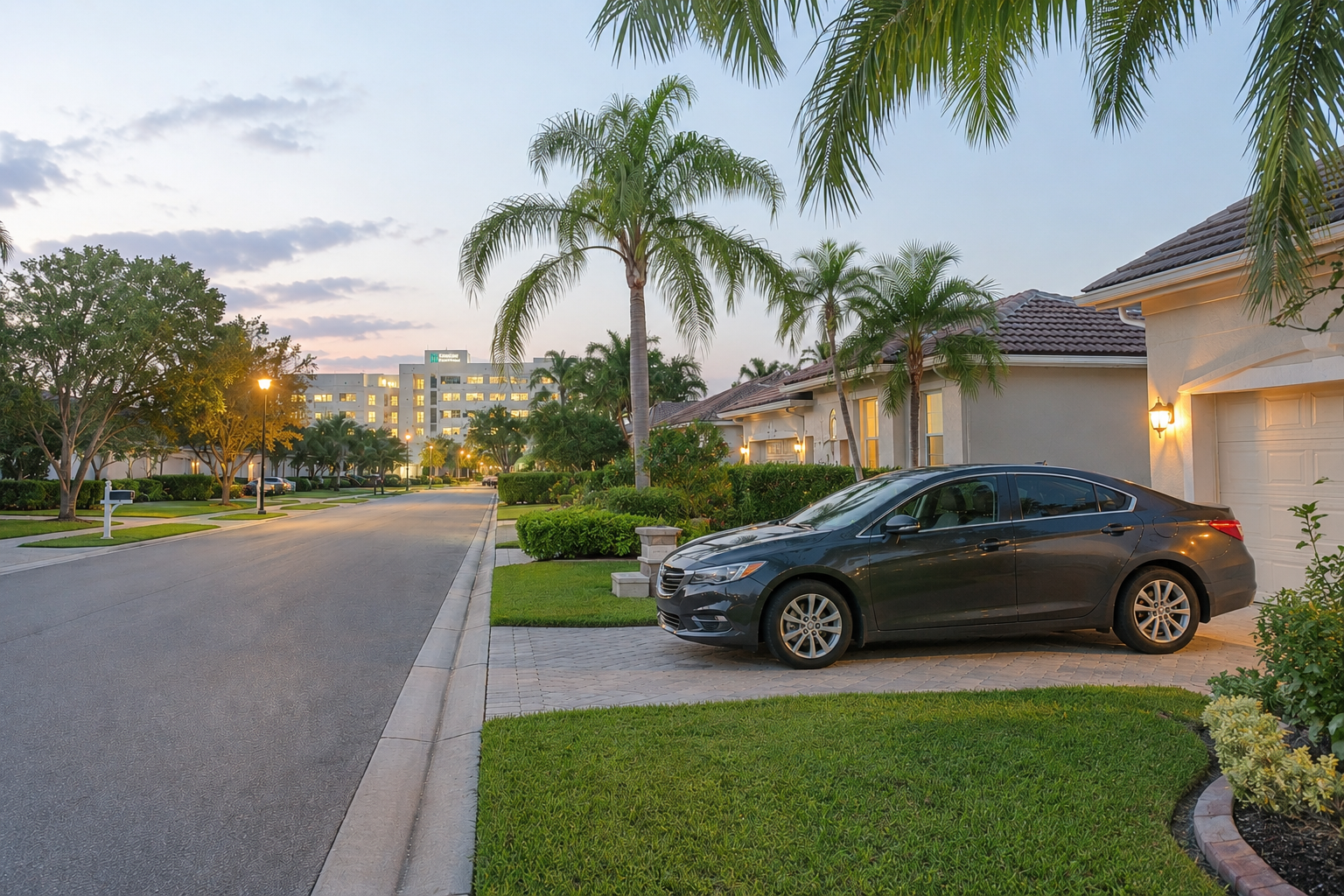
What Palm Beach County Healthcare Workers Should Know Before Buying a Home
Many of the healthcare professionals who contact us about buying in Palm Beach County aren't thinking about real estate in the way the industry assumes they are. They're not browsing listings casually. They're working through a practical problem — one that has been quietly shaping itself around their schedule, their commute, and the particular exhaustion that comes from clinical work. The home decision, when it finally surfaces, is usually less about square footage and more about how much the wrong location is costing them in hours they don't have.
That framing matters. Because the housing decisions that hold up over time for healthcare professionals in this market are the ones that were made around how they actually live — not how they expect to live once things settle down. Things rarely settle down. The schedule stays compressed. The commute either works or it erodes everything around it. And the property either supports recovery and rest, or it quietly adds to the load.
If you're navigating this decision now — or have been circling it for a few months — the Palm Beach County real estate resource for healthcare professionals we've developed addresses the specific conditions of this market for clinical and administrative healthcare buyers.
How Shift Schedules Reshape What Proximity Actually Means
The standard commute calculation — distance divided by average traffic time — doesn't apply cleanly when the schedule involves rotating shifts, overnight coverage, or variable start times. A drive from Boynton Beach to a facility in Palm Beach Gardens looks different at 6:45 a.m. on a weekday than it does at 11 p.m. after a twelve-hour shift. Both are real commutes. Only one typically gets factored into the housing decision.
What we observe repeatedly across healthcare buyers in this market is that the commute concern enters the conversation early and exits it too quickly. A neighborhood passes the initial proximity test, the property checks the other boxes, and the commute slides to the background. Then the schedule starts — and the drive at the end of a night shift, or the turnaround between a closing shift and an opening one, surfaces as a daily friction that the purchase didn't account for.
Palm Beach Gardens sits at a practical center point for several major healthcare systems in the county. Buyers who orient around that corridor — and who are honest about what their specific schedule looks like at both ends of the day — tend to make decisions that hold up well over time. Those who optimize for the property first and rationalize the commute may find themselves reassessing later than they expected.
The honest calculation isn't commute time in ideal conditions. It's commute time in the conditions that apply to the shifts you actually work, at the hours you actually finish, on the days when you have the least margin.
What South Florida Ownership Pressure Looks Like for a Shift Worker
The structural conditions of South Florida ownership don't pause for anyone's schedule. Salt air and humidity work continuously on roofing, HVAC systems, exterior paint, pool equipment, and irrigation lines, often at a pace that can catch buyers coming from milder climates by surprise. Hurricane preparation isn't a single event — it's an annual operational cycle that requires time, attention, and coordination with vendors whose availability can tighten precisely when demand is highest.
For a healthcare professional working rotating shifts, those ownership demands don't arrive at convenient times. The HVAC service call falls during a run of overnight shifts. The roof assessment needs to happen before the window closes on an insurance renewal. The hurricane prep checklist needs to be completed before a storm track develops — not after. In markets with milder climates, these pressures distribute differently. In South Florida, they can compound in ways that a buyer evaluating a property in a stable season may not fully anticipate.
Insurance has become a separate conversation entirely. Many buyers entering this market are purchasing into an insurance environment that looks materially different from what existed five years ago, as carriers have adjusted their presence and risk approach across the state. What that means in practice varies significantly by property, so it's worth getting a property-specific insurance estimate early — before an offer, not after closing — rather than relying on general assumptions about a neighborhood or zip code. That number belongs in the pre-purchase calculation.
HOA reserve study health is worth examining carefully as well. Communities where reserves are underfunded are communities where a special assessment — sometimes a significant one — is a latent financial event. For a buyer on a clinical salary managing a new mortgage, that exposure is real and worth evaluating before, not after, the purchase.
A direct question worth sitting with: If the commute from the property you're considering added forty-five minutes to your turnaround between a closing shift and an opening one — every time that rotation came around — would the property still be the right decision?
If there's hesitation in the answer, the commute calculation probably deserves more weight than it's currently getting. The healthcare professional real estate resource we've built addresses how to structure that evaluation for this specific market.
Why This Market Responds Differently to Healthcare Buyer Timelines
Healthcare relocation timelines can be tightly compressed. Employment start dates don't flex around real estate search windows. A buyer who accepts a position at a Palm Beach Gardens facility in late spring and needs to be in place before a July onboarding date is working a search window that many purchase timelines don't accommodate cleanly. Contract-to-close cycles, inspection periods, and financing contingencies don't compress just because the buyer's schedule requires it.
After working with Palm Beach County homeowners and buyers for more than three decades, one pattern appears often in healthcare relocation situations: buyers who front-load the market education and the decision criteria before they are under schedule pressure tend to navigate a compressed timeline more smoothly. Buyers who arrive with two to three weeks available and no prior engagement with the market are often working against a structural disadvantage that isn't about inventory or pricing — it's about the time required to make a confident decision in an unfamiliar market.
We worked through a situation in Boynton Beach where a family had approximately three weeks between a discharge date and the point at which the existing property was no longer workable for their situation. They had been thinking about the decision for a year. In that compressed window, we were able to move quickly because the clarity was already there — it just hadn't been acted on. What created the stress wasn't the market. It was the gap between when the decision was ready and when it was acted on. A healthcare buyer can face a version of this: the employment decision creates a deadline that the housing decision has to absorb.
Wellington and Boca Raton both sit within the broader countywide commute geography healthcare facilities draw from, and both have enough inventory variation that a buyer without prior market familiarity can spend real time just developing baseline orientation. That time cost is real and recoverable only if there's enough runway to absorb it.
What This Means for Your Situation
If you are a healthcare professional evaluating a purchase in Palm Beach County — whether the timeline is immediate or still forming — the decision variables that will matter most aren't the ones the standard homebuying process surfaces first. They are the ones that intersect with how you actually work.
Commute geography in relation to your specific shift schedule. Insurance carrying costs on the properties you're seriously considering. The ownership demand profile of a South Florida property relative to the time and bandwidth you realistically have. HOA financial health. The gap between what a property costs on paper and what it costs in practice when the South Florida maintenance cycle is running at full speed.
The financial readiness to purchase and the operational readiness to own well in this climate are related but different things. Many buyers arrive at the transaction with strong financial position and genuine excitement about the property — and then find themselves managing maintenance demands that didn't register during the search. That gap narrows when the evaluation process accounts for South Florida's ownership conditions specifically, not homeownership conditions generally.
The questions worth asking before you are under contract: What does the insurance environment look like on this specific property? When were the major systems last replaced, and what is the projected replacement cycle from this point? What does the HOA reserve study reflect? And — honestly — what does this commute look like on the day you are least equipped to handle it?
Those questions are answerable before the purchase. They are considerably harder to answer after it.
Do healthcare professionals qualify for any special financing programs in Florida?
Several state and county-level programs have historically offered assistance to first-time buyers in healthcare and other essential professions — down payment support, favorable rate structures, and similar instruments. Availability, funding levels, and eligibility criteria change. The most reliable approach is to confirm current program status with a lender who works actively in Palm Beach County rather than relying on program descriptions that may reflect prior cycles. Financing ultimately depends on individual factors — income documentation, employment history, credit, and debt-to-income — so it's worth having that conversation early with a lender rather than assuming a particular outcome.
How much does commute distance actually affect day-to-day quality of life for shift workers in this market?
The effect can be greater than a buyer initially accounts for, and less evenly than a simple distance calculation suggests. The commute from a property near Royal Palm Beach to a facility in Palm Beach Gardens runs differently at 7 a.m. on I-95 than it does at midnight on a surface route. Healthcare buyers who map the commute at multiple relevant times — including the end of a long shift, not just the beginning of a morning commute — may find their assessment changes. The commute that looked manageable in the search phase can look different after living it for a while on a rotating schedule.
What should healthcare professionals look for specifically when evaluating a property's maintenance profile in South Florida?
Roof age and material relative to the insurance market's current risk appetite, HVAC system age and service history, pool equipment condition if applicable, and evidence of any deferred exterior maintenance — paint, caulking, window seals — that the climate will accelerate. Communities with active HOA reserve funding are generally in a better position than those where reserve studies reflect underfunding. The inspection process will surface much of this, but orienting around these questions before the inspection — during the search phase — allows a buyer to screen more efficiently rather than discovering the maintenance profile after emotional investment in the property has already formed.
The decisions that hold up in this market are the ones made with an accurate picture of what ownership actually requires here. If you are a healthcare professional evaluating a purchase in Palm Beach County — or working through the relocation decision in any stage — the healthcare professional real estate resource we've developed for this market is a useful starting point. For owners curious about what current equity looks like in their specific area, the Palm Beach County home value resource provides a grounded starting point.