


What a Reserve Study Actually Tells You
When owners compare one association-governed community with another, they compare the dues. It is the number on the listing, the number in the conversation, the number people remember. On its own, it says less about the ownership position than owners tend to assume.
Dues describe what is currently being collected. They say nothing at all about what is going to be needed. The document that speaks to the second question is the reserve study, and it is the closest thing in association ownership to a forward view — which makes it central to the total ownership load set out in what this property actually costs you to own. A low assessment against a thin reserve is not automatically a saving. It may be a cost that has not been billed yet, sitting on a different page.
One pattern we consistently observe: owners compare communities on the monthly dues and almost never on the reserve position. The dues tell you what is being collected. The reserve study tells you what is coming.
Why the Two Numbers Diverge
A reserve is a fund built over time so that when a shared component reaches the end of its life, the money to replace it already exists. Where that funding has not been accumulated in advance, the cost does not disappear — it has to be met closer to the time, through whatever routes are available to the association under its documents and applicable law. Those routes may include raising regular assessments, a special assessment, borrowing, staging or deferring the work, or some combination the board arrives at.
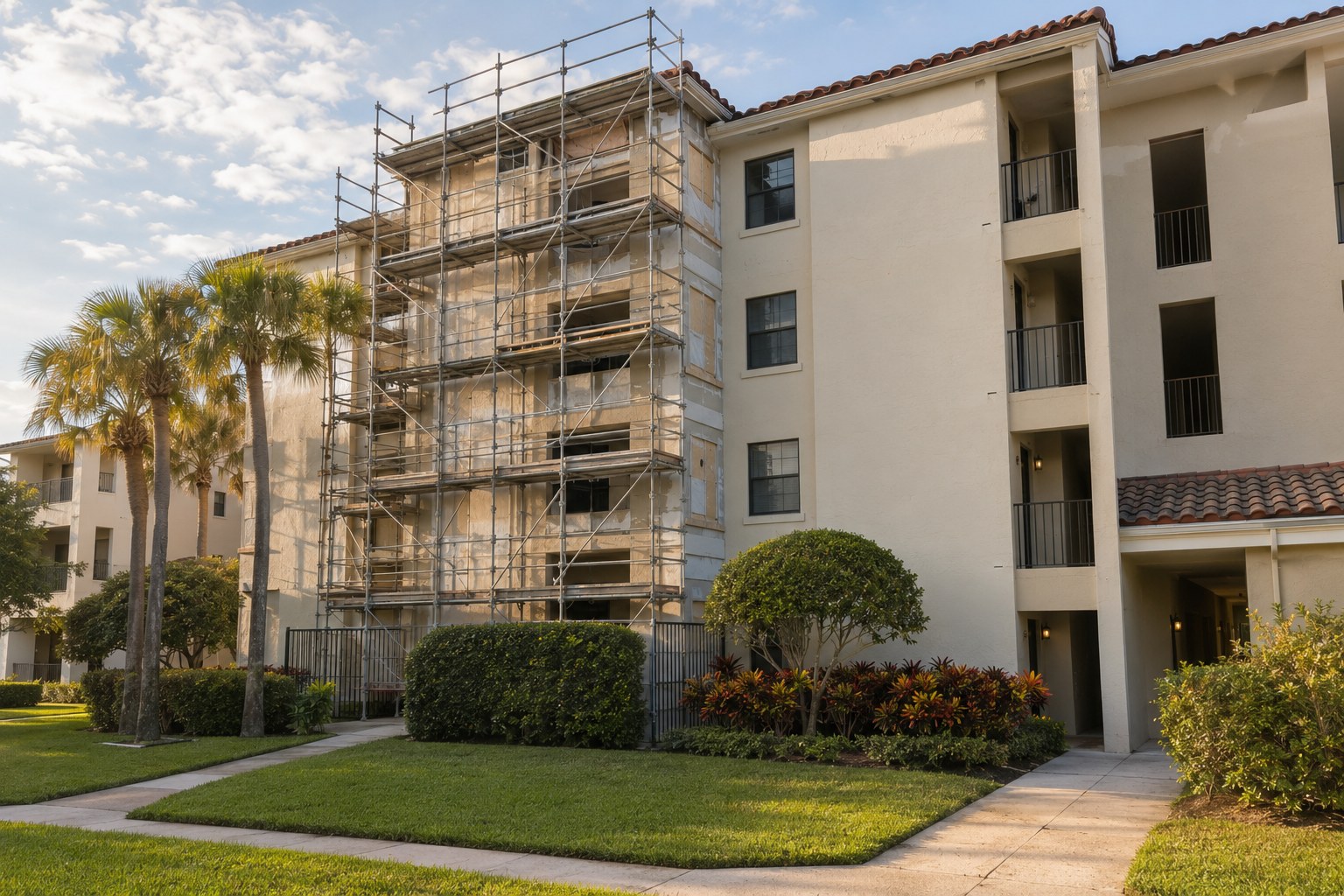
That is the whole mechanism, and it explains why dues and need come apart. A board can hold assessments flat and let the reserve position erode. Nothing visible happens for years. The building is doing what buildings do in this climate — coatings, sealants, roof systems and exterior elements working through their lives on a rolling basis rather than pausing — and the gap between what has been collected and what will be required widens quietly. Some homeowners tell us the first they knew of it was a notice, and that the notice was not really the event. The event had been running for a decade.
This is the association-governed version of a pattern that shows up everywhere in ownership economics: pressure accumulates gradually, each increment is manageable, and the shape of the position changes without any single moment that announced itself. The same logic runs through maintenance as a budget and replacement as a capital event, which is worth reading alongside this one.
The Four Questions a Reserve Study Answers
- What does the association actually own? The component inventory — roof systems, structural elements, waterproofing and exterior coatings, paving, mechanical and life-safety systems, amenities. Scope is the first thing to read, because the study only shows funding for the components it covers; if something is missing from the inventory, the study does not tell you how, or whether, that item is being funded, and that is a question to put to the association.
- How much life is left in each component? Remaining useful life, estimated from age and condition. This is where a study is only as good as its inspection and the conditions it recorded. How much weight an older study still carries depends on its scope, whether it has been updated, and what has happened to the components since it was performed.
- What will each cost to replace? Current replacement cost estimates, which is why studies are updated — construction costs and requirements move independently of anything happening in the community.
- How far from funded is it, and what is the plan to close the gap? The funding plan and the percent funded measure — the ratio of what is actually in the reserve to what would be there under full funding. That single ratio is the summary an owner should be able to state about their own community, and in the conversations we have it is one of the figures owners most often have not seen.
Two structural details worth knowing when you open one. Reserves may be accounted for component by component or on a pooled basis, and the two present very differently on the page without necessarily meaning different things about the underlying health. And exterior waterproofing and painting appear on these schedules as recurring cycles rather than one-time events, so it is worth reading how often they are scheduled and what has actually been funded against them.
Do you know your community's percent funded?
If not, that figure — together with the date of the most recent reserve study and the current funding plan — is the place to start, and the association or its manager is where those records are requested.
Condominium and Homeowners Association Are Not the Same Regime
This is where a great deal of confusion lives, and the distinction is worth getting right rather than hedging around.
Condominium and cooperative associations in Florida are governed by a different chapter of statute than homeowners associations, and the reserve obligations differ accordingly. For condominium and cooperative buildings of three storeys or higher, Florida law requires a structural integrity reserve study covering a specified set of structural components — roof, load-bearing elements, foundation, waterproofing and exterior painting, windows and exterior doors, plumbing and electrical among them — and has narrowed the ability of members to vote to waive or underfund reserves for those specific components. Separately, buildings of certain ages are subject to milestone inspection requirements. Those are two different obligations that owners routinely merge into one; the milestone inspection assesses structural condition, the reserve study funds the components.
Homeowners associations operate under a different regime, where reserve funding is not established on the same statutory footing and may depend on how the reserves were created and what the governing documents provide. So a villa or townhome association may be perfectly well run and still have reserve arrangements that work differently from a three-storey condominium building — not better or worse, differently constituted. Which regime applies is a document question rather than a location question: two communities on the same road can sit under different chapters. The question to ask is not "is this an HOA" but "under which regime does this association fund, and what do its own documents say".
Two further boundaries. The association holds these records, not any public office; owners generally have a statutory right to request official records, and that request goes to the association or its manager. And what a specific statutory provision requires of your specific community, or what your governing documents oblige, is a question for an attorney or the association's counsel — not something to settle from an article. Identifying which document answers a given question, and where to request it, is usually the practical first step before any of that.
Reading Your Exposure to the Reserve Position
Here is the shift that changes how owners think about this. A reserve shortfall is not, by itself, a debt already attached to your unit. Nothing is owed until the association creates an obligation — through the budget, a special assessment, borrowing, or some combination — under its governing documents and applicable law. What the shortfall does describe is a gap between what has been collected and what the components are projected to require, and the routes available to an association for closing that gap generally run back through the owners. So the exposure is worth pricing before it is billed, and the distinction between a present obligation and a contingent one is exactly what a careful reader is trying to establish.
Which means the reserve study belongs in the same analysis as your own roof and your own systems. In practice that produces a few things worth doing. Read the most recent study and note its date, then ask what has changed since — an older study describes the components as they were inspected then, so its usefulness depends on whether it has been updated and what work or deterioration has happened in the interval. Look at the funding plan rather than only the balance, because the plan is where the board's intentions become visible. Read the last few years of budgets and any special assessment history together, which is what makes direction visible rather than level. And treat a very low assessment in an older community as a question rather than an attraction.
What it means for the decision depends on what you find. If the position is well funded and the plan is credible, that is real information supporting a keep, and keeping deliberately is a complete outcome. If it is thin, the honest framing is that a projected cost sits ahead of the association and has not yet been converted into an obligation on your unit — the open questions are whether, when and in what form the gap gets closed: gradual increases, a special assessment, borrowing, or some combination the board decides under the documents, with member participation as those documents and the applicable statute provide. That is worth knowing while all four positions are still open. In some situations that become difficult, a pattern we have seen is that the decision was delayed past the point where every option was still available.
Common Questions
My dues are low. Isn't that good?
It is good if it reflects a well-funded reserve and a credible plan, and it is the opposite if it reflects deferral. The two look identical from outside and are distinguished only by the documents. Low dues against a thin reserve in a community with ageing shared components may be a cost postponed rather than a saving enjoyed, and if the association later funds that cost, the units are ordinarily where the funding comes from. The figure to ask for is percent funded, alongside the date of the most recent study.
Can the association simply decide not to fund reserves?
That depends on which regime governs the association and which components are in question, and it has changed. For the structural components covered by a structural integrity reserve study in condominium and cooperative buildings of three storeys or higher, Florida law has narrowed what members can vote to waive or reduce. Homeowners associations sit under different provisions where more may turn on the governing documents and how reserves were established. What applies to your community specifically is a question for the documents and, where the answer carries consequences, for an attorney — it is not safe to generalise from a neighbour's experience in a differently constituted association.
The study says a component is near end of life. Should I sell?
Not on that alone. A known upcoming replacement in a community with a funded plan is ordinary ownership working as designed. The question is not whether something is coming — something always is — but whether the funding is there, whether the plan is realistic, and how a coming replacement sits alongside everything else your position carries. Where it changes the picture is when several lines are moving at once, which is the resilience question rather than the reserve question. Whether the property can absorb a bad year takes that further.
Association ownership is often described as transferring responsibility, and it does — the work, the scheduling, the vendor coordination genuinely sit somewhere else. What it does not remove is the cost. Funding for shared components generally comes back to the units through what the association collects, and it stays largely invisible until a document is opened or a notice arrives. Owners who read the reserve study are not being pessimistic; they are declining to carry an exposure they have never looked at. It usually takes an evening, and what tends to follow, in the conversations we have, is not alarm. It is that the picture finally has a shape. Where that shape sits inside the wider annual load is the question taken up in what this property actually costs you to own.
About the Authors
Chris and Sue Kull write for long-tenured owners weighing what a property is actually asking of them before deciding what to do about it.