


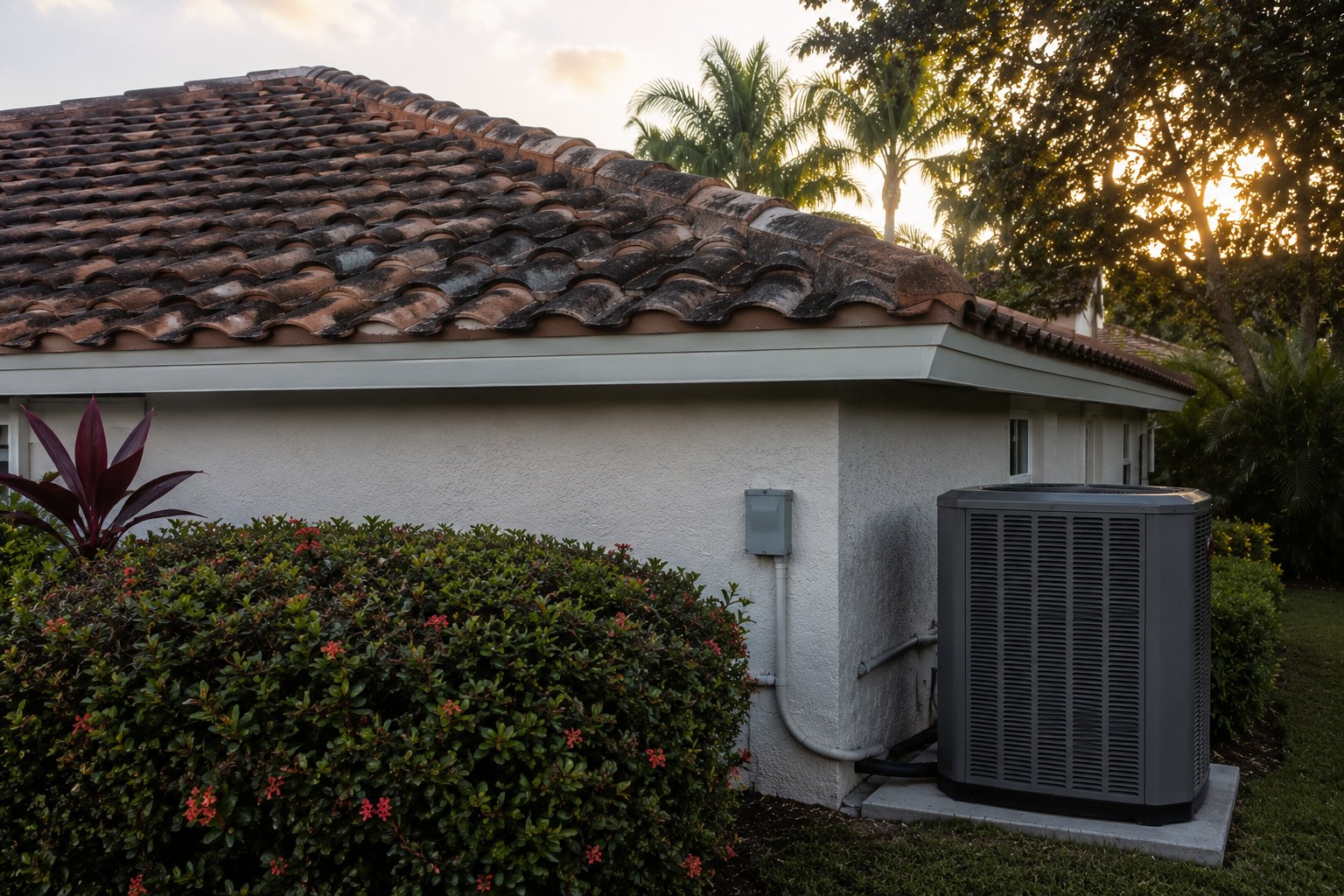
Maintenance Is a Budget. Replacement Is a Capital Event.
If your household budget carries a line called something like home upkeep — servicing, cleaning, treating, the small repairs, the annual contracts — it is a sensible line, and for the recurring work it is meant to cover it holds up.
Then a year arrives when it does not hold at all, and what changed is not the price of upkeep. Something reached the end of its life. A roof, an air handler, a pool heater, a well pump, a seawall panel, a set of openings. Those are not upkeep at a larger scale. They are a different kind of cost with a different shape, and putting them in the same mental line is how the money line of the total ownership load described in what this property actually costs you to own ends up looking calmer than it is.
The distinction is not accounting pedantry. It changes where the money should sit, what you should be watching, and which of the four ownership positions is genuinely open to you.
Four Tests That Separate the Two
Four questions separate the two.
Four Tests: Maintenance or Capital Event?
- Frequency. Does it recur on a rhythm you set — monthly, quarterly, annually — or does it happen roughly once per component life? Recurring is budget. Once-per-life is capital.
- Scale. Does it fit comfortably inside the annual upkeep line, or is it a multiple of that line? A cost that would swallow the whole year's budget is not a budget item.
- Effect. Does it restore something to working condition, or does it reset the clock on a component's remaining life? Servicing restores. Replacement resets.
- Deferral. If you postpone it a year, does the eventual scope of work stay the same? Postponing a service call may change little about the work itself. Postponing a component that is already failing can change what the eventual work involves, and that difference is the subject of what deferral actually costs.
South Florida complicates the sorting in one specific way. Heat, humidity, ultraviolet exposure and storm season keep a set of items in near-continuous attention — coatings, sealants, exterior finishes, irrigation. Those read as maintenance because they are constant, and in that sense they are. But the same conditions act on the components underneath them, which means the maintenance line and the replacement schedule are connected rather than independent. Attentive upkeep does not remove a capital event. It influences when one arrives.
Position sharpens that. On a property in an oceanfront town such as Juno Beach, in northern Palm Beach County, salt-bearing air reaches exterior metal directly — railings, fasteners, fixtures, exposed hardware — so those items sit on a shorter attention cycle than the interior components they are mounted to, and they belong on the watch list as a distinct group rather than inside a general exterior line.
Why the Concentrated Year Happens
Three capital events landing inside eighteen months is an outcome rather than a plan. There are three mechanisms by which it assembles.
The first is vintage. Where a home's major components were installed or replaced in the same period, their replacement windows can overlap, because components put in at the same time can reach the end of their working lives at similar times. That is worth checking for deliberately rather than meeting one item at a time.
The second mechanism is classification. If replacement has been living in the upkeep line conceptually, nothing has been accumulating against it. The money that would have made a capital event ordinary was never separated out, so the event arrives as a shock rather than a withdrawal.
The third is deferral compounding. Each individual postponement can look reasonable on its own — not now, not this year, it is still working. Stack several of those and the postponed items begin to overlap with the ones that were always going to arrive.
A concentrated year is not a single decision. It is several separate, individually reasonable postponements arriving in the same window.
Ownership pressure does not have to arrive all at once to matter; it can accumulate quietly while every individual year still looks manageable. The concentrated year is a poor vantage point from which to start weighing a change of position, because by then the sequence is already underway.
Do you know which capital events are ahead, and in what order?
If you would like to discuss the component picture for a specific property, you can request an Ownership Sustainability Review.
Building the Component Picture
The exercise itself is simple. List the major components. For each, record what the evidence actually supports about when it was installed, and mark it in one of three states: documented, where a permit, invoice or report establishes the date; estimated, where partial evidence supports a reasoned range; unknown, where there is nothing.
That third state has to survive contact with the desire for a tidy spreadsheet. One way this exercise goes wrong is substituting the year the property was purchased for an installation date. A component may have been replaced years before the purchase or years after it. The purchase date establishes when you took ownership and nothing whatsoever about when anything was installed, and building a ten-year picture on that substitution produces a projection that looks precise and rests on nothing.
An unknown carried honestly is more useful than a plausible date, because it tells you where an inspection would actually buy information. Remaining life on a specific component is a question for a licensed inspector or the relevant trade — they can look at what you have and tell you what they see, and that assessment is theirs to make. Sorting which question belongs to which professional, and where the documentation for it would live, is part of building the list rather than a substitute for the assessment itself.
There is a second boundary worth stating plainly. Deciding how much money to hold against a capital schedule, where to hold it, and how that sits alongside the rest of your finances is personal financial planning, not real estate advice, and it belongs with your own financial adviser, accountant or tax professional. Insurance implications belong with your carrier or agent, and questions about governing documents or contracts belong with your attorney. What a component list can do is give those professionals something specific to work from.
Then look at the sequence rather than the sum. Three capital events spread across a decade arrive one at a time, with years in between them. The same three inside two years is a different position entirely, with the same total attached to it. That is the whole argument in sequence beats total, and it is the reason the order matters more than the arithmetic.
Two ownership conditions change the shape of the list itself. Where a property sits in an association-governed community, some components are budgeted at association level rather than by the individual owner; where that line falls is set by the community's governing documents and reflected in its budget and whatever reserve information the association maintains, so that boundary is something to confirm against those documents for the specific community rather than assume from general practice. Where a property sits on unincorporated acreage in the Loxahatchee area of western Palm Beach County and is served by a private well and its own septic system rather than by utility connections, the reverse applies: the well pump, pressure tank, treatment equipment and septic components are owner-held capital items, sitting on the same list as the roof and the air handler.
What the Picture Changes
Having the schedule does not make anything cheaper. It changes what you can do about it, which is a different and more useful thing.
It makes Keep a decision rather than a default. An owner who knows what is ahead and roughly when can plan against it deliberately, and a capital event met from money already set aside is a withdrawal rather than a scramble. Keeping with that picture in hand is a complete outcome, and a better-informed position than keeping without it.
It makes Improve properly assessable, because replacing a component at end of life on your own schedule converts an unpredictable failure into a planned expense and takes the monitoring off your plate. It also makes Reposition and Sell answerable on real terms rather than on a vague sense that the house is getting expensive — the schedule is what you would be handing over or leaving behind, and it belongs in that comparison.
None of that requires new components. It requires knowing which ones are near the end.
Common Questions
How much should I be setting aside?
There is no general figure worth quoting, and any number offered without reference to your components would be invented. What determines it is your specific list — which components are near end of life, what evidence supports those dates, and how close together the events fall. Two properties with identical annual upkeep lines can face completely different capital schedules. The useful first move is not choosing a number; it is building the list, because until the list exists any figure is arbitrary. Choosing the number itself, and deciding where the money should sit, is a conversation for your financial adviser or accountant — the list is what you bring to it.
If I maintain things well, can I avoid the capital events?
You can influence timing and sometimes extend a component's working life. You cannot remove the event. The mechanical and structural components on the list wear as they are used, and South Florida's heat and humidity act on the ones exposed to them — with salt-bearing air adding to that where a property sits near the coast. The honest framing is that good upkeep buys you scheduling control — the ability to replace on your terms rather than after a failure — and scheduling control is worth a great deal. It is just a different benefit from avoidance, and treating it as avoidance is how the concentrated year gets built.
Does this apply if I have no plans to move?
It applies more, not less. Three of the four ownership positions involve continuing to own the property, and every one of them is easier to hold with the schedule visible. A capital event you have already written down and planned around arrives as an item on a list. The same event, unrecorded, arrives as news.
A component reaching the end of its life is not a surprise in principle. It becomes a surprise in practice because the work of writing down what exists, and what is actually known about each of them, never feels urgent until the year it becomes urgent for several things at once. Doing it early changes nothing about the property. It only changes whether you are watching the schedule or being surprised by it. An Ownership Sustainability Review is one place to work through that schedule alongside everything else the property asks of you.
About the Authors
Chris and Sue Kull are real estate professionals in Palm Beach County, Florida. This article sets out the maintenance-versus-capital distinction, the Four Tests, and the documented–estimated–unknown method.