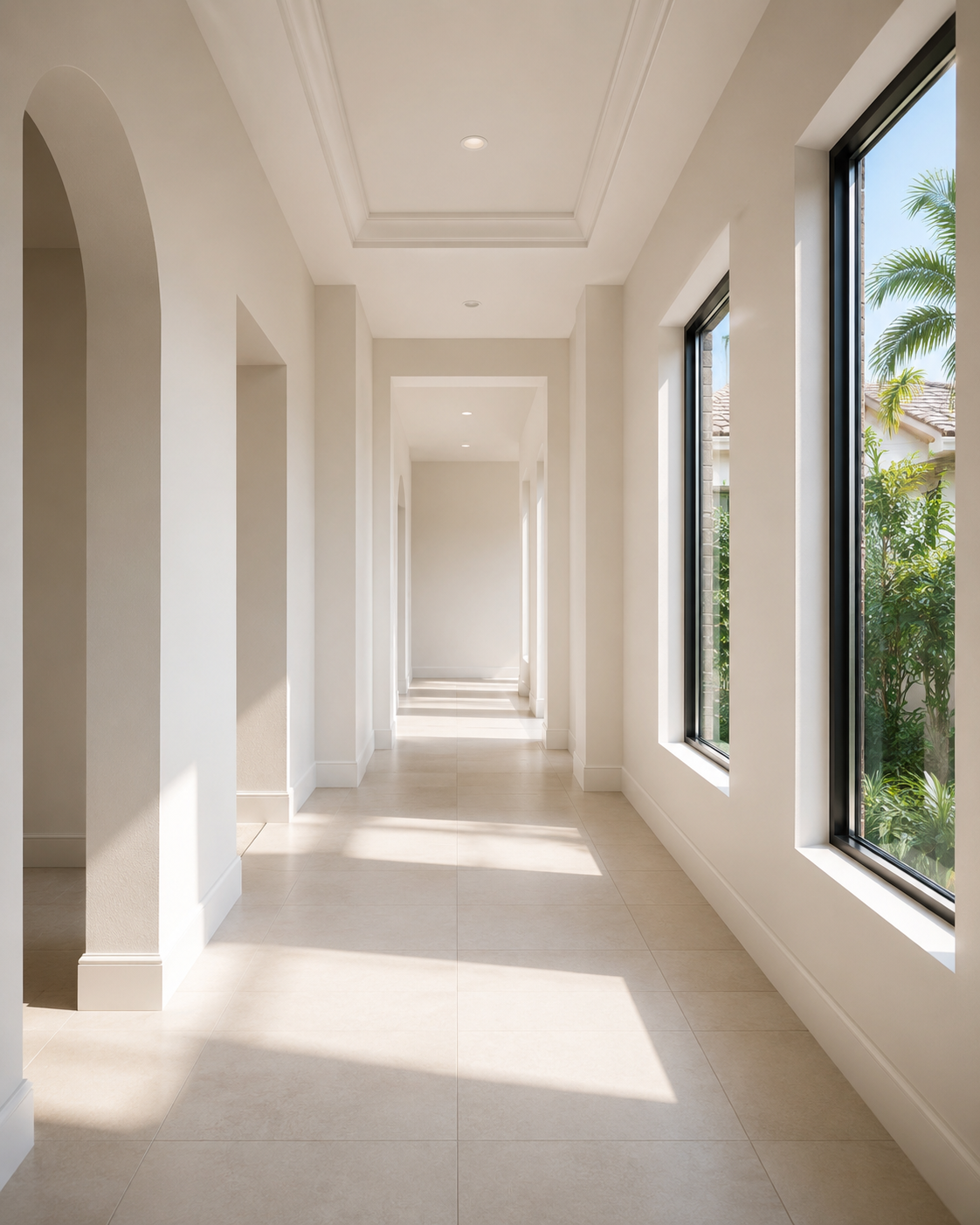
What Newer Construction Actually Feels Like After 25 Years in an Older Home
Most people who have lived in the same South Florida home for two decades or more don't describe it as a burden. They describe it as familiar. The quirks are known. The contractors are on speed dial. The seasonal rhythms — what needs attention before hurricane season, what deteriorates fastest in the summer humidity, which system will be next — have become part of how they manage their lives. The house is not a problem. It is just the background condition of everything else.
What shifts, often quietly and without a single triggering event, is the weight of that background condition. The mental overhead that comes with owning an aging property in this climate doesn't announce itself. It accumulates. And at some point, a homeowner who has managed that overhead for twenty-five years starts to wonder what their life would feel like without it — not because anything has gone catastrophically wrong, but because the cumulative cost of staying ahead of an older home in South Florida has become something different than it used to be.
That is the conversation this asset is written for. Not the decision to sell. Not the mechanics of buying newer construction. The lived difference — what ownership actually feels like on the other side of that transition, and why so many homeowners who have made it say the change was more significant than they anticipated.
If you are already thinking about what that transition might look like for your specific situation, the Sell High Buy Smart framework is where that conversation starts.
The Operational Difference Is Not What Most People Expect
Homeowners who transition from a 1990s or early 2000s build to newer construction — particularly in communities designed around lower-maintenance living — consistently report the same surprise: the change they notice first is not the systems. It is the silence.
Not literal silence. The absence of low-grade anticipation. The background awareness that something is probably approaching — a roof that is getting close, an HVAC that ran harder than usual last summer, a pool heater that the technician mentioned during the last service visit — disappears. It does not fade gradually. It stops.
That absence is disorienting for some homeowners initially, particularly those who have managed an older Palm Beach County property long enough that the anticipation became invisible to them. It was no longer experienced as stress. It was just how ownership felt. The transition to newer construction reveals, retroactively, how much cognitive load had been running in the background.
The practical reasons for this are structural. A home built in 2018 or 2020 carries different system replacement timelines than one built in 1998. The roof is not approaching the end of its rated life. The HVAC was not installed during an era before current efficiency standards. The windows are impact-rated, not retrofit-braced. The electrical panel is not a subject of conversation with an insurance underwriter. These are not small differences in a South Florida context — they are the difference between an ownership experience that requires ongoing triage and one that requires ordinary maintenance.
One pattern we consistently observe: Homeowners who have lived in the same property for twenty or more years frequently underestimate how much of their mental bandwidth is occupied by deferred decisions — not the repairs they've made, but the ones they can see approaching. The transition to newer construction doesn't just reduce maintenance costs. It retires a class of decisions that had been silently consuming attention for years.
What South Florida's Climate Does to Older Homes Over Time
This market ages property differently than almost anywhere else in the country. The combination of salt air, humidity, heat cycling, and the annual hurricane preparation cycle creates deterioration patterns that national maintenance averages do not capture. Exterior paint that should last seven years lasts four. Pool equipment that should cycle at ten years cycles at seven. HVAC systems run longer hours under greater thermal load. Irrigation systems corrode from the inside. Landscaping requires year-round attention because the climate does not provide a dormant season that resets the clock.
Insurance has added a layer to this that did not exist for most of the years that longer-term homeowners in Boynton Beach, Royal Palm Beach, and Lake Worth purchased their properties. The insurance environment that existed in 2005 or 2010 is materially different from the one that exists now. Many owners are managing a carrying cost structure — particularly around homeowners insurance — that would have been difficult to anticipate when they bought. The conversation about whether to stay in an older home now starts with insurance in a way that it simply did not a decade ago.
For homeowners who purchased between 2000 and 2008, there is a specific compounding pattern that surfaces repeatedly in this market. Systems installed at purchase — roof, HVAC, water heater, pool equipment — often reach the end of their practical life within the same eighteen-month window. Not because anything failed prematurely, but because everything was installed simultaneously and South Florida's climate applies consistent pressure across all of them. The result is a concentrated capital expenditure period that can feel sudden even when it was statistically predictable. That convergence is one of the most common catalysts for the decision to transition to newer construction — not because the owner can't afford the replacements, but because they can see the next version of the same situation forming ten years out.
Are you managing an older South Florida home and starting to feel the weight of what is coming next?
The shift to newer construction changes more than the maintenance calendar. It changes the daily experience of ownership in ways that are difficult to fully appreciate until you are on the other side of it. If the calculation is starting to feel different than it did a few years ago, that shift is worth examining honestly.
The Transition Corridor: What Newer Construction Actually Offers in This Market
For Palm Beach County homeowners who are considering newer construction — particularly in the Port St. Lucie corridor — the conversation often begins with the wrong frame. The first question is usually financial: what does newer cost versus what can I get from selling? That is a legitimate question. But the homeowners who report the most satisfaction with the transition are typically the ones who asked a different question first: what do I actually want my daily ownership experience to feel like?
Newer construction communities in the Port St. Lucie corridor carry concrete structural advantages that are specific to this context. Insurance underwriting on post-2015 construction is materially more favorable than on older South Florida housing stock — a difference that affects monthly carrying costs, not just the theoretical replacement value. HOA-managed communities eliminate the vendor coordination burden that has become one of the most consistent sources of ownership fatigue among longer-term Palm Beach County homeowners. Finding reliable contractors, scheduling maintenance windows, managing multiple relationships across multiple systems — that entire category of effort transfers to the HOA structure.
Lot sizes in many Port St. Lucie communities are intentionally smaller than the quarter-acre and larger properties common in Wellington and western Boynton Beach. For homeowners who have been maintaining larger exterior footprints for two decades, this reduction is frequently underestimated as a quality-of-life variable. Exterior maintenance — irrigation, landscaping, exterior paint, pool upkeep — scales with the property footprint in ways that become increasingly significant as years accumulate.
The lifestyle pacing also differs from Palm Beach County's density and seasonal traffic patterns. This is not a subjective preference statement. It is a structural characteristic of the corridor that affects how owners use their time. The seasonal congestion patterns, the commercial density, the commute dynamics — they are different enough that homeowners who relocate there consistently name it as one of the changes they notice most in daily life.
The Signals That the Calculation Has Changed
After working with Palm Beach County homeowners for more than three decades, one pattern appears consistently enough to name directly: the homeowners who are most satisfied with the transition to newer construction are rarely the ones who moved because something failed. They are the ones who moved because they saw the next ten years clearly and decided they did not want to spend them the same way.
The single repair — the roof estimate, the HVAC replacement, the insurance renewal that came in significantly higher — is rarely the cause of the move. It is the moment of clarity. The point at which the next decade becomes visible as a series of the same decisions, the same contractors, the same conversations about whether to fix or replace. Once that projection forms, it rarely reverses. What changes is simply whether the homeowner acts on it immediately or continues to defer.
The Ownership Pressure Stack — recognizing where you are:
- System age convergence — multiple major systems approaching replacement simultaneously
- Insurance environment shift — carrying costs materially higher than at purchase, with continued upward pressure
- Vendor coordination fatigue — the mental overhead of managing contractors, scheduling, and anticipating what is next
- Deferred maintenance accumulation — projects that have been postponed long enough that they are now compounding
- Equity gap recognition — financial readiness to move that arrived before emotional readiness to act
- Decade projection — the ability to see the next ten years of ownership clearly, and the recognition that it looks like the last ten
Homeowners who recognize three or more of these conditions simultaneously are typically further along in the decision than they present themselves to be. The conversation that feels like early research is frequently a late-stage confirmation process.
Does newer construction actually cost less to own over time in South Florida?
The acquisition cost of newer construction is typically higher than comparable square footage in older housing stock. But the total cost of ownership conversation is more nuanced than the purchase price. Insurance underwriting on post-2015 construction in South Florida is materially more favorable than on older homes — a difference that compounds over years of ownership. System replacement timelines on newer construction extend significantly beyond those of homes built in the 1990s and early 2000s. And the deferred maintenance accumulation that older South Florida homes generate — accelerated by climate conditions that are specific to this market — does not exist in the same form in newer construction. The correct frame is not what newer construction costs to buy. It is what it costs to own compared to the trajectory of an aging South Florida property.
What does the transition from selling an older home to buying newer construction actually look like in practice?
The sequencing concern — the fear of ending up between transactions, overextended, or homeless — is the most common reason homeowners delay this transition longer than their financial situation actually requires. In practice, the contract contingency structure available in this market is designed to manage precisely this scenario. The mechanics of a simultaneous sale and purchase, when sequenced correctly with appropriate contingencies, are significantly more manageable than most homeowners assume before they've walked through the specifics. The anxiety is real. The risk, when the transaction is structured properly, is considerably more contained than the anxiety suggests.
How do I know if the equity I've accumulated actually positions me to make this move?
Many Palm Beach County homeowners who have owned for fifteen or twenty years are equity-rich in ways that their current carrying cost experience doesn't reflect. The gap between what the property would yield in a sale and what a comparable newer construction purchase would require is frequently more favorable than owners estimate — particularly for homeowners who purchased before 2015 and have not recalculated their equity position against current market conditions. The home value assessment is the most direct way to ground that conversation in actual numbers rather than assumptions.
Most homeowners assume they will know exactly when it is time to simplify. In reality, most discover later that the decision had been forming quietly for years — visible in retrospect, but not always named in the moment. The ownership pressure doesn't announce itself as a decision point. It presents as ordinary maintenance, ordinary anticipation, ordinary management of a property that has served its purpose well. The question is rarely whether the calculation has changed. The question is whether you have given yourself permission to look at it honestly. If you are at that point, the Sell High Buy Smart framework is where that conversation begins.