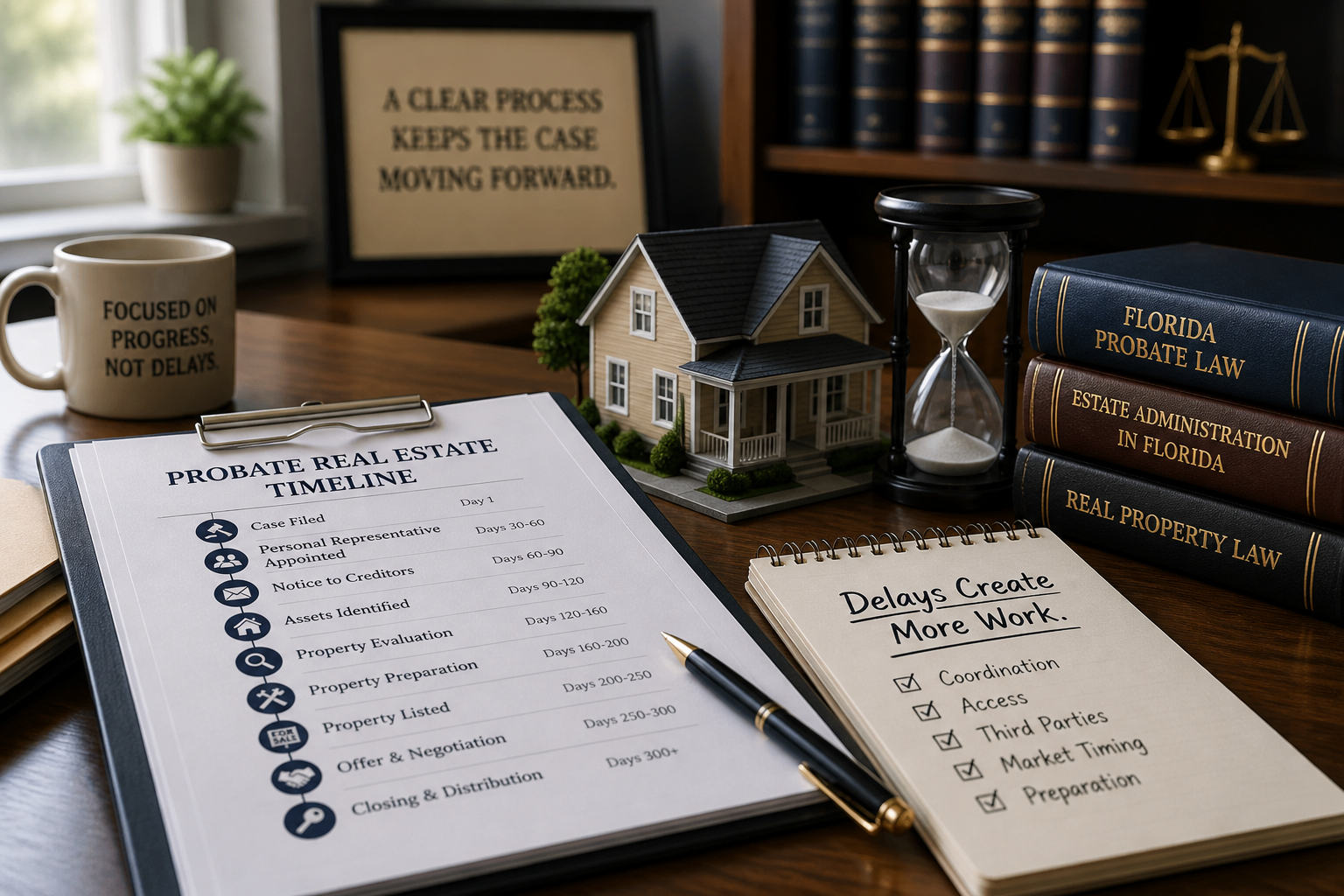
Why Probate Property Delays Often Turn Into More Work for the Attorney
Most probate timelines are structured to move forward in a defined sequence.
Then the property enters the process, and timelines begin to shift—not because the structure is unclear, but because execution introduces dependencies that do not resolve at the same pace as the legal steps.
What appears as a delay at the surface is often something more specific underneath.
Progress becomes dependent on completion, not just direction.
Where Property Timelines Begin to Separate From Case Timelines
Legal progression is based on defined actions. Filings are completed. Deadlines are met. Steps follow in order.
Property-related progress does not follow that same pattern.
Access has to be coordinated. Condition has to be evaluated. Preparation decisions may need to be made. Vendors, buyers, or third parties introduce timing that is not fully controlled within the case itself.
At that point, the case is no longer moving on a single timeline.
It is moving on two—one legal, one operational.
This separation is where delays begin forming.
Why Delays Rarely Exist as a Single Event
Most delays are not caused by one major disruption.
They form through accumulation.
A scheduling gap. A decision that requires additional input. A task that cannot move forward until another is completed. Each item is manageable on its own, but together they extend the timeline in ways that are difficult to isolate.
The result is not a visible stop—it is a gradual slowing.
Movement continues, but at an uneven pace.
How Delays Begin Creating Additional Involvement
As timelines extend, communication increases.
Clients ask for updates. Heirs request clarification. Expectations begin to shift as the original timeline becomes less predictable.
At that point, the attorney is often placed in the position of explaining progress that is no longer strictly tied to legal steps.
This is where delays begin creating additional involvement—not because the case has changed, but because the timeline has.
Why Timeline Gaps Lead to Repeated Clarification
When progress is not continuous, it requires interpretation.
Each pause creates a moment where someone needs to understand what is happening next. When that understanding is not clearly defined through execution, it often returns to the attorney for clarification.
These moments are not disruptive individually.
But they repeat.
And over time, the need to interpret the timeline becomes part of the workload.
This pattern connects directly to how responsibility expands within the case, as outlined in how probate real estate becomes an ongoing responsibility for attorneys.
Local Conditions Can Extend Timelines in Different Ways
Property timelines are also influenced by location.
In markets like Port St. Lucie, pricing sensitivity and buyer pacing can affect how quickly offers materialize. In Jupiter, access, condition expectations, and preparation standards can introduce different timing dependencies.
These are not obstacles—they are variables that affect how long each step takes to complete.
When those variables are not managed within a separate execution layer, they tend to extend the case timeline indirectly.
When Delays Shift From Timing Issues to Structural Issues
At a certain point, delays stop being isolated timing issues and begin affecting the structure of the case itself.
Decisions are deferred because prior steps are incomplete. Communication increases because expectations need to be reset. Progress becomes dependent on resolution of items that were not originally part of the case structure.
This is where the timeline is no longer just extended—it is altered.
The case begins adapting to the property, rather than the property fitting within the case.
What Changes When the Timeline Is Not Carried by the Case
When the operational timeline is handled independently, the case is no longer responsible for absorbing those delays.
Tasks move forward based on completion rather than availability within the file. Coordination continues without requiring additional clarification at each step. Progress remains consistent because it is no longer tied to unresolved dependencies.
This allows the legal timeline to remain intact, even as property-related tasks continue in parallel.
Within probate real estate support for attorneys in Florida, this separation is what prevents delays from continuing to expand inside the case itself.
How the Case Feels When Timeline Pressure Is Reduced
The difference is not speed—it is consistency.
Updates remain aligned with actual progress. Expectations are easier to maintain. Communication becomes more direct because fewer gaps need to be explained.
The attorney is no longer positioned as the point where timeline uncertainty is interpreted.
The case moves forward with fewer interruptions.
When This Shift Becomes Relevant
This shift becomes necessary when delays begin stacking rather than resolving.
Not because something has gone wrong, but because the number of small dependencies has reached a point where they continue extending the timeline.
At that stage, allowing those dependencies to remain inside the case often leads to continued involvement.
Separating them allows the process to continue without carrying that weight.
Maintaining Progress Without Extending the Case
The objective is not to eliminate delays entirely.
It is to prevent those delays from expanding the scope of the case.
When execution is handled independently, the timeline continues moving without requiring additional interpretation or repeated clarification.
If the property has begun extending the timeline rather than moving within it, this is typically the point where separating that layer becomes useful.
Keep Timeline Delays From Expanding the Case
If the property is beginning to extend the timeline through coordination gaps, dependencies, or repeated follow-up, that layer can be handled separately without affecting how the case progresses.
- Where timeline gaps typically begin forming
- What causes delays to compound instead of resolve
- How execution can continue without extending the case timeline
- How control remains fully with the attorney throughout the process
No change to your process. No added obligation.
Frequently Asked Questions
Why do probate property timelines tend to extend beyond expectations?
This usually occurs when execution introduces dependencies such as coordination, access, preparation, or third-party involvement. These elements do not always move at the same pace as the legal process, creating gradual extensions rather than a single delay.
Does managing the timeline separately affect control over the case?
No. The purpose is to allow execution to continue without requiring additional involvement, while the attorney maintains full control over all legal decisions and direction.