


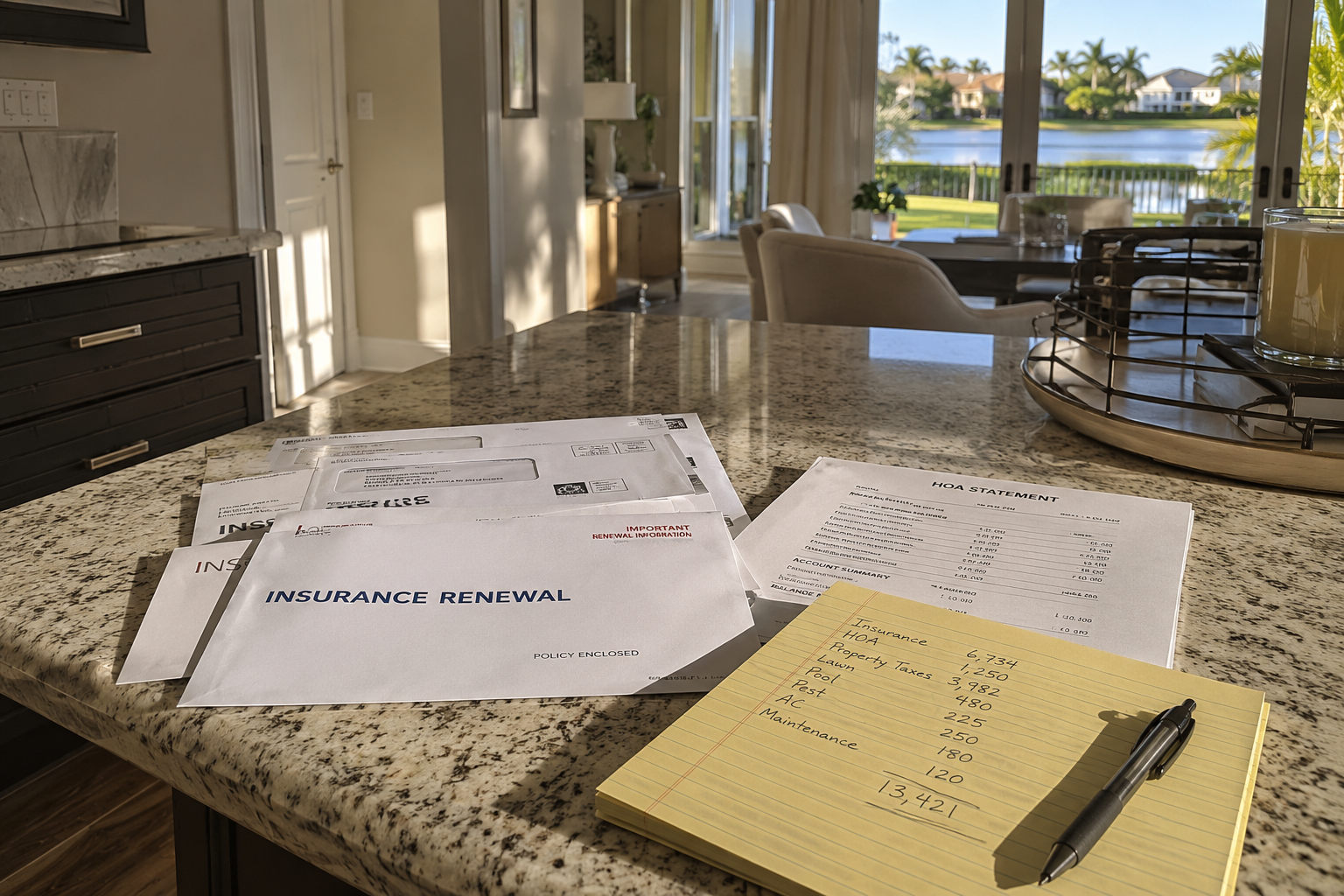
The Real Carrying Cost of a Palm Beach County Home in 2026
Most Palm Beach County homeowners can state their mortgage payment from memory. The other lines — insurance, maintenance, association dues, property taxes — tend to get handled one at a time, as each one arrives. Handled that way, they never get assembled into a single figure. And the single figure is what the ownership decision actually runs on. This article is about building that figure correctly for your property, and about a distinction that determines whether the figure is usable once you have it. It applies most directly if you own in Palm Beach County and have not sat down with all four lines since the year you purchased or last refinanced.
This is not an argument for selling. It is an argument for seeing the full number clearly, because the number is what the next decision should be built on. Some owners assemble it and decide to stay. Others find that it clarifies a decision that had already been forming. Either way, the number is worth knowing before anything else gets decided. Where that clarity tends to lead next — evaluating what the equity behind those costs could do in a different location or property type — is the subject of The Kull Group's Sell High Buy Smart framework, which addresses the Palm Beach County to Port St. Lucie transition specifically.
The Four-Line Read: Why the Total Alone Is the Wrong Number
The standard advice is to add up your annual housing costs. That advice produces a total, and the total has a problem: it treats four unlike things as if they were one thing. The Four-Line Read is the correction. Before you add the lines, sort them by how they behave.
Principal and interest. On a fixed-rate loan, this is set by contract. It is the only line in the calculation that does not reprice. Everything a homeowner intuitively knows about the stability of their housing cost comes from this line — which is exactly why the intuition misleads.
Insurance. This line reprices at renewal, on terms set by underwriting rather than by you. Your first-year premium is a historical fact, not a governing one. The governing figure is the one on your current declarations page.
Property taxes and association dues. These are set by another party — taxing authorities, an association board — on that party's schedule and through that party's process. You are a payer here, not a negotiator.
Maintenance. This one is not a rate at all. It is a schedule of items with finite service lives, and folding it into an annual average can obscure what that schedule actually holds.
Sort them this way and the conclusion is immediate: three of the four lines can move without your participation, and the fourth is not an annual figure to begin with. A one-year total therefore answers a question you were not asking. The usable figure is your current annual total plus the maintenance schedule you are carrying across the horizon you actually intend to hold the property. That is a different number, and it is the one the stay-versus-move decision is entitled to.
Insurance: The Line Where Condition Can Affect Availability
Insurance deserves separate attention because it behaves unlike the others in one structural way. Every line on the list can change in price. Insurance is the line where the condition of the property can affect not only what you pay but whether coverage is offered on the terms you have been assuming. Roof age, systems, and construction characteristics are underwriting inputs, and underwriting outcomes are decided by carriers, not by market commentary.
That has a practical consequence for the calculation. For every other line, the question is "what is it now?" For insurance, there are two questions: what is it now, and what is it conditional on? The answers are not general knowledge — they are in your declarations page, your renewal correspondence, and any inspection or condition requirements your carrier has communicated. What your specific policy covers, what your renewal will require, and what any condition finding means for your coverage are determinations for your carrier or a licensed insurance professional. The real estate consequence is what belongs here: an insurance figure that depends on a property condition is a carrying cost with a repair attached to it, and it should be entered into the calculation that way — as a cost with a contingency, not as a flat annual number.
Maintenance: A Schedule, Not an Annual Average
National maintenance rules of thumb — a percentage of home value, a fixed annual set-aside — are averages built from averages. Whether any of them describes your property is a question your property's own record answers better than any national figure does.
The Four-Line Read handles maintenance by date rather than by average. Write down each major system and the year it was installed or last replaced: roof, HVAC, water heater, pool equipment, irrigation, exterior finish, and any component with a documented condition concern. Those dates will not tell you when anything will fail. Actual timing turns on condition, installation quality, usage, and maintenance history, and a licensed inspector or the relevant trade professional is far better positioned to assess where a given system stands than an installation date is. What the dates give you is a planning basis — a way of seeing which items are early in their service life, which are late in it, and which are close enough together to matter.
That last point is the one worth sitting with, because it is where the arithmetic changes character. Items considered one at a time read as a series of separate expenses. Several major systems approaching replacement inside the same two or three years read differently: a cost concentration and a coordination burden at once. Whether that concentration is comfortable or consequential depends on the property, the systems, and your own finances — which is precisely why it is a figure to assemble rather than a conclusion to assume.
So the questions that actually determine the maintenance line are these. How many months a year does each system run, and what does that suggest about the interval you should be planning for? Which items are likely to fall inside the window you intend to keep the home? Do several of them cluster in the same window? The decision-relevant unit was never the single repair quote in front of you. It is the schedule behind it — and while your dates will not predict any individual replacement, they are enough to show you whether that schedule is short, long, or concentrated.
A direct question worth sitting with: If you added up your current annual insurance premium, your association dues, your property tax obligation, and the maintenance items that look likely to fall inside the next five years — would the number surprise you? Assemble it before you decide anything. The figure is specific to your property, and it is the only version of it that matters.
See how that number factors into the Sell High Buy Smart framework.
Taxes and Association Costs: The Lines Someone Else Sets
Property taxes in Palm Beach County are the product of two separate determinations made by two different sets of officials, and conflating them is a reliable way to get the line wrong. The Palm Beach County Property Appraiser establishes assessed and taxable value and administers exemptions and any assessment limitation that applies to your parcel. The taxing authorities — county, municipal, school, and applicable districts — set their own millage rates. Your ad valorem tax is what results when those millage rates are applied to your taxable value. Neither office alone determines the figure.
The TRIM notice you receive each year is proposed-tax information: it states proposed millage rates and the estimated taxes those rates would produce for your parcel, along with the dates of the public hearings where the rates are set. It is not the final bill. For the calculation, use your most recent actual tax bill as the figure and read the TRIM notice as the current estimate of where the next one is heading. If the treatment of your exemption, your taxable value, or a proposed rate change is unclear, that is a question for the Property Appraiser's office, the relevant taxing authority, or a qualified tax professional rather than for general market commentary.
There is an analytical point here that changes how the tax line should be read. What you pay reflects your ownership history on that parcel. What a buyer would pay reflects theirs. Those are two different figures for the same property. That matters in both directions: it means your carrying cost is not the property's carrying cost, and it means a buyer evaluating your home is underwriting a cost structure you may never have experienced.
Association costs work differently again. If your community charges dues, the documents that tell you where they are heading are the association's own: the adopted budget, the reserve schedule, the most recent reserve study if one exists, and any assessment notices. Those documents are specific to your community; general commentary about association costs is not.
One point of law is worth stating precisely, because it is frequently applied too broadly. Florida's structural integrity reserve study requirements were enacted for condominium and cooperative associations. They do not extend in the same form to homeowners' associations, which operate under a different statutory regime. Which framework governs your community, what it requires, and what it means for your dues or for any assessment you have received are determined by your governing documents and by Florida law — and they are properly confirmed with your association or a Florida attorney, not inferred from what applies to a neighboring community with a different ownership structure.
What This Means for Palm Beach County Homeowners in 2026
Once the four lines are assembled and the maintenance schedule is laid out, the calculation is only half finished. Carrying cost describes what the property takes from you. It says nothing about what the property currently holds for you. Read alone, either half gives a confident answer to the wrong question — a high carrying cost looks like a reason to leave until you find there is nothing to leave with, and substantial equity looks like a reason to stay until you find what the next five years of holding it will cost.
Read together, they form a single ownership position, and the position is what a decision can actually be made on. The questions that produce it are specific:
What is your current annual total across all four lines, taken from actual documents rather than working assumptions? What does the maintenance schedule add across the horizon you intend to hold the property? What is the home worth today relative to what it was worth when your original carrying-cost assumptions were formed? And what would the same four lines look like on a different property, in a different market — priced from an actual insurance quote, an actual tax figure, and actual association obligations for a specific address, rather than from a general impression that costs are lower somewhere else?
If the alternative under consideration is north along the corridor toward Port St. Lucie — the transition the Sell High Buy Smart framework is built around — answer that question the same way you answered the first three: line by line, on real numbers, for a specific address. An impression about a different market is not a comparison. A four-line read on both ends of the move is.
Frequently Asked Questions
How do I find out what my home is actually worth before I decide whether the carrying costs justify staying?
You want a current valuation grounded in comparable closed sales rather than asking prices, from someone who works this market regularly and can speak to what buyers have actually paid for properties like yours. You can get a starting point through The Kull Group's home value tool for Palm Beach County, which provides current market context for your specific property. From there, the equity side of the ownership position becomes a figure rather than an assumption — which is what allows it to be read against the carrying-cost figure you assembled.
My association just sent notice of a special assessment. Does that affect what my home is worth to a buyer?
An assessment enters the transaction as something a buyer and their agent will see and evaluate. How much weight it carries in practice depends on details that are specific to your situation: what the assessment funds, the amount, whether it is payable in a lump sum or over time, and whether it reflects a discrete capital need or a longer funding pattern visible in the association's reserve documents. Those documents are the place to establish the facts before the conversation with a buyer happens. The disclosure and negotiation dimensions are real estate matters worth discussing with an agent who knows your community; how the obligation attaches to the transaction, and to you or a buyer, is governed by your association's documents and Florida law and should be reviewed with a qualified attorney.
We have been in our home a long time and are not sure where we would go. Does the Sell High Buy Smart approach still apply?
It applies most directly in exactly that position, because the approach does not start with a destination. It starts with the ownership position: what the four lines cost you now, what the maintenance schedule adds over the horizon you have in mind, and what the equity behind those costs is currently worth. If your working assumptions date from the year you purchased and have not been revisited since, the distance between those assumptions and your current figures is simply unmeasured — assembling the lines is what measures it, and the result is whatever your documents say it is. The framework is built to close that gap first: what staying costs, what the equity is worth, and what a move would look like from a sequencing and logistics standpoint. The destination is a decision the information supports, not a prerequisite for gathering it.
If you have been tracking these costs individually and suspect the assembled figure may be higher than your working assumption, the useful next step is assembling it. The Sell High Buy Smart framework is built for Palm Beach County homeowners who want both halves of the ownership position in view — what staying actually costs across the horizon they have in mind, and what the equity behind those costs is actually worth — before committing to any direction. That conversation starts with your numbers, not ours.