


The Hours You Do Not Count
Every property has a labor line. Nothing in the ownership paperwork records it.
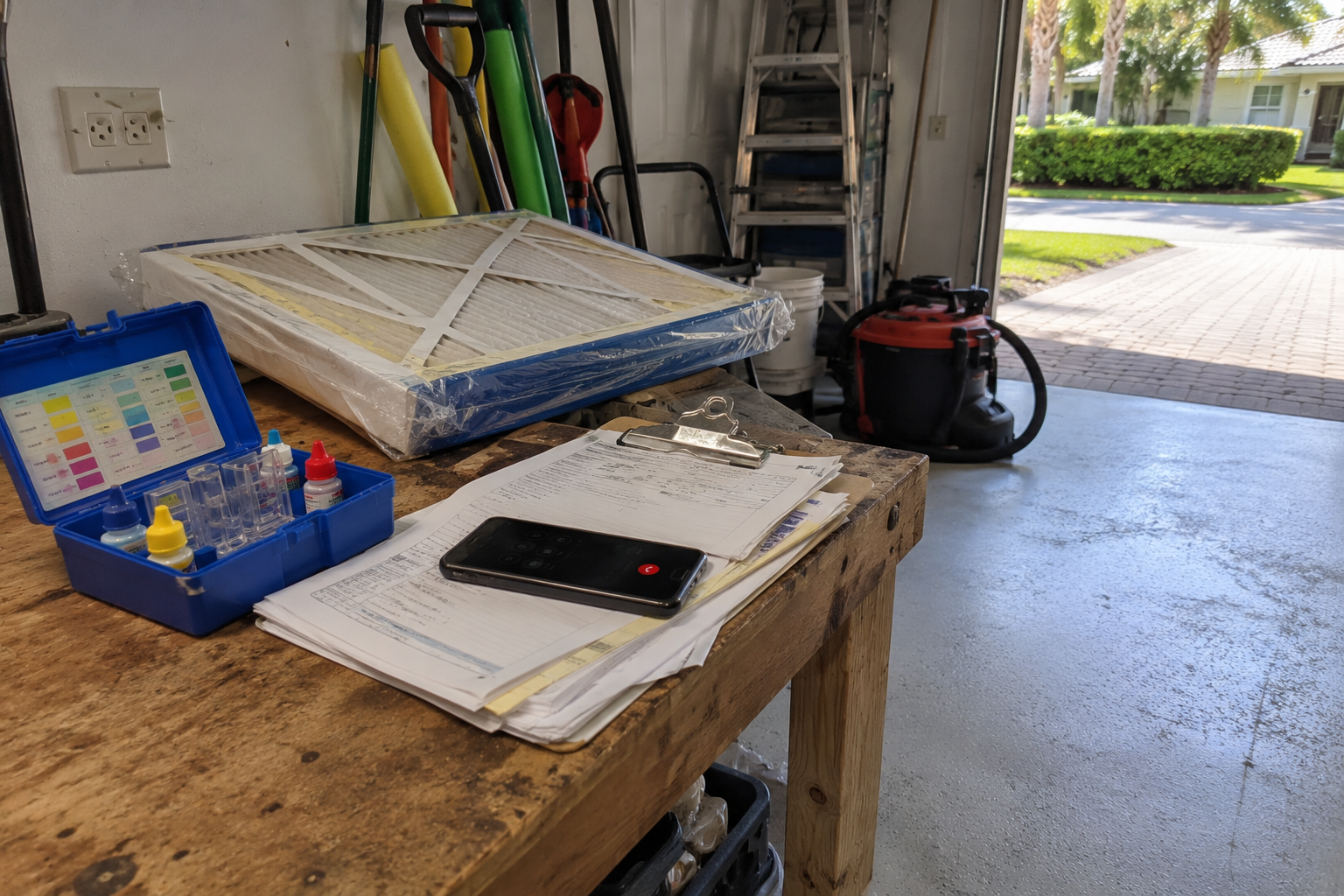
Ask what a home costs and you will hear about taxes, insurance, assessments, utilities and the repairs that were large enough to remember. What the statements do not capture is the Saturday morning spent waiting for a technician who arrived in the afternoon, the three phone calls it took to find someone who would come out at all, the twenty minutes on hold with a carrier, the evening spent reading a reserve study, or the standing background awareness that the irrigation timer has been behaving oddly for a fortnight. None of that appears on a statement. All of it is a real input into what the property costs to hold, which is why the framework in what this property actually costs you to own treats money, labor and attention as three separate lines rather than one.
This is not an argument that you should be doing less. It is an argument that the line exists, that it is easy to underestimate because nothing records it, and that leaving it out produces an ownership picture that is quietly incomplete.
What the Labor Line Actually Contains
The easiest hours to picture are the ones spent on the work itself — the pressure washing, the filter change, the trip to the hardware shop. They are also the easiest ones to count, which is part of why the rest of the line goes missing.
The Four Kinds of Ownership Hours
- Doing. The physical work you perform yourself. Real, visible, and the easiest of the four to recognize as ownership work.
- Coordinating. Finding a vendor, getting quotes, scheduling, being present, following up when they do not return, and re-scheduling when the first date slips. It produces no artefact when it goes well, which is why it is easy to leave out of an estimate.
- Deciding. Working out whether something is a repair or a replacement, whether a quote is reasonable, whether to file a claim, whether to defer. Deciding is unpaid analytical work, and it draws on a different kind of attention than physical work does.
- Monitoring. The low-level ongoing awareness — knowing which things are near end of life, noticing a change in a sound or a stain, holding a rough map of what is coming next. It has no start or finish time, which is what makes it hard to see as a task at all.
In South Florida, each of the four has something reliable to draw on. Hurricane preparation is an annual operating cycle rather than an event, with its own coordination and its own decisions. Salt air and humidity act on coatings, fasteners, coils and seals over time, so exterior components ask for attention on a rolling basis rather than seasonally. Landscape and irrigation do not pause. Insurance paperwork asks for reading time as well — policy structure, deductibles, and questions about what a current wind mitigation inspection may affect.
What any of that means for a particular policy, a particular deductible, or a particular claim decision is a question for a licensed insurance professional and for the carrier holding the policy; nothing here is coverage advice or an underwriting opinion. The point for this article is narrower: the reading, the calls and the decisions attached to insurance take hours, and those hours belong on the labor line whatever the coverage answer turns out to be.
Why the Line Stays Invisible
Three things keep it off the page.
The first is that it arrives in fragments. No single instance is large enough to be worth recording. An hour here, a call there, a Saturday that was going to be quiet anyway. Money accumulates in a statement whether you track it or not; hours only accumulate somewhere if you decide to put them there.
The second is that much of it does not present itself as work. Deciding whether the pool heater is worth repairing happens while you are doing something else. Monitoring runs in the background. An item like that is easy to file afterwards as not really anything, and still have taken a fortnight to close out — the size of something in memory and the size of it in hours are two different measurements.
The third is distribution. The labor line does not necessarily fall evenly within a household, and where it concentrates on one person, that person is not always the one keeping track of it. What concentrates there is also not only the doing. Remembering what is outstanding, holding the order of what comes next, and carrying the items that are not yet resolved are attention rather than money, and a balance sheet has nowhere to put them.
In our view, the part of this that registers is rarely a number. It is the past month's list set down in one place, and the length of it becoming visible.
Do you know what your labor line actually looks like?
Money, labor and attention are three separate lines. If you would like to work through what they look like on your own property, that is the conversation an Ownership Sustainability Review is for — and deciding to keep the property is a legitimate place for that conversation to end.
What Converting Hours to Money Actually Buys
The obvious response to a heavy labor line is to hire it out. That works, though not always in the way it is expected to, and the gap between expectation and result is worth understanding before spending against it.
Hiring the work out purchases the doing. It does not by itself purchase deciding who does the doing — and where that decision-work is the larger part of what an owner has been carrying, the hours fall by less than the spending would suggest.
Paying a vendor converts the doing. The coordinating remains — someone still selects the vendor, lets them in, checks what was done, handles the invoice and re-books when the schedule slips — and so does the judgement sitting behind it. A service contract can move some of the scheduling; it does not by itself move the decisions.
Structural transfer works differently from purchased transfer, because the obligation itself moves rather than the task being bought back each time. Where a property sits in an association-governed community, the governing documents may place exterior maintenance and reserve planning with the association rather than with the individual owner, which removes categories of task rather than outsourcing them. What the documents give back in return is governance participation: material to read, meetings that matter, assessments and reserve schedules set by people you did not choose. That is a different kind of hour, not an absence of hours. What any particular set of documents actually assigns is a question for those documents, and for counsel where the language matters.
Some obligations move not to a private board but to a public one, and that changes what participation looks like. Drainage and water control across much of Wellington are administered through the Acme Improvement District, a dependent special district whose board is the Village Council, funded by its own assessment. For an owner, that is not the same relationship as an association: the hours attached to it are civic rather than contractual — a district agenda rather than a board packet — and responsibility for any one canal bank, culvert or easement is worth confirming feature by feature with the village rather than assumed from the district's existence.
The opposite case is structural retention, where an obligation never left the owner because no entity exists to hold it. Out in the unincorporated Loxahatchee area, a property served by a private well and a septic system rather than a central utility carries water supply and wastewater treatment itself: testing, servicing, and eventually replacement, with no utility standing behind any of it. That is not a heavier version of a utility bill. It is monitoring and deciding that a utility-served owner never holds at all, which is why knowing which arrangement a property is actually on matters before assuming one labor line resembles another.
Improving can also reduce the line rather than only converting it. Replacing a system at end of life turns an unpredictable failure into a scheduled expense and takes the monitoring off the table. Simplifying a landscape or removing a feature removes the hours permanently rather than reassigning them. That distinction is worked through in when spending money reduces the load.
Reading Your Own Labor Line
You do not need a time sheet. You need one honest month.
Write down every property-related item as it happens, in any of the four categories — the call, the wait, the quote, the decision, the read. Do not wait and estimate at the end of the month. The doing leaves a result behind to remember it by; a phone call that produced nothing and a fortnight of low-level watching do not, and those are the entries a contemporaneous record exists to catch. Then look at the shape rather than the total: which category dominates, whether one property system is generating most of it, whether the pattern is steady or building, and whether it falls on one person in the household or is genuinely shared.
Two cautions. Do not treat an unusual month as typical, and do not treat a quiet one as the baseline either — a month with no capital event is the between-years case, not the average. And when the exercise turns up components whose history you cannot document, leave them undocumented. A component may have been replaced before you bought the property or years afterwards; the purchase date establishes when you took ownership and nothing about when anything was installed. Keeping the record straight is most of what the ownership file is for.
What the exercise is really testing is not endurance. It is whether the hours are still buying something you want. They may well be — a property can be worked on because working on it is part of the pleasure of owning it, and that is a complete answer. The other answer is that the hours have quietly become maintenance of a position rather than enjoyment of a home, and that one has different options behind it.
Common Questions
Isn't this just saying I should hire more help?
No. Hiring converts the doing. The coordinating and the deciding do not transfer with it, so hiring changes the composition of the labor line before it changes the size. That may still be worth doing. But it is a different move from structural transfer, where obligations genuinely sit with somebody else, and a different move again from improving, where the task is removed rather than reassigned. Knowing which one you are buying prevents disappointment with a result that was never available.
How do I put a number on my own time?
You mostly should not, and any hourly figure suggested here would be invented. The useful output is not a currency value — it is the shape: which of the four categories dominates, which property system is generating it, whether it is steady or building, and whether it falls on one person. Those tell you what to do. A number does not, and attaching one can turn the exercise into an argument about the rate rather than a conversation about the load.
Does the labor line matter if I can afford the property comfortably?
That is precisely when it matters, because nothing else is going to raise it. Affordability and sustainability are different tests, and a property can pass the first while the labor and attention lines are doing something the money line does not show. An owner in that position is also choosing rather than reacting, which is a different position to decide from.
It is easy to imagine the moment a property stops being worth the effort arriving as a decision. It can be smaller and stranger than that: a stretch of months in which the calls keep coming, none of them significant on its own, until at some point the house has become something being administered rather than a place being lived in. The hours were never hidden. They were just never written down anywhere they could be seen together. Putting them somewhere visible does not commit you to anything; it only makes the question answerable. If it is worth an hour, that is what an Ownership Sustainability Review conversation is for.
About the Authors
Chris and Sue Kull write for The Kull Group on residential ownership decisions in Palm Beach County. This article reflects their own view of how ownership labor accumulates, and why it is worth making visible before deciding what to do about it.