


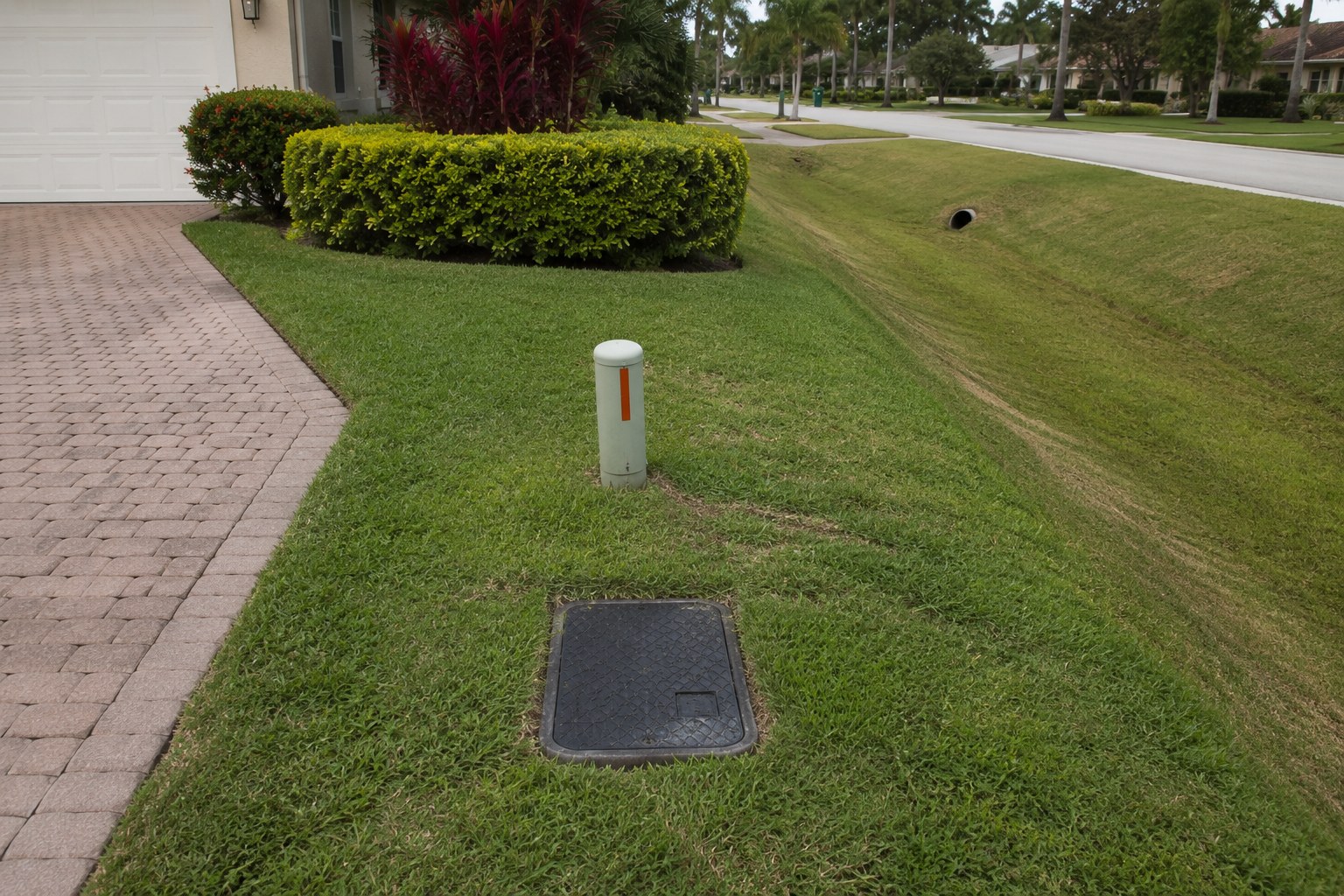
The Utility Lines You Did Not Choose
You chose the house. You did not choose who supplies its water, who bills its electricity, who moves the stormwater off the street, or who decides what any of that costs. Those were settled by the parcel, before you arrived, and in most cases they cannot be changed by anything you do.
This is one of the quieter facts about ownership economics in Palm Beach County, and it does real work in the money line of the total load set out in what this property actually costs you to own. Two houses of similar size a few miles apart can draw on entirely different service arrangements, with different bodies setting the rates and different structures behind them. Not better or worse — different, and worth knowing which one you are in.
One pattern we consistently observe: owners can tell you what they pay for water and electricity and have no idea who decides those numbers — or that the answer can change at the end of their own street.
The Provider Came With the Parcel
Utility service in this county is drawn by service area rather than by choice. Some municipalities operate their own water and wastewater utilities. The county's utilities department serves much of the unincorporated area and, under service agreements, parts of incorporated areas too. Electric service across most of the county comes from an investor-owned utility whose rates are regulated at state level, while a small number of municipalities — Lake Worth Beach among them — run their own electric utilities entirely.
The boundaries do not always follow the lines you would expect. Municipal limits, utility service areas, drainage district boundaries and solid waste collection arrangements do not sit on top of one another neatly, and a property can be inside one and outside another. That is why the answer to "who provides my water" has to be established from the parcel itself — through an address lookup, the current bill, or confirmation from the provider's own office — rather than from a neighbourhood assumption, and why a neighbour's experience two streets away is not evidence about your parcel.
None of this is unusual or a problem to be solved. It matters because the arrangement itself is fixed: which body serves the parcel, and which body sets the rate structure, is not something the household can change. Consumption, rate schedule and equipment upkeep are a separate matter, and are dealt with further down. It is worth separating the part of the money line that is a characteristic of the parcel from the part that responds to what you do.
The Five Service Lines Decided by the Parcel
- Water and wastewater. Municipal utility, county utility, or neither — where central service does not reach, the property supplies its own. Municipal utilities commonly apply a different rate structure to customers served outside city limits than to those inside.
- Electric. Investor-owned in most of the county, with rates regulated by the Florida Public Service Commission through formal proceedings; municipally owned in a small number of places, where the city's governing body sets rates.
- Stormwater and drainage. Administered by a municipality, by the county, or by a special district — and districts are not all structured the same way. Wellington's Acme Improvement District is a dependent district of the Village of Wellington, with the Village Council sitting as its board, while the Indian Trail Improvement District serving The Acreage is an independent district with its own elected board. Both come up regularly in conversations with owners in those areas.
- Solid waste. Disposal is handled countywide through the Solid Waste Authority of Palm Beach County, but collection is arranged locally: the Authority arranges residential collection in the unincorporated area and in municipalities that contract with it, while other municipalities arrange their own collection. Where the Authority's assessment applies, it appears on the annual tax bill as a non-ad valorem assessment rather than as a separate utility bill; where a municipality arranges and charges for collection itself, that charge may arrive on a municipal bill or as a municipal assessment instead. Which arrangement applies is an address question.
- What you own outright. On properties without central service, the well and the septic system are yours — equipment, testing, maintenance and eventual replacement included.
An important caveat on the third of those. A district administers the infrastructure it is responsible for, and that is not the same as being responsible for every feature within its boundary. Any given canal bank, culvert, swale or easement may belong to the district, to the county, to a private party or to a recorded easement holder. That is a per-feature question to confirm rather than an assumption to carry, and getting it wrong is how an owner discovers a maintenance obligation they did not know was theirs.
Do you know which of your costs you cannot influence?
Separating the lines that respond to something a household does from the lines that are simply characteristics of the parcel is a property-specific question rather than a general one. If you want it looked at against a particular address, that is the question to bring to an Ownership Sustainability Review.
Who Actually Sets the Number
Owners tend to speak of "the utility" as though one body were behind all of it. Four different kinds of body are, and they answer to different processes.
A municipal utility's rates are set by that municipality's governing body, through its own budget and rate-setting process, in public meetings with published agendas. An investor-owned electric utility's rates are regulated by the Florida Public Service Commission, and changes go through formal proceedings rather than a city commission. A special district sets its assessments through its board on its own budget cycle — and whether that board is independently elected or is the governing body of the local government the district depends on is part of what you are confirming. And where the Solid Waste Authority's assessment applies, it is set by the Authority and collected with the annual tax bill by the Tax Collector, which is a third arrangement again, and the reason it is easy to forget it is a utility cost at all; where a municipality arranges and charges for collection itself, that charge is set and billed by the municipality instead.
This distinction matters more than it sounds, because it tells you where a question goes and where a rate change actually gets decided. A concern about a district assessment belongs at that district's board — which, for a dependent district, may be the municipality's governing body sitting in that capacity — rather than at the county. A question about electric rates does not belong at a city that does not run an electric utility. In our own conversations with owners across the county, a recurring source of frustration is not the cost itself — it is the question being raised with a body that has no authority over it.
Two further boundaries worth keeping straight. Service area is not the same as jurisdiction for anything else: being served by a county utility does not make an incorporated property unincorporated, and being inside an improvement district does not change which building department has jurisdiction over your permits. And none of these bodies determines permitted use on the parcel — that remains with planning and zoning.
When You Are the Utility
Out through the western communities, on acreage parcels beyond the reach of central service, a great many properties supply their own water and treat their own wastewater. That changes the shape of the money line rather than only its size.
Two of the names that come up most often in that conversation need separating before anything else, because they are not the same kind of place. The Acreage is unincorporated county land, so its parcel questions run to the county and to the Indian Trail Improvement District described above rather than to a city hall. "Loxahatchee," by contrast, is first a mailing address rather than a single jurisdiction: the name appears on unincorporated county parcels and on addresses associated with the incorporated Village of Loxahatchee Groves, so an address that reads "Loxahatchee" has to be resolved to the entity that actually contains the parcel before you can say which body answers for drainage, permitting or service arrangements there.
There is no monthly bill for water, which owners notice. What replaces it is less visible: pump and pressure tank maintenance, filtration and treatment where the water requires it, periodic testing, septic tank pumping on a recurring cycle, drainfield care, and eventually replacement of equipment that has a finite life like everything else. Some of that is routine budget and some of it is a capital event, and the distinction between the two is exactly the one drawn in maintenance as a budget and replacement as a capital event. How much warning a drainfield gives before it fails varies with the system, its age, its condition and how it has been used — some show signs over time, and others present a problem with little advance notice, which is why condition is a question for a licensed septic contractor rather than something to assume either way.
Two structural points that catch owners out. Regulation of onsite sewage treatment and disposal systems sits with a state agency, and which agency has changed in recent years — so if you are looking for permit history or requirements, confirm current jurisdiction rather than working from what was true when the system went in. And where a central sewer line is extended to reach a property, connection may become mandatory within a period set by local ordinance, with a connection charge attached. Whether that applies to a particular parcel, on what timetable, and at what charge, is governed by the ordinance and the responsible authority for that address; it is not a real estate question, and where the answer carries real money or a disputed obligation it is one for the governing agency and, if needed, an attorney. What matters for the ownership conversation is that this is a capital event that can arrive from outside, on someone else's timetable, rather than one the household schedules.
The documentation problem compounds all of this. In our experience, well and septic equipment is often among the less well documented parts of a property file, which is why it belongs in the file alongside everything else — and why an undocumented installation date should stay undocumented rather than being quietly assumed from the year the property changed hands. The ownership file covers what to keep and where to request it.
Common Questions
How do I find out who actually serves my property?
By address, through the relevant provider's own service-area lookup, and by checking more than one — water, electric, drainage and waste can each answer differently for the same parcel. Your current bills are a practical starting point, since they name the billing entity. If a bill exists for something and you cannot identify it, the annual tax bill is worth reading closely too, because a non-ad valorem assessment for waste service or district infrastructure sits there rather than arriving separately. Where a boundary looks ambiguous, the provider's own office will confirm for a specific address.
Can I switch to a cheaper provider?
Generally no, and that is the point of this piece. Service areas are not competitive markets you opt into; they are drawn geographically, and the provider that serves your parcel serves it. What you can sometimes influence is consumption, rate schedule or billing arrangement within what your provider offers, and on well and septic properties you influence the equipment and its upkeep. What you cannot do is choose a different water utility because a neighbouring community's structure appeals to you. Treat the provider arrangement itself as a characteristic of the parcel rather than a cost to be shopped.
Does being on well and septic mean lower running costs?
It means differently shaped costs, and the honest answer is that it depends entirely on the property and the equipment. The absence of a monthly water bill is real. So are the maintenance, testing and eventual replacement obligations that no utility is carrying on your behalf. Whether that nets out favourably for a specific property is not something to generalise about — it turns on the age and condition of the equipment, the water on the site, and what the system has been asked to do. A licensed well or septic contractor can assess the equipment; what belongs in the ownership conversation is knowing that the obligation sits with you rather than somewhere else.
Most of what owners think of as "the cost of the house" is really the cost of a specific position — a particular parcel, inside a particular set of boundaries, served by bodies that were chosen for it long before anyone currently living there arrived. Some of that position can be improved. Some of it can only be understood. Telling those two apart is most of the value in looking honestly at what a property asks of you, because effort spent on the second kind is effort that was never going to change anything. Where that line falls on a particular parcel is a property-specific question, and it is the one to bring to an Ownership Sustainability Review.
About the Authors
Chris and Sue Kull are the authors of this article and the source of the first-party observations attributed in it. Those observations come from their own conversations with owners in Palm Beach County and are offered as professional observation rather than as a general rule.