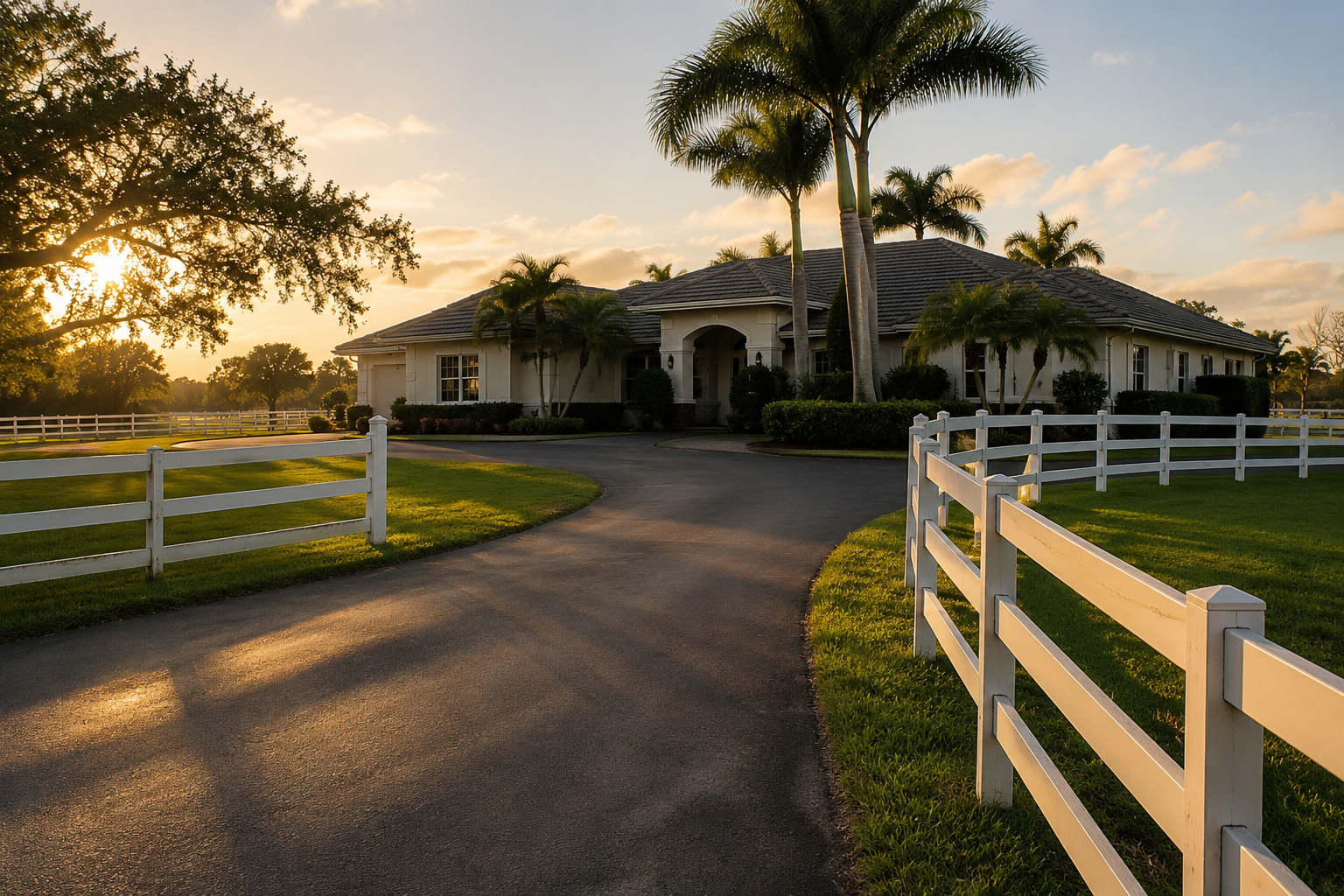
What It's Really Like to Live in Wellington, FL
Wellington is one of those places that people research for months before they understand what they are actually considering. It sits in the western reaches of Palm Beach County — inland, structured, unusually self-contained for South Florida — and the experience of living there is shaped less by its location on a map than by the particular rhythms the community has built around itself. If you are trying to get a clear picture of daily life before making a decision, most of what you will find online describes the horse show season, the equestrian trails, and the school ratings. Those things are real. But they are not the complete picture.
What follows is a more honest accounting — the kind that comes from having worked with Wellington homeowners, sellers, and buyers across multiple market cycles, and from watching what the ownership experience actually looks like once people are inside it.
If you want to understand what your home's current position in the Wellington market looks like, a starting point for that conversation is here.
The Equestrian Culture Is Real — and It Shapes the Entire Town
Wellington was built around the horse. That is not marketing language — it is a structural fact about how the community developed and how it continues to function. The Global Dressage Festival, the Winter Equestrian Festival, the show grounds off South Shore Boulevard — these are not seasonal decorations on an otherwise ordinary suburb. They are the economic and cultural axis around which the town rotates from roughly December through April.
For residents who participate in that world, the arrangement is seamless. Equestrian trails run through residential neighborhoods. Horses have legal right-of-way on designated roads. Properties in communities like Paddock Park, Palm Beach Point, and Mallet Hill were designed with horse ownership as a baseline assumption — not an afterthought — with acreage, barn access, and paddock configurations built into the lots themselves.
For residents who have no connection to the equestrian world, the arrangement is still present — just differently. Traffic patterns shift in January. Certain roads carry more agricultural vehicles than you might expect. The social and commercial ecosystem leans toward the equestrian calendar in ways that are subtle but consistent. Neither experience is better. But they are genuinely different, and the distinction matters when you are deciding how you want daily life to feel.
What long-time Wellington homeowners tend to say — and this surfaces consistently across conversations — is that the equestrian culture creates a kind of anchor for the community that most South Florida suburbs lack. There is a reason people come back every year. There is a reason properties in equestrian-zoned corridors hold value through conditions that affect other parts of the county more severely. The culture is not peripheral to Wellington's real estate story. It is the story.
HOA Structure Here Is More Complex Than Most Buyers Anticipate
Wellington contains dozens of distinct communities, and the HOA landscape across them varies considerably. Some communities carry relatively light covenant structures with modest fees and minimal architectural oversight. Others — particularly those closer to the show grounds or within master-planned communities with shared amenity infrastructure — carry layered HOA arrangements where a neighborhood-level association exists inside a larger master association, each with its own fee schedule, reserve study, and enforcement posture.
This is not unusual for Palm Beach County, but Wellington's version of it can catch buyers off guard. The monthly fee you see in a listing is sometimes only part of the picture. Reserve study health — the financial condition of the association's long-term capital replacement fund — varies significantly from one community to the next. After more than three decades of working with Palm Beach County homeowners, one pattern that surfaces consistently is how rarely buyers ask about reserve study health before closing, and how frequently it becomes relevant afterward when a special assessment arrives that the prior owner was already aware of.
In communities where HOA fees are substantial, the question of what those fees actually cover — and what the association's current reserve position looks like — is worth more time than most buyers give it.
If you have been living in Wellington for several years and find yourself thinking more often about what the next chapter looks like — whether that means a different property configuration, a different season-to-season arrangement, or something else entirely — that line of thinking is worth a conversation.
Find out where your Wellington home stands in the current market.
The South Florida Ownership Pressures Are Present Here — Just Experienced Differently
Wellington sits far enough inland that the salt-air deterioration that accelerates maintenance timelines along the coastal communities — Boca Raton, Boynton Beach, Lake Worth Beach — is less of a factor. That is a genuine ownership advantage that coastal buyers sometimes underestimate when comparing properties across the county.
But Wellington is still South Florida, and the structural ownership pressures that define this market apply here in full. The heat and humidity cycle is relentless on roofing systems, HVAC equipment, exterior paint, and pool surfaces. Irrigation systems run continuously. Landscaping maintenance is year-round with no seasonal pause. These are not exceptional conditions — they are the baseline.
The insurance environment has changed the carrying cost conversation for Wellington homeowners in the same way it has changed it across Palm Beach County. Owners who purchased a decade ago are managing a materially different insurance picture than the one they bought into. Homeowners in communities with aging infrastructure — particularly those built in the late 1990s and early 2000s — are increasingly encountering situations where multiple major systems approach end-of-life in the same window. Roof, HVAC, water heater, pool equipment. The financial weight of those cycles arriving together is something that does not show up in the listing price history, but it shows up very clearly in the ownership experience.
Royal Palm Beach and the Acreage communities to Wellington's north experience similar dynamics, as do the older western Boynton Beach corridors. But Wellington's specific combination of larger lots, equestrian infrastructure, and community-level amenity systems creates a maintenance profile with its own particular character — one that rewards owners who stay ahead of it and accumulates quietly on those who don't.
Who Actually Lives Here — and What the Life-Stage Picture Looks Like
Wellington draws a range of resident profiles that is broader than the equestrian identity might suggest. Families with school-age children represent a substantial portion of the permanent resident base, drawn by the school quality and the structured, community-oriented feel of many of Wellington's neighborhoods. Seasonal residents — particularly those connected to the horse show world — occupy a different slice. And then there is a growing segment of longer-term owners navigating a transition that is less visible but just as significant: the post-children, approaching-retirement household that bought into Wellington for the family infrastructure and is now reassessing what the property actually needs to be.
This transition surfaces in a particular way here. The family that chose Wellington for the school districts fifteen years ago is now living in a four-bedroom home on an acre and a half, with irrigation lines that need attention and an HOA fee that made sense when the community amenities were part of daily life. The equity has accumulated. The carrying costs have climbed. The internal conversation about what comes next has been running quietly for a while.
What we observe repeatedly across South Florida — and Wellington is not an exception — is that the financial readiness and the emotional readiness for that transition operate on different timelines. The numbers often tell a clear story well before the homeowner is ready to act on it. The conversations that move forward are rarely the ones that start with market conditions. They are the ones that start with an honest accounting of what the ownership experience has actually become — and what a different configuration might make possible.
The life-stage shift and the ownership cost pressure are not separate conversations in this market. They tend to arrive in the same window. The insurance renewal lands higher the same year the last child starts college. The roof decision coincides with the first serious retirement planning conversation. That convergence is not coincidence — it is the compressing of a decision that has been forming for years.
What This Means for Buyers and Sellers in South Florida
For buyers, Wellington rewards a specific kind of due diligence that many South Florida searches skip. The lot itself rarely tells the whole story — what matters more is which HOA layer governs the property, what the reserve study shows, and whether the community's equestrian zoning matches the buyer's actual intentions. A buyer who wants the structured, amenity-rich feel of Wellington without horse involvement should weigh in carefully on which corridors carry equestrian-use covenants regardless of current improvements, since that designation affects resale positioning later, not just present-day use.
For sellers, the calculus is different but related. A Wellington property's value story depends heavily on how clearly the listing can speak to the buyer profile most likely to want it — equestrian infrastructure read as a premium to the right buyer and as irrelevant carrying cost to the wrong one. Sellers who understand which segment their home actually serves position more accurately than those who market broadly and hope the right buyer self-selects. The same applies to HOA disclosure: sellers who get ahead of reserve study questions before they surface in due diligence tend to move through contract with less friction than those who wait for the buyer's inspection period to raise it.
The hesitation pattern in this market is rarely about price. It is about uncertainty — buyers unsure whether they are buying into a maintenance profile they understand, sellers unsure whether their property's specific advantages are even visible in how it is being presented. Both sides benefit from the same thing: a clear-eyed accounting of what the property actually is, not just what the listing says.
Questions Wellington Homeowners Actually Ask
Does the equestrian season affect property values for homes that have no horse facilities?
Generally, yes — in ways that are positive but indirect. The equestrian calendar drives significant seasonal economic activity through Wellington and supports the commercial and service infrastructure that benefits all residents. Properties without equestrian components do not command the premium that acreage or barn-equipped lots carry, but they tend to benefit from the broader demand the equestrian community sustains. What matters most is whether a property sits in an equestrian-zoned corridor, since that designation affects what the lot can do — not just what it is currently used for.
What should I understand about Wellington HOA fees before buying in a specific community?
Two questions matter more than the fee amount itself: what does the fee cover, and what is the reserve study showing. An HOA with a healthy reserve fund is managing its future maintenance obligations proactively. One with a depleted reserve is deferring that cost to future owners, often through special assessments that arrive without much warning. Communities built between 1995 and 2005 are now at the age where roofing, paving, and common-area infrastructure replacement cycles are becoming active — making reserve study health one of the more consequential financial facts buyers tend to overlook.
If you have been living in Wellington for a while and are in the middle of one of those quieter internal conversations about what the next few years should look like, understanding where your property stands in the current market is usually the most useful first step — not because it forces a decision, but because it gives the conversation a foundation.
Explore Homes by City
If you're comparing areas, home types, or neighborhood environments, browsing homes by city can help put pricing and location tradeoffs into perspective.
Explore Homes by CityKeep Exploring South Florida Real Estate
If you're comparing communities, evaluating lifestyle tradeoffs, or trying to better understand how different parts of South Florida align with your long-term goals, reviewing additional local resources can help create clearer perspective.
About the Authors
Chris and Sue Kull are South Florida real estate professionals with more than three decades of experience helping buyers, sellers, and property owners navigate real estate decisions throughout Palm Beach County and surrounding communities.