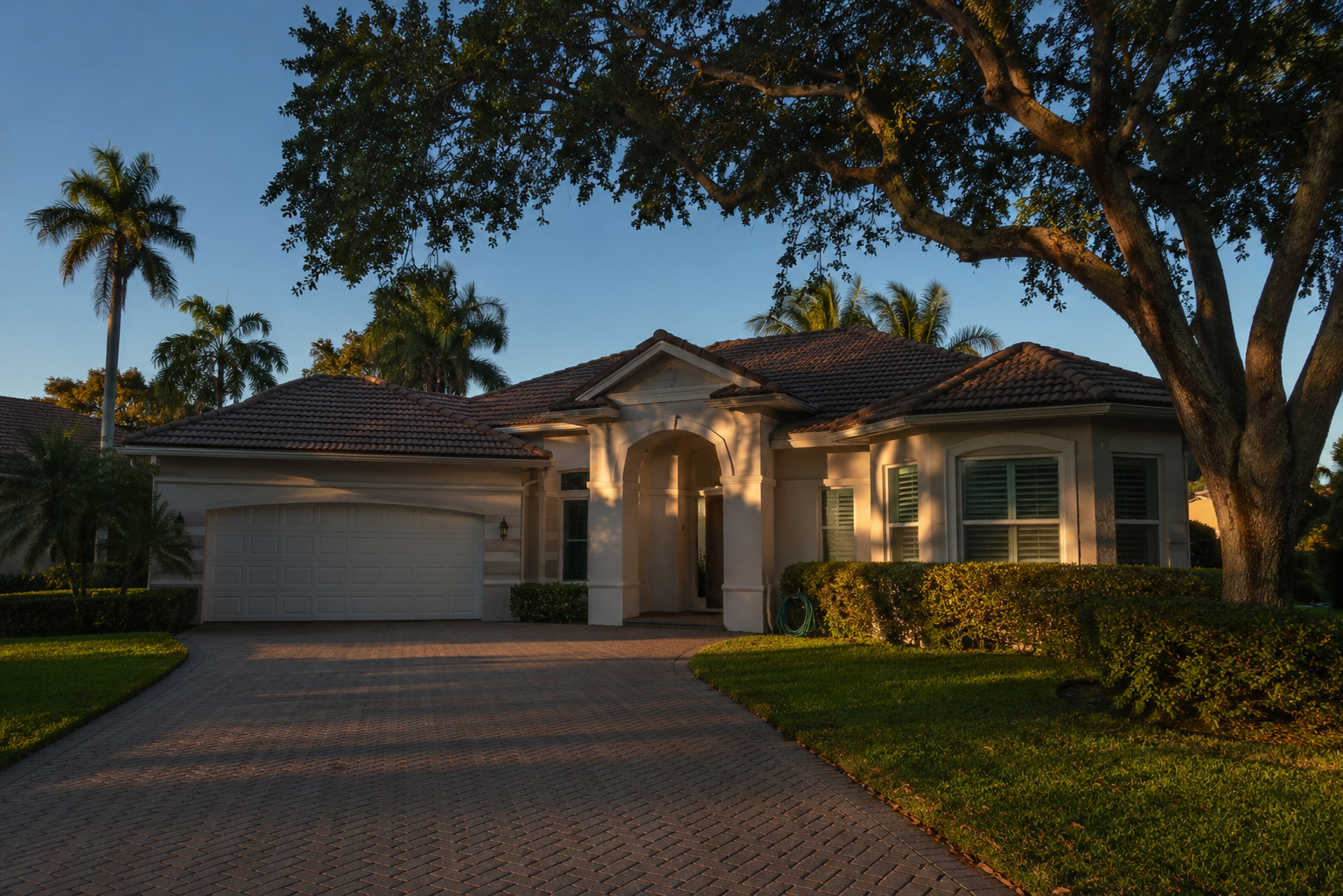
Most Palm Beach County homeowners who have owned for more than seven years are carrying two different numbers in their heads. One is the equity number — the figure they half-know exists, built from years of appreciation they've watched happen without fully pricing it in. The other is a decision number — what they believe that equity actually lets them do. The gap between those two numbers is rarely a math problem. It is almost always a current market valuation problem, and closing it is usually the only thing standing between an owner and a property that fits where their life actually is now.
This isn't market commentary. It's an observation about how equity gets misread, specifically in this market, by people who are financially positioned to move and don't yet know it.
The Equity-Rich Trap: When the Number Is There but the Confidence Isn't
A specific pattern surfaces repeatedly with Palm Beach County owners who purchased between 2012 and 2019. They bought at a price that felt substantial at the time. They've watched values rise in ways that would have seemed implausible when they signed. And yet, when the question of moving comes up — upsizing, right-sizing, or simply getting into a property that works better for where they are now — the internal response is almost always the same: the numbers probably don't work.
The numbers almost always work better than expected. The disconnect isn't financial. It's perceptual.
What happens, consistently, is that owners anchor their mental model to the purchase price and the original mortgage balance — not to current equity. They're calculating flexibility from where they started rather than from where they stand. A homeowner in Boynton Beach who purchased at $280,000 and is carrying a $190,000 balance may be sitting on $400,000 or more in equity, depending on what the current market supports. That is not the same financial position it was five years ago. The decision framework shouldn't be either.
The equity-rich trap is staying in a property you've outgrown because the version of yourself who bought it couldn't have afforded to move — without noticing you're no longer that version of yourself.
What South Florida Specifically Does to Equity Calculations
National commentary about home equity treats appreciation as a uniform force. It isn't. What's happened in Palm Beach County — and specifically in Wellington, Boca Raton, Lake Worth, and Royal Palm Beach — represents a compression of appreciation that would normally have taken fifteen years. That compression changes the arithmetic in ways that catch owners off guard in both directions.
It also introduces a variable most national equity analyses skip entirely: the carrying cost trajectory. South Florida ownership has become materially more expensive over the last four years. Insurance premiums have restructured what it costs to hold a property here. HOA reserves in older Wellington and Boca Raton communities are being revisited following legislative changes, and the assessments that follow are not small. HVAC systems, roofs, and pool equipment deteriorate faster here than the national replacement cycle suggests — and for properties purchased in the early 2000s, those systems are reaching end-of-life in clusters, not one at a time.
One pattern we consistently observe: the owners most surprised by their equity position are the ones who last recalculated it the year they refinanced or the year a neighbor sold — not the year they're actually standing in. The number keeps moving. The mental model doesn't, unless something forces it to.
The equity that exists on paper is real. But the cost of retaining access to it — by continuing to hold the property — is rising too. That changes the net position more than most owners have accounted for.
Are you calculating your flexibility from where you started — or from where you actually stand?
The equity position in most Palm Beach County homes purchased before 2020 looks materially different today than the number most owners are carrying in their heads.
See how the Sell High Buy Smart approach works for homeowners in your position.
The Timeline Misalignment Nobody Names
Financial readiness and emotional readiness operate on different timelines, and the gap between them is where most of the delay lives. An owner can be fully positioned — strong equity, favorable market conditions, a clear picture of where they want to go next — and still not move for eighteen months. Not because the finances don't support it. Because the decision hasn't finished forming.
Owners in this gap often explain their hesitation in financial terms when the actual hesitation is something else. They say the numbers don't work when what they mean is: I haven't fully decided yet. The financial framing feels objective. The real question — whether this is still the right property for the next chapter — is harder to answer, so it gets converted into a spreadsheet problem instead.
The Equity Clarity Sequence is the order that actually resolves this, in the sequence owners who move cleanly tend to follow it in:
- Get the number. A current valuation, not a recalled one — this is the only fact-based input in the entire decision.
- Separate the math from the mindset. What the equity allows you to do is a different question from whether you want to do it. Answering them together produces neither answer honestly.
- Price the next decade. Not this year's repair — the pattern of repairs, assessments, and overhead that decade implies if nothing changes.
We worked through exactly this with a couple in Royal Palm Beach who were convinced that selling and buying simultaneously wasn't financially viable — that the sequencing would leave them either overextended or without a place to land. The financial picture wasn't actually the constraint. Once we walked through how contract contingencies work in practice, and built the real numbers from their current equity position instead of their original assumptions, the clarity they'd been waiting for arrived in a single conversation. The decision had been ready. The analysis hadn't caught up.
What This Means for Homeowners in Palm Beach County
If you've owned in this market for more than six or seven years, your equity position almost certainly supports more flexibility than your current mental model reflects. That's a structural observation about how appreciation has moved here relative to how owners update their own financial picture — not a sales point.
For owners weighing a move toward the Palm Beach-to-Port St. Lucie corridor specifically, the comparison usually undersells the destination. Port St. Lucie's newer housing stock changes the maintenance-cycle math directly — fewer systems reaching end-of-life at once, different insurance underwriting on newer builds, and larger lot sizes at a fraction of Palm Beach County's per-square-foot cost. Many of the newer communities carry HOA-managed exteriors, which shifts a meaningful share of the ongoing overhead off the owner entirely. The pacing is different too — less density, less noise, a slower daily rhythm that owners moving out of Wellington or Boca Raton condominiums often undervalue until they're living it.
There's also a longer-horizon question worth sitting with. It isn't about today's repair decision — it's about what the next ten years look like if nothing changes. Most South Florida homes purchased before 2015 are entering the phase where major systems come due in sequence: roof, HVAC, pool equipment, irrigation. The single repair that finally prompts the conversation is rarely the actual cause of the move. It's the moment of clarity about the decade that follows it.
How do I know if my equity position actually supports a move in this market?
The only honest starting point is a current market valuation — not an online estimate, but an analysis of what comparable properties have actually closed for in your specific neighborhood recently. Palm Beach County submarkets have moved differently from each other, and the gap between an automated estimate and an accurate valuation can be large enough to change the decision entirely.
I'm worried about the simultaneous transaction — selling before I find something, or being locked in without a place to go. How do most owners handle this?
This is the most common practical concern we encounter, and it's almost always more manageable than it feels from the outside. Florida contract structures give sellers real tools for managing the transition — contingency clauses, possession agreements, and close-of-escrow coordination most people don't know exist until they're at the table. The anxiety is real; the actual risk, once the mechanics are mapped out, is usually smaller.
Does it still make sense to sell given where interest rates are?
The rate question is real but tends to get applied in isolation, when it's actually one variable in a larger equation. The relevant calculation isn't whether rates are higher than they were in 2021 — they are. It's what your current equity nets you, what the next property requires in financing, and whether your existing carrying costs are rising in ways that make the comparison more favorable than it first appears. For many owners with substantial equity, the rate environment affects the new payment but doesn't materially change whether the move makes sense over a five-to-ten year horizon.
Most homeowners assume they'll know exactly when it's time to simplify. In reality, most discover later that the decision had been forming quietly for years, underneath a financial calculation that had already changed without them. The question is rarely whether the math works. It's whether you've looked at the current numbers closely enough to find out.
Start with a current valuation for your Palm Beach County property, and see what the full picture actually supports through the Sell High Buy Smart framework.