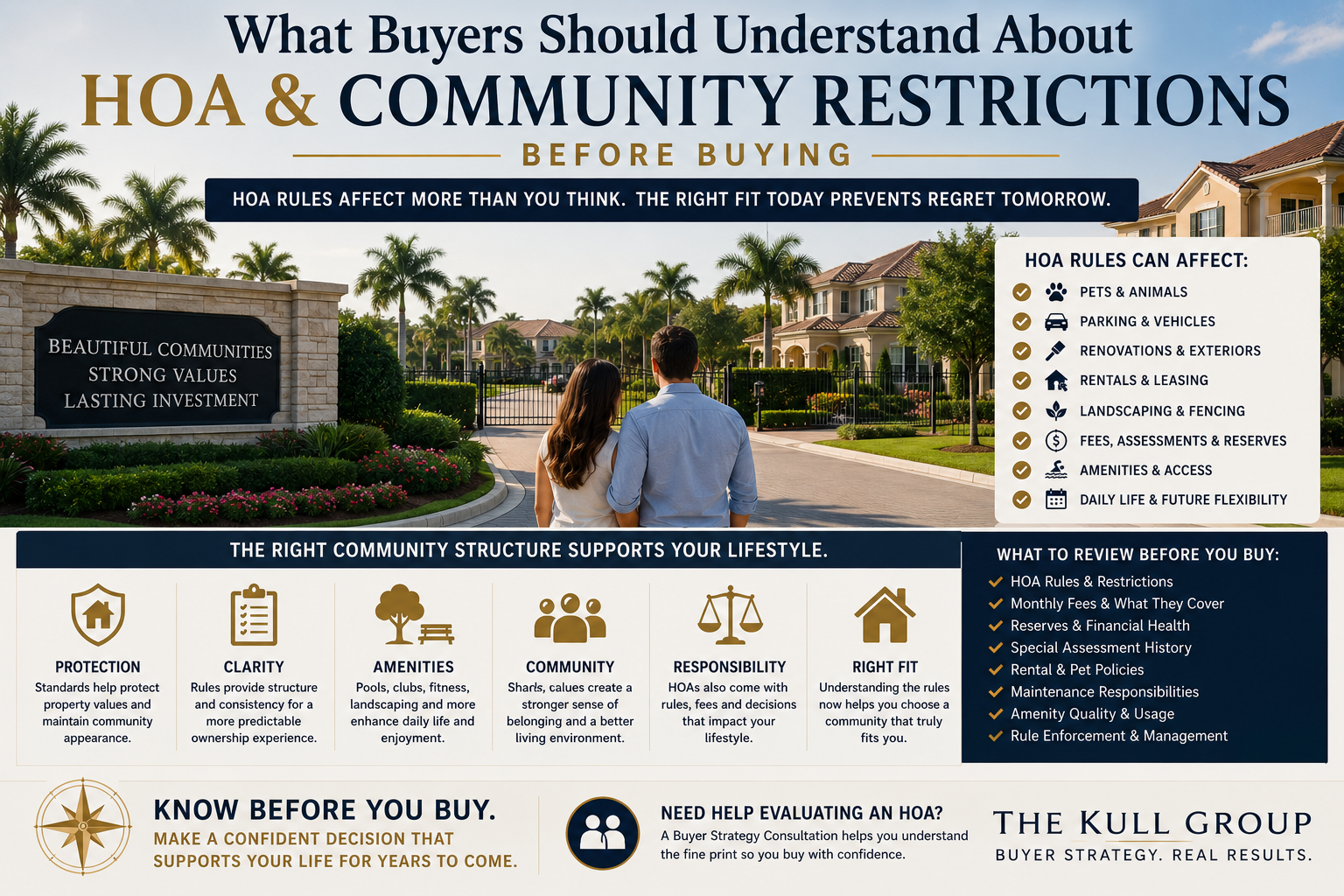
What Buyers Should Understand About HOA and Community Restrictions Before Buying
HOA rules are easy to treat as paperwork during the buying process. Buyers may glance at the monthly fee, review the amenities, and assume the rest can be handled later.
That can be a costly mistake.
Community restrictions often shape daily life more than buyers realize. They can affect how a home is used, what changes can be made, where vehicles can be parked, whether pets are allowed, how rentals are handled, how exterior maintenance is managed, and how much control the owner actually has after closing.
For some buyers, that structure creates comfort. For others, it slowly becomes frustrating.
The issue is not whether an HOA is good or bad. The issue is whether the structure fits the way the buyer actually wants to live.
The strongest HOA buying decisions usually happen when buyers evaluate community rules as lifestyle infrastructure, not just as monthly fees or neighborhood paperwork.
HOA Structure Can Support the Right Buyer
Some buyers thrive in HOA-managed communities because the structure reduces uncertainty. Rules, standards, maintenance expectations, and shared amenities can create a more predictable ownership environment.
That may appeal to buyers who want:
- consistent community appearance
- shared maintenance responsibility
- amenity access
- landscaping standards
- reduced exterior decision-making
- neighborhood organization
- a more managed ownership experience
For buyers who value simplicity, structure, and consistency, HOA communities can feel supportive rather than restrictive.
The problem begins when buyers choose that structure without understanding how it will affect their daily habits, future plans, renovation goals, or tolerance for community oversight.
Rules Matter More When They Affect Real Life
Many buyers review HOA rules abstractly. They may understand that restrictions exist but not think through how those restrictions may affect ordinary life.
That is where friction can appear later.
Restrictions may affect:
- work vehicles
- guest parking
- pets
- fencing
- paint colors
- landscaping changes
- exterior renovations
- short-term or seasonal rentals
- boat, trailer, or RV storage
For one buyer, those rules may barely matter. For another, they may affect daily convenience, future flexibility, or even whether the community fits their lifestyle at all.
Buyers evaluating how community rules affect lifestyle should also review what daily life feels like in different Palm Beach County communities.
Compare Homes by Community Structure Before You Commit
Once buyers understand how much structure or flexibility they want, the home search becomes more useful. Instead of comparing only price, photos, and square footage, buyers can compare how each community may function after closing.
Some buyers begin comparing:
- HOA-managed communities versus lower-restriction neighborhoods
- condos and townhomes versus single-family homes
- gated communities versus open neighborhoods
- club communities versus non-club ownership
- shared maintenance versus direct owner responsibility
- amenity-heavy communities versus simpler ownership environments
Fees Are Only One Part of the HOA Decision
Many buyers focus heavily on the monthly HOA fee because it is easy to compare. A lower fee may appear more attractive, while a higher fee may feel like an unnecessary burden.
But the fee alone does not tell the full story.
Buyers should understand:
- what the fee covers
- what the homeowner remains responsible for
- whether reserves are healthy
- whether assessments may be likely
- how maintenance is managed
- whether insurance is included or separate
- how rules are enforced
- whether amenities are actually useful to the buyer
A low fee with weak reserves or unclear maintenance responsibility may create more future uncertainty than a higher fee in a well-managed community.
A higher fee may be worthwhile if it meaningfully reduces maintenance responsibility or supports the lifestyle the buyer truly wants.
Palm Beach Gardens Is a Strong Example of Structure-Driven Ownership
Palm Beach Gardens includes many communities where HOA structure, club expectations, gated access, landscaping standards, and amenity environments can significantly shape ownership.
For some buyers, that is exactly the appeal. They want a polished, organized environment where community standards support the lifestyle they are choosing.
For others, the combination of fees, rules, club expectations, and maintenance responsibilities may feel more complex than expected.
The strongest decisions usually happen when buyers understand whether the community structure feels supportive or restrictive before they become emotionally attached to a specific home.
Buyers comparing structured ownership environments may benefit from exploring Palm Beach Gardens buyer strategy guidance.
HOA Rules Can Affect Future Flexibility
Buyers often evaluate a home based on current needs. But HOA structure can also affect future adaptability.
Rules may influence whether a buyer can:
- rent the property later
- renovate the exterior
- add certain improvements
- change landscaping
- keep additional vehicles
- accommodate changing family needs
- use the property seasonally
That future flexibility matters because life rarely stays exactly the same after closing.
A community that fits well today may become restrictive later if the buyer’s family structure, work situation, ownership goals, or lifestyle needs change.
Buyers evaluating future adaptability may also benefit from reviewing whether location, home size, or lifestyle flexibility should come first.
Boca Raton Shows How HOA Fit Can Differ by Community
Boca Raton includes many ownership environments where HOA structure ranges from highly managed club communities to less restrictive residential neighborhoods.
That variation matters because two homes in the same city may create completely different ownership experiences.
One buyer may want the consistency and structure of a gated or club environment. Another may prefer more control, fewer rules, or lower monthly obligations.
The strongest Boca Raton buying decisions usually happen when buyers evaluate how community structure affects daily life, not just how desirable the area looks from the outside.
Buyers comparing those ownership differences may benefit from exploring Boca Raton buyer strategy guidance.
Condo and Townhome Buyers Need Extra Clarity
HOA review becomes especially important for condo and townhome buyers because the ownership structure may involve shared systems, common elements, building reserves, insurance arrangements, and collective decision-making.
Buyers should understand:
- building maintenance responsibility
- roof and exterior obligations
- insurance structure
- reserve studies
- special assessment history
- rental restrictions
- pet restrictions
- parking rules
- amenity upkeep
For some buyers, this structure creates simplicity. For others, it creates dependency on association decisions and community-wide financial planning.
The best fit depends on the buyer’s comfort with shared responsibility.
HOA Fit Is Really a Lifestyle Fit Question
At its core, HOA fit is not just financial. It is behavioral.
Buyers should ask themselves:
- Do I want structure or flexibility?
- Do I value consistency or control?
- Do I want shared maintenance or personal responsibility?
- Do I want amenities or lower obligations?
- Do I want community standards or more independence?
- Will these rules still fit my life several years from now?
There is no universal right answer.
The right answer depends on whether the community structure supports the buyer’s actual lifestyle after closing.
Buyers who want a broader strategy framework may also benefit from reviewing buyer strategy and area fit guidance for Palm Beach County.
Need Help Understanding Whether an HOA Community Fits Your Lifestyle?
If you are comparing HOA communities, gated neighborhoods, condos, townhomes, or lower-restriction homes, a buyer strategy consultation can help clarify how community structure may affect daily life, future flexibility, maintenance responsibility, and long-term ownership satisfaction.
- Compare HOA-managed communities with lower-restriction ownership options
- Understand fees, rules, reserves, and maintenance responsibilities
- Evaluate whether community structure supports your lifestyle goals
- Clarify how much flexibility or structure you actually want after closing
No pressure. Just practical guidance designed to help buyers avoid choosing a community structure that does not fit the way they actually live.
Frequently Asked Questions About HOA and Community Restrictions Before Buying
Are HOA communities a good fit for every buyer?
No. HOA communities can be a strong fit for buyers who value structure, shared maintenance, amenities, and community standards. They may feel restrictive for buyers who want more control, flexibility, or independence.
What should buyers review before purchasing in an HOA community?
Buyers should review fees, rules, reserves, maintenance responsibility, rental policies, pet restrictions, parking rules, architectural guidelines, assessment history, and what the association actually covers.
Can HOA rules affect future flexibility?
Yes. HOA rules can affect rentals, renovations, exterior changes, vehicle storage, pets, leasing options, and how the home can be used as life changes over time.
Why do HOA fees not tell the full story?
Monthly fees are only one part of the decision. Buyers should also understand what the fee covers, reserve strength, future assessment risk, maintenance obligations, insurance structure, and community management quality.
How should buyers decide if an HOA fits their lifestyle?
Buyers should evaluate whether they prefer structure, consistency, shared maintenance, and community standards or whether they need more flexibility, control, and lower restrictions in daily ownership.