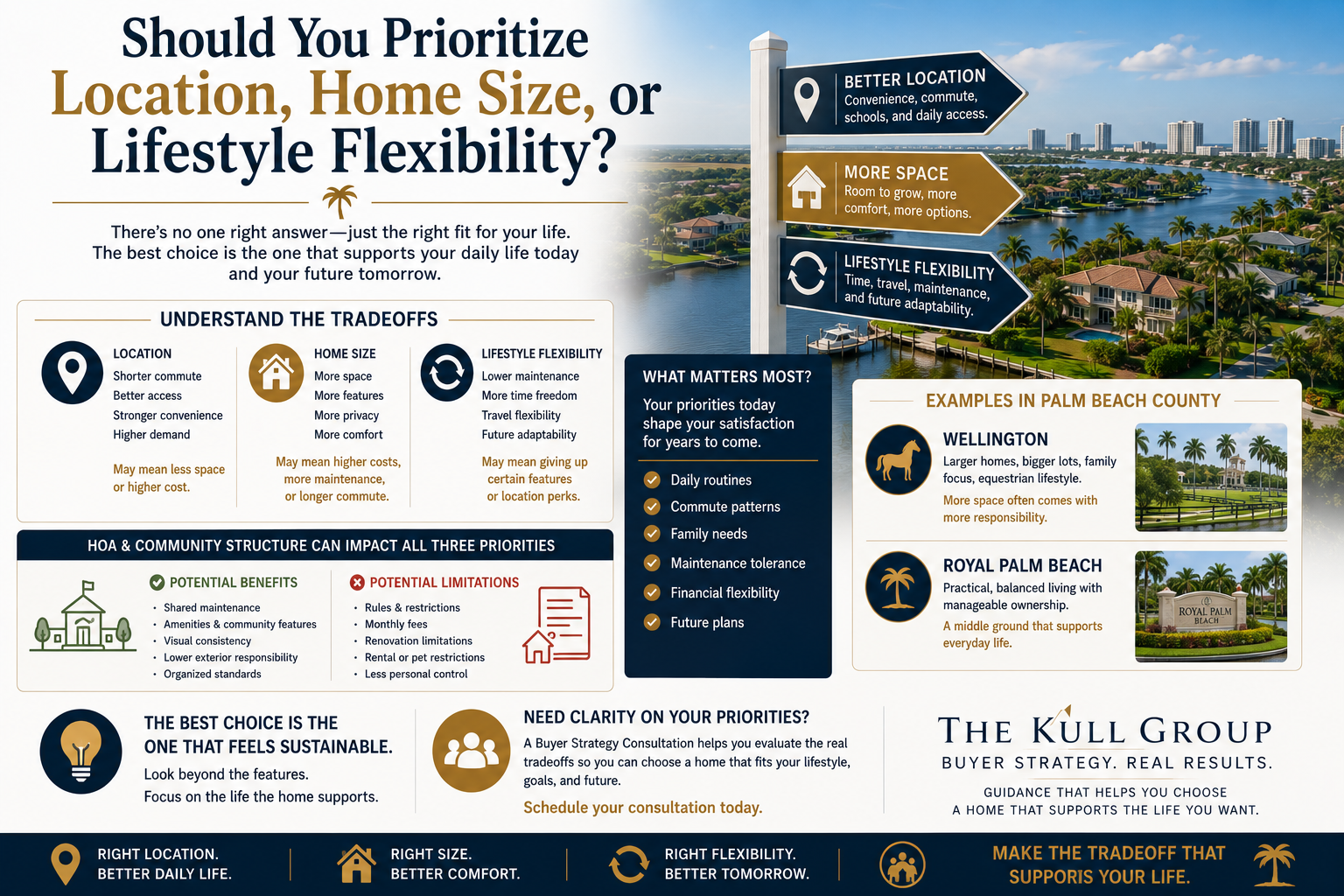
Should You Prioritize Location, Home Size, or Lifestyle Flexibility?
Most buyers eventually face the same difficult question: should they prioritize location, home size, or lifestyle flexibility?
It sounds simple until the tradeoffs become real.
A better location may mean a smaller home. A larger home may mean a longer commute. A lower-maintenance property may mean less space. A more flexible lifestyle may require giving up features that looked important early in the search.
That is why buyers often struggle when they compare homes only by price, square footage, or appearance. The real decision is usually about which tradeoff will feel most sustainable after closing.
The best answer is not the same for every buyer.
The strongest decision depends on how the home will support daily routines, future needs, emotional comfort, maintenance tolerance, commute patterns, and long-term ownership goals.
The strongest buying decisions usually happen when buyers stop trying to maximize every feature and start identifying which tradeoff supports the life they actually want to live.
Location Usually Affects Daily Life More Than Buyers Expect
Location does not only affect resale value or convenience. It affects ordinary life every day.
Location can shape:
- commute time
- school routines
- access to healthcare
- shopping and service convenience
- social activity
- travel flexibility
- energy levels
- how easy or difficult daily movement feels
Some buyers realize over time that a slightly smaller home in a better-fitting location creates more long-term comfort than a larger home that adds pressure to everyday routines.
Others are genuinely happier accepting a longer drive or less central location because the additional space, privacy, or affordability matters more to them.
The key is knowing which tradeoff fits your actual life instead of assuming there is one universally correct answer.
Home Size Can Be Valuable, But Only If It Supports Real Use
More space can improve quality of life when the space solves a real problem.
A larger home may make sense for buyers who need:
- dedicated work-from-home areas
- room for children or extended family
- storage
- guest space
- hobby areas
- outdoor room
- more privacy inside the home
But extra space also creates responsibility.
Larger homes may involve more cleaning, higher utility costs, greater maintenance exposure, larger roofs, more landscaping, more furnishing costs, and more time spent managing the property itself.
For some buyers, that tradeoff is entirely worthwhile. For others, the additional space eventually becomes more burden than benefit.
Buyers evaluating those patterns may also benefit from reviewing how buyers sometimes choose the wrong area for their lifestyle.
Compare Homes by the Tradeoff That Matters Most
Once buyers understand which priority matters most, the search process becomes more focused. Instead of comparing every home against every possible feature, buyers can compare homes through the lens of their real ownership priorities.
Some buyers begin comparing:
- central location versus larger homes farther out
- low-maintenance living versus more property control
- walkability versus quiet residential space
- affordability versus commute convenience
- HOA structure versus ownership flexibility
- current needs versus future adaptability
Lifestyle Flexibility Is Often the Hidden Priority
Many buyers do not initially describe their goal as “lifestyle flexibility.”
They may say they want a certain number of bedrooms, a specific location, a garage, a pool, a gated community, or a particular price point.
But underneath those features, many buyers are really trying to protect flexibility.
They want:
- time flexibility
- financial flexibility
- travel flexibility
- family flexibility
- work flexibility
- future resale flexibility
- maintenance flexibility
A home that technically meets the search criteria may still reduce flexibility if it creates too much cost, upkeep, commute pressure, or operational complexity.
The stronger decision usually comes from understanding which home supports the buyer’s life without boxing them in unnecessarily.
Wellington Is a Strong Example of Space Versus Responsibility
Wellington often appeals to buyers who want larger homes, larger lots, family-oriented neighborhoods, school-centered planning, equestrian influence, and a more decompressed residential environment.
For many buyers, that ownership style can be an excellent fit.
But Wellington also illustrates the importance of evaluating responsibility alongside space.
Buyers may gain:
- larger living areas
- more outdoor space
- family-oriented neighborhood structure
- residential stability
- greater decompression
They may also take on:
- more maintenance
- longer commute patterns
- larger landscaping demands
- higher operating costs
- more property management responsibility
For the right buyer, that tradeoff feels worthwhile. For another buyer, a more compact or centrally located ownership environment may be a better fit.
Buyers evaluating that decision may benefit from exploring Wellington buyer strategy guidance.
Royal Palm Beach Often Represents a Practical Middle Ground
Some buyers do not want the largest home, the most active lifestyle environment, or the highest-profile location. They want a practical ownership structure that supports ordinary life without creating unnecessary pressure.
Royal Palm Beach often appeals to buyers looking for that type of balance.
The area may support buyers who value:
- practical suburban living
- manageable ownership demands
- family-oriented routines
- balanced commute access
- moderate lifestyle pressure
- long-term operational sustainability
For some buyers, that middle-ground ownership structure creates more lasting satisfaction than chasing the largest home or most prestigious location.
Buyers comparing practical ownership environments may benefit from exploring Royal Palm Beach buyer strategy guidance.
HOA Structure Can Affect All Three Priorities
HOA and community structure can influence location, home size, and lifestyle flexibility at the same time.
An HOA-managed community may provide:
- shared maintenance
- amenities
- visual consistency
- organized community standards
- lower exterior responsibility
But it may also create:
- rules
- fees
- renovation limits
- rental restrictions
- pet or vehicle limitations
- less personal control
For some buyers, the structure adds convenience. For others, it reduces the flexibility they actually need.
Buyers weighing that decision may also benefit from reviewing what buyers should understand about HOA and community restrictions before buying.
The Best Choice Usually Depends on Your Current Life Stage
A buyer’s best priority often changes depending on life stage.
A growing family may value space and school planning. A healthcare professional may prioritize commute reliability. A downsizing buyer may value lower maintenance. A remote worker may prioritize home functionality. A second-home buyer may value simplicity and management structure.
That is why generic buyer advice often fails.
The right decision depends on:
- how you work
- how often you travel
- how much maintenance you want
- how your family may change
- how much flexibility you need
- how much commute pressure you can tolerate
- how long you expect to own the home
The strongest ownership outcomes usually happen when buyers choose based on life fit rather than feature comparison alone.
The Right Tradeoff Should Feel Sustainable
Every buyer makes a tradeoff.
Some trade space for location. Some trade location for affordability. Some trade flexibility for structure. Some trade maintenance simplicity for privacy. Some trade walkability for quiet.
The issue is not whether a tradeoff exists.
The issue is whether the tradeoff feels sustainable after the initial excitement fades.
A strong ownership decision usually feels:
- realistic
- manageable
- emotionally calmer
- financially sustainable
- aligned with daily routines
- supportive of future flexibility
Buyers looking for a broader decision framework may also benefit from reviewing buyer strategy and area fit guidance for Palm Beach County.
Trying to Decide Which Tradeoff Makes the Most Sense?
If you are deciding between location, home size, maintenance responsibility, HOA structure, commute patterns, and long-term flexibility, a buyer strategy consultation can help clarify which ownership tradeoff best supports the life you actually want after closing.
- Compare location, space, and flexibility tradeoffs realistically
- Evaluate how different choices affect daily life over time
- Understand which ownership structure fits your current and future needs
- Clarify which priorities should lead your home search
No pressure. Just practical guidance designed to help buyers choose the tradeoff that feels sustainable long term.
Frequently Asked Questions About Location, Home Size, and Lifestyle Flexibility
Should buyers prioritize location or home size?
It depends on how the tradeoff affects daily life. Some buyers are happier with a smaller home in a better-fitting location, while others value additional space enough to accept longer commutes or greater maintenance responsibility.
Why does lifestyle flexibility matter when buying a home?
Lifestyle flexibility affects how easily the home supports changing work patterns, family needs, travel, maintenance tolerance, financial comfort, and long-term ownership goals.
How can a larger home become a problem for some buyers?
A larger home can create more cleaning, maintenance, utility costs, landscaping responsibility, furnishing needs, and long-term operating costs than buyers initially expect.
How does HOA structure affect lifestyle flexibility?
HOA structure may create consistency, shared maintenance, and amenities, but it can also limit renovations, rentals, pets, parking, exterior changes, and how freely the owner can use the property.
What is the best way to decide which priority should lead the search?
The best approach is to evaluate which tradeoff will feel most sustainable after closing based on commute patterns, maintenance expectations, daily routines, financial comfort, and future flexibility.