


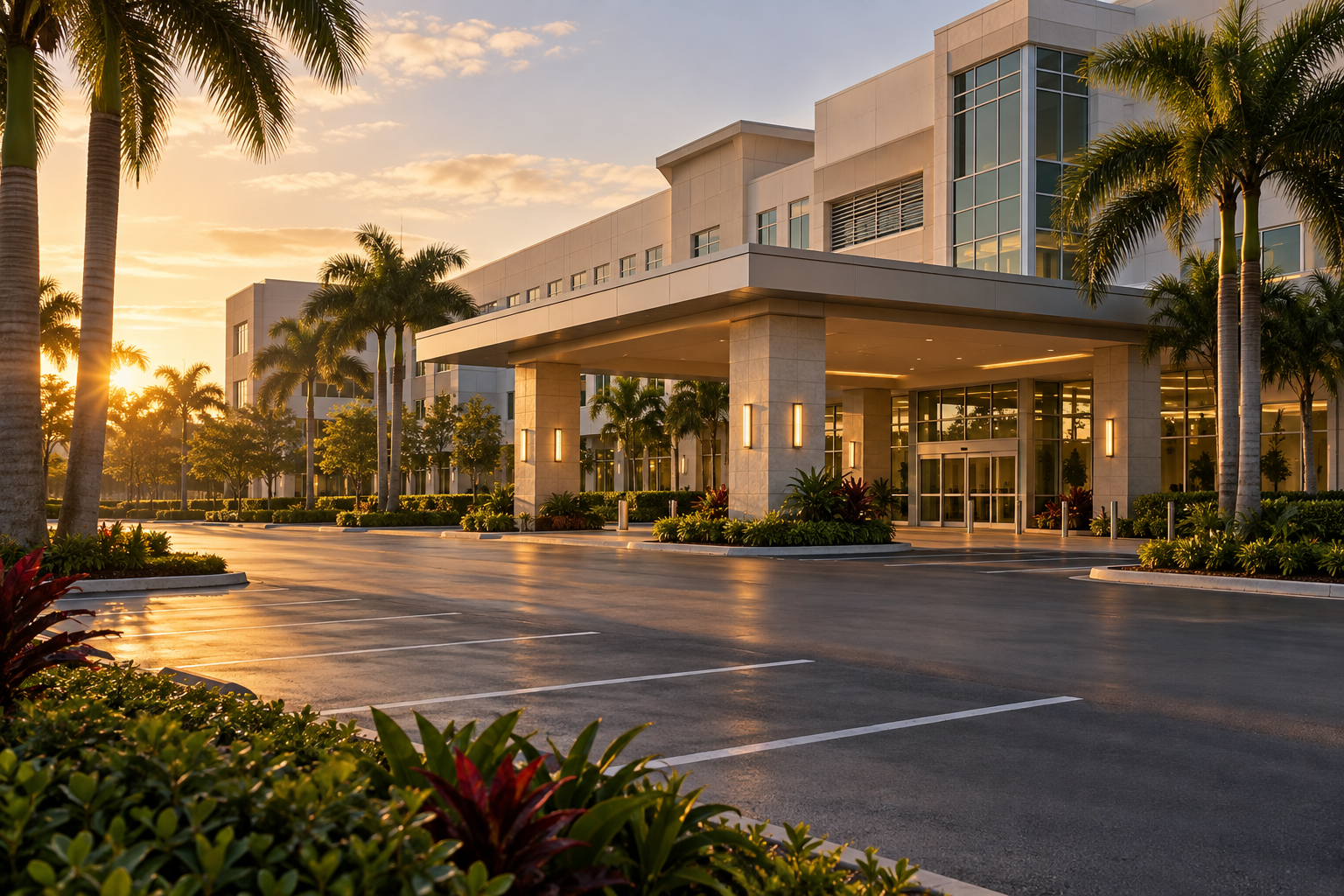
What Hospital Expansion in Palm Beach County Could Mean for Demand Near Your Home
By Chris & Sue Kull · Florida REALTORS® · The Kull Group powered by Keller Williams Wellington · 31+ years · 1,000+ homes sold · 561-440-0777
Quick answer: Hospital expansion may bring relocating employees into a local buyer pool. Whether it affects demand for your home depends on three things you can check. First, has the institution announced a specific expansion with dates? Second, is your home within a realistic commute of that campus? Third, is your home ready for a buyer working against a fixed start date? The third is the part you control. It covers system records, insurance questions answered by your agent, inspection preparation, a current valuation and a timeline that fits your plans. Call Chris & Sue Kull, The Kull Group powered by Keller Williams Wellington, at 561-440-0777.
A hospital may hire staff when it adds beds, opens a new building or expands a campus. Some of those hires may relocate and look for homes nearby. This article helps you work through two questions: whether any of that reaches your house, and whether it should change how or when you sell.
This article is for you if you own a home in Palm Beach County, are considering a sale, and want to know whether nearby medical growth belongs in your planning. If you are relocating to the county for a healthcare position yourself, start with our Palm Beach County Real Estate for Healthcare Professionals resource, which covers the buyer side of this decision.
What we are and aren't claiming. This article does not name specific facilities, cite hiring figures or describe expansion timelines. We also don't have market data that isolates hospital-driven demand by neighborhood. We use four labels throughout:
- A Florida statute or public record is a verifiable fact you can check yourself.
- "Our view" or "we think" marks our interpretation as Florida REALTORS®. It is not a measured market trend.
- "We recommend" marks guidance for your decision. It is not a prediction about your home's price or timing.
- Any statement about how a buyer might behave is framed as a possibility to plan for. We don't treat it as a rule.
A Three-Part Check Before Hospital Expansion Enters Your Sale Plan
Sue and I suggest three questions. Together, they tie the idea of "hospital-driven demand" to something you can verify. They run in order, because each one matters only if the one before it holds.
1. Evidence: Is there a confirmed expansion? Start with the institution's own announcement. Find out:
- which campus is expanding;
- what is being added, such as beds, a specialty unit or an outpatient building;
- when it is scheduled to open or begin hiring.
A groundbreaking date, a hiring timeline or an opening date is something you can check. General talk about healthcare growth in the county gives you nothing to check. Our view is that if you can't find the announcement, you shouldn't price or time your home around it.
2. Reach: Does it plausibly reach your home? A confirmed expansion at one campus says nothing yet about your street. The next section explains how to test your own location.
3. Readiness: Would your home answer a time-pressed buyer's questions? You control this one. It is also useful whether or not the first two checks hold, because roof age, insurance and condition are questions a buyer may raise regardless of why they are moving.
Where Demand Could Form: Judging Your Own Location
Even a confirmed expansion doesn't tell you which neighborhoods will see interest. We don't have data that maps hospital hiring to home purchases by community, so we won't assign demand profiles to particular towns. We recommend testing your own location against the factors that would shape a relocating employee's search.
- Commute to the specific campus, at realistic hours. Clinical schedules don't always follow business hours. Drive the route from your home to the facility early in the morning and in the evening, as well as at midday.
- Housing type. Note whether your home is a single-family house, a townhome or a condominium. Condominium and cooperative units in buildings three stories or more carry statutory requirements a buyer may ask about. These are covered in the next section.
- Jurisdiction. The Palm Beach County Property Appraiser publishes parcel records, including whether a parcel is in a municipality or in unincorporated Palm Beach County. A relocating buyer may want to know which local government governs the property. We recommend confirming it on your parcel record and stating it accurately.
- Corridor position. Our primary market covers Palm Beach County and the Palm Beach-to-Port St. Lucie corridor. Our view is that distance from the specific facility is what matters. A campus in one part of that stretch shouldn't be assumed to create demand in another simply because both sit in the same county or corridor.
Your home may sit far from the campus, or the commute may be difficult at the hours that matter. In that case, we'd leave hospital expansion out of your timing and pricing decisions and evaluate the sale on its ordinary merits.
Why South Florida Can Change a Relocating Buyer's Calculus
A buyer relocating from outside Florida for a hospital position may be meeting South Florida ownership costs for the first time. We think it's reasonable to expect that buyer to ask questions a local buyer may already have answered for themselves:
- What will property insurance cost on this specific house?
- How old are the roof and the major systems?
- What does hurricane preparation involve each season, in time and money?
If your home is a condominium or cooperative unit in a building three stories or more in height, Florida law adds two items to that conversation:
- Florida Statutes §553.899 requires milestone structural inspections for condominium and cooperative buildings of that height.
- Florida Statutes §718.112(2)(g) requires structural integrity reserve studies for condominium buildings three stories or more in height.
We recommend getting the association's current documents on both before listing. That way you can hand them over instead of tracking them down during a contract period.
Where our role ends. We can help you anticipate the questions a buyer may raise and organize the documents that answer them. We don't make the professional determinations behind those answers:
- Insurability, coverage, premiums and underwriting: your insurance agent or carrier.
- Whether an association's reserves are adequate, or what an inspection or reserve study means for a building: the association and its engaged professionals.
- The condition of a particular home: a licensed home inspector or contractor.
If you own a home near a medical campus and are thinking about timing a sale, start with the three checks: confirm the expansion, test your location's reach, and get your documents in order before a buyer asks for them.
See the buyer side of this decision: Palm Beach County real estate for healthcare professionals
What We Think Is Worth Knowing About Buyers on a Fixed Start Date
Some healthcare hires relocate on an employer's schedule. That schedule might include a start date, temporary housing that ends on a fixed day, or employer relocation assistance. Not every buyer has those, and terms vary by employer and position. We treat them as possibilities to ask about, and we don't assume them.
Suppose a buyer does come with a firm start date. We think having your documentation ready is worthwhile for that buyer, since open questions can take time to resolve and that buyer may have less time to spare. That is a reason to prepare. We wouldn't treat it as a reason to expect a higher price.
A relocation can involve a whole household, so more people may weigh in, and there may be less time to visit in person. We recommend making the home easy to evaluate from a distance. Clear photos, a floor plan and system records in the listing package let a buyer answer basic questions without a second trip.
What This Means for Homeowners in Palm Beach County
If your home passes the evidence and reach checks, we recommend putting your effort into preparation before you think about price. Here is what we mean by preparation:
- System documentation. Gather the replacement dates for the roof, HVAC, water heater and pool equipment from invoices, permits or warranties. Don't estimate them from when you bought the house.
- Insurance questions. Ask your insurance agent now what a buyer's carrier would likely want to know about the roof, windows and other features. Also ask what your current policy and any recent inspections show. Your agent is the right source on coverage and underwriting.
- Inspection readiness. Consider a pre-listing inspection by a licensed inspector, so condition items surface on your timeline. Then decide, with the appropriate professionals, how you want to handle each one.
- Association documents. If you own a condominium or cooperative unit in a building three stories or more, gather the milestone inspection and structural integrity reserve study documents that apply to your building.
- Valuation. Get a current valuation built from recent comparable sales near your home. A general sense of what healthcare growth might do is not a substitute.
- Timing. A confirmed expansion may have an opening date. It's reasonable to ask whether that date fits your plans. We'd let it influence your timing only if the evidence and reach checks both hold, and your own move should still drive the decision.
After 31+ years in real estate, our view is that these questions are easier to handle before a buyer exists. Once you're under contract, the inspection and financing periods set the pace. A roof-age question you could have answered in a day at home becomes one you're answering against a deadline.
A current market valuation is a useful starting point for the price side of this decision: Home Value — Palm Beach County.
Frequently Asked Questions
Does proximity to a hospital expansion affect what my home is worth in Palm Beach County?
Possibly, but distance to a hospital doesn't answer the question by itself. A buyer's offer and an appraisal rest on comparable sales, condition and the inventory available when you list. A confirmed expansion near your home could add some relocating buyers to the pool. We don't have data that measures that effect by neighborhood, though, and we wouldn't assume it. We recommend starting with a valuation based on recent sales near your home, then working through the evidence, reach and readiness checks for your specific property.
How can I tell whether hospital-related demand is showing up near my home?
Look for evidence you can check. Start with the institution's own announcement of what it's building and when. Then review recent comparable sales near your home. Once you list, notice who is actually touring and asking questions. If buyers who tour mention a new position at a nearby campus, that is a direct signal for your listing. If none do, we'd treat hospital expansion as background and keep it out of your pricing.
How do I know if my home is positioned well for a relocating buyer?
Ask whether you could answer, with documents, the questions a buyer moving from outside Florida might raise. Those include roof age, HVAC service history and your current insurance. For condominium units in buildings three stories or more, they also include milestone inspection and structural integrity reserve study status. If you can answer them, you are prepared for those questions from any buyer who raises them. If you can't, we recommend a direct property consultation, beyond a valuation, so you know where you stand before the first buyer arrives. Your insurance agent and a licensed inspector make the determinations that belong to them.
Who should I call about selling a home near a hospital expansion in Palm Beach County?
Call Chris and Sue Kull of The Kull Group powered by Keller Williams Wellington at 561-440-0777. We are Florida REALTORS® with 31+ years of real estate experience and 1,000+ homes sold. Our primary market is Palm Beach County and the Palm Beach-to-Port St. Lucie corridor, where we provide residential seller and buyer representation.
If you're weighing whether a nearby hospital expansion should shape when or how you sell, Sue and I are glad to work through the three checks with you for your specific property. You can reach us at 561-440-0777. If you're approaching this from the buyer side, our Palm Beach County Real Estate for Healthcare Professionals resource is the place to start.