


The Maintenance Costs That Belong in a Boynton Beach Homeowner's Simplification Math
By Chris & Sue Kull · Florida REALTORS® · The Kull Group powered by Keller Williams Wellington · 31+ years · 1,000+ homes sold · 561-440-0777
Quick answer: A complete simplification calculation for a Boynton Beach home counts three layers of cost, not just the mortgage balance and the sale price. The first is recurring operating costs: dues, insurance, property taxes, landscaping, pool service and irrigation repairs. The second is deferred capital exposure, which is each aging system's written replacement estimate divided by its remaining service life. The third is association exposure, meaning what the reserve study and any assessments indicate you may owe. Total those layers for staying, build the same total for the home you would move to, and compare both over the same years. To talk it through, call The Kull Group powered by Keller Williams Wellington at 561-440-0777.
A Boynton Beach homeowner who is thinking about simplifying may already have run some of the numbers: mortgage balance, estimated sale price, and a rough idea of what they would buy next. Those figures are only one side of the equation. The other side is the carrying cost: what the property costs to maintain now, and what it is likely to cost over the next several years if the owner stays. Once those numbers are added in, the math can look different than it did the first time.
This isn't a failure of financial sophistication. It reflects how ownership costs accumulate. Many of the real costs don't arrive as line items. They arrive as contractor calls, annual cycles and eventual capital decisions. Each one is manageable on its own and easy to absorb and move past. Seeing the cumulative picture takes deliberate effort.
If your decision involves both selling and buying your next home, our Sell High Buy Smart page on selling and buying across the Palm Beach-to-Port St. Lucie corridor covers the related next step.
How to Build the Full Carrying-Cost Calculation
The calculation separates costs that are visible every month from costs that are building up out of sight. Sue and I would ask you to use your own records and written estimates rather than general assumptions. We'd work through it in three layers.
Layer 1: Recurring operating costs. These are the visible monthly and annual expenses. Add up twelve full months of actual statements and invoices. Include HOA or condominium dues, your homeowners insurance premium, property taxes, landscaping, pool service, irrigation repairs and routine maintenance. Use a full year rather than a single month, because seasonal spending is easy to miss.
For property taxes, check the Palm Beach County Property Appraiser's parcel record. It shows whether the parcel lies within the City of Boynton Beach or in unincorporated Palm Beach County. A Boynton Beach mailing address does not settle that question on its own. Run the same check on any property you are considering next. Jurisdiction determines which local government's taxes appear on the bill, so two homes with the same postal city can carry different tax structures.
Layer 2: Deferred capital exposure. This is the cost that has not been billed yet. List each major system: the irrigation system, the pool pump, heater, filter and automation, and any other major component nearing replacement. For each one, record its age and current condition. Then get a written replacement estimate and an estimate of remaining service life from a licensed contractor. Annualize each item by dividing the replacement estimate by the years of service remaining. For example, an estimate expected to come due in three years adds one-third of that amount to each year of the calculation.
Layer 3: Association exposure. If the home is in an association-governed community, look at three things. First, what the most recent reserve study says about components coming due. Second, whether any special assessment has been adopted or is under discussion. Third, how your share would be calculated under the governing documents. The section on reserves below covers how to find this information.
The comparison. Add the three layers over the years you are planning around. Then build the same three layers for the home you would move to. Ask about the age of its systems and the condition of its association's reserves in the same way. Your sale estimate, purchase costs and financing figures from your agent and lender complete the other side of the ledger. The decision question we'd put to you is whether staying would require funding Layer 2 and Layer 3 costs before a move would happen anyway. If so, the money spent maintaining the current home is capital you may fund and then leave behind.
What Irrigation Systems Actually Cost Boynton Beach Homeowners
A functioning irrigation system isn't a set-and-forget asset. It's an ongoing operational item with components that wear out: heads, valves, controllers and supply lines. If your system has separate zones for the front, back and side landscaping, plus any entry or accent areas, each zone adds valves and heads that can fail. A single head replacement is an afternoon. A valve bank failure during a dry stretch is an emergency. A controller that starts misfiring can damage the landscaping before anyone notices, which adds to the repair cost.
Your actual irrigation cost has two parts, and Sue and I would separate them clearly. The first is what the system has cost you over the past twelve months. That figure comes from your invoices and belongs in Layer 1. The second is the forward cost: what the system is likely to cost over the next three to five years given its current age and condition. That figure belongs in Layer 2. For a system installed at original construction with no documented overhaul, we'd treat the forward number as something that warrants a written estimate from an irrigation contractor. It's not safe to assume the system will keep working simply because it has worked so far.
Landscaping follows a similar pattern, and we'd count it the same way: a full twelve months of crew invoices, not a single month's bill. If you maintain the yard yourself, the time cost is real even when the dollar cost isn't tracked. That time belongs in your own thinking about what staying requires, even if it never appears as a dollar figure.
Pool Equipment: The Cost That's Easy to Defer Until It Isn't
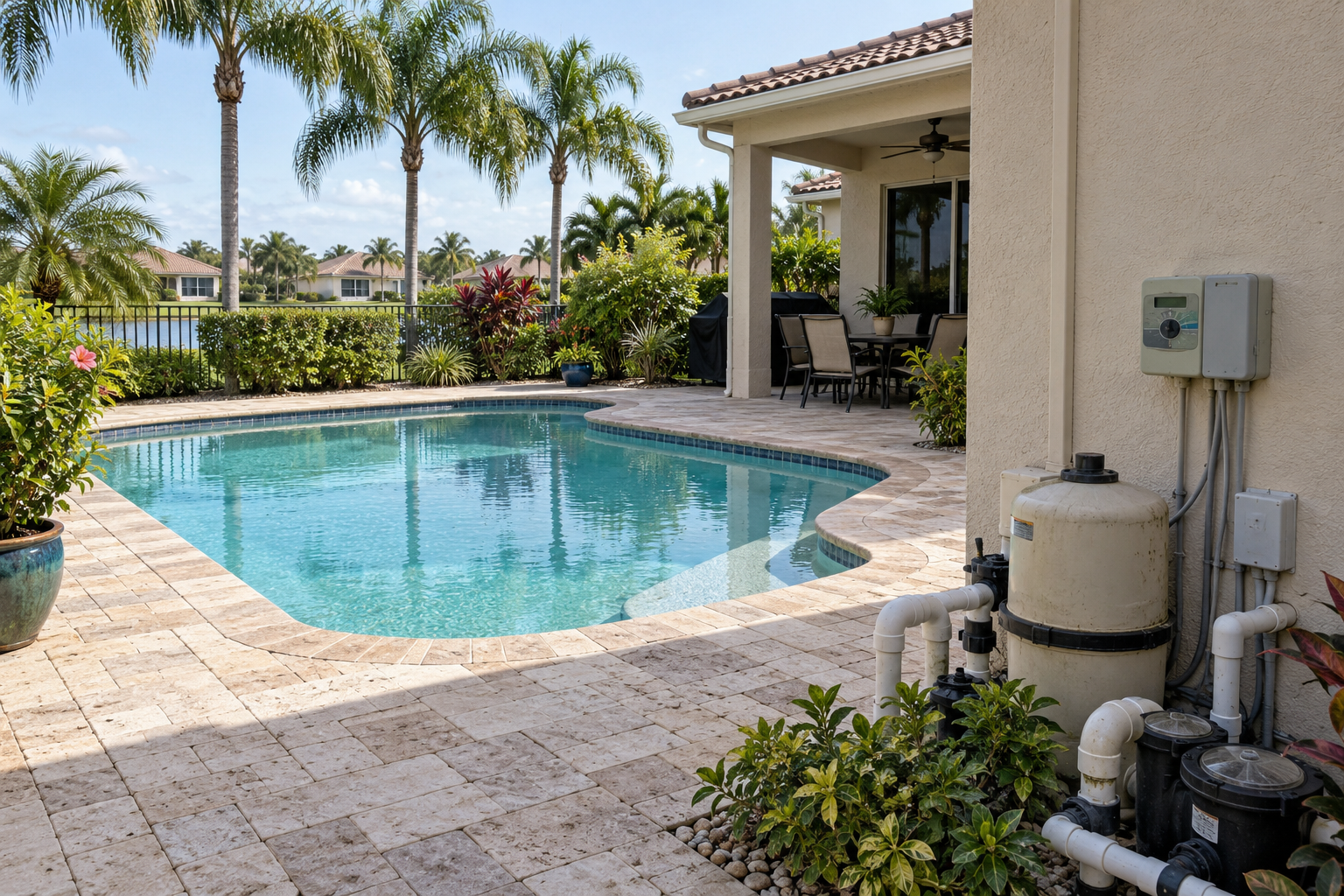
Pool equipment has a finite service life. Pumps, heaters, filters and automation systems each wear out on their own schedule. How long a specific piece lasts depends on the equipment, how heavily it runs and how it has been maintained. A licensed pool contractor who inspects your equipment can estimate its remaining life. Manufacturer documentation gives the design range.
Equipment that is still technically working is easy to defer. A pump that runs louder than it should, a heater that takes longer to reach temperature, an automation panel that needs occasional resets: each of these is manageable until it fails. A failure doesn't wait for a convenient budget cycle, and the replacement cost may not be in anyone's near-term plans.
That is why Sue and I put pool equipment in Layer 2 of the simplification math. If the equipment's age and condition point to a capital decision in the next few years, the timing of a move matters. Selling first can turn that replacement into part of the sale conversation, rather than a purchase you fund and then leave behind.
A question worth sitting with: When you calculate what simplifying would do for you financially, are you comparing your current carrying costs, including irrigation, pool, insurance and maintenance cycles, against what ownership would actually look like on the other side? Or are you comparing two mortgage numbers?
The full picture can look materially different than the mortgage comparison. Continue to Sell High Buy Smart for the selling-and-buying side of the decision.
HOA and Condominium Reserves: The Document That Belongs in the Ownership Math
If your Boynton Beach home is in an association-governed community, the monthly fee is the visible cost. The less visible cost is the association's reserve position, which may be documented in a reserve study or reserve schedule. That record shows how the association has planned and funded for future capital replacements. The community may be a condominium, a villa or townhome association, or a single-family HOA with shared amenities.
The reserve record lets you compare what has been set aside with the components the association expects to replace, such as roofing on common structures, pool and clubhouse infrastructure, entry monuments, common-area irrigation and paving. How any particular repair is ultimately paid for, whether from reserves, a special assessment or some other means, depends on the association's finances, its governing documents, the law that applies to it and decisions made by its board. Sue and I would read the reserve record as a way to see whether that question may be coming, not as a prediction of how it will be answered.
What applies to your association depends on what kind of association it is. In Boynton Beach condominium buildings three stories or more in height, two Florida statutes apply. Florida Statutes §718.112(2)(g) requires structural integrity reserve studies, and Florida Statutes §553.899 requires milestone structural inspections. Requirements for other associations, including single-family HOAs and low-rise villa communities, depend on the statutes and governing documents that apply to that particular association.
Component timing is worth checking as well. If your association's reserve study or component schedule shows several major items, such as roofing, parking surfaces, pool equipment or amenity structures, scheduled for replacement within a similar window, we'd note that timing in Layer 3. Whether that applies to your community is something the study itself can show; a shared construction date alone doesn't establish it.
An owner who has read the reserve study knows which components the study lists as approaching replacement and how the association has planned for them. The monthly fee on its own doesn't show that. Sometimes the study confirms the plan is on track. Sometimes it tells a different story.
For homeowners in Boynton Beach communities with aging shared infrastructure, we'd treat the reserve study as more than a secondary document. It's part of the ownership math, and it belongs in Layer 3 of the calculation above.
Note: Reserve study interpretation and assessment risk carry HOA governance and legal dimensions that go beyond real estate advisory. A qualified HOA or condominium attorney or a community association professional can help you interpret your community's specific reserve position and obligations.
What This Looks Like at a Simplification Life Stage
Sue and I would ask you to consider a Boynton Beach household in a specific transition. The children have moved out, and the home is larger than daily life requires. The property's operational demands have stayed the same even as the household using it has contracted. The pool gets used less. The irrigated yard is maintained for its own sake more than for anyone's enjoyment of it. The guest rooms are guest rooms in name only.
That shift between the life the home was purchased for and the life actually being lived in it can be gradual enough that it doesn't announce itself. It accumulates. When the simplification math starts, it may be because the gap between the property's demands and the household's actual use of it has become visible enough to prompt the question.
The financial calculation and emotional readiness do not necessarily arrive at the same time. Once irrigation exposure, pool capital, insurance cost, HOA reserve risk and maintenance vendor costs are all counted, the financial case for moving can become clear before the owner is emotionally prepared to act on it. That gap is real, and it isn't a failure of logic. It reflects how long a move can take to form in the background before the math gets written down.
For a homeowner in this position, the conversation about simplifying can arrive in stages. It may start as a general sense that the property is working harder than they are. Then comes a specific trigger: a repair estimate, an insurance renewal, a reserve assessment notice. Then a call.
Our suggestion is to run the full math before that trigger arrives. It means calculating what you are spending to stay, what you are likely to spend over the next several years, and what your equity position makes possible on the other side. If an estimate or notice does arrive later, you would then be reviewing it against figures you have already assembled, rather than building the calculation for the first time while responding to it.
Frequently Asked Questions
How do I find out whether my Boynton Beach HOA has an adequate reserve fund?
Start by asking your property management company or board for three documents: the association's most recent reserve study or reserve schedule, the current budget, and any recent board minutes discussing major projects or assessments.
Whether a reserve study is legally required depends on the association type. For condominium buildings three stories or more in height, Florida Statutes §718.112(2)(g) requires a structural integrity reserve study, and Florida Statutes §553.899 requires milestone structural inspections. Requirements for other associations, including single-family HOAs and low-rise villa communities, depend on the statutes and governing documents that apply to that association.
If the study reports a funded percentage, meaning current reserves compared with the study's fully funded target, read it alongside which components are due and when. No single percentage answers the question on its own. A qualified HOA or condominium attorney or a community association professional can interpret your association's specific position and confirm your rights to review association records.
If I'm thinking about selling, should I repair pool equipment and irrigation before listing, or price to reflect the condition?
There's no universal answer. The right approach depends on your equipment's condition, what buyers in your price tier expect, and what the repairs would cost compared with how they would be perceived in an offer. A pre-listing inspection that documents condition can support an honest pricing conversation instead of an investment in repairs that may not return dollar-for-dollar. This is a strategic conversation worth having before committing to either path. The math varies by property, price tier and current buyer behavior in your specific community.
Is simplifying in Boynton Beach financially realistic right now for homeowners with significant equity?
It depends on four things: your current carrying costs, your equity position, your next property's price range, and what the full comparison looks like when both sides of the ledger are calculated honestly. Equity can widen the options for a next purchase, including how much financing it requires. Whether it does so in your case comes down to the three-layer calculation above, applied to both the home you own and the home you would buy. For the selling-and-buying side of that comparison, continue to Sell High Buy Smart.
Who should I call about weighing maintenance costs before selling a house in Boynton Beach?
Call Chris and Sue Kull of The Kull Group powered by Keller Williams Wellington at 561-440-0777. They are Florida REALTORS® with 31+ years of real estate experience and more than 1,000 homes sold across three states. They provide residential seller and buyer representation, including senior relocations, across Palm Beach County and the Palm Beach-to-Port St. Lucie corridor. Questions about reserve studies, insurance or legal obligations belong with the appropriate specialists.
If you're a Boynton Beach homeowner who has started this calculation and isn't sure you've included everything, compare your figures against the three layers above. The costs that get left out of simplification math aren't obscure. They're simply the ones that don't arrive as monthly statements. Starting with the full carrying-cost picture, not just the sale price, gives you a more complete basis for the decision. Sue and I can be reached at 561-440-0777. For the selling-and-buying side, continue to Sell High Buy Smart. You can also start with an honest look at what your property is worth in the current market, the figure the rest of the calculation builds on.