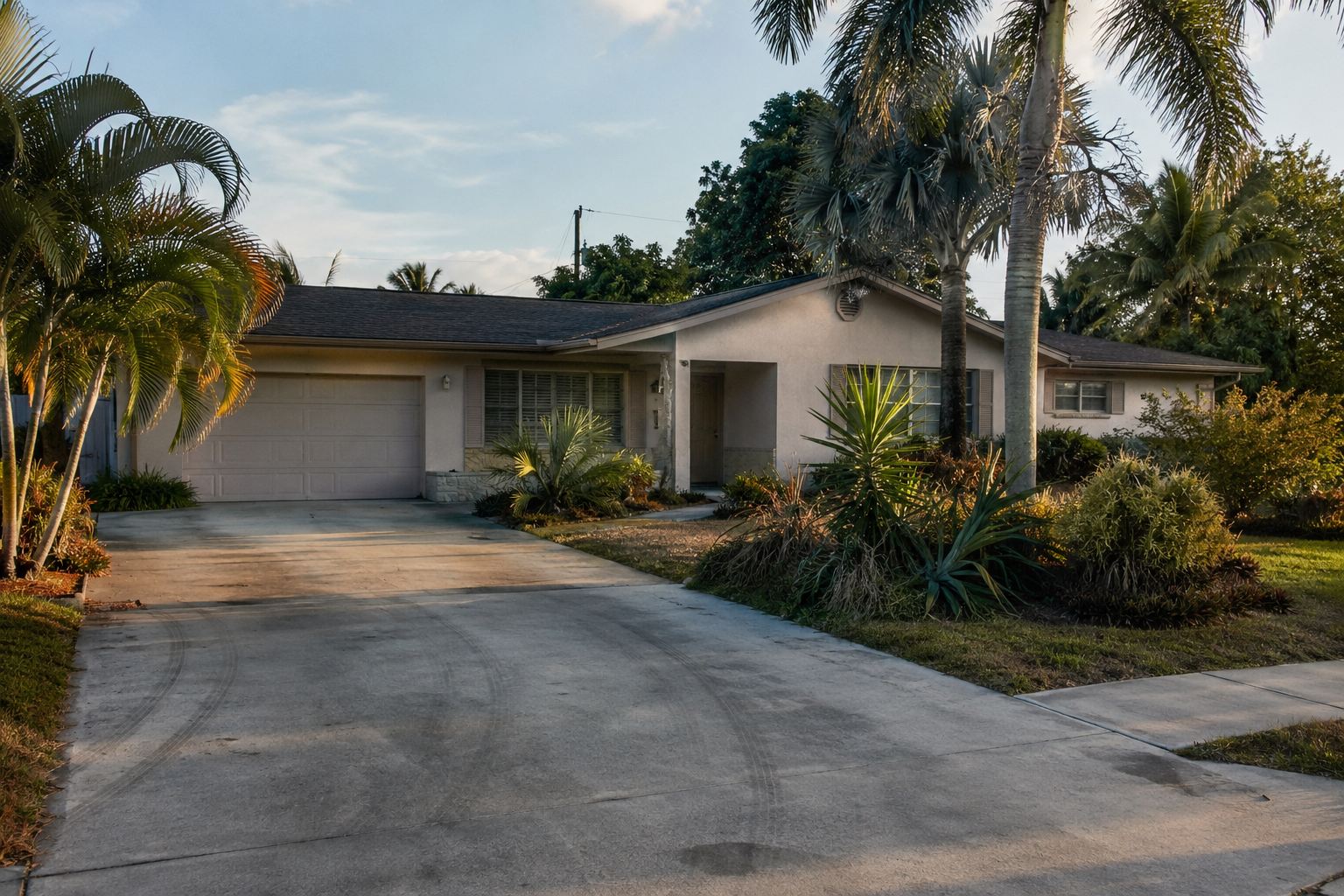
What Out-of-State Heirs Need to Know About Florida Probate Real Estate
Distance doesn't change what probate requires. It changes how hard every step becomes to execute. If you've recently inherited — or expect to inherit — real property in Palm Beach County while living in another state, the legal framework is the same as it would be for any local heir. What isn't the same is the cost of every misjudgment, the weight of every delay, and the compounding effect of making decisions about a property you cannot see, in a market you don't know, through a process that moves on its own timeline regardless of yours.
Most out-of-state heirs don't underestimate Florida probate. They underestimate the distance tax — the way geographic separation quietly increases the difficulty of every decision that would otherwise be straightforward. Understanding that gap early is the most useful thing you can do before anything else begins. Our probate and inherited property resource for Palm Beach County covers the broader framework. What follows is specific to what changes — and what goes wrong — when the heirs are not here.
The Property Is Here. The Decisions Are Happening Somewhere Else.
Florida probate is a court-supervised process that unfolds in the county where the property is located. It does not pause because the heirs are in Illinois or New York or California. It does not accelerate because someone needs it to. It operates on a schedule defined by the court, the attorney, the estate, and in many cases the condition of the property itself.
That last point matters more than most out-of-state heirs anticipate. A property in Boynton Beach or Lake Worth that sits unoccupied during a South Florida summer is not simply sitting still. The humidity is working on the interior. The air conditioning — if it's running — is cycling constantly and aging faster than it would under normal use. If it's not running, the damage accumulates faster than most people expect. Roof issues that might be caught early by an attentive owner go undetected for months when no one is regularly on site. Pool equipment degrades. Landscaping overgrows or dies. Exterior paint deteriorates at a rate that surprises people who own property in climates where seasons create natural maintenance intervals.
This is not a reason to panic. It is a reason to have someone with local knowledge assessing the property on a consistent basis — not a property manager hired remotely, but someone who understands what the South Florida climate actually does to a structure over six months of deferred attention.
The properties we see that enter the market in the strongest condition are the ones where someone was paying attention during the probate period, not just at the end of it.
What Out-of-State Heirs Consistently Get Wrong About Timing
There is a pattern that appears with enough regularity to call it reliable: out-of-state heirs arrive at the timing question from a financial logic that makes complete sense from a distance and breaks down when it meets the actual property.
The logic usually goes: wait until probate clears, then assess the property, then decide whether to sell or hold. It's reasonable. The problem is that in South Florida — in markets like Royal Palm Beach, Wellington, and Boca Raton — the carrying costs during that wait are not trivial, and they are often invisible until the first bill arrives. Insurance premiums in Palm Beach County now reflect the post-2021 market reality, which is materially different from what was in place when the property was originally purchased. HOA fees continue during probate. Utilities continue. And in many cases, the property's insurance situation requires immediate attention — because coverage that was adequate for the original owner may not transfer cleanly, and the gap between "we're figuring out the estate" and "we need an active policy on this structure" is one where exposure accumulates quietly.
After working with Palm Beach County families through probate for more than three decades, one pattern appears consistently: the heirs who fare best are not the ones who move fastest. They are the ones who understand — early — what the property is actually costing them to hold, and make an informed decision about that cost rather than discovering it over time.
Are you managing a Florida probate property from another state?
The decisions that matter most in this process are often the ones that feel like they can wait. A conversation early — before the property sits through another South Florida summer — is almost always more useful than one that happens after carrying costs have compounded and condition has declined. There's no obligation. Just a clearer picture of what you're actually managing.
Schedule a probate property consultation with The Kull Group.
When Multiple Heirs Are Involved — And Not Everyone Agrees
The most common version of this situation isn't one heir managing one property from out of state. It's several heirs — frequently siblings — managing a shared decision from different states, different financial positions, and different emotional relationships with the property.
We worked with three siblings who had inherited a property in Lake Worth — one in the Midwest, one on the West Coast, one locally. The property itself was relatively uncomplicated. The coordination wasn't. Each sibling had a different assessment of what the property was worth, different assumptions about what it would cost to prepare for market, and different timelines driven by their own financial situations. None of them were wrong, exactly. They were working from different information, and the disagreement had plenty of places to hide inside that information gap.
What helped wasn't pressure in any direction. It was giving all three siblings the same clear picture of what the property actually represented — its current condition, a realistic range of value, what preparation would cost, and what holding would cost per month — so that the conversation could happen on shared ground. When everyone is looking at the same information, disagreement tends to clarify rather than escalate.
This is where local representation serves a function that remote coordination cannot replicate. It is not just about access to the market. It is about having a consistent point of contact who can give every stakeholder the same honest assessment and keep the decision from stalling inside the communication gaps that distance creates.
What we observe repeatedly is that the most significant delays in multi-heir probate situations don't come from legal complications. They come from information asymmetry — heirs working from different assumptions who have no shared reference point to reason from together.
What This Means for You as an Out-of-State Heir
If you've inherited property in Palm Beach County — or you expect to — and you're managing it from somewhere else, the useful question isn't whether to sell. It's what you're actually managing right now, and whether you have an accurate picture of it.
The financial readiness to make a decision often arrives before the emotional readiness. The equity may be there. The market may be favorable. The carrying costs may be clear. But the decision stalls anyway — not because the numbers are wrong, but because there's internal work the situation requires that numbers don't resolve. That's not a failure of logic. It's a realistic description of what inherited property decisions actually involve. The conversations that tend to move things forward aren't the ones that reinforce the financial argument. They're the ones that acknowledge what the decision actually requires and give everyone language for what they're already navigating.
Here is what the pattern suggests, across the situations we've worked through repeatedly:
Understand the property's current condition before anything else. Not a general sense of it — an actual assessment by someone who knows what South Florida's climate does to a structure that isn't actively maintained. Insurance situation, roof age, HVAC condition, HOA status — these aren't secondary details. They are the foundation of every decision that follows.
Understand what the property is costing to hold, monthly, in real numbers. Insurance, utilities, HOA, property taxes, and deferred maintenance that is accumulating while decisions are pending. That number is often larger than heirs expect, and it changes the timing calculus significantly.
If other heirs are involved, establish shared information before establishing shared decisions. The disagreements that stall probate situations are almost never about the end goal. They are about different assumptions that were never examined together. A clear, shared baseline changes the dynamic.
For additional context on how decision-making authority works in Florida probate, this resource covers who has authority to sell probate property in Florida — a question that comes up early and often in out-of-state situations.
Does Florida probate require the heirs to be physically present in the state?
Not necessarily, though it depends on the estate's complexity and how the proceedings unfold. Florida courts can accommodate remote participation in many circumstances, and a properly appointed personal representative — even one residing out of state — can manage the process without continuous physical presence. That said, having someone with local knowledge available to assess the property, coordinate with attorneys, and respond to time-sensitive conditions is materially different from legal presence requirements. The two are often conflated, and the distinction matters.
How does the South Florida insurance environment affect an inherited property specifically?
More than most out-of-state heirs anticipate. The insurance market in Palm Beach County has undergone significant changes in recent years — premiums have increased, coverage options have narrowed in some segments, and the requirements around roof age and condition have tightened. An inherited property may be carrying a policy that no longer reflects current market availability, or it may face a lapse in coverage during the transition between the estate and the heirs. Getting clear on the insurance situation early — before a named storm season, before an extended vacancy period — is one of the more consequential early steps in managing inherited property here.
What happens if one heir wants to sell and another doesn't?
This is one of the more common situations we encounter, and it rarely resolves through pressure. In Florida, a legal mechanism called a partition action can compel a sale when co-owners cannot agree — but reaching that point is expensive, slow, and tends to produce worse outcomes for everyone involved than a negotiated resolution. What typically works better is establishing a shared, accurate picture of what the property is worth, what it costs to hold, and what selling would actually yield — and then letting the disagreement work itself out against real information rather than assumptions. Most of the time, the conflict is smaller than it appears once everyone is looking at the same numbers.
If you're working through an inherited property situation in Palm Beach County from out of state, the probate and inherited property resources on this site are a reasonable starting point for understanding what you're managing. When you're ready for a direct conversation about the property itself, a probate consultation with The Kull Group is available at no obligation. If a current value estimate would help anchor the conversation, a home value assessment for Palm Beach County properties is also available as a starting reference.