What the House Will Ask of You in the Next Ten Years
A house tells you almost nothing about its future. It reports condition — how it looks, whether anything is currently leaking — and condition is a poor predictor of obligation. A roof in its nineteenth year and a roof in its ninth can look identical from the driveway, and one of them is a decision you will be making inside three years.
What follows is a method rather than a warning. It applies whether you are weighing a move, planning to stay indefinitely, helping a family member think it through, or simply want to know what is coming. The work takes an afternoon and it produces something most owners have never had: a dated picture of what the property will require, built from records rather than impressions. If you are working through the larger housing question, our five housing paths framework covers where this fits.
Why the Purchase Year Tells You Almost Nothing
The most common shortcut is also the least reliable. Someone bought in 2004, so the roof is twenty-one years old, so it is probably near the end.
That reasoning fails in both directions and it fails often. A component may have been replaced by the previous owner in the year before the sale — which is common enough, since a failing roof is one of the things that gets addressed to make a property saleable. It may have been replaced by you eleven years ago and half-forgotten. It may have been repaired rather than replaced, which resets nothing. Or it may be original to a house built in 1988 and quietly past its expected cycle while looking perfectly sound.
The purchase date establishes when a household took possession. It establishes nothing about when any specific component went in. Those are separate facts, and only one of them is written down in a place you can check.
The place to check is the permit record. Roof replacements, HVAC change-outs, re-pipes, panel upgrades, water heater replacements and window or door replacements are permitted work, and permitted work leaves a record with a date on it. That record sits with whichever building authority has jurisdiction over the parcel — the municipality's building department where the property is inside city limits, or Palm Beach County's building function where it is in unincorporated territory. In Boca Raton this distinction catches people regularly, because the City notes on its own site that a Boca Raton address does not necessarily place a property inside its limits. Establishing which authority holds the file is the first step, not an afterthought.
Two things the permit record will not tell you. It will not show unpermitted work, which is its own finding — an addition or a change-out with no corresponding permit is worth knowing about before it surfaces at an inspection or in an insurance question. And it will not tell you condition. It gives you dates; a licensed inspector or the relevant contractor gives you the state of the thing.
The Seven Systems That Set the Clock
Almost every forward obligation on a residential property traces to one of seven systems. Each has an expected service life, each has a record, and each behaves differently when it reaches the end.
The Seven Systems That Set the Clock
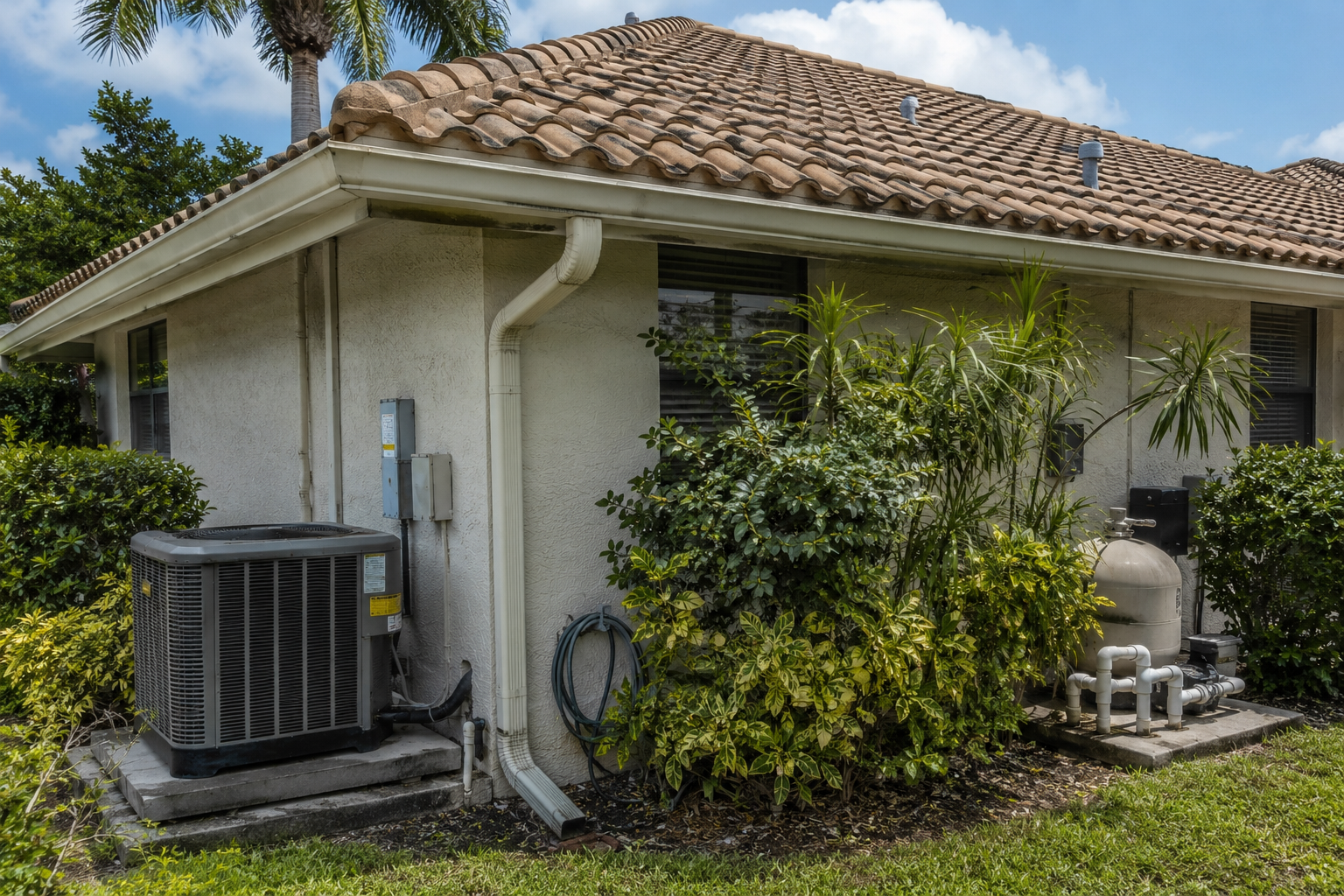
- Roof. The largest single line and the one with the widest consequences, because insurance underwriting can be materially affected by roof age and covering. Tile, shingle and flat or low-slope sections all age differently, and a property can have more than one on it.
- HVAC. Air handler and condenser, frequently installed together and frequently replaced together. Runs harder here than in most markets and rarely reaches the upper end of its nominal life.
- Water heater. Smaller, shorter-lived, and the one most likely to announce itself by failing rather than by ageing visibly.
- Electrical panel and branch wiring. Panel type and age can affect both safety and insurability. On older stock, the panel may have been upgraded while the branch wiring behind it was not.
- Plumbing supply and drain lines. Original material matters — cast iron, galvanised and polybutylene each have their own trajectory, and a re-pipe is a project rather than a repair.
- Pool and irrigation equipment. Pumps, heaters, control systems and valves. Short cycles, moderate cost, and easy to defer until several arrive at once.
- Exterior envelope. Paint, sealant, windows, doors and any shutters or impact glazing. The line that South Florida's climate acts on most continuously.
On acreage properties in Wellington, Loxahatchee and The Acreage, add two more that the house itself does not have: the well system, with its own pump and testing schedule, and the septic system, whose drainfield has a service life and whose capacity relates to bedroom count and occupancy.
Can you put a date on all seven?
Most owners can date two or three with confidence and are guessing at the rest. The gap between those two groups is where a ten-year projection goes wrong — and closing it is a records exercise rather than a decision.
How South Florida Changes the Arithmetic
National service-life figures are a starting point and consistently optimistic here. The climate is not a backdrop to ownership in this market; it is a mechanism acting on the building continuously.
Salt air, humidity and heat run exterior paint, HVAC, pool equipment and irrigation on shorter cycles than an owner arriving from a drier climate tends to expect. Coastal exposure compounds it — properties in Jupiter and Juno Beach carry corrosion questions on railings, fasteners, exterior hardware and cooling equipment that inland properties in Royal Palm Beach or Greenacres do not face in the same degree. Hurricane preparation is an annual operational cycle rather than an occasional event, and it puts recurring demand on shutters, glazing, tree work and drainage.
Then there is the convergence problem, which is the part most owners have not modelled. Some owners who purchased between 2000 and 2010 can face overlapping replacement cycles, because components installed around the same time may reach end-of-life around the same time. When roof, air handler and pool equipment land inside the same eighteen months, a figure that looked manageable spread across a decade arrives as one concentrated year — and it tends to arrive without warning, because nothing was individually overdue.
Local regulation can also change what a replacement involves. In Delray Beach, a property inside one of the locally designated historic districts follows a different approval path for exterior work than for interior work — which means a roof or window replacement there is a permitting question as well as a contracting one. Across the older stock in Lake Worth Beach and the earlier construction layers of Royal Palm Beach, original-material questions on supply lines and panels come up more often than they do on newer construction. In Palm Springs, homes in the original village core are approaching seventy years old, and the questions there are specific rather than general.
Worth keeping distinct, because they get compressed: the building authority with jurisdiction determines what may be done and holds the permit record. An association's architectural review, where one exists, is a separate approval with its own standards and calendar. The Palm Beach County Property Appraiser administers assessed value, exemptions and portability and does not hold permit history or determine what work is permitted. Three bodies, three functions, and an answer from one is not an answer from the others.
Building the Ten-Year Picture
The method is straightforward. It is the doing of it that most households have never done.
Establish the dates, and label how you know each one. Pull the permit history from the building authority with jurisdiction, then add anything you have receipts or warranties for. Every component ends up in one of three states, and keeping them separate is what makes the exercise worth doing:
Documented — a permit, receipt or warranty gives you an actual date. Use it.
Estimated — no document, but something supports a reasonable range: an inspection report from your purchase noting the component's age, a contractor's assessment, a manufacturer's date plate. Record the date and mark it estimated.
Unknown — no record and nothing to estimate from. Record it as unknown. Do not assign it an age.
That last state is the one most methods get wrong, and it matters here because the dates feed a projection. A component whose age you cannot establish is not an old component; it is an undated one. Writing "original to the structure" into the ledger converts an absence of evidence into a fact, and the projection then carries a number nobody actually knows.
What you can do with an unknown is model it. Run a separate scenario in which the undated components are assumed to be at or near end of life, and see what that does to the ten-year picture. If the scenario changes nothing material, the unknown can wait. If it changes the picture significantly, that component has just become the one worth paying an inspector to assess — which is a far more useful result than a guess dressed as a date.
Place each system on its cycle. For each of the seven, work out roughly how much service life remains. Where you are unsure, a licensed contractor in that trade can assess it, and a general home inspector can cover several at once. This is where estimate becomes evidence.
Price the ones inside the horizon. Current local replacement costs from licensed contractors, not national averages. Anything landing inside ten years belongs in the picture.
Look for convergence. Lay the dates out and see what clusters. Two or three large items in the same eighteen months is the finding that changes planning most, and it is invisible until the dates are on one page.
Check the second-order effects. Roof age connects to insurance underwriting. Panel type can connect to insurability. A re-pipe may affect what else is worth doing while walls are open. These interactions are where a component-by-component list becomes a plan.
What we've seen repeatedly across Palm Beach County is that the component causing the most difficulty is rarely the one an owner was watching. It is the one nobody had a date for.
What the finished picture does is worth being precise about. It does not tell a household what to decide. It removes a specific kind of uncertainty — the sense that something is always pending without knowing what or when. Some owners find the emotional burden of a property becomes more significant than the financial one, and the mental overhead of anticipating what needs attention next accumulates in ways that do not show up on a balance sheet. A dated picture converts that background hum into a list, and a list can be planned against.
It also makes the housing question answerable. A household that knows what staying requires over ten years can weigh that against what adapting would cost and what moving would involve. Without the dates, staying looks free and everything else looks expensive — which is not a comparison. And in some transactions that became difficult, a pattern we have seen is that the decision was delayed past the point where every option was still available, often because a system failure forced a timeline nobody had chosen.
Frequently Asked Questions
The permit record has gaps. What do I do about the systems it does not cover?
Gaps are normal, particularly on older properties and for work that predates digital records. Fill what you can from your own receipts, warranty paperwork, and any documents from your purchase — inspection reports from the time you bought frequently note component ages, and a manufacturer's date plate on equipment is often still legible. Anything you can support that way is an estimated date and should be labelled as one.
What remains after that is genuinely unknown, and the useful thing is to leave it that way rather than assigning it an age. Then run the unknowns as a scenario: assume they are at or near end of life and see whether that changes the ten-year picture materially. If it does, you have identified exactly which component justifies paying a licensed inspector or the relevant trade contractor to assess — which is a more efficient use of an inspection than a general one. A gap in the record is also worth noting for its own sake, since unpermitted work can surface at inspection or in an insurance question later.
Is it worth replacing something before it fails?
That depends on the component and on factors outside the component itself, which is why it is worth mapping the second-order effects. Roof age, for instance, can affect insurance underwriting and eligibility, so the replacement decision may involve a licensed insurance professional's input alongside a roofing contractor's — the two answers together tend to be more useful than either alone. Emergency replacement also generally costs more than planned replacement and removes any choice about timing or contractor. Whether that tradeoff is worth it for your situation is a judgement that belongs to you, with the relevant professionals supplying the inputs.
We are probably moving within a few years. Does this still matter?
It matters differently, and arguably more. Buyers and their inspectors will establish these dates regardless, so knowing them first means you are not learning about them during a negotiation. It also informs what is worth addressing before a sale and what is better left for a buyer to price — a question worth working through with an advisor rather than deciding on instinct, since the answer varies by component and by what the property is competing against. A household that has the picture is negotiating; one that does not is reacting.
Owners tend to think about a house in terms of what it currently is. A house is better understood as a set of components at different points in their lives, each with a date attached, most of which nobody has written down. The question is not whether the property will ask something of you over the next ten years — it will. The question is whether you would rather find out on your own schedule or on its. If you would like help assembling that picture, a practical conversation is a reasonable place to begin.
Resources Directory
Related reading
- Staying, Adapting, or Moving: The Five Housing Paths
- When Staying Is the Right Answer
- Is This a Decision for Now, or a Decision for Later?
- Having the Conversation Without Taking Over
- What This House Actually Costs to Keep
- What Adapting a Home Actually Involves
- Location, Access, and the Things You Cannot Change Later
- Sequencing a Move When There Is No Deadline
- Who Belongs in This Decision, and in What Order
- Palm Beach County Home Value Assessment
Guidance by community
- Wellington
- Boca Raton
- Lake Worth
- Boynton Beach
- Royal Palm Beach
- Loxahatchee
- Palm Beach Gardens
- Delray Beach
- Jupiter
- Greenacres
- West Palm Beach
- Palm Springs
- Juno Beach
- Port St. Lucie
- Stuart
- The Acreage
About the Authors
Chris and Sue Kull have spent more than three decades working with South Florida families through property decisions across Palm Beach County and the surrounding communities. Their focus is on making the structure of a decision visible early, so the household weighing it can choose on its own terms.