What This House Actually Costs to Keep
Ask most long-tenured owners what their house costs and you will get a confident answer that is roughly half the real figure. Not because anyone is being careless — because the number they have in mind is the one that arrives on a predictable schedule, and a good deal of what a house costs does not.
The mortgage is fixed or gone. Taxes come annually. Those feel like the cost of the house. Meanwhile insurance has moved, the association raised dues twice and passed an assessment, and there is a roof that will need attention within a horizon nobody has actually named.
This piece assembles the whole figure, and then does the more useful thing: it separates the lines that stay level from the lines that climb. Those are different kinds of obligation, and confusing them is what makes a ten-year projection wrong. If you are working through the broader question of whether the house still fits, our five housing paths framework covers where this fits in.
Why the Monthly Number Is Not the Carrying Figure
The monthly number is a payment. The carrying figure is what it costs to own the property for a year, averaged across the things that do not happen every year.
The distinction matters because the items that fall outside the monthly rhythm are the ones with the largest amounts attached. A roof does not appear in a monthly budget until the month it does. Neither does a special assessment, an air handler, or a re-pipe. Excluding them does not make them optional — it makes the figure wrong by a margin that grows as the property ages.
There is also a psychological reason the monthly number persists, and it is worth naming. Some owners find the emotional burden of a property becomes more significant than the financial one — the mental overhead of anticipating what needs attention next accumulates in ways that do not show up on a balance sheet. A household carrying that overhead often has a fairly accurate instinct that things have got heavier, without a figure to attach to it. Assembling the number tends to be less about discovering bad news than about giving an existing instinct something to sit on.
The Six Lines of a Carrying Figure
Every long-owned property has the same six. What differs is which ones are moving.
The Six Lines of a Carrying Figure
- Debt service. Mortgage principal and interest, or nothing if the property is owned outright. Level or absent.
- Ad valorem taxes. Based on assessed value as established by the Property Appraiser, at rates set by the county, the municipality where applicable, the school district and any other taxing authority. Constrained on a homestead by the Save Our Homes cap.
- Non-ad valorem assessments. District charges that are not based on property value at all — stormwater, solid waste, streetlights, improvement district assessments. These appear on the same bill and behave nothing like the line above.
- Insurance. Homeowners, plus flood as a separate policy where applicable, plus wind where separately written.
- Association obligations. Regular dues, plus any special assessment, plus whatever the reserve position implies about future assessments.
- Operating and replacement. Utilities, lawn and pool service, pest control, routine repair — and the annualised cost of major systems that will need replacing, whether or not you are setting money aside for them.
The sixth line is the one most households leave out entirely, and it is frequently the largest. A roof with eight years left is costing you something every year whether you write it down or not.
Can you fill in all six lines for your property?
Most households can do four from memory and have to look up two. Knowing what the property would realistically be worth is the other half of that picture — the two figures together are what make any comparison meaningful.
Which Lines Accelerate, and Why
Three of the six behave predictably. Three do not, and the difference is where a ten-year projection is won or lost.
Insurance is the line that has changed character. For some South Florida owners it has become a bigger part of the ownership decision than it was five years ago — occasionally the carrying-cost conversation now starts there rather than with mortgage or taxes. Underwriting can be materially affected by construction age, roof age and covering, and wind mitigation features, which means this line is tied to the condition of the building rather than to anything about the household. On an older roof, the insurance line and the replacement line are not independent of each other; they are the same conversation arriving from two directions.
Association obligations move in steps rather than curves. Dues rise gradually; assessments arrive whole. What makes this line hard to project is that the signal is in the reserve position and the assessment history rather than in the current dues figure. A community with low dues and a thin reserve is not cheaper — it is deferring, and the deferral has a date on it even if nobody has announced one.
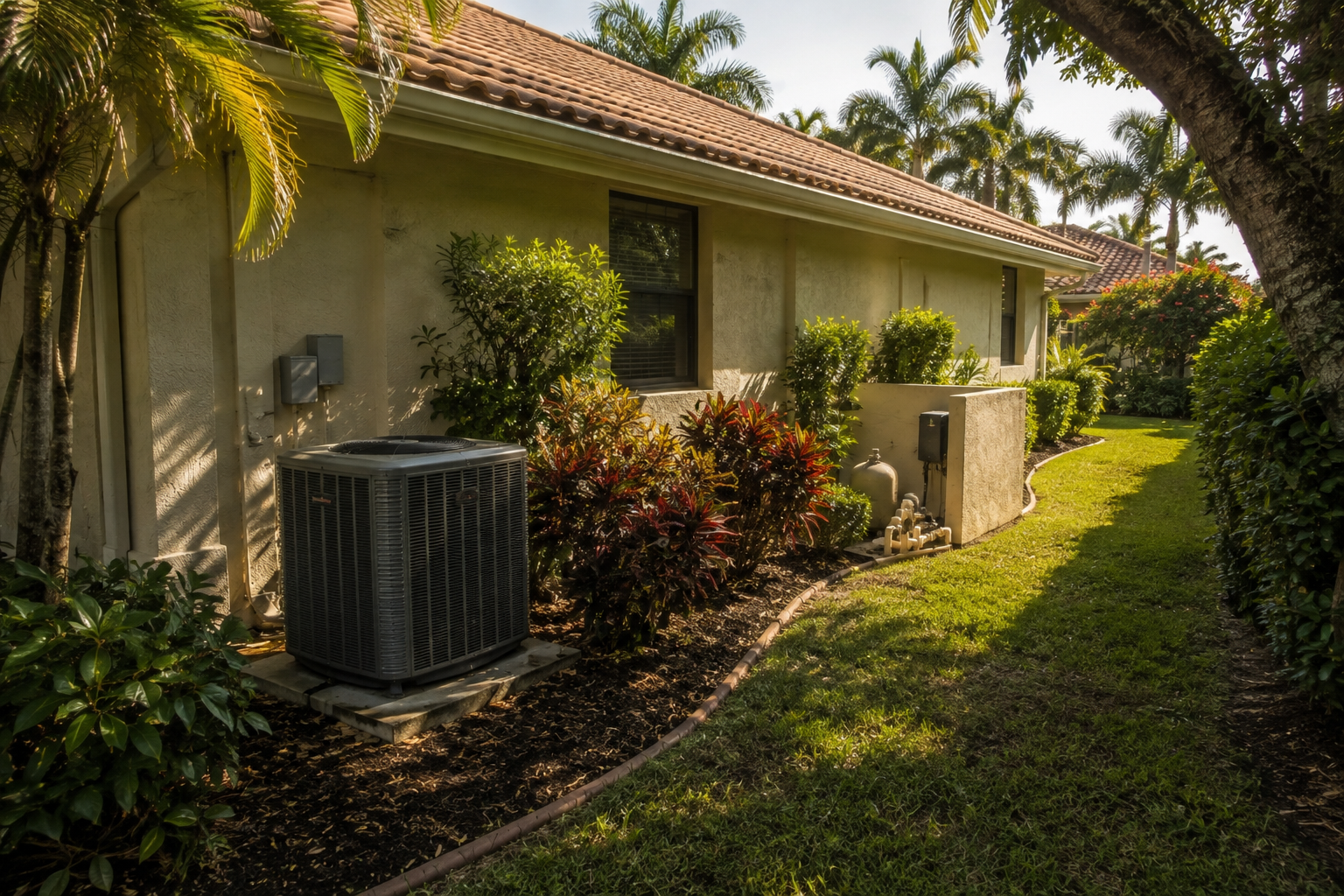
Replacement is the line that compounds. South Florida runs exterior paint, HVAC, pool equipment and irrigation on shorter cycles than an owner moving from a drier climate might expect, and hurricane preparation is an annual operational cycle rather than an occasional event. Some owners who purchased between 2000 and 2010 can face overlapping replacement cycles, because components installed around the same time may reach end-of-life around the same time. When roof, air handler and pool equipment converge inside eighteen months, the annualised figure that looked manageable across a decade arrives as a single very concentrated year.
A note on how to date any of this: the year the property was purchased establishes nothing about when a specific component was installed. Components get replaced before a sale, after one, or deferred past their expected cycle. Installation records and permit history are what answer it, and both are obtainable.
The non-ad valorem line deserves a separate mention because it is genuinely confusing. In parts of Palm Beach Gardens, properties fall within an improvement district organised into Units of Development, where the district states plainly that assessments are not based on the value of the property. In Wellington, drainage and roads run through a dependent district of the Village with its own assessment. In Royal Palm Beach, the Village maintains its roadway and canal network directly through Public Works. Three different structures, three different lines on a tax bill, none of which move when assessed value moves.
Utility provider varies too. Lake Worth Beach has operated a municipal electric utility since 1914, and its service territory does not follow the city limits. In Boynton Beach, the city's utility serves customers well past its municipal boundary while stormwater service stops at the line. Which provider serves a specific address is worth confirming rather than assuming, particularly if you are comparing two properties.
Worth keeping distinct throughout: the Palm Beach County Property Appraiser establishes assessed value and administers exemptions and portability. The county, the municipality where applicable, the school district and other taxing authorities set their own millage rates. Special districts levy non-ad valorem assessments on a different basis entirely. The Appraiser establishes the value; it does not set the rates, and it does not levy the district assessments.
What the Figure Tells You Once You Have It
Assembling six lines takes an afternoon. What it produces is not a verdict.
What we've seen repeatedly across Palm Beach County is that when a household finally assembles the whole figure, the surprise is rarely the total. It is which line has been growing while nobody was watching it — and how long that has been true.
For some owners, rising ownership costs do not become a problem all at once; pressure accumulates gradually, and looking back, a few realise they had been weighing a change for longer than they had assumed. A complete carrying figure tends to make that visible in a way that a monthly payment never does, which is most of its value.
The figure also does something specific for the decision itself. It makes staying comparable to the alternatives — because a household that knows what remaining costs over ten years can weigh that against what moving costs once, and against what adapting costs and what it would change. Without the figure, staying reads as free and every other path reads as expensive, which is not a comparison so much as a default.
What it does not do is tell you what to choose. Some owners become equity-rich well before they feel ready to use that equity, and financial and emotional readiness can operate on different timelines. A carrying figure will not close that gap, and applying more arithmetic to it tends not to help. It simply removes the excuse that the numbers are unknown.
Frequently Asked Questions
How do I estimate the replacement line without a home inspection?
Start with dates rather than condition. Pull the permit history for the property and locate installation records for the roof, air handler, water heater and electrical panel. That establishes where each component sits in its cycle. From there, current local replacement costs are obtainable from licensed contractors, and dividing each by its remaining years gives a workable annual figure. That is an estimate rather than an inspection — an inspector or the relevant licensed contractor is who confirms actual condition, and worth engaging before any large decision rests on it.
Our association dues seem reasonable. Is that enough to go on?
Not by itself. Current dues describe what the community is collecting now, not what it will need. The reserve study and reserve funding position, the assessment history over the past several years, and any capital work the board has discussed but not yet funded are the parts that indicate what is coming. Those documents are available to owners, and the association is the right source. Where the stakes warrant, an attorney is the appropriate professional to review governing documents rather than a real estate advisor.
Insurance went up sharply. Is there anything to do besides pay it?
Possibly, and it is worth asking a licensed insurance professional about the specifics on your address. Underwriting can be materially affected by roof age and covering and by wind mitigation features, which means physical changes to the property can change the quote — and it also means that a roof replacement you were treating purely as a maintenance cost may have a second effect on a different line. Requoting rather than renewing automatically is a reasonable habit; the pricing and eligibility questions themselves belong with the insurance professional.
Owners tend to describe the cost of a house as a number, and it is closer to a slope. The question that matters over a ten-year horizon is not what the property costs this year — it is which of the six lines are pointed upward and how steeply. Most households can answer that in an afternoon and have simply never been asked to. If you would like to work through what that means for your situation, a practical conversation is a reasonable place to begin.
Resources Directory
Related reading
- Staying, Adapting, or Moving: The Five Housing Paths
- When Staying Is the Right Answer
- Is This a Decision for Now, or a Decision for Later?
- Having the Conversation Without Taking Over
- What the House Will Ask of You in the Next Ten Years
- What Adapting a Home Actually Involves
- Location, Access, and the Things You Cannot Change Later
- Sequencing a Move When There Is No Deadline
- Who Belongs in This Decision, and in What Order
- Palm Beach County Home Value Assessment
Guidance by community
- Wellington
- Boca Raton
- Lake Worth
- Boynton Beach
- Royal Palm Beach
- Loxahatchee
- Palm Beach Gardens
- Delray Beach
- Jupiter
- Greenacres
- West Palm Beach
- Palm Springs
- Juno Beach
- Port St. Lucie
- Stuart
- The Acreage
About the Authors
Chris and Sue Kull have spent more than three decades working with South Florida families through property decisions across Palm Beach County and the surrounding communities. Their focus is on making the structure of a decision visible early, so the household weighing it can choose on its own terms.