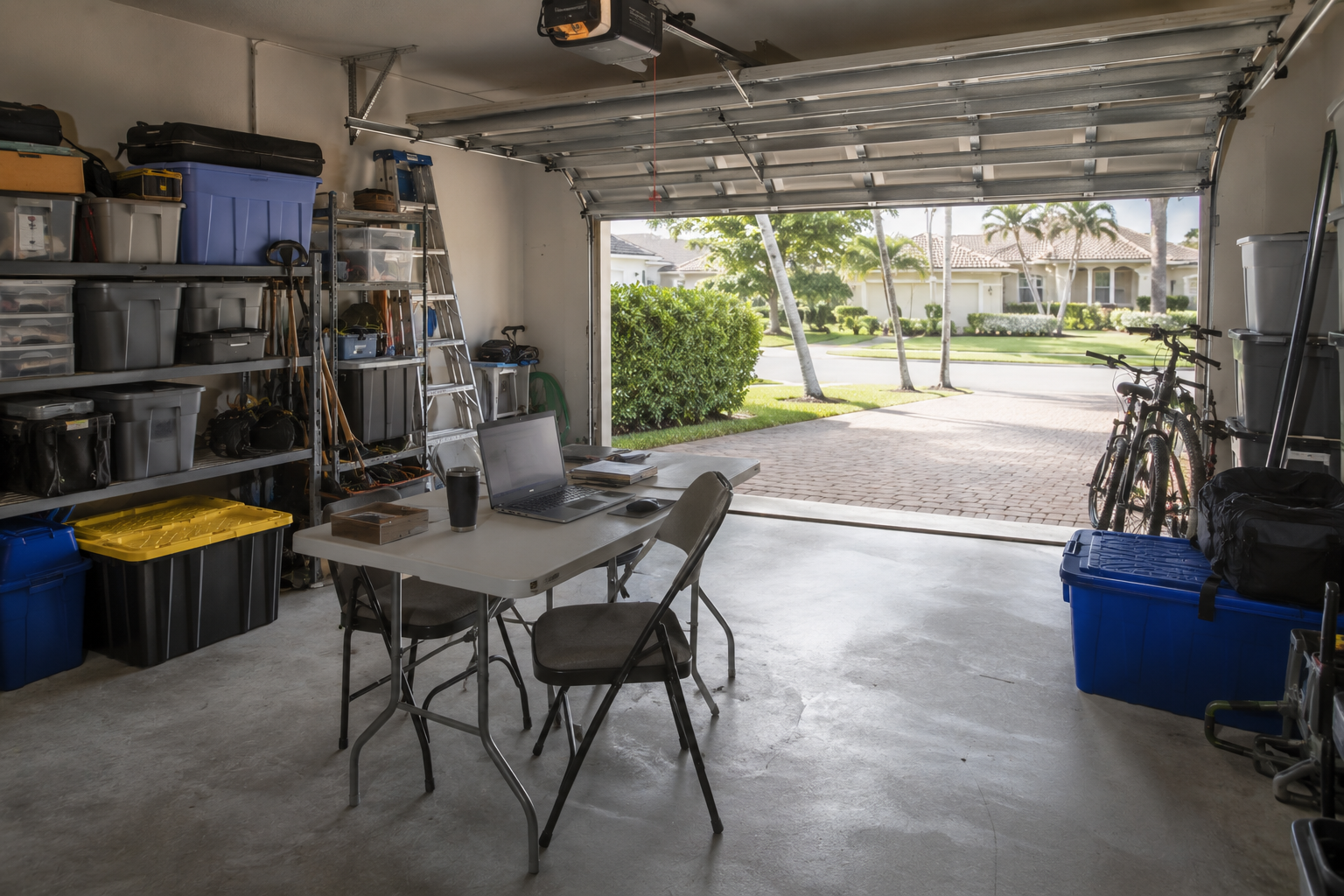
When 'We'll Just Make It Work' Becomes the Wrong Answer
Making it work is usually the right instinct. A household adapts, rearranges, absorbs a little inconvenience, and gets on with things. That flexibility is a strength, and most of the time it costs almost nothing to exercise.
The difficulty is that the phrase does not come with an expiry date. A household can say it about the third bedroom, then the garage, then the schedule, then the storage unit — and each time it is a reasonable answer to a small question. What is harder to notice is the moment when the workarounds stop being adaptations and start being the actual shape of how you live. This piece is about locating that moment honestly, in either direction. If you are also weighing who to involve in the decision, our guide to choosing the right real estate professional covers that separately.
Making Do Is Often the Right Answer
It is worth saying this clearly before anything else, because the alternative framing — that adapting is a failure to act — is both wrong and expensive.
Plenty of households adapt for good reasons and are right to. A stretch of years with a defined end. A career phase that will change. A property that suits the household in most respects and falls short in one. Moving carries real costs, and staying put while a temporary pressure passes is often the more sensible calculation, not the more timid one.
Some homeowners tell us they spent a long time feeling vaguely guilty about not having moved yet, when what they were actually doing was waiting sensibly for a reason to. In our experience the useful question is not whether you have adapted, but whether the adaptations still meet a few conditions.
The Four Conditions for Making It Work
A workaround remains a reasonable answer while these hold. When one of them stops holding, that is worth noticing.
The Four Conditions for Making It Work
- It has an end. A workaround for a defined period behaves differently from one with no horizon. If you cannot say roughly when the arrangement stops, it has become the arrangement rather than a bridge to something.
- It is not accumulating cost. Some accommodations are genuinely free. Others carry a recurring charge — storage, a rented workspace, repeated small alterations, a service you would not otherwise need. Those are worth totalling rather than absorbing one line at a time.
- It has not created a second problem. A converted garage that solved a room shortage and created a parking or storage shortage has moved the problem rather than resolved it. That is worth counting honestly.
- It is not producing recurring friction between people. Where an arrangement generates the same negotiation every week — over space, quiet, timing, or whose turn it is to work somewhere else — the cost is being paid in a currency that never appears on a statement.
All four holding suggests making do is still serving you. One or two no longer holding is worth a conversation rather than an alarm. Several no longer holding usually means the household has already made the decision without saying so out loud.
How long has the temporary arrangement been temporary?
That one question tends to be more revealing than any amount of square-footage comparison — and it is easier to answer honestly before a specific house is in front of you.
When a Workaround Starts Costing More Than It Solves
Beyond the household-level costs, some workarounds carry consequences that only surface later — usually at sale, which is the least convenient moment to learn about them.
Structural and exterior alterations generally require permits through the municipal or county building department. Enclosing a patio, converting a garage to living space, adding a room, altering electrical or plumbing — these typically fall inside permitting requirements, and the specifics vary by jurisdiction and by the nature of the work. Where a community has an association, architectural review may apply as a separate approval with its own standards and timeline. Those are two distinct processes administered by different bodies, and satisfying one does not satisfy the other.
Work completed without required permits tends to surface eventually. It can appear during a buyer's inspection, in an appraisal where unpermitted square footage may not be credited, in a title or disclosure context, or in an insurance question after a claim. Resolving it afterward can involve retroactive permitting, inspection, and sometimes reversal of the work. A conversion that solved a space problem for several years can become a transaction problem in a single week.
There is a marketability layer too. Some workarounds reduce the pool of buyers who find the property suitable — a garage converted without a replacement for parking or storage, a bedroom created by dividing a larger room, a patio enclosure that changed how the house lives. None of that makes the workaround wrong. It does mean the cost of the adaptation includes something that will be paid later.
One pattern we consistently observe when families finally stop making do: the accumulated spend on workarounds is often larger than anyone had added up, and in our experience the surprise is rarely the size of any single item. It is that nobody had ever put them on the same page — the storage, the alterations, the service that exists only because the house does not quite work. Totalling them is uncomfortable and usually clarifying.
What Changes If You Decide It Is Time
Concluding that the workarounds have run their course does not mean acting immediately. It means the question shifts from whether to how, and the how is more manageable than most households expect.
The practical sequence starts with establishing facts rather than looking at listings. What your current home would contribute. What the carrying picture looks like on a property that actually fits. Whether any unpermitted work on your current home needs addressing before it becomes a negotiation point — a question worth raising with the building department and, where an association is involved, with management. That is preparation rather than commitment, and it can be done without a decision attached.
There is a timing layer worth naming as well. For some households the space question surfaces alongside higher ownership costs or an approaching system expense on the current home. When that happens, the comparison is not simply between staying and moving — it is between two sets of costs, one of which you already know intimately.
The verification work does not change much by location. A household in Wellington, Boca Raton, Boynton Beach, Lake Worth or Royal Palm Beach faces the same sequence — check permit history on any completed work, establish what the current home would realistically contribute, quote the carrying picture on a specific candidate property, and confirm any association requirements — even though what those checks return will differ property by property. Our overview of the preparation that comes before listing covers the first half of that, and a Palm Beach County home value assessment establishes the starting figure.
Each piece of this sits with someone: the building department for permit history, an insurance agent for coverage questions on altered structures, a contractor for what remediation would involve, and association management for architectural records. What helps is having someone who keeps those threads connected and identifies early where a given question belongs. Our overview of the professionals involved in a real estate decision covers who does what.
Frequently Asked Questions
What are the signs you've outgrown your house?
Look at the arrangements rather than the square footage. Useful signals include a temporary accommodation that has lost its end date, recurring costs that exist only because the house does not quite work — storage, rented workspace, repeated small alterations — a workaround that solved one problem by creating another, and the same negotiation over space or quiet happening every week. Any one of those on its own may be manageable. Several together generally indicate the household has been answering a question it has not formally asked.
When should we stop making do in a small house?
There is no fixed threshold, and anyone offering one is answering a different household's question. The more workable test is whether the adaptations still have an end, still cost little, have not generated a second problem, and are not producing recurring friction between people. When several of those conditions stop holding, the arrangement has usually shifted from a bridge to a permanent state — which is worth deciding on deliberately rather than by default. It is also worth checking whether any alterations made along the way were permitted, since that question tends to arrive later at an inconvenient moment.
What makes this decision unusual is that there is rarely a moment that forces it. A roof fails and you replace it; a lease ends and you renew or leave. Outgrowing a house produces no such event. It just becomes gradually more true while everyone continues managing around it, which is why households often look back and find the answer had been settled long before anyone said it. The question is not whether you can keep making it work. It is whether you would still choose this arrangement if you were choosing it today for the first time. If you would like to work through where your household actually stands, a practical conversation is a reasonable place to begin.
Resources Directory
Related reading
- Not Every Real Estate Professional Works the Same Way—Here's Why That Matters
- The Difference Between Selling a Home and Helping Someone Make the Right Decision
- Questions Every Buyer and Seller Should Ask Before Choosing a Real Estate Professional
- Why Major Life Transitions Require More Than a Real Estate Transaction
- The Best Real Estate Decisions Begin Long Before a Home Goes on the Market
- What Does a Trusted Real Estate Advisor Actually Do?
- The Professionals Behind Great Real Estate Decisions
- Your Real Estate Decision Doesn't End at Closing—and Neither Should Your Representation
Communities we serve
- Wellington
- Boca Raton
- Lake Worth
- Boynton Beach
- Royal Palm Beach
- Loxahatchee
- Palm Beach Gardens
- Delray Beach
- Jupiter
- Greenacres
- West Palm Beach
- Palm Springs
- Juno Beach
- Port St. Lucie
- Stuart
- The Acreage
About the Authors
Chris and Sue Kull have spent more than three decades working with South Florida families through property decisions across Palm Beach County and the surrounding communities. Their focus is on making the shape of a decision visible early, so the household weighing it can choose deliberately rather than by default.