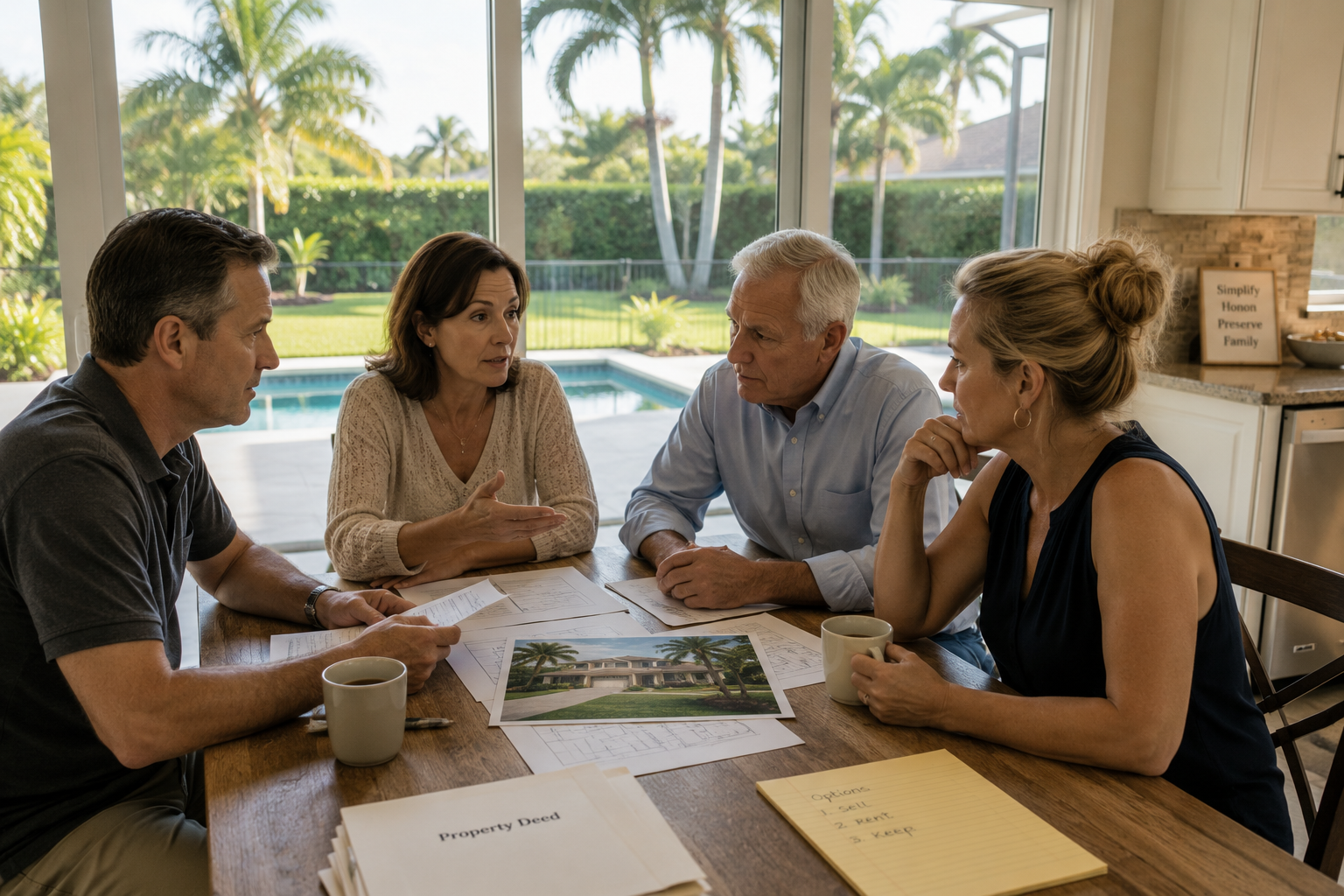
Why Heir Disagreements Are Usually About Readiness, Not Price
When heirs disagree about what to do with an inherited property, the disagreement almost always surfaces around a number. One sibling thinks the home should list at a certain price. Another thinks that number is too low. A third wants to wait. The conversation becomes about the price, and the price becomes the problem — and the real issue never gets named. What looks like a financial disagreement is usually something else entirely: one or more people who are not yet ready, and a family that has no shared language for that.
This is one of the most consistent patterns in probate real estate — and understanding it changes how families navigate the process. If you are dealing with an inherited property and the conversations keep stalling, it may be worth reading through what The Kull Group has put together for Palm Beach County families navigating probate before assuming the disagreement is about numbers.
The Price Objection Is Usually a Readiness Signal
Here is what happens repeatedly in these situations. A property comes into the estate. The heirs are notified. Conversations begin. And almost immediately, the discussion turns to value — what the home is worth, what it should list for, whether now is the right time. Those are real questions, and they deserve real answers. But they also function as a way to stay in motion without actually making a decision.
The heir who objects most strongly to a proposed list price is often not primarily concerned with the number. They are managing something else — grief that hasn't settled, a sense that selling the home means something irreversible about the parent or the childhood or the family as it existed. The price objection gives them a legitimate platform to slow the process without having to say any of that out loud. Because saying it out loud feels vulnerable, or beside the point, or like it will be dismissed.
This is not manipulation. It is a completely understandable response to an emotionally complicated situation that arrives with legal deadlines and financial pressure attached. The problem is that when the real issue goes unnamed, the conversation circles indefinitely around the number — and no price adjustment will resolve something that isn't actually about price.
Why This Pattern Is Harder to Navigate in Florida Probate
Florida's probate process adds a specific layer of pressure that families in other states don't always face. The carrying costs on an inherited South Florida property begin accumulating from the moment the estate takes possession — and they accumulate fast. Homeowners insurance on a vacant property in Palm Beach County is categorically different from standard coverage. Properties in communities with HOA structures are generating monthly assessments that don't pause for family timelines. And the South Florida climate is not waiting either: humidity, heat, and the absence of regular occupancy create maintenance conditions that deteriorate faster than most heirs anticipate when they are sitting in another state.
In Wellington, Boca Raton, and communities throughout the county, heirs who are in no immediate financial stress individually often discover that the property itself is creating a carrying burden that none of them budgeted for. That pressure has a way of sharpening disagreements that might otherwise resolve slowly on their own — but it also has a way of hardening positions, because making a decision under financial pressure feels like surrendering to the pressure rather than choosing freely.
What we have observed across many of these situations: the heir who lives closest to the property — often the one managing vendor access, fielding HOA correspondence, handling the operational details — frequently reaches the limits of their patience faster than the heirs who are at a distance. That asymmetry of burden becomes its own source of friction layered on top of everything else.
If the conversations about your inherited property keep returning to the same disagreements without resolution, the question worth asking is not what the right price is — it is what would need to be true for everyone to feel ready to move forward.
That is a different conversation, and it tends to move faster. A probate property consultation with The Kull Group is a useful place to start it.
What Actually Moves These Conversations Forward
After working with Palm Beach County families through probate situations for more than three decades, one pattern surfaces with enough regularity that it is worth naming directly: the families who resolve heir disagreements fastest are almost never the ones who found the right price first. They are the ones who found a way to give every stakeholder the same clear information at the same time — and then created enough space for each person's readiness to catch up to the decision.
A few years ago, we worked with three siblings who had inherited a property in Lake Worth. All three were in different states. All three had different financial situations. All three had different ideas about timing. The property itself was not complicated — the valuation was straightforward, the condition was manageable, the market was cooperative. The complication was entirely about coordination: each sibling was receiving slightly different information through slightly different channels, and the gaps between those information streams were where the disagreement was growing.
What helped was not pressure. It was clarity. When all three had the same factual picture — the carrying costs, the realistic market position, what the process would actually look like — there was less room for the disagreement to sustain itself. The readiness didn't arrive instantly. But it arrived faster once the uncertainty was removed.
In Boynton Beach, Royal Palm Beach, and communities throughout the county, the same dynamic appears in different configurations. The details change. The structure doesn't. Disagreements that seem to be about price are almost always sustained by asymmetric information, unspoken readiness gaps, or both. Address those and the price conversation usually gets shorter.
What This Means for Buyers and Sellers in South Florida
For families navigating an inherited property, the most useful reframe is this: stop treating the price as the problem to solve first. The price will follow readiness. It almost always does.
The questions worth asking before the next family conversation are not "what should we list for" or "should we wait for a better market." They are quieter than that. Is everyone working from the same information, or are there gaps between what different family members understand about the property's condition, carrying costs, and realistic market position? Is someone carrying more of the operational burden than the others, and is that asymmetry being acknowledged? And honestly — is there anyone in this situation who hasn't yet arrived at a place where they feel the decision is theirs to make freely, rather than one being made for them by circumstance?
Those questions don't have fast answers. But they are the ones that, when asked directly, tend to move things forward in ways that another round of price negotiation simply won't.
The financial readiness and the emotional readiness in these situations operate on different timelines. Knowing which one is actually driving the delay is the most practically useful thing a family can establish early — because the tools for addressing each one are completely different. For sellers ultimately moving toward a decision, understanding the property's current market position gives the conversation a factual foundation to build from.
Questions Palm Beach County Families Ask About Inherited Property
We've been through this situation before — how do we keep it from happening again?
The most effective thing families can do is establish a shared information baseline before positions have time to form around different assumptions. When co-heirs are receiving the same property condition information, the same carrying cost picture, and the same realistic market assessment from a single credible source, there is less space for competing interpretations to take root. The goal isn't to rush anyone — it's to make sure the disagreement, if one exists, is actually about something that disagreement can resolve.
What if one heir genuinely wants to keep the property and the others want to sell?
This configuration is worth separating into two distinct questions. The first is financial: can the heir who wants to keep the property buy out the others at fair market value, and what does that process look like? The second is a readiness question: does that heir actually want the property itself, or do they want to preserve something the property represents — the family's access to it, a childhood connection, a sense that letting go of the house is letting go of something else? Both are legitimate situations. But they call for different conversations. Treating them as the same one is usually where families get stuck.
Keep Exploring South Florida Real Estate
If your family is navigating an inherited property in Palm Beach County — whether the conversations are early or have already become complicated — reviewing additional local resources can help create clearer perspective before decisions need to be made.
About the Authors
Chris and Sue Kull are South Florida real estate professionals with more than three decades of experience helping buyers, sellers, and property owners navigate real estate decisions throughout Palm Beach County and surrounding communities.