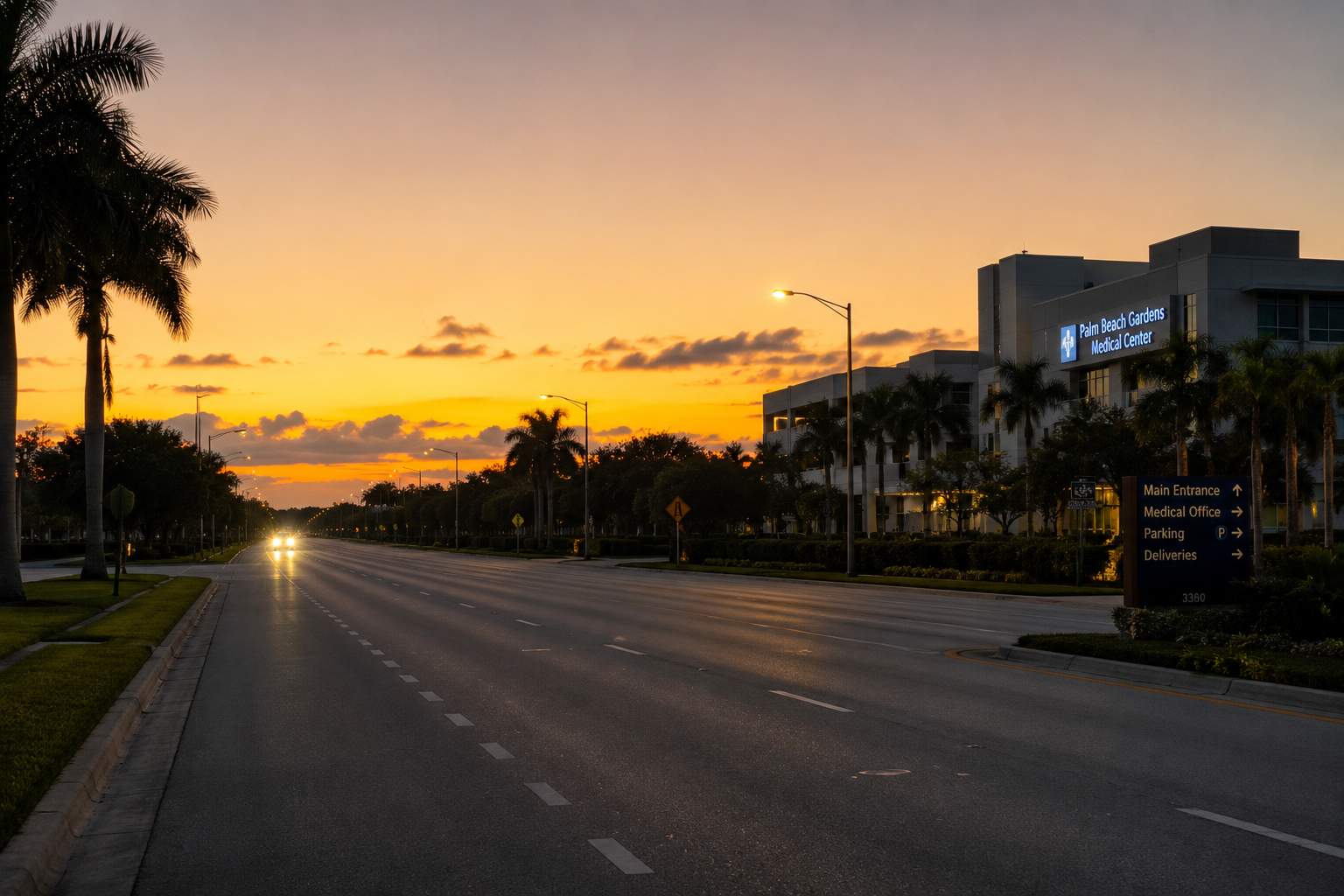
How Shift Schedules Shape Home Location Decisions for Palm Beach County Healthcare Workers
Standard buyer guidance — get pre-approved, set a price range, list what you need in a home — often gives insufficient attention to nontraditional work schedules. If you're a nurse, a tech, a respiratory therapist, or a physician working three 12-hour shifts or rotating nights, that gap matters more than it might seem. Your schedule doesn't just affect your commute. It changes which neighborhoods actually function for you day to day, in ways a Saturday-afternoon showing won't reveal.
For healthcare workers considering a move or a first purchase in Palm Beach County, the location decision is more operationally specific than most guidance accounts for — and the consequences of a poor fit may appear gradually, through recurring commute, noise, scheduling, and recovery-related friction rather than anything that shows up at closing.
Why Commute Distance Alone Doesn't Tell You What You Need to Know
A 12-hour shift starting at seven in the morning means leaving the house well before six. Traffic conditions at that hour can look very different from what the same route looks like mid-morning or in the evening. FDOT continues to evaluate and improve traffic operations, capacity, and safety on portions of I-95 and major Palm Beach County interchanges and connecting corridors. That doesn't translate into a fixed answer for any one commute, because actual travel time depends on the specific origin, destination, day, and conditions.
The more reliable approach is to test the route you'd actually be driving, at the actual hours you'd be driving it — both directions, on more than one day, ideally comparing a weekday commute to a weekend one. Use current navigation data and Florida's official FL511 traffic resources alongside personal route testing, and don't test a return commute when fatigue makes driving unsafe — a saved travel-time estimate from FL511 or a navigation app can substitute for an in-person test when driving after a long shift isn't a safe option. Crashes, construction, school schedules, seasonal traffic, and weather all shift the picture, so a single test drive on a quiet Saturday won't tell you what a Tuesday 5:45 a.m. departure will feel like. If there's any chance of working at more than one facility, it's worth testing commutes to each of the locations you might realistically end up at, not just the one you're hired at today.
Night Shift Changes What a "Good" Neighborhood Looks Like
Night-shift workers largely invert the assumptions built into how residential neighborhoods typically function. They sleep when the street is active and need their home to work as a recovery environment during hours when landscaping, deliveries, school activity, construction, or other daytime uses may be occurring nearby. That's not a countywide pattern with a fixed schedule; it varies by municipality, HOA, and property, which is exactly why it's worth checking directly rather than assuming.
Before buying, it's worth visiting a property during the hours you'd actually be trying to sleep, asking about nearby schools, commercial uses, and any documented landscaping, construction, or collection schedules, and reviewing the association's governing documents for anything relevant. Bedroom position, distance from a commercial corridor, and how much daytime noise reaches the house are all things you can observe directly rather than guess at.
Window treatments are worth checking specifically: review any association rules affecting exterior-facing shutters, tinting, or window alterations, and evaluate whether the bedroom can actually be darkened effectively within those rules before assuming it can.
If standard buyer guidance doesn't account for your shift schedule, important location variables may be missing from the evaluation.
The location variables that matter most for healthcare workers in Palm Beach County rarely surface in a conventional home search. Before narrowing neighborhoods by price and square footage, it's worth talking through how your specific schedule shapes which locations will actually work for you. Talk with The Kull Group about healthcare worker location strategy in Palm Beach County.
What Deserves Extra Attention in This Market
Mileage alone is an unreliable measure of commute burden in Palm Beach County. Actual travel windows should be tested rather than assumed, and major corridors carrying heavy traffic don't always have alternative routes offering equivalent travel times for every origin and destination — that varies by property, so it's worth checking for your specific situation rather than relying on a general rule.
Florida's property-insurance environment adds an important local layer to affordability and due diligence. Construction date and documented wind-mitigation features may affect insurance options or pricing, but the effect is property-, carrier-, inspection-, and policy-specific. Seek property-specific insurance guidance as early as practical — ideally before relying on a monthly ownership budget or allowing the applicable due-diligence period to expire. For buyers balancing housing costs with other financial obligations, an insurance estimate obtained late in the process can materially change the monthly ownership picture.
South Florida's climate is a real factor in property condition, and it affects exterior materials, roofing, HVAC systems, and pool equipment differently than in many other regions. Rather than estimating deterioration or system sizing without inspection, this is exactly the kind of thing qualified inspectors, HVAC contractors, and other specialists are positioned to evaluate directly — and worth building into the due-diligence period rather than assuming based on a home's price point or age.
The Shift-Fit Test
Instead of relying on general assumptions about a neighborhood, it's worth working through the same questions systematically for any property you're seriously considering:
- Actual commute windows — test both directions, at the real hours of your shift, more than once.
- Recovery environment — assess daytime noise, light, and bedroom position if you work nights.
- Employer flexibility — if a facility change or travel contract is plausible, compare access to more than one likely work location.
- Total ownership cost — get lender, insurance, association, and property-specific numbers rather than estimating.
- Property condition and maintenance — use qualified inspectors and specialists to evaluate relevant systems and conditions rather than relying on general assumptions.
- Household fit — account for any other commuters, caregiving responsibilities, or daily obligations in the household.
One pattern we often see: working through commute and recovery-environment testing before making an offer can surface practical concerns that price and distance alone may not reveal.
A real estate advisor can help organize the location, property, association, and commute considerations above. Actual travel times should be independently tested; insurance pricing and eligibility belong with a licensed insurance professional; structural and mechanical condition belongs with qualified inspectors and contractors; financing belongs with your lender; and employment decisions remain yours to make.
What This Means For You
If you're a healthcare worker in Palm Beach County — relocating here or renting while you get established and now ready to buy — the location decision benefits from more specific evaluation than most buyer guidance accounts for. The questions worth asking before narrowing a search: What does your actual commute look like at the exact hours you'd drive it? If you work nights, what is a given property like between roughly seven and eleven in the morning? What does a property-specific insurance quote actually look like for homes in your price range? Does the HOA have rules that could create friction for a schedule that doesn't look like Monday-through-Friday daytime?
None of these questions disqualify a location — they sharpen it. Some relocating buyers tell us that renting or spending time in an area before purchasing gave them a clearer read on whether it would actually work for their schedule. The goal isn't a home that looks good on a Saturday showing; it's one that still works eighteen months in, once the daily routine is all that's left. That calculation starts with your schedule, not your price range.
Frequently Asked Questions
Does it matter whether I'm closer to one hospital system versus another if I might change employers?
It's worth weighing, but it doesn't need to dictate the decision. Several major facilities — including Wellington Regional Medical Center, HCA Florida JFK Hospital, and Bethesda Hospital East and West in Boynton Beach — are spread widely enough across the county that a location built around one employer can mean a meaningfully different commute to another. If a system change or travel contract is plausible in the next few years, comparing your commute to more than one likely employer before buying is a reasonable way to build in some flexibility.
I work three days a week. Does commute distance matter as much as it would for someone working five?
The math is different, but the effect isn't necessarily smaller. Three 12-hour shifts still mean three commutes, and they land at the edges of the day — often when you have less energy to absorb a difficult drive than a standard daytime commuter would. Testing your actual route at your actual shift times is the most reliable way to know what that trade-off looks like for you specifically.
Are there areas of Palm Beach County that tend to work better for healthcare workers?
It depends more on your specific commute and schedule than on any one area being broadly "better." The more reliable approach is to identify the facilities you're likely to work at, test actual commute times to each from the properties you're considering, compare total ownership costs including a property-specific insurance quote, and review each community's association rules against your schedule. A property that works well for a day-shift worker with one likely employer may not work the same way for a night-shift worker weighing two.
For healthcare workers navigating this market, the location decision benefits from more specific evaluation than standard buyer guidance typically provides. The Kull Group helps Palm Beach County healthcare professionals evaluate the location and timing variables that standard home searches may underweight. If you'd like to work through what your options look like given your schedule, your employment situation, and this market's realities, that's a conversation worth having before the search narrows.
About the Authors
Chris and Sue Kull lead The Kull Group, bringing more than 30 years of combined South Florida real estate experience to homeowners and buyers across Palm Beach County.