West Palm Beach, FL Real Estate: What Living Here Actually Feels Like Before You Commit
Most people who end up in West Palm Beach didn't start there. They started somewhere else in Palm Beach County — maybe they were circling Jupiter or Palm Beach Gardens to the north, or weighing Boca Raton to the south — and West Palm kept surfacing as the comparison point. That pattern says something worth paying attention to. This is the city people use to calibrate everything else in the county, and yet it's consistently the city people understand the least accurately before they move in.
West Palm Beach is urban in a way most of Palm Beach County simply is not. It's not urban in the way Miami or Fort Lauderdale are urban, but it carries the friction, the energy, and the ownership tradeoffs of a real city center — which matters enormously depending on what stage of life you're in, what kind of daily pace you actually want, and how much of your week you're prepared to spend managing the logistics that come with that density.
After more than three decades of helping buyers and sellers throughout Palm Beach County, one thing stands out about West Palm Beach decisions specifically: the gap between what people imagine before they commit and what they discover after they've closed is wider here than almost anywhere else in South Florida. Understanding why that gap exists — and how to close it before making a decision — is what this piece is for.
The Urban Texture Most Buyers Don't Anticipate
Clematis Street and the downtown waterfront don't fully explain what it feels like to own property here. What actually shapes daily life in West Palm Beach is the way urban density creates ownership friction at ordinary moments — navigating parking near CityPlace on a Friday evening, the ambient noise level in neighborhoods that sit close to the downtown corridor, or the way traffic on Okeechobee Boulevard changes your morning routine depending on exactly where your home sits relative to it.
None of that is inherently bad. For people who genuinely want walkability, cultural programming, and proximity to dining and arts without a thirty-minute drive each way, West Palm delivers in a way very few Palm Beach County cities can. But one pattern we've observed repeatedly is that buyers are drawn to downtown imagery long before they've honestly evaluated whether they actually enjoy urban living day to day. The waterfront looks extraordinary from a distance. It's also a working city center with real urban rhythms, and those rhythms follow you home regardless of which neighborhood you're in.
This ownership friction tends to be most pronounced for buyers arriving from suburban environments — Jupiter, Palm Beach Gardens, Wellington — who are attracted by what West Palm Beach offers culturally but haven't stress-tested whether urban lifestyle alignment is genuinely compatible with how they move through the world. The discovery that it isn't usually comes three to six months after closing, not before.
Neighborhood Identity Premium: Why West Palm Beach Isn't One Market
West Palm Beach is not one experience. It's several stacked within a few miles of each other, and landing in the wrong neighborhood for your life creates a kind of low-grade dissatisfaction that's difficult to name but easy to feel.
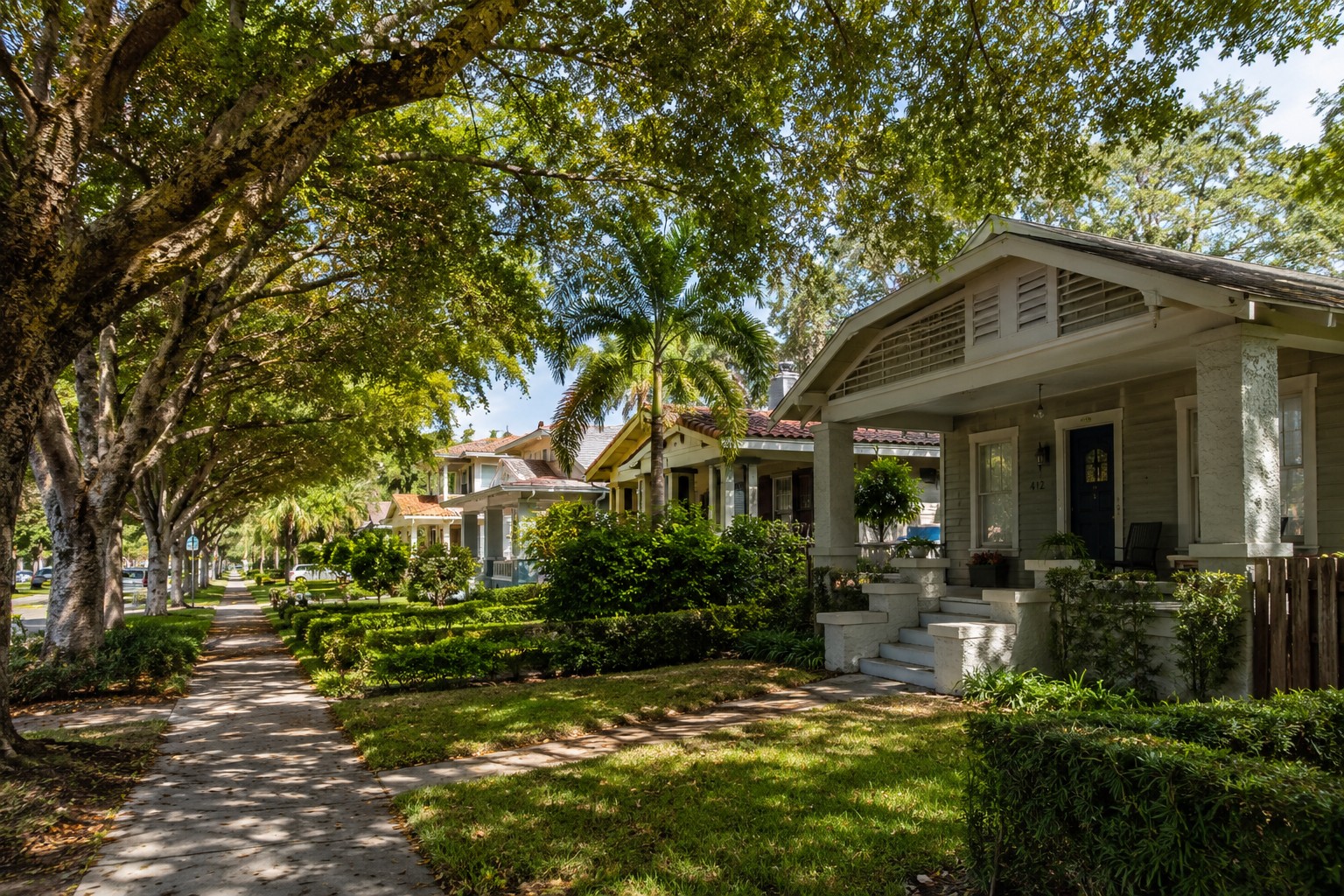
El Cid and Flamingo Park draw buyers who want architectural character that newer construction elsewhere in the county simply cannot replicate — bungalows, mature tree canopy, historic district designation, and a neighborhood identity premium that holds value with a specific buyer profile. That premium is real, but so are the ownership realities beneath it: maintenance cycles on older structures, update costs that compound over time, and an insurance environment that has become meaningfully more complicated for pre-code Florida homes.
SoSo — South of Southern — has attracted sustained renovation energy over the past decade, and values there have tracked accordingly. Northwood Village carries its own identity: arts-adjacent, independently commercial, with a street-level texture that feels genuinely distinct from anything in the county's more polished corridors. For buyers who prioritize neighborhood identity over neighborhood polish, these pockets offer something that can't be found in planned communities further north or west.
Further west toward Military Trail and the Turnpike corridor, the character shifts considerably. Those communities feel suburban — more like Greenacres or Lake Worth in daily texture — and pricing often reflects the tradeoff. Buyers who want the West Palm Beach address without the downtown intensity sometimes settle in these areas, but they frequently find they've also traded away the walkability and urban energy that justified the city's appeal in the first place.
For anyone comparing neighborhoods within the city, browsing by area helps make the pricing spread and property type differences concrete before narrowing a search.
Explore Homes by City
If you're comparing areas, home types, or neighborhood environments, browsing homes by city can help put pricing and location tradeoffs into perspective.
Explore Homes by CityWhy West Palm Beach Has Been One of Palm Beach County's Most Misunderstood Markets
For years, West Palm Beach occupied an awkward position in Palm Beach County's market narrative — overshadowed by the island to its east and outpaced by the suburban growth engines to its north. That dynamic has shifted meaningfully, and the forces behind the shift matter for anyone evaluating the city's long-term ownership trajectory.
Brightline's downtown station changed the city's geographic equation in a way that took time to fully register. A buyer who lives within reasonable distance of the station isn't just buying into West Palm Beach — they're buying access to Miami, Boca, and Fort Lauderdale in a way that reframes what "location" means in practical terms. That connectivity premium gets priced into certain pockets of downtown and near-downtown real estate, and it's not going away.
The remote-work migration wave that reshaped South Florida broadly between 2020 and 2023 brought a specific buyer profile to West Palm Beach: research-oriented, lifestyle-motivated buyers from the Northeast — New York, New Jersey, Connecticut, Massachusetts — who were accustomed to urban living and actively seeking it in a lower-tax, warmer environment. That migration accelerated demand in walkable, character-rich neighborhoods and created price compression in areas that previously had more inventory breathing room. Many of those buyers landed well. Some discovered that South Florida's version of urban living carries its own friction that didn't appear in the research phase.
Historic inventory constraints have also shaped the market in ways that aren't immediately obvious. West Palm Beach has a finite supply of genuinely distinctive historic properties in desirable neighborhoods. That scarcity creates a different demand dynamic than what exists in cities with more land available for new development. Buyers waiting for a specific combination of neighborhood, property type, and price point in El Cid or Flamingo Park can find themselves waiting considerably longer than they anticipated — which itself is market information worth understanding before anchoring a search to that target.
Insurance pressure has complicated the ownership calculus for older properties more sharply here than in newer suburban communities. That's not a reason to avoid West Palm Beach, but it is a material factor in how total ownership cost compares to alternatives — and it's one that some buyers only fully absorb after they've received their first renewal notice.
What Migration Patterns Reveal About Geographic Fit
The buyer profile arriving in West Palm Beach from outside South Florida has evolved. Earlier waves of Northeast migration leaned toward retirees and seasonal residents. The more recent wave has skewed younger — working professionals, families with school-age children, remote workers with flexible schedules — and that demographic shift has created different demand patterns, different neighborhood priorities, and different friction points.
One pattern we've observed repeatedly among Northeast relocators is that buyers who come from genuinely urban environments — Manhattan, Brooklyn, Boston proper — tend to adapt to West Palm Beach's downtown texture more quickly and more comfortably than buyers who describe themselves as "from New York" but actually lived in suburban Westchester or northern New Jersey. The self-identification doesn't always match the lifestyle reality, and the gap matters when evaluating geographic fit for a city with West Palm Beach's particular density level.
Buyers arriving from the Midwest or from car-dependent Southern cities frequently underestimate how much walkability will matter to them once they're living here. Several buyers have described the same experience: they bought further west to save on price, then spent a year driving to the urban experiences they'd moved to West Palm Beach for, then wished they'd prioritized proximity differently. Walkability often becomes more valuable after ownership than buyers expect before purchase — which is a pattern worth building into the decision architecture before closing, not after.
Lifestyle migration, as a broader category, tends to succeed most clearly when buyers have been honest about which specific lifestyle elements they're actually trying to access and how often. West Palm Beach's appeal is most durable for buyers who want regular, not occasional, access to what the city offers.
Patterns We've Observed Among West Palm Beach Buyers
After working with buyers throughout Palm Beach County for more than three decades, certain West Palm Beach decision patterns appear consistently enough to be worth naming directly.
Buyers relocating from major Northeastern cities adapt to West Palm Beach's downtown energy more readily than almost any other buyer profile. The urban texture feels familiar in a way that doesn't require adjustment — they've already calibrated to density, noise, parking friction, and city rhythms. Their challenges tend to emerge elsewhere: the insurance environment, the summer climate intensity, and the way South Florida property maintenance demands differ from what they managed in the Northeast.
Historic-home buyers almost universally focus on character first and maintenance realities later. The architectural appeal of El Cid or Flamingo Park is genuine — these neighborhoods carry something that can't be replicated in newer construction. But buyers who don't build a realistic maintenance budget into their purchase plan from the beginning frequently find themselves managing unexpected costs during the first two years of ownership. The character is worth it for the right buyer. The right buyer is one who goes in with open eyes about what older construction in a South Florida climate actually requires.
Buyers coming from suburban Palm Beach County communities — Gardens, Jupiter, Wellington — who move to West Palm Beach for lifestyle reasons often discover that commute friction matters more after closing than it did before. When the daily routine was being imagined, the idea of having restaurants and cultural programming nearby felt dominant. Once ownership begins, the reality of driving into or through downtown on a Tuesday morning for a work commitment recalibrates that math.
One additional pattern worth noting: buyers who purchase in West Palm Beach with a clear geographic anchor — a specific neighborhood they researched thoroughly, a commute route they drove at 8am on a weekday, a property type they compared against real alternatives — tend to report significantly higher satisfaction two and three years in than buyers who made decisions based primarily on price availability or general area appeal.
What This Means for Buyers and Sellers in South Florida
For buyers, West Palm Beach requires more intentional decision-making than most Palm Beach County cities. The market is not monolithic — pricing, property condition, neighborhood character, and lifestyle experience vary more sharply here than in cities with more homogeneous housing stock. A buyer who hasn't clearly defined what they're optimizing for can land in a neighborhood that technically matches their stated criteria while missing what they actually needed. That mismatch is more common here than in simpler suburban markets, and it's more consequential to reverse.
Seller positioning in West Palm Beach depends heavily on which part of the city is in play. Historic district properties command attention from a specific buyer profile that prioritizes character and location over turnkey condition — and pricing strategies that account for that demand type tend to outperform strategies built on pure square-footage comps. Properties in transitional corridors attract investor and renovation-minded buyers who underwrite differently. Suburban-scale properties on the western edges compete in a broader market that includes neighboring cities, and sellers who price based on the West Palm Beach name rather than honest competitive analysis sometimes find their timeline extended in ways they didn't anticipate.
The broader South Florida buyer pool has become more sophisticated about Palm Beach County geography. Remote-work migration brought a research-oriented buyer cohort that asks better questions and compares more carefully. That shift has raised the baseline expectation for what good guidance looks like — and it means that buyers comparing West Palm Beach against Palm Beach Gardens real estate are weighing genuinely different ownership experiences, not just price differentials. Understanding how those experiences actually diverge is what makes a long-term decision feel grounded rather than approximate.
For both buyers and sellers, the most consequential variable is accuracy: accurate expectations about what a specific neighborhood actually delivers, accurate understanding of which buyer pool a given property attracts, and accurate comparison logic when evaluating how West Palm Beach stacks up against the realistic alternatives on the table.
Long-Term Livability and the Ownership Arc
Buyers who land in the right part of West Palm Beach with clear expectations tend to stay, and tend to stay satisfied. The city has enough cultural infrastructure, enough walkable texture in the right neighborhoods, and enough genuine energy to sustain daily life in a way that more suburban Palm Beach County cities can't replicate. That's not a value judgment about which environment is better — it's an honest observation about what different environments actually offer over time, and for whom.
Long-term ownership in West Palm Beach also means engaging honestly with the insurance environment, which has affected South Florida broadly but has particular implications for the older housing stock concentrated here. Buyers entering the market with pre-code properties should build realistic insurance cost projections into their purchase analysis from the beginning — not as a reason to walk away from the right property, but as a real factor in how total cost of ownership compares to alternatives in newer construction markets.
The city's ongoing downtown investment, continued redevelopment corridor activity, and the sustained connectivity premium attached to the Brightline station suggest a long-term trajectory that supports ownership value. But trajectory and daily ownership experience are different things. Buyers exploring West Palm Beach real estate who understand both — what the city is moving toward and what it actually feels like to live there now — make decisions that hold up over time rather than decisions that made sense in a research document but struggled under the weight of daily life.
Frequently Asked Questions
Is West Palm Beach a good place to buy real estate right now?
It depends on where within the city and what the buyer is genuinely optimizing for. Historic district neighborhoods and walkable urban corridors carry demand profiles that have remained durable even as the broader market has shifted. The western suburban edges compete in a more price-sensitive environment with less differentiation. Buyers who've defined their lifestyle priorities clearly and understand the neighborhood-level differences within West Palm Beach are in a substantially better position to find real opportunity than buyers treating it as a single, uniform market.
How does West Palm Beach compare to Palm Beach Gardens for families relocating to South Florida?
They serve genuinely different lifestyle orientations. Palm Beach Gardens trends more suburban — newer construction, planned communities, school district infrastructure that draws families who want that structure and predictability. West Palm Beach offers more architectural variety, urban energy, and walkable texture, but daily life requires real tolerance for city-level density and older housing maintenance realities. Families who want neighborhood identity, cultural proximity, and walkable daily routines often find West Palm Beach compelling; families prioritizing school zoning, newer construction, and quieter rhythms tend to land more comfortably in Gardens.
Keep Exploring South Florida Real Estate
If you're comparing communities, evaluating lifestyle tradeoffs, or trying to better understand how different parts of South Florida align with your long-term goals, reviewing additional local resources can help create clearer perspective.
About the Authors
Chris and Sue Kull are South Florida real estate professionals with more than three decades of experience helping buyers, sellers, and property owners navigate real estate decisions throughout Palm Beach County and surrounding communities.