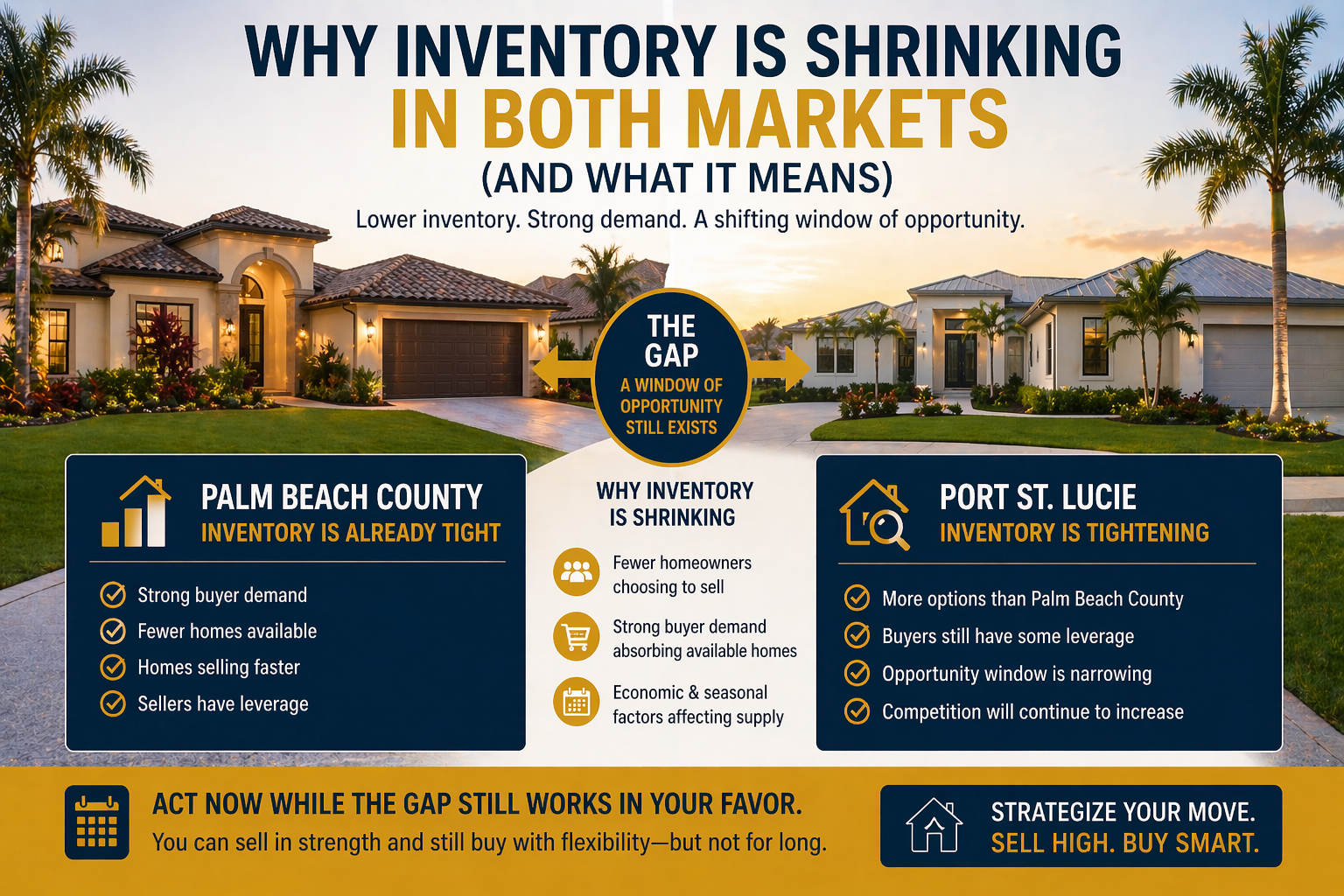
Why Inventory Is Shrinking in Both Markets (And What It Means)
Inventory does not tighten all at once. It contracts gradually, then suddenly starts changing how every decision feels.
At first, buyers still believe they have options. Sellers still believe they can wait. Then the market reaches the point where flexibility quietly begins disappearing from both sides at the same time.
That is where Palm Beach County and Port St. Lucie are now—except the two markets are moving through that transition at different speeds.
What Shrinking Inventory Actually Changes
Most homeowners think shrinking inventory simply means fewer homes for sale. In reality, the larger effect is reduced negotiating flexibility.
As supply tightens, timing becomes less forgiving. Buyers lose the ability to wait comfortably. Sellers gain leverage, but only while enough demand still exists underneath the market.
That is why understanding what changes if you wait to sell and buy matters before assuming the current window will remain stable.
The shift usually starts subtly:
- Homes with strong positioning attract faster activity
- Negotiation windows narrow
- Buyer hesitation becomes more expensive
- Replacement inventory becomes harder to secure
Once those patterns accelerate, the same move often requires more pressure to accomplish.
Why Palm Beach County Is Already Feeling It
Palm Beach County has already moved into a tighter phase of the cycle.
Well-positioned homes still attract strong attention because buyers competing for lifestyle markets, coastal access, school zones, and established communities are now working from a smaller pool of available inventory.
This does not mean every seller automatically wins. It means the market has already shifted enough that seller leverage exists more consistently than buyer leverage.
That distinction matters because many homeowners still assume conditions will remain equally favorable later. Inventory cycles rarely work that way.
Why Port St. Lucie Still Looks Different
Port St. Lucie is following the same path, but the market has not fully tightened yet.
That lag is what currently creates the opportunity gap between selling in Palm Beach County and buying farther north.
Some buyers can still negotiate selectively. Certain listings still experience longer market exposure. Some sellers are still adjusting pricing or expectations before competition fully compresses available inventory.
A closer look at why buyers still have flexibility in Port St. Lucie helps explain why that gap still exists—and why it may not remain open indefinitely.
Why the Difference Between the Markets Matters
The opportunity is not simply that inventory is shrinking.
The opportunity is that the two markets have not tightened at the same speed.
Palm Beach County sellers may still operate from relative strength while Port St. Lucie buyers can still find selective flexibility.
That overlap creates the foundation of the entire move.
Once both markets fully tighten at the same time, the advantage begins compressing from both directions. Sellers face more competition for replacement housing while buyers lose negotiating room on the purchase side.
This is why timing matters more than many homeowners initially realize. The move becomes harder when leverage disappears simultaneously.
How Inventory Tightening Quietly Changes Buyer Behavior
Buyers rarely become aggressive immediately.
What usually changes first is decision speed.
Homes that would have sat longer begin moving faster. Buyers become less comfortable waiting. Financing timelines become more sensitive. Properties with strong condition or location advantages attract quicker offers because buyers recognize fewer alternatives exist.
That behavioral shift matters because it changes how leverage works.
In earlier stages, buyers negotiate from patience. In later stages, buyers negotiate from fear of losing the opportunity altogether.
Why This Directly Affects Equity Strategy
Shrinking inventory does not just affect availability. It affects what your current equity can still accomplish.
If your home continues appreciating while replacement inventory becomes harder to secure, the raw number attached to your equity may still rise while the flexibility attached to it quietly declines.
That is where homeowners often misread the situation.
The important question is not whether your home still has value. The important question is whether that value still creates enough room to improve your next position.
Understanding how equity translates into a stronger next move becomes critical once inventory begins tightening on both sides.
How This Starts Showing Up Across Palm Beach County
Different cities feel inventory compression differently.
In markets such as Lake Worth, inventory tightening may affect older homes, insurance-sensitive properties, or condition-driven buyer decisions first.
In stronger lifestyle markets, buyer urgency may increase faster because replacement options become harder to replicate.
The local market matters because it determines how long sellers can maintain leverage before the balance begins shifting again.
What Happens If Inventory Tightens Further
As supply contracts further, flexibility usually disappears before prices make dramatic moves.
That is the part many homeowners miss.
The first loss is not value. The first loss is optionality.
Buyers become more reactive. Sellers become more selective. The transition between selling and buying becomes harder to coordinate cleanly because fewer workable choices exist at the same time.
The earlier phase of shrinking inventory still allows strategic movement. The later phase forces more reactive decision-making.
What This Really Comes Down To
Inventory shifts matter because they change how much control exists inside the move.
Right now, many Palm Beach County homeowners can still:
- Sell into relatively stronger conditions
- Transfer equity before replacement inventory fully tightens
- Buy while selective flexibility still exists farther north
That overlap is where the opportunity lives.
Once the markets tighten together, the same move may still be possible—but often with less flexibility, more pressure, and fewer favorable choices.
Before You Decide What to Do Next
Every move depends on timing, equity, replacement inventory, and how both sides of the transition interact.
Before deciding whether to wait or move forward, it helps to understand how shrinking inventory is affecting your specific position—and whether the current market gap still gives you enough room to use your leverage effectively.
Avoid Getting Caught Between Two Markets
The biggest risk in this move is not the sale—it is the transition.
- How to avoid selling without a clear next step
- What happens if inventory tightens further
- How to protect yourself from timing mismatches
- How to move without unnecessary pressure
No pressure. Just clarity before you make a move.
Frequently Asked Questions
Why is inventory shrinking in both Palm Beach County and Port St. Lucie?
Inventory is tightening because buyer demand continues absorbing available homes while fewer homeowners choose to list, reducing the number of properties available across both markets.
How does shrinking inventory affect my ability to move?
As inventory tightens, buyers lose flexibility, negotiation windows narrow, and replacement housing becomes harder to secure. That makes timing more important when coordinating both the sale and purchase sides of a move.