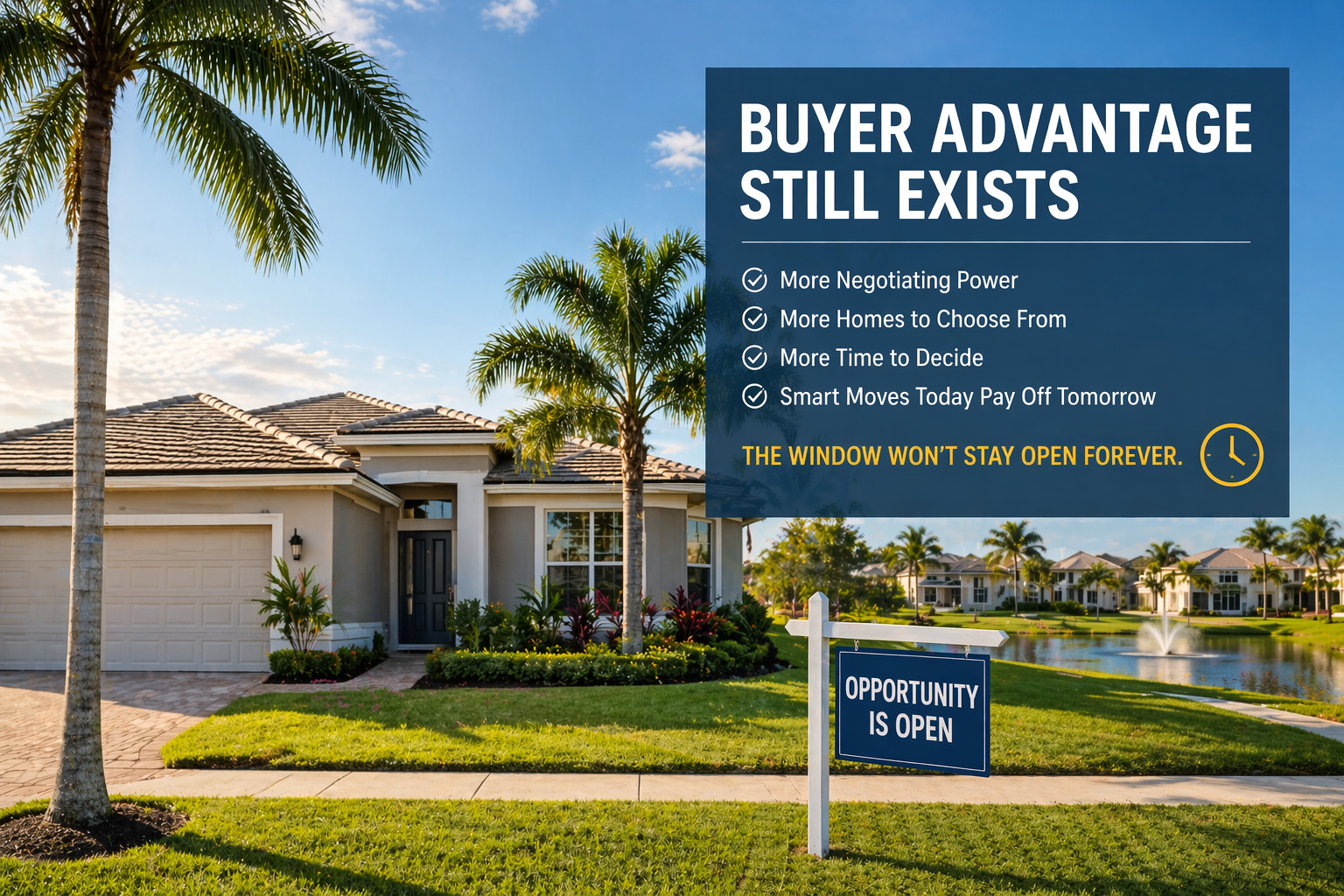
Why Port St. Lucie Still Offers Buyers an Advantage (For Now)
Port St. Lucie still gives some buyers room to think, compare, and negotiate.
That does not mean the entire market is easy. It means the market has not fully tightened in the same way many Palm Beach County markets already have.
That difference is the opportunity.
For homeowners selling from a stronger position farther south, the advantage comes from using Palm Beach County leverage before Port St. Lucie buyer flexibility becomes harder to access.
Why Buyer Advantage Still Exists in Port St. Lucie
Buyer advantage does not show up evenly across every listing.
It appears where pricing, timing, seller motivation, days on market, or property presentation creates enough imbalance for a buyer to move with more control.
Some buyers are still finding room to negotiate. Others are running into resistance because they are looking in the most competitive parts of the market or assuming every listing carries the same flexibility.
A closer look at where buyers are still finding opportunity in Port St. Lucie helps clarify why the advantage is selective rather than universal.
The Window Exists Because the Two Markets Are Not Moving Together
The current opportunity is not based on Port St. Lucie being weak.
It exists because Palm Beach County and Port St. Lucie are moving through different parts of the market cycle at different speeds.
Palm Beach County has already tightened in many segments. Sellers in well-positioned areas may still benefit from limited supply, steady demand, and strong buyer interest.
Port St. Lucie is also tightening, but certain parts of the market still allow buyers to evaluate more carefully, negotiate more selectively, and avoid full competition in every situation.
For homeowners coming from a stronger selling position, understanding whether selling now preserves leverage becomes part of the same decision as the purchase.
What Is Already Starting to Change
The buyer advantage is narrowing quietly.
Inventory is becoming more selective. Stronger listings are drawing faster attention. Sellers with better-positioned homes are gaining confidence. Buyers waiting for obvious discounts are finding fewer clear opportunities.
None of these shifts need to be dramatic to matter.
A small reduction in inventory can reduce negotiation room. A slight increase in buyer demand can shorten decision timelines. A stronger seller response can change how much leverage remains in a deal.
That is why understanding how inventory shifts affect both markets is important before assuming today’s balance will stay available later.
Why Timing Often Matters More Than Price
Many buyers focus only on whether they are getting a lower price.
That is too narrow.
A better buying opportunity may come from timing, seller flexibility, inspection leverage, closing structure, or the ability to make a decision without competing against multiple buyers.
Price matters. But timing often determines whether the purchase can be structured in a way that actually improves the overall move.
Buying before the market fully tightens may create:
- More room to compare options carefully
- Better negotiation conditions in specific situations
- Less pressure to waive important protections
- More control over timing between sale and purchase
Those advantages are not guaranteed, but they still exist in parts of the Port St. Lucie market.
How Waiting Changes the Buyer Position
Waiting does not simply delay the purchase.
It changes the purchase environment.
As more buyers recognize the same value proposition, competition can increase around the homes that make the most sense: newer construction, strong locations, better layouts, lower-maintenance properties, and homes priced correctly from the start.
At the same time, Palm Beach County selling conditions may begin shifting in a different direction.
That is where the advantage compresses from both sides.
A deeper look at how waiting impacts both sides of the move shows why delay can reduce flexibility even when the move remains possible.
How Strategic Buyers Are Approaching This Window
The buyers benefiting most are not treating Port St. Lucie as a uniformly favorable market.
They are being selective.
They are studying where seller expectations have not fully adjusted, where listings have sat longer than expected, where pricing has softened, and where condition or presentation has caused buyers to overlook usable value.
That kind of approach changes the purchase from a simple search into a positioning strategy.
The goal is not to buy any home before competition increases. The goal is to identify a property that supports the next stage without absorbing the leverage created by the sale.
Where This Shows Up Locally
Port St. Lucie still offers a mix of resale homes, newer communities, builder inventory, and properties where pricing or timing may create room for a buyer to move strategically.
Nearby markets behave differently.
Stuart can create a more constrained buying environment in certain segments because inventory may be tighter and lifestyle-driven demand can concentrate around fewer suitable homes.
Those differences matter because the buy-side advantage is not just geographic. It is tied to inventory type, seller motivation, pricing structure, and how quickly each market is tightening.
The Risk Is Misreading the Direction
The most common mistake is assuming today’s flexibility will still exist later.
Buyers may see a few negotiable listings and assume the same conditions will be available months from now. But markets move in phases, and the best opportunities often disappear before the broader market feels fully competitive.
For homeowners managing both a sale and a purchase, coordinating both sides of the move without losing flexibility becomes critical.
The risk is not just paying more later.
The risk is having fewer useful ways to convert your current equity into a better next position.
What This Means for Your Next Move
This is not about whether Port St. Lucie is a good market.
It is about how long the current buyer-side advantage remains usable.
Right now, some buyers can still find selective negotiation, evaluate without immediate pressure, and avoid peak competition in certain situations.
But those conditions are transitional.
The advantage belongs to buyers who understand where flexibility still exists, how quickly it may narrow, and how the purchase connects to the larger move from Palm Beach County.
Before You Decide How to Approach Port St. Lucie
Every buyer enters this decision with a different starting point.
Equity, timing, financing, risk tolerance, and the strength of the current sale all shape what the right purchase strategy should look like.
Before moving forward, it helps to understand how your current position interacts with the direction of both markets—not just the home you want to buy.
Review Whether Port St. Lucie Still Gives You Buyer Advantage
If you are considering a move from Palm Beach County toward Port St. Lucie, the first step is understanding whether the purchase side still gives you enough flexibility to make the transition work.
- Where Port St. Lucie buyers still have practical negotiation room
- How your Palm Beach County sale may shape the next purchase
- What happens if inventory tightens before you act
- How to structure the move without unnecessary timing pressure
No pressure. Just clarity before you make a move.
Frequently Asked Questions
Is Port St. Lucie still favorable for buyers right now?
In certain situations, yes. The risk is assuming every listing still offers the same leverage. The control principle is identifying where pricing, timing, condition, and seller motivation still create room. The execution reality is that buyer advantage is becoming more selective as inventory tightens and stronger listings attract faster attention.
Will buyers continue to have this advantage later?
Not necessarily. The risk is waiting until the best buying opportunities become more competitive. The control principle is evaluating the purchase side before flexibility narrows further. The execution reality is that as inventory declines and buyer activity increases, negotiation room can shrink even before the entire market feels fully tight.