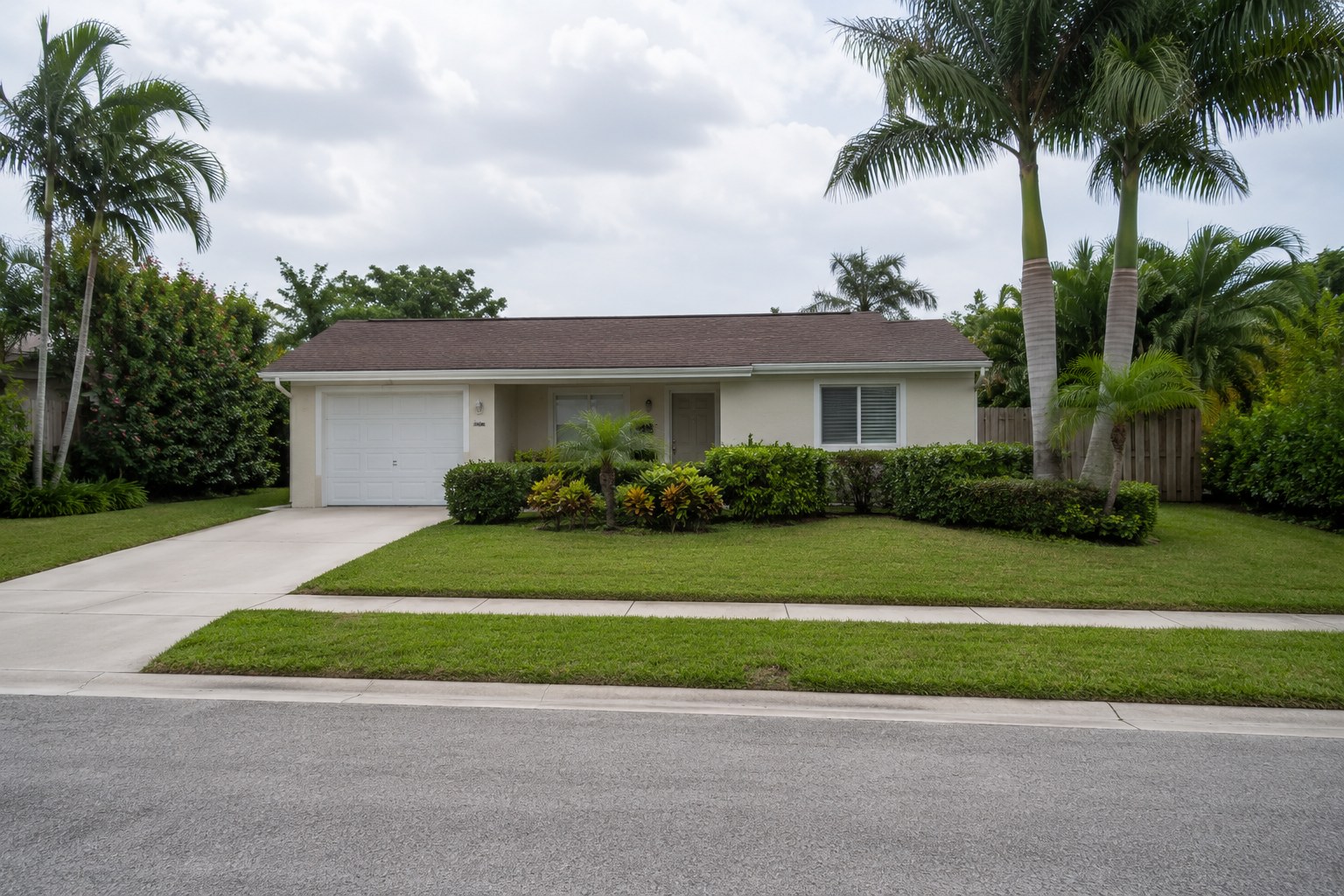
How to Read Your Palm Beach County Equity Position Before Making a Move
An equity figure becomes useful only when it can answer two questions at once: if you sold this property and bought another one, what would you actually have to work with, and what would the new property cost you to hold? A number that answers only the first half can still leave a move looking better on paper than it turns out to be at the closing table and in the first year of ownership.
This article works through how to read an equity position in Palm Beach County so that it answers both halves. It is written for an owner weighing a move — scaling up, scaling down, or relocating within the county or beyond it — who wants the origin side of the decision priced before the destination side is chosen. If you are not considering a transaction and simply want a value estimate, the first section will be enough; the rest is built for someone who intends to act on the number. The Sell High Buy Smart framework follows the same sequence: price the position you are selling from before you define the position you are moving into.
What Your Equity Position Actually Includes
Equity begins as a subtraction: current market value minus what you owe. That is the opening line of the calculation rather than the closing one, because the figure that funds a next purchase is whatever remains once the closing statement is settled.
It helps to sort the reductions into three classes, because preparation can move only one of them.
- Fixed transaction costs. Agent compensation, title and settlement charges, state transfer taxes on the deed, recording fees, prorated property taxes, and payoff-related charges. These belong in one class because preparation and presentation do not move them — not because they share a single basis. Some are calculated from the sale price or from the terms you agree to; some follow a published fee schedule rather than the price; prorated items depend on the closing date and the period being divided between the parties; and payoff-related charges depend on what your lender's payoff statement includes. Each line has to be read from the source that sets it — the closing statement your title or settlement agent prepares, the applicable fee schedule, and your lender's payoff figure — rather than estimated as one percentage of price.
- Condition-driven reductions. Repair credits, post-inspection price adjustments, and any work a buyer's insurer may require before it will bind coverage on the property. This is the class that pre-listing decisions can influence, which is why it is worth identifying before a list price is set rather than after an inspection report arrives.
- Timing and carrying exposure. Costs created by the interval between closings — an additional month of two housing payments, temporary housing, storage, a second move. These are invisible in a gross equity figure and are entirely a function of how the transaction is sequenced.
One item is frequently filed in the wrong place: cost basis. Basis is a tax concept. It bears on whether gain on the sale is taxable and in what amount; it does not determine how much cash the closing produces. The two calculations run in parallel and should be kept separate. Proceeds tell you what you can redeploy. Basis, and any exclusion that may apply to the sale of a primary residence, belong to a CPA or tax attorney. Collapsing them into one number can make a move look either more affordable or more expensive than it is.
The other half of the read is what the proceeds are being measured against. Four hundred thousand dollars of net proceeds behaves one way against a $600,000 target and a different way against a $350,000 target. Equity is not a destination. It is a position on a balance sheet, and reading it accurately means reading it in relation to a specific next property rather than to the market in general.
The Equity Reading Framework — A Working Structure
This framework is The Kull Group's, and so are the observations attributed to us below: they describe how we sequence an equity read for Palm Beach County owners. They are labeled as our observations to keep them separate from the two other kinds of statement in this article — independently verifiable facts, which come from the county property appraiser, a licensed insurance agent or carrier, an association's own records and governing documents, and your lender or payoff statement; and recommendations, which are ours to make and yours to accept or reject.
- Step 1 — Establish current market value: An automated online estimate is a reference point, not the input. What any particular model can account for depends on the data available to it and on how that model is built, and those inputs differ from product to product and from property to property. The details that a comparative market analysis is built to weigh — the age of your roof, the condition of your kitchen, an assessment pending at your association — are not necessarily captured in an automated estimate, and an estimate does not tell you which of them it reflected. Use a current comparative market analysis prepared for your specific submarket, and treat any online figure as something to reconcile against it rather than to substitute for it.
- Step 2 — Calculate gross equity: Market value minus every recorded obligation against the property, including home equity lines of credit, second mortgages, and any other lien that must be satisfied at closing.
- Step 3 — Apply the reductions that apply to your transaction: The fixed costs, plus the condition-driven adjustments your property is realistically positioned to generate, plus whatever timing exposure your intended sequence creates.
- Step 4 — Estimate net proceeds: The figure that actually leaves the transaction and becomes available for the next purchase.
- Step 5 — Map net proceeds against target purchase: What does that position enable at your target price point, and what financing structure, if any, does the gap require? Whether a given structure is available to you, and on what terms, is a licensed mortgage lender's determination rather than an output of this framework.
Step 1 governs everything downstream. An error there does not stay contained; it propagates through the reductions, the proceeds figure, and the purchase mapping, and nothing in Steps 2 through 5 is built to flag it — the arithmetic stays internally consistent around a wrong starting value. In The Kull Group's experience sequencing these reads for Palm Beach County owners, that is why a Step 1 error tends to become visible later, at the negotiating stage, rather than while the numbers are being assembled. It is also why we spend more time on Step 1 than on any other step.
When Step 1 Is Harder Work: Acreage and Equestrian Property in Wellington
Where a Wellington property includes acreage or equestrian improvements, Step 1 is a different piece of work than it is on a tract subdivision home. The comparative market analysis has to establish which sales are genuinely comparable to that specific parcel, and how — or whether — improvements such as barns, paddocks, or arenas are reflected in them; where the supportable answer is a range rather than a point, a licensed appraiser is the right party to narrow it. The consequence for the read is procedural, and this is how The Kull Group handles it: carry the proceeds figure forward as a range with a defined low end, and test the purchase mapping against that low end rather than the midpoint.
The Second Reading: Proceeds Capacity Is Not Carry Capacity
The five steps answer an acquisition question — what can I buy. A move has a second, independent test that the five steps do not answer: can I hold what I buy, at the cost of ownership the new address will be underwritten at?
Treat them as two separate tests, run in this order:
- The proceeds test. Does net proceeds, plus whatever financing you are qualified for and willing to carry, reach the target price? Qualification and terms come from a licensed mortgage lender, not from an assumption inside the read.
- The carry test. At the target property specifically, what do property taxes, insurance, and any association obligation cost on a recurring basis once they are set at that address?
The reason to separate them is that a proceeds calculation cannot see reset exposure. Some ownership costs travel with an owner and some are re-underwritten at the new property:
- Property taxes are assessed at the new property, and the assessment is not the same thing as the bill. Florida homestead property carries an assessment limitation, and a portability provision exists for transferring an accumulated assessment difference to a new homestead. That difference is not a fixed amount that simply travels with the owner: eligibility and the transferable amount depend on the relationship between the assessed and just values of the prior homestead and the new one, on whether you are moving to a property of higher or lower just value, and on the limits set by Florida law. The county property appraiser makes that determination, so confirm it with the Palm Beach County Property Appraiser's office rather than estimating it. The assessment side is also only part of the figure: what is actually billed depends on the taxable value remaining after any exemptions are applied and on the millage rates levied by the taxing authorities for that specific parcel, which those authorities set and which can differ from the ones appearing on your current parcel's bill. A purchase therefore changes the inputs to the tax figure; it does not by itself produce a predictable amount, and where the question is tax treatment rather than confirming these figures, it belongs with a CPA or tax attorney.
- Insurance is re-underwritten at the new address. A different property is rated on its own characteristics — roof age and material, opening protection, construction type, elevation, distance from open water. Only a licensed insurance agent or carrier can quote it, and your current premium is not a usable proxy for the target's.
- Association obligations attach to the specific community. If the target property sits in a condominium or homeowners association, the recurring assessment and any approved or pending special assessment are part of the carry. Those figures come from that association's own records and financial documents, and they should be read before the carry test is called complete.
The practical value of splitting the tests is that they can disagree. A move can clear the proceeds test — the money reaches the price — and still fail the carry test, because the reset cost of ownership at the new address exceeds what the household wants to commit to monthly. The reverse also happens: a target is comfortable to hold, but the proceeds figure does not reach it without a financing structure the owner does not want. When the two tests disagree, the variable to revisit is the target itself — price point, property type, association status, insurability profile — because those are the inputs reset exposure is built from. Financing structure adjusts the proceeds test; it does not fix a carry problem.
Association-Governed Property in Boca Raton: Both Sides of the Read
Deed-restricted communities and condominium associations are part of the housing picture inside the Boca Raton city limits. Where that applies to your property, the reduction side of the read has to include the association's recurring assessment, any approved or pending special assessment, and the estoppel figures requested at closing. On the purchase side, an association's own approval process becomes part of the timeline you are trying to sequence. All of those figures come from the governing documents and records of that specific community, not from a countywide average — which is why The Kull Group establishes association status, rather than price alone, as the first thing to pin down about a Boca Raton property in a move.
What South Florida Ownership Conditions Add to the Calculation
Two conditions specific to owning here interact with the read, and both belong to the reduction and carry side of it rather than the value side.
The first is insurance. Premiums here are underwritten against wind and water exposure, and the premium an owner budgeted at purchase and the premium on a current renewal notice can be very different figures. Whether that is true of your policy is a question for your agent and your renewal documents, not an assumption to carry into a calculation. What the read requires is that both sides be current and quoted: what you pay now, and what the target property would be quoted at. Remembered numbers on either side will move the carry test in the wrong direction.
The second is component condition, and this one The Kull Group states as an observation from our own listing work rather than as a general rule about buildings here: an owner's recollection of when a roof, an air handler, or pool equipment was installed and the documented record of that installation are not always the same starting point, and it is the documented version that an inspection, an appraiser, and a buyer's insurer work from. So rather than assuming a service life, put the actual age and documented condition of each major component in front of you before running Step 3. A roof with a documented installation date and a permit record is an input. A roof described as "a few years old" is a condition-driven reduction waiting to be negotiated, and it can also affect a buyer's ability to obtain coverage, which turns a condition question into a closing-timeline question. Where the question is how much service life a component actually has left, that is a call for a licensed inspector or contractor rather than an estimate made inside the read.
Pre-Sale Permits and the Lake Worth Jurisdiction Question
Once documented condition is in front of you, the follow-on question is which government governs the repair or the open permit — and that is a jurisdictional fact you can confirm yourself. A Lake Worth mailing address does not by itself establish which government the property answers to. An address that mails as Lake Worth can lie in unincorporated Palm Beach County rather than inside the City of Lake Worth Beach, the municipality formerly named Lake Worth. Because permitting authority, code enforcement, and municipal fee schedules follow the jurisdiction rather than the mailing address, confirm the parcel's actual jurisdiction through the county property appraiser's parcel record before assuming which rules and which costs govern a pre-sale repair or a permit you need closed out before listing.
Where do you actually stand?
Converting a general sense of your equity into a working number is the step that makes every later decision in a move a decision rather than a guess. The Sell High Buy Smart framework begins with that conversation: what your current position enables, and how the sequencing of a move from Palm Beach County works in practice.
A Worked Reading, Start to Finish
The figures below are arbitrary placeholders chosen to show how the arithmetic moves. They are not estimates of any market, any property, or any cost, and no line here should be reused as an input. Substitute your own quoted and documented numbers.
- Step 1. Comparative market analysis supports a value of $700,000.
- Step 2. Mortgage payoff of $220,000 and no other liens. Gross equity: $480,000.
- Step 3. Assume fixed transaction costs of $49,000, condition-driven reductions of $15,000 for a documented HVAC and exterior item, and $6,000 of timing exposure for a one-month overlap. Total reductions: $70,000.
- Step 4. Net proceeds: $410,000.
- Step 5. Target purchase at $600,000. The proceeds test clears if the owner is prepared to finance the $190,000 difference plus purchase-side closing costs — and whether that financing is available to this owner, in what amount, and on what terms is a licensed mortgage lender's determination, not something this framework can supply.
At that point the read is only half finished. The carry test on the $600,000 target has not been run, and it cannot be run from the numbers above. It requires a property-tax estimate built from the assessment and exemption figures confirmed with the county property appraiser — including whether and how much assessment difference is portable — together with the millage applicable to that specific parcel; an insurance quote from a licensed agent on that specific property; and, if the target is in an association, the current assessment and any pending special assessment from that association's records. If those figures come back within the household's monthly commitment, both tests clear and the remaining work is sequencing. If they do not, the target changes — and it is far less expensive to learn that before a listing goes live than after.
Notice what the exercise produced: not a single number, but two answers and an order of operations. That is the difference between an equity figure and an equity read.
What the Read Makes Possible: Sequencing
Once both tests are answered, the remaining question is how the sale and the purchase are ordered and protected. How the contracts are written, how contingencies are layered, and how the interval between closing dates is managed determine whether the timing exposure line in Step 3 stays a modest estimate or becomes the largest reduction in the calculation. An owner who arrives at those decisions with accurate proceeds and carry figures can weigh a contingency, a rent-back, or a longer closing window against a known cost. An owner working from a gross number is weighing them against a guess. Where a sequence depends on financing — carrying a purchase before the sale has closed, or any interim credit arrangement — availability, qualification, and terms are set by the lender extending it, and we work from what your lender confirms rather than from an assumption. Where a question turns on contract language or legal exposure rather than price and timing, it belongs with an attorney.
A current home value assessment is the foundation of the read, and it is where Step 1 begins. You can request one here.
How is home equity calculated in Palm Beach County, and what reductions should I plan for?
Start with current market value minus every recorded obligation against the property — that is gross equity. From there, subtract three classes of reduction: fixed transaction costs (agent compensation, title and settlement charges, state transfer taxes on the deed, recording fees, prorated taxes — grouped together because preparation does not move them, not because they share one basis, so each line has to come from the closing statement, the applicable fee schedule, or your lender's payoff figure); condition-driven reductions (repair credits, post-inspection adjustments, work a buyer's insurer may require before binding coverage); and timing exposure created by the interval between your sale and your purchase. What remains is net proceeds, and net proceeds is the figure you plan from. Keep cost basis out of this calculation: basis affects whether gain on the sale is taxable and in what amount, not how much cash the closing produces. Tax treatment is a question for a CPA or tax attorney; this article addresses the real estate transaction side of the calculation.
Do I need to sell before I can understand what I can buy?
No. A meaningful read can be run well before you commit to listing. What it requires is a current value assessment, an accurate payoff figure, an honest inventory of property condition with documented component ages, and a defined target price range. Running it early tells you which of the two tests is the binding constraint — proceeds or carry — because the remedies are different. A proceeds shortfall is addressed through price, preparation, or financing structure, with availability and terms of any financing confirmed by a licensed mortgage lender rather than assumed. A carry shortfall is addressed by changing the target: a different price point, a different property type, or a property with a different insurance and association profile. Knowing which one you are solving for is the point of running the analysis before the transaction begins rather than during it.
What's the best sequence for selling and buying at the same time in this market?
There is no single answer, because the sequence follows your numbers. The inputs that decide it are your net proceeds figure, whether you can carry financing on the purchase without the sale having closed, how much timing exposure you can absorb if the two closings do not align, and how much inventory exists in your destination market at your target price point. Those four inputs, not a general rule, determine whether a contingent purchase, a rent-back, an extended closing window, or a bridge arrangement fits your situation. Whether you qualify to carry a purchase before your sale closes, and whether an interim or bridge arrangement is available to you and on what terms, is determined by a licensed mortgage lender — that answer has to come from your lender before it can be used as an input here. Sequencing is a negotiation and timing discipline; where the mechanics involve contract language or legal risk, an attorney should review it. Either way, the conversation cannot start productively until the equity read is complete.
An equity position is not difficult to read accurately. It is easy to read incompletely — to stop at gross equity, or to stop at net proceeds without ever pricing what the next property costs to hold. Running both tests, in order, with quoted figures rather than remembered ones, is what turns an equity figure into something you can make a decision with. If you want to run that calculation on your own numbers, the Sell High Buy Smart conversation starts here — or begin at Step 1 and request a current home value assessment.