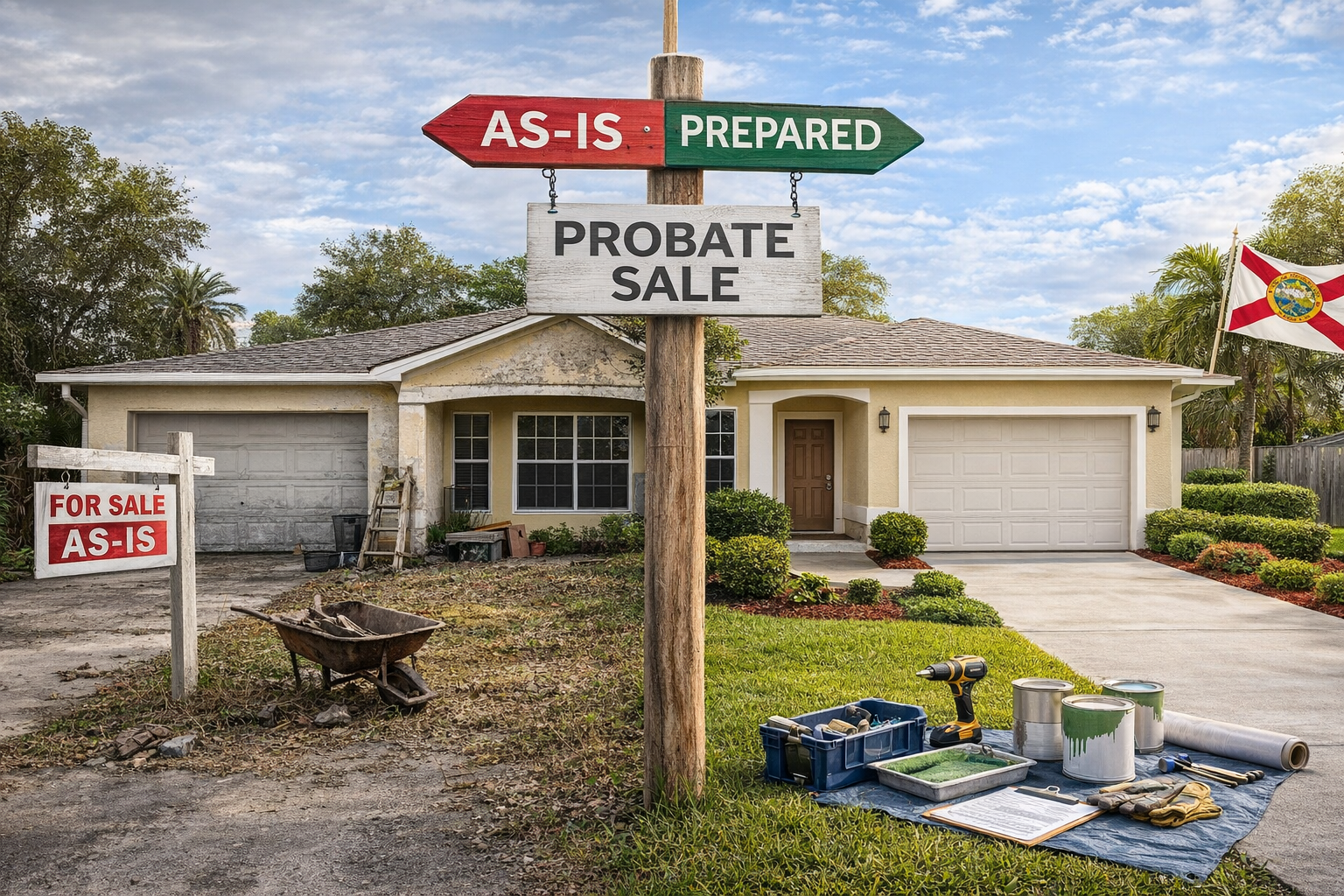
Should Probate Property Be Sold As-Is or Prepared for Market in Florida?
This is usually the point where inherited-property decisions stop feeling theoretical.
The family has likely already spent weeks — sometimes months — trying to understand authority, timing, costs, and what should happen next.
Eventually the conversation narrows into one practical question:
Should the home be sold exactly as it sits, or should time and money be invested into preparing it first?
There is no universal answer because the strongest decision depends on the condition of the property, the family’s financial position, timeline pressure, buyer expectations, and how much coordination everyone is realistically prepared to handle.
That is why this decision often shapes the entire outcome more than families initially expect.
The Simplified Version of This Decision Is Usually Incomplete
Most people first view the situation like this:
- prepare the property → potentially higher sale price
- sell as-is → simpler and faster process
That sounds straightforward on paper.
Real inherited-property situations are rarely that clean.
Preparation introduces:
- time
- coordination
- repair exposure
- vendor management
- additional carrying costs
- financial uncertainty
Meanwhile, selling as-is may reduce pressure, simplify the timeline, and eliminate ongoing obligations sooner.
The strongest outcome is not always the option with the highest theoretical sale price.
It is often the option that creates the best balance between timing, stress level, preparation cost, market response, and final net result.
What Selling an Inherited Property As-Is Actually Means
Selling as-is does not automatically mean the property is being “given away.”
It means the home is being positioned honestly based on its current condition without major repair commitments or extensive preparation beforehand.
This path often makes sense when:
- the property needs substantial repairs
- the family wants a simpler process
- holding costs are already becoming expensive
- multiple heirs are involved
- the property is being managed remotely
- funds for improvements are limited
In many inherited-property situations, simplicity itself becomes valuable.
Reducing the timeline, minimizing coordination pressure, and limiting additional spending can sometimes protect the overall outcome better than chasing incremental price increases through extended preparation.
Understand the ongoing costs attached to inherited property
Preparation Does Not Always Mean Full Renovation
One of the biggest misconceptions families have is assuming “preparing the property” automatically means a large renovation project.
Often it means something much more targeted.
Preparation may involve:
- estate sale coordination
- personal property clean-outs
- junk removal
- light handyman work
- landscaping cleanup
- paint or cosmetic improvements
- pre-listing inspections
- addressing obvious buyer concerns
Sometimes relatively small improvements create a noticeably stronger buyer response.
Other times, the cost, delay, and coordination effort required to improve the home never fully returns enough value to justify the process.
The goal is not improving the home blindly.
The goal is understanding which preparation decisions actually improve the outcome and which ones simply increase stress and delay.
The Middle Ground Is Often Where Value Starts Leaking Away
The largest problems usually do not come from choosing the “wrong” option.
They come from avoiding the decision altogether.
Families often get stuck between paths:
- not fully committed to preparing the home
- not fully comfortable selling as-is
- waiting for perfect certainty before moving forward
Meanwhile:
- holding costs continue
- maintenance continues
- the property may deteriorate further
- heir frustration grows
- the timeline stretches longer
That middle ground initially feels safer because no final decision has been made yet.
In practice, it often becomes the stage where time, money, and clarity slowly start working against the family instead of for them.
This Decision Is Connected to Timing, Costs, and Heir Alignment
Whether an inherited property should be sold as-is or prepared is rarely an isolated question.
It connects directly to:
- holding costs
- timeline pressure
- heir coordination
- available funds
- property condition
- market timing
If those surrounding issues remain unresolved, the property-preparation decision usually becomes heavier and more expensive over time.
These related guides may help explain how those pieces affect inherited-property situations together.
What usually affects inherited-property timelines?
How do disagreements between heirs affect decisions?
How This Commonly Plays Out in Palm Beach County
In Palm Beach County, the gap between inherited-property conditions can be substantial.
Some homes are move-in ready. Others involve deferred maintenance, older systems, insurance concerns, aging roofs, or years of accumulated personal belongings that need to be addressed before buyers respond positively.
In areas like Lake Worth or Boynton Beach, inherited properties may require selective preparation simply to compete effectively with surrounding inventory.
At the same time, some families discover that the coordination effort required to fully prepare the home outweighs the likely financial benefit of waiting.
Out-of-state ownership can increase the complexity further because every repair, inspection, contractor appointment, or clean-out requires remote coordination.
That is often where simpler solutions begin making more practical sense.
These local inherited-property guides may help explain how preparation expectations and buyer behavior differ by area.
Lake Worth inherited property guidance
Boynton Beach inherited property guidance
The Better Question Is Usually About Overall Outcome
Most families initially focus on maximizing sale price.
Over time, the more useful question usually becomes:
Which path creates the strongest overall outcome once timing, costs, coordination, preparation effort, and stress level are all considered together?
That answer is different for every inherited property.
Once the family understands the full picture clearly, the process usually becomes much easier to move forward with confidence.
Compare the As-Is and Preparation Paths Before Spending Time or Money
If your family is trying to determine whether the inherited property should be sold as-is or prepared before listing, a structured review can help clarify what improvements may actually matter, what preparation may not be necessary, and which path realistically fits the situation best.
- Evaluate condition, repair exposure, and buyer expectations clearly
- Compare preparation costs against likely outcome differences
- Review timeline and coordination impact before committing
- Coordinate property planning alongside the probate attorney
The goal is not to over-improve the property. It is to make the decision with clarity before unnecessary delay builds.
Continue With the Questions That Shape the Process
Inherited-property preparation decisions are closely connected to timing, carrying costs, mortgage obligations, and family coordination. These guides explain how those issues often affect the process together.
- What costs continue while the property is being held?
- What usually causes inherited-property timelines to stretch?
- How does a mortgage change the decision?
For a broader overview of inherited-property guidance, preparation strategy, attorney coordination, and local market considerations, you can also return to the main inherited-property hub.
Back to the Inherited Property Guidance Hub
Frequently Asked Questions
Is it usually better to sell inherited property as-is?
Sometimes. Selling as-is can reduce holding costs, simplify coordination, and shorten the timeline when the property needs significant work or the family wants a cleaner process. In other situations, selective preparation may improve buyer response enough to justify the additional effort.
Does preparing an inherited property always increase the final sale price?
Not always. Some improvements meaningfully strengthen marketability, while others increase cost and delay without creating enough additional value to offset the extra time, coordination, and carrying expenses involved.