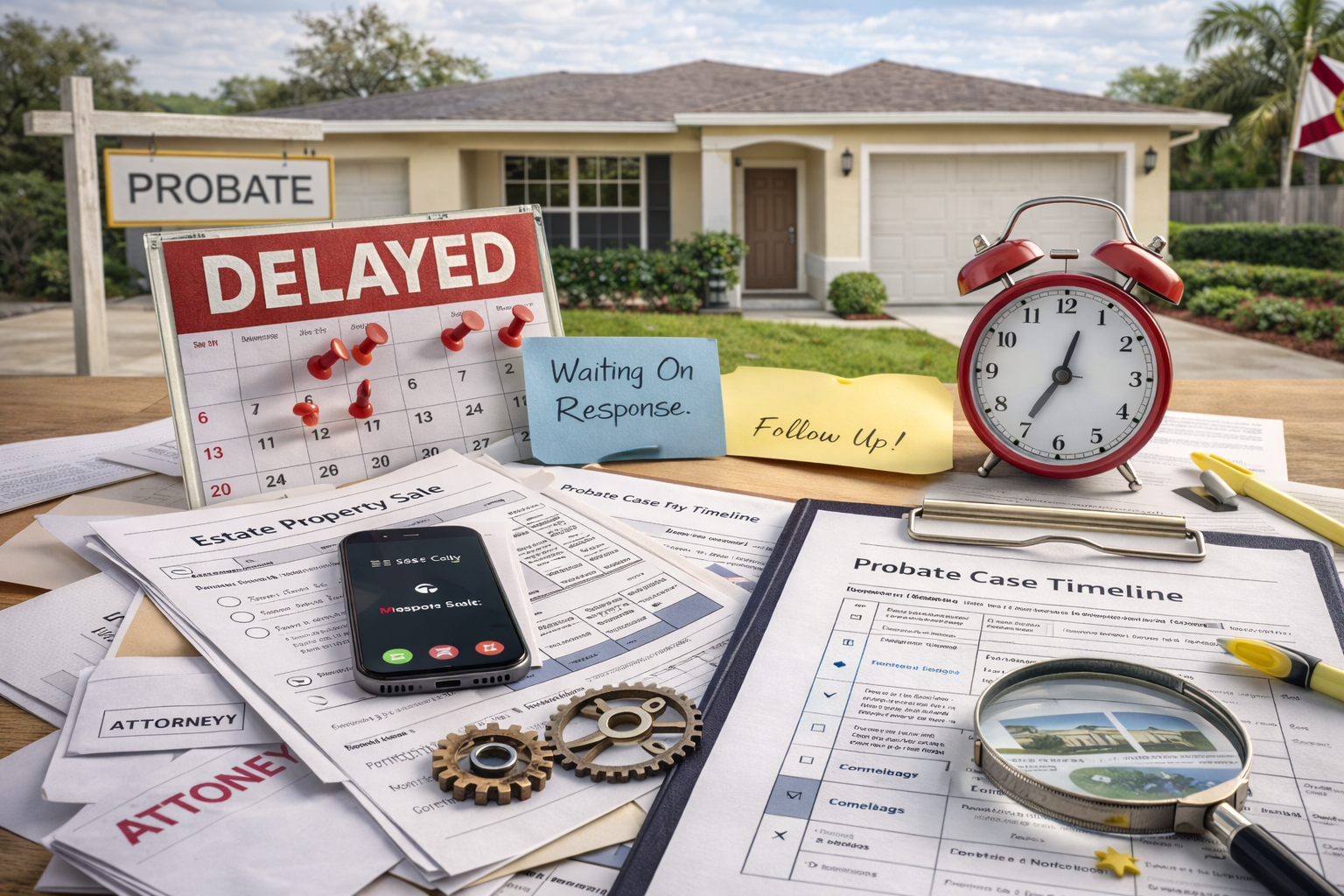
Timeline of Selling a Probate Property in Florida
Most families begin looking for a timeline almost immediately.
How long will probate take? When can the property be sold? How quickly can everything finally be resolved?
What they usually discover instead is that probate-property timelines are not driven by a single clock.
They are shaped by a series of decisions, approvals, conversations, preparation steps, and moments where uncertainty either gets resolved — or quietly expands.
That distinction matters because inherited-property situations rarely slow down for only one reason.
They slow down when legal timing, family coordination, property condition, and decision-making all start affecting each other at the same time.
There Is No Single Probate Timeline That Fits Every Property
Some inherited-property situations move relatively smoothly. Others take far longer than the family originally expected.
The difference is rarely explained by the market alone.
Probate timelines are usually influenced by several factors happening simultaneously:
- when authority is formally established
- how quickly the property is evaluated
- whether heirs remain aligned
- how much preparation the home may require
- how efficiently decisions are made once options become clear
When those pieces begin aligning early, the process tends to feel organized and manageable.
When they remain unclear, delays start stacking quietly in the background until pressure builds later.
Most Delays Do Not Start With the Court
Families often assume probate timelines are controlled entirely by the legal system.
In reality, many inherited-property delays happen long before the property reaches the market.
The timeline often stretches because:
- no one fully understands who has authority yet
- heirs avoid difficult conversations
- the property condition has not been evaluated
- the family delays deciding between as-is or preparation strategies
- repairs, clean-outs, or vendor coordination remain unresolved
- the property sits while everyone waits for clarity
Those are not always legal barriers.
They are operational gaps.
If authority still feels unclear, it helps to first understand how probate-property authority is usually structured in Florida.
Who has authority to sell a probate property in Florida?
The Probate Timeline Usually Moves in Stages
Although every inherited-property situation is different, most follow a similar sequence.
1. Probate authority is established
A personal representative is formally appointed and gains the ability to begin managing estate-related decisions.
2. The property itself becomes clearer
The family begins understanding:
- property condition
- maintenance concerns
- holding costs
- buyer expectations
- likely repair or preparation needs
- possible pricing range
3. A property strategy is chosen
The family decides whether the inherited property should:
- be sold as-is
- receive selective preparation
- undergo larger renovation coordination
- be held temporarily
4. The home enters the market
Once authority, preparation, and timing are aligned, the transaction process starts resembling a more traditional sale.
5. Contract and closing
The smoother the earlier stages were handled, the cleaner this stage usually becomes.
Each stage can move efficiently — or become delayed — depending on what clarity existed beforehand.
Condition Problems Often Extend the Timeline Quietly
Inherited homes frequently carry condition issues that families underestimate at first.
The property may still contain years of personal belongings. Deferred maintenance may not become obvious until inspections begin. Insurance concerns, roof issues, landscaping problems, plumbing repairs, or outdated systems may all affect buyer response once the home reaches the market.
That is why the preparation phase often shapes the timeline more than families expect.
Many inherited-property situations require decisions involving:
- junk removal
- estate sale coordination
- contractor walkthroughs
- handyman work
- clean-outs
- repair prioritization
- pre-listing inspections
- vendor coordination
The important part is not automatically choosing the fastest option.
The important part is understanding which decisions actually improve the outcome versus which ones simply create additional delay.
Should the inherited property be sold as-is or prepared first?
Heir Alignment Has a Major Impact on Timing
Probate-property timelines often stretch when heirs remain uncertain, misaligned, or emotionally overwhelmed by the process.
One person may want to move quickly while another wants more time. Someone may believe repairs should happen before listing while another prefers a simpler as-is sale.
Sometimes no one wants to be the person forcing the conversation forward.
Meanwhile, the property continues creating responsibilities in the background.
The longer uncertainty lasts, the harder decisions often become.
If multiple heirs are involved, understanding how disagreements typically affect inherited-property situations becomes important early.
Do all heirs have to agree before selling inherited property?
How Probate Timelines Commonly Play Out in Palm Beach County
In Palm Beach County, timelines are often influenced by property condition, coordination complexity, and local buyer expectations.
Inherited homes in Lake Worth or Boynton Beach may need cleanup, maintenance, or preparation before buyers respond well to pricing expectations. Larger homes in other areas may involve landscaping, insurance, vacant-property management, or contractor coordination that extends the preparation phase.
Out-of-state heirs can also increase timing challenges because access, communication, vendor scheduling, and decision-making become harder to coordinate remotely.
In many situations, the timeline improves once the family stops trying to predict an exact closing date and instead focuses on organizing each stage clearly and realistically.
These local inherited-property guides may help explain how preparation and buyer expectations differ by area.
Lake Worth inherited property guidance
Boynton Beach inherited property guidance
Build a Clearer Timeline Before Delays Start Compounding
If your family is trying to understand how long the inherited-property process may realistically take, a structured review can help identify what stage the property is actually in, what decisions remain unresolved, and what may affect timing moving forward.
- Identify likely preparation or coordination delays early
- Review condition, repair, and timing considerations clearly
- Compare as-is versus preparation strategies realistically
- Coordinate real estate planning alongside the probate attorney
The goal is not to force speed. It is to reduce avoidable delays before pressure builds.
Continue With the Questions That Shape the Process
Probate timelines are connected to authority, property condition, family coordination, and preparation decisions. These guides explain how those pieces often affect inherited-property situations together.
- What costs continue building while the property sits?
- What can families organize before probate is complete?
- How does out-of-state ownership affect the process?
For a broader overview of inherited-property guidance, preparation strategy, attorney coordination, and local market considerations, you can also return to the main inherited-property hub.
Back to the Inherited Property Guidance Hub
Frequently Asked Questions
How long does it usually take to sell a probate property in Florida?
The timeline depends on probate authority, heir coordination, property condition, preparation needs, and how quickly important decisions are made. Some inherited-property situations move efficiently, while others take longer because unresolved preparation or communication issues continue delaying progress.
What usually causes inherited-property timelines to slow down?
Most delays come from unresolved decisions rather than the market itself. Common issues include unclear authority, heir disagreement, delayed preparation planning, repair uncertainty, vendor coordination problems, and hesitation around whether the property should be sold as-is or prepared before listing.