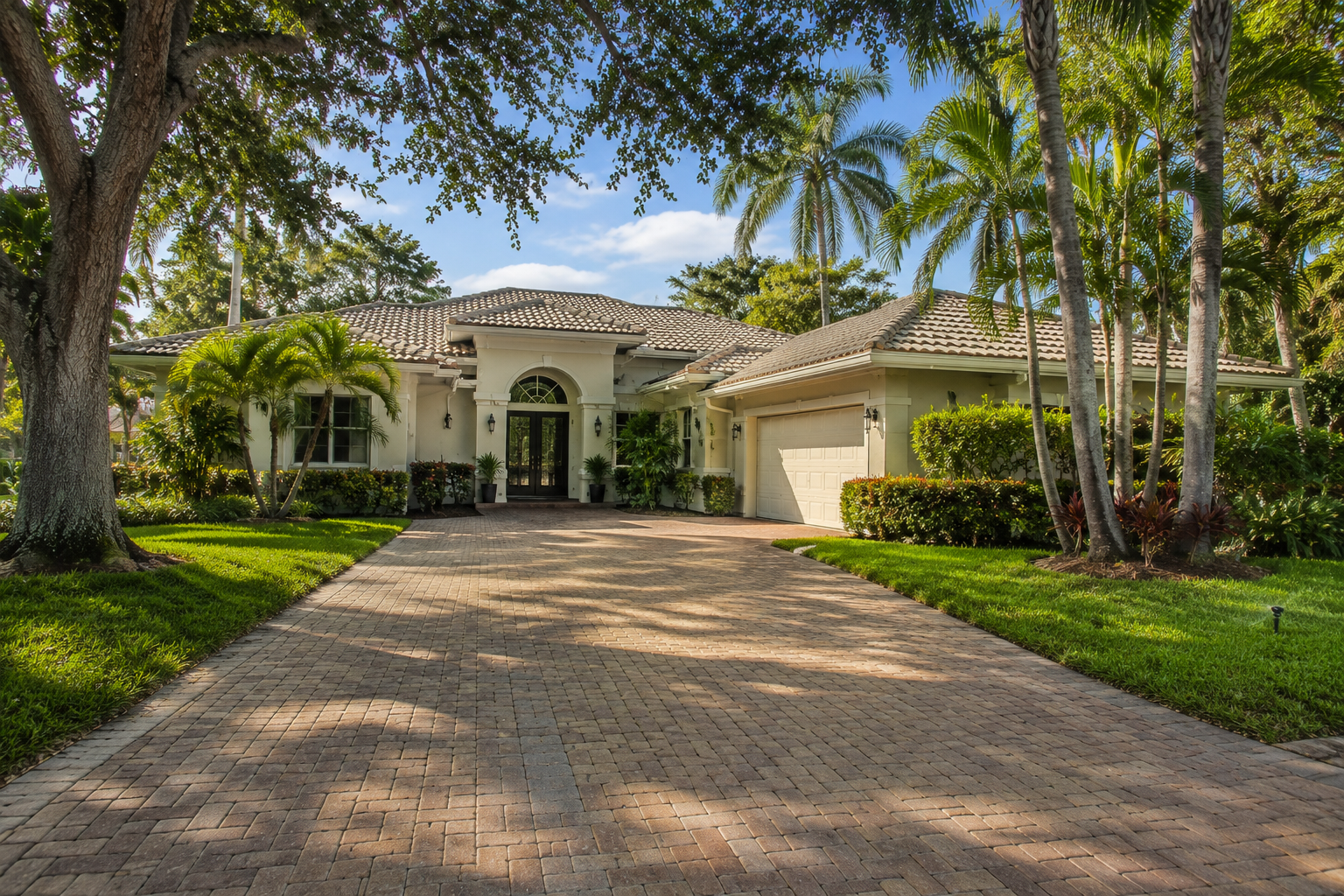
What a Move-Up Really Costs Beyond the Purchase Price
Most move-up budgets get built around one number. The household works out what it can borrow, translates that into a monthly payment, and treats the result as the answer. It is a reasonable place to begin. It is an incomplete place to stop. With a fixed-rate loan, principal and interest may be the most predictable part of the monthly carrying picture; insurance, taxes, association obligations, maintenance and escrow requirements can each change independently of it.
What follows is not a warning against moving up. It is an attempt to make the number complete before it gets used to make a decision, so the figure you are working from is the one you will actually live with. Households that assemble the full picture early tend to search with more confidence, not less — because they stop wondering what they have missed. If you are also weighing who to involve in that work, our guide to choosing the right real estate professional covers that separately.
Why the Mortgage Payment Is Only Part of the Question
A larger home changes several obligations at once, and they do not all scale the same way.
Insurance is one of the clearest examples, and in this market it deserves attention early. Homeowners premiums here are underwritten substantially on construction characteristics rather than square footage alone — construction age, roof age and covering material, wind mitigation features, opening protection. A larger, newer home can sometimes underwrite more favorably than a smaller older one. It can also go the other way. The direction is not predictable from size, so the reliable approach is to get quotes on the specific property before the number is settled.
Flood coverage is a separate matter from homeowners insurance and worth treating as such. For financed purchases, flood insurance may be required when the structure lies in a designated Special Flood Hazard Area and the loan is subject to federal or lender requirements. Coverage may still be advisable — or required by a particular lender — outside those zones, and FEMA mapping does not describe the full extent of flood risk. Local floodplain regulations are administered separately at the county or municipal level. Two homes on the same street can carry different flood-zone designations, so this is verifiable per address rather than assumable by neighborhood.
Property taxes work differently from what many households expect when moving within Florida. The Palm Beach County Property Appraiser administers assessed value, the homestead exemption, and the portability of accumulated assessment benefit — that office is distinct from the taxing authorities that set millage rates, which include the county, the municipality, the school district and any applicable special districts. Portability can transfer a benefit when moving between Florida homesteads, but the mechanics are specific and depend on your circumstances, so the Property Appraiser's office is the place to establish what actually applies to your situation rather than working from a general assumption.
The Costs That Arrive With the House
Beyond insurance and taxes, several ongoing obligations attach to the property itself and can be established from documents rather than estimated.
The Full Carrying Picture
- Homeowners insurance — quoted on the specific property, not extrapolated from your current premium.
- Flood coverage — a separate policy, tied to the address's designation and to lender requirements where financing is involved.
- Property taxes — assessed value at the new home plus applicable millage, with any portability benefit established through the Property Appraiser.
- Association obligations — HOA or condominium dues, and any community development district assessment where one applies. A CDD is a separate special district from an association, with its own assessment, and both can apply to the same property.
- Maintenance that scales with the structure — more roof area, more exterior surface to paint, larger cooling capacity, more irrigation zones, and a pool if there is one. In this climate those cycles run on their own schedule regardless of how new the house feels.
- Personal maintenance reserve — your own household fund, distinct from any association reserve, sized to the systems in the new home rather than the old one, because those are the replacement costs you would actually face.
The association line deserves a closer look than a glance at the dues figure. Where applicable, reserve studies, budgets, financial statements, inspection reports and recent meeting records can help reveal how shared obligations are being funded, and that funding position bears on the likelihood of special assessments later. The documents available — and the requirements governing them — vary by association type and by property, so what you can review differs from community to community. Ask early what exists rather than assuming a standard package.
Do you know what your current home would contribute to this?
The full carrying picture on the next house only becomes usable once you know what the existing one releases. That figure is the anchor for everything else, and it is worth establishing before the search rather than during it.
The One-Time Costs of the Transition Itself
Separate from what the house costs to hold, a move-up carries a set of costs that occur once and are easy to leave out of a spreadsheet built around monthly figures.
There are the transaction costs on both sides. There is the move itself. There is the furnishing gap that a larger home tends to create — rooms that were adequate in one house and empty in another, window treatments sized differently, exterior spaces that need something. There are inspection-driven items negotiated or absorbed at closing. In association communities there may be application and transfer fees, and some associations collect a capital contribution or working capital fee at closing that is separate from ongoing dues and is set out in the governing documents.
And depending on the sequence chosen, there may be a period of carrying two properties. That cost is real, finite, and worth quantifying in advance rather than discovering.
One pattern we consistently observe in move-up conversations: a recurring source of post-closing discomfort is not the purchase price alone, but the accumulation of first-year expenses that were never part of the budget. The purchase price tends to get scrutinized carefully. The year around it sometimes does not.
Some Palm Beach County families have told us the first-year figure surprised them more than the payment did — not because anything went wrong, but because several ordinary items landed in the same stretch of months.
What to Do With the Full Number
Assembling the complete picture commonly produces one of a few outcomes, and each of them is useful.
Sometimes the number confirms the move comfortably, and the household proceeds with more confidence than it had before. Sometimes it shifts the target — a slightly different price band, a different community structure, or a property with a newer roof and updated systems that underwrites differently and carries differently. And sometimes it establishes that the timing is not right yet, which is a real answer rather than a failure, and one that comes with a clear list of what would need to change.
A caution on one common shortcut: the year a house was purchased does not establish when its roof, HVAC or water heater was actually installed. Components get replaced before and after purchase, and deferred past their expected cycles. If a system's remaining life is part of your carrying-cost estimate, the installation dates and permit records are what to check, not the closing date. That distinction can move a first-year figure meaningfully in either direction.
There is also a timing layer worth naming. For some households, the move-up question surfaces in the same period as higher ownership costs on the current home or an approaching system expense. When that is the case, the comparison is not simply between staying and moving — it is between two different sets of costs, one of which is already known. Some families have found that framing more useful than treating the current home's costs as a fixed baseline.
The verification work itself does not change much by location. A household in Wellington, Boca Raton, Boynton Beach, Lake Worth or Royal Palm Beach faces the same sequence — quote the insurance on that address, check the flood designation, establish the tax position with the Property Appraiser, read whatever association and district documentation exists — even though what those checks return will differ property by property. The method travels. The answers do not.
That work involves several parties, each responsible for their own piece — a lender for financing structure and qualification, an insurance agent for quotes on the specific property, the Property Appraiser's office for assessment and portability questions, and a tax professional for anything touching your broader tax position. What helps is having someone who can keep those threads connected and identify early where a given question belongs. Our overview of the professionals involved in a real estate decision covers who does what, and the preparation that comes before listing covers the other half of the equation.
Frequently Asked Questions
What are the hidden costs of buying a bigger house in South Florida?
Two that are commonly left out are insurance and association obligations. Homeowners premiums here are underwritten on construction age, roof age and covering, and wind mitigation features rather than square footage alone, so the direction of change is not predictable from size — it has to be quoted on the specific property. Flood coverage is a separate policy tied to the address's designation and to lender requirements. Where applicable, association dues, CDD assessments, budgets, reserve information, inspection reports and recent assessment history should be reviewed before closing, keeping in mind that what exists varies by association type and property. Beyond those, maintenance scales with the structure, and one-time transition costs tend to cluster in the first year.
How should I budget for moving up to a bigger home?
Build two numbers rather than one. The first is the full monthly carrying figure — payment, insurance, flood coverage if applicable, taxes at the new assessed value, association and district obligations, and a realistic maintenance allowance for the systems in that specific house. The second is the first-year one-time figure — transaction costs, the move, furnishing the additional space, any association application or capital contribution, and a household reserve appropriate to the new property. Households that carry both numbers into the search tend to decide faster, because they are comparing properties against a standard rather than against a hope.
The instinct to focus on purchase price is understandable, since it is the number everyone talks about and the one attached to every listing. But the purchase price is a single event, and the carrying figure is the thing you live inside afterward. A recurring source of regret is not simply what the house cost at closing, but how much the first year required beyond the payment — and how little of that had been looked at in advance. If you would like to work through what the full picture looks like for your situation, a practical conversation is a reasonable place to begin.
Resources Directory
Related reading
- Not Every Real Estate Professional Works the Same Way—Here's Why That Matters
- The Difference Between Selling a Home and Helping Someone Make the Right Decision
- Questions Every Buyer and Seller Should Ask Before Choosing a Real Estate Professional
- Why Major Life Transitions Require More Than a Real Estate Transaction
- The Best Real Estate Decisions Begin Long Before a Home Goes on the Market
- What Does a Trusted Real Estate Advisor Actually Do?
- The Professionals Behind Great Real Estate Decisions
- Your Real Estate Decision Doesn't End at Closing—and Neither Should Your Representation
Communities we serve
- Wellington
- Boca Raton
- Lake Worth
- Boynton Beach
- Royal Palm Beach
- Loxahatchee
- Palm Beach Gardens
- Delray Beach
- Jupiter
- Greenacres
- West Palm Beach
- Palm Springs
- Juno Beach
- Port St. Lucie
- Stuart
- The Acreage
About the Authors
Chris and Sue Kull have spent more than three decades working with South Florida families through property decisions across Palm Beach County and the surrounding communities. Their focus is on making the full cost of a decision visible early, so the household weighing it can plan on accurate terms.