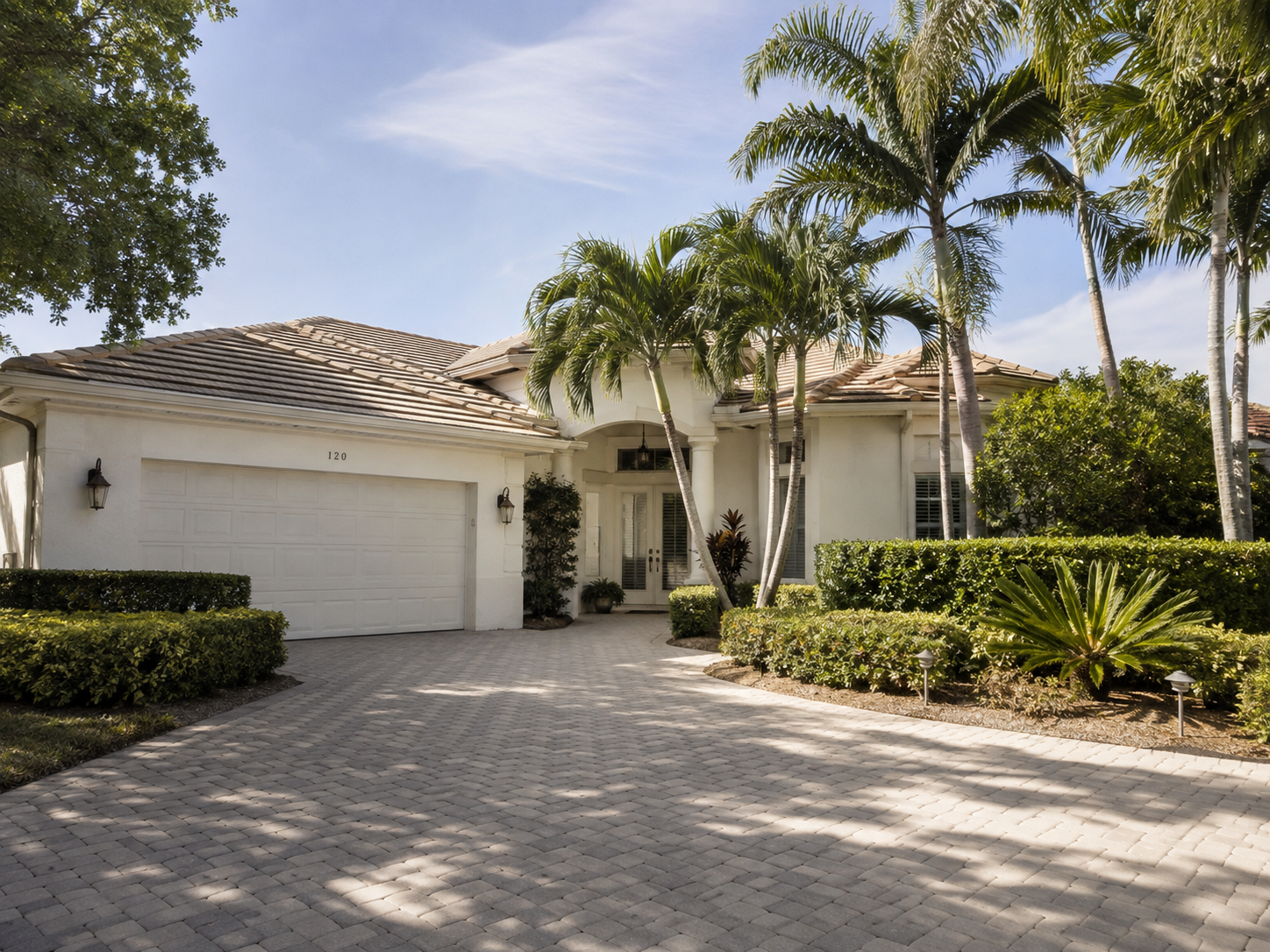
What Lower-Maintenance Actually Means in the Port St. Lucie Market
"Lower-maintenance" is a phrase that appears in listing descriptions and in community marketing along the corridor from Palm Beach County into Port St. Lucie. It carries no fixed definition. What it means — specifically, operationally, in terms of what a property actually asks of the person who owns it — has to be established one property at a time, and that is the version you need when you are standing in front of one particular house.
This article sets out a working definition and a method for applying it to a specific property. It is not a claim about what one market delivers and another does not. Lower-maintenance is a property-level condition. It is established by evidence about that property — its documented system ages, its governing documents, its inspection findings — not by the city name on the listing.
If you are weighing what that move would involve in sequence and structure, the Sell High, Buy Smart framework walks through how a Palm Beach County sale and a Port St. Lucie purchase are ordered relative to each other.
What a Single Repair Estimate Actually Puts in Front of You
If a specific number is what prompted this question — a roof estimate, an HVAC replacement quote, a pool resurfacing bid that arrived alongside an inspector's note about deck stress fractures — then the estimate itself is the smaller part of what you are deciding. A single expense is a one-time decision. What changes an ownership calculation is the schedule of decisions standing behind it.
That schedule is knowable, and it is worth separating from guesswork. Published service-life ranges for roofing, HVAC, water heaters and exterior coatings are national planning averages. They do not establish the remaining life of a particular system on a particular parcel. Environmental exposure varies from one property to the next; whether salt air, humidity or sun has meaningfully shortened the life of a specific condenser, coating or roof covering is an inspection finding, not a climate generalization.
What can actually be established about the home you own now, or one you are considering:
- The documented installation date of the roof, HVAC system, water heater and any major exterior coating — which, for permitted work, is evidenced by the permit record for that address.
- The service and repair history for each of those systems, to the extent records exist.
- A licensed inspector's or qualified contractor's assessment of present condition and remaining service life.
- Which of those items are scheduled to come due inside your intended ownership horizon, and which fall outside it.
That last line is the whole exercise. One repair is an expense. Four systems arriving inside the same five-year window is a different kind of decision, and it is the one worth making deliberately.
What "Lower-Maintenance" Should Mean When You Evaluate a Port St. Lucie Property
Port St. Lucie is a municipality in St. Lucie County, north of Palm Beach County along the I-95 and Florida's Turnpike corridor. Its residential inventory includes individually platted single-family homes that answer to no association at all, and master-planned communities operating under recorded declarations and association governance. Those are two different ownership environments rather than two versions of the same one: in the first, every exterior item is the owner's and there are no association records to read; in the second, the recorded declaration assigns responsibility between the association and the owner, and whatever reserve or funding documentation that particular association maintains — a reserve study where one exists — is what indicates how the association's own obligations are funded. Because both exist inside the same city limits, the city name on a listing establishes nothing about maintenance burden. The property does, and so do its recorded documents.
Which means the useful version of "lower-maintenance" is not a market comparison. It is a checklist of five categories, each of which has a document or an inspection behind it.
The Ownership Pressure Stack — The Five Categories That Determine Whether a Property Is Actually Lower-Maintenance
- Roof status. Not roof age as an impression, but the documented installation date, the covering type, and an inspector's assessment of remaining service life. Roof condition also carries underwriting consequences, which belong to a carrier and a licensed insurance professional to evaluate for the specific property.
- Association-maintained exterior items. In an association-governed community, some exterior responsibilities may sit with the association and some remain the owner's. Which is which is answered by the recorded declaration and the community's governing documents — not by the community's marketing. Request them, together with whatever reserve or financial documentation that association actually maintains. Ask specifically whether a reserve study exists for that community rather than assuming one does; where none is available, the funding question has to be answered from the documentation the association does provide.
- Lot and landscaping scope. Lot dimensions are in the property record. Landscaping obligations, permitted alterations and any required approvals are in the governing documents where a community is association-governed. Together they set the outer bounds of the recurring landscaping obligation — what is required of you, what is permitted, and what needs approval before you change it.
- Storm-preparation burden and wind mitigation. Which Florida Building Code edition applies to a home follows its permit date, and the wind-resistive features actually present are documented by a wind mitigation inspection. That inspection records which features exist. What preparing the property before a named storm actually involves — what has to be installed or moved, how long it takes, and who does it — is a separate question, answered by walking the specific property rather than by reading the inspection form. What a carrier credits for documented features is a matter for the carrier and a licensed insurance professional.
- Insurance and the rest of carrying cost. Insurance is underwritten and priced on property-specific factors. Treat it as a number to be quoted for the specific address by a licensed insurance professional before it enters your comparison — never as an assumption carried over from the home you own now.
Where Are You in This Decision?
If you have been circling this question rather than deciding it, the financial side is the part you can start putting real figures against — a current market assessment of what your Palm Beach County property would be expected to bring, and what a figure in that range would reach at the Port St. Lucie price point. Neither of those is a settled number: what a property actually brings is determined at sale and by what is negotiated on the way there, and what you could carry afterward depends on terms a lender approves and on the taxes, insurance and assessments quoted for a specific address. But a supported estimate you can work from is a different position than no figure at all.
The Sell High, Buy Smart framework is built for exactly that moment — when the thinking is mostly done and what is needed is a clear look at the actual numbers and the sequencing.
What Changes When the Property Sits in St. Lucie County Instead of Palm Beach County
Most of what determines maintenance burden is property-level, and the five categories above would read the same in either county. Four things are not property-level, and each one changes either how you verify a property or what it costs to hold once you own it.
- Where the permit record lives. Permits are issued by the authority with jurisdiction over the parcel — the municipality when the property sits inside city limits, the county when it does not. A Port St. Lucie address inside city limits is permitted by the City; a Palm Beach County property may be permitted by its municipality or by the county, depending on whether it sits in an incorporated area or in unincorporated Palm Beach County. Because the documented installation dates this entire evaluation rests on come from that record, confirm which office holds it for each specific address rather than assuming one office covers both sides of the move.
- Where the recorded documents live. A declaration, plat, and the parcel record for a St. Lucie County property are held by a different clerk and a different property appraiser than the offices holding the record for your current home. Request the declaration, the governing documents, and any reserve study or financial documentation the specific association maintains, from the source that holds them, rather than relying on the marketing materials that describe them.
- What the tax line on a listing is telling you. Under Florida's homestead assessment limitation, a long-tenured owner's assessed value can sit well below market value, and property is reassessed on a change of ownership. The tax figure shown on a Port St. Lucie listing reflects the current owner's position, not necessarily yours. Florida also provides for transferring an accumulated homestead assessment benefit to a new homestead, administered by the property appraiser for the county where the new homestead is established, subject to its own limits and filing requirements. A CPA or tax professional should evaluate how any of that applies to your situation, and the county property appraiser is the authority on the assessment itself.
- Who actually shows up. The vendor relationships you have built in Palm Beach County — the roofer, the AC company, the pool service, whoever puts up your shutters — do not automatically extend to an address north along the corridor. Whether a given vendor serves a St. Lucie County address is a question to ask each of them directly, and it belongs in the comparison before the move rather than after it.
None of those four changes what a specific property will ask of you week to week. They change how you verify it, and what it costs to hold once you do.
The Part That Is Measurable, and the Part That Is Not
Two different things change when a property's maintenance burden changes, and only one of them shows up on a spreadsheet.
The measurable part is carrying cost. Whether a move reduces yours depends on your net sale proceeds, the purchase price, your financing terms, the assessed value at purchase, the association assessment where one applies, and the insurance quoted for the specific property. Those inputs are not all the same kind of number, and the comparison only works if you keep them separated. Some can be quoted or documented for a specific address before you commit to anything: an insurance premium quoted by a licensed insurance professional, the assessment an association currently charges its owners, the documented system ages behind your repair schedule. Others stay estimates until something settles them — net proceeds depend on what the property actually sells for and on what is negotiated at closing; financing terms depend on what a lender is willing to approve after underwriting; the assessed value you will carry follows reassessment by the county property appraiser rather than the tax figure shown on the current listing. A quoted number and an estimate should not be added together as though they carry the same weight. What none of them is knowable from is a general comparison between two markets. A CPA or tax professional should evaluate the tax implications of your situation, and a lender should evaluate financing terms.
The part that is not measurable is the one this article's definition rests on: the number of recurring decisions a property requires you to keep making. Those decisions are specific and they are listable — whether to repair or replace a system that is near the end of its documented life, which vendor to schedule and when, whether a deferred item can wait another season, what to do about a renewal quote that arrived with conditions attached, what has to be done before a named storm and who is going to do it.
Any one of them, taken by itself, is a decision you could make and be finished with. Their weight comes from being always open — never fully resolved, never fully out of mind. And that is the distinction worth holding onto: lower-maintenance does not mean a shorter task list. It means fewer decisions that stay open in the background. A property with newer documented systems and clearly assigned association responsibilities closes more of those loops before you ever move in. A property without that documentation leaves them open regardless of what the listing calls it.
What This Means If You Own in Palm Beach County
The practical question is not whether one market is lower-maintenance than another in the aggregate. It is whether your own property has crossed the threshold where what it costs to hold — in money, in scheduled obligations, and in open decisions — is out of proportion to what it gives back.
That threshold is specific to you, and there is a way to test it rather than feel it out:
- List the ownership decisions your property has actually required of you in the last twenty-four months.
- List the ones you know are coming inside your intended ownership horizon, with the documented system ages behind each.
- Note which of those would still exist under an association-governed structure where exterior responsibilities are assigned by the declaration, and which would not.
- Put a supported current value estimate on the property, so the alternative side of the comparison stops being abstract.
Four lists. Whatever answer they produce is a better basis for the decision than any general statement about either market — including the ones in this article.
Frequently Asked Questions
Is Port St. Lucie actually lower-maintenance, or is that just a selling point?
Neither, as a blanket statement. Port St. Lucie contains both individually platted homes that answer to no association and association-governed communities, so the answer is property-specific rather than city-specific. A roof with remaining documented service life, exterior items assigned to an association by recorded declaration, and wind-resistive features confirmed present by inspection are conditions that can reduce what a property asks of an owner — but each of those is a condition of the property, established for one address by a document or an inspection. The documentation evidences the condition; it does not create it. Build year alone does not establish present condition or remaining service life. Evaluate the specific property through inspection, documented system ages and maintenance history, and review of the governing documents — along with any reserve study or other financial documentation that particular association maintains, which is worth asking about specifically rather than assuming is available.
How does the simultaneous sale and purchase actually work — do I have to sell before I can buy?
Not necessarily, and the answer depends on your equity position and financing rather than on a general rule. Whether a purchase can be written so that it depends on the sale of your current home — and what any such provision would obligate you to do — is a question about contract terms. How a specific provision is drafted and what legal effect it carries is a matter for a Florida real estate attorney and is not something a general article can settle for your transaction. What can be said on the real estate side is narrower: whether a particular seller accepts a given structure is negotiated case by case rather than guaranteed by market conditions, and what is workable at all depends on the financing terms a lender is willing to approve — which is why that conversation belongs early. A lender should evaluate your specific financing situation. Once the financing picture is defined, the sequencing of the two closings becomes a structuring question with a limited number of workable answers, which is what the sequencing framework is for.
What should I look at first — what my Palm Beach County home is worth, or what Port St. Lucie can offer at that price point?
Start with your own equity position — not because it settles the rest of the calculation on its own, but because it is the input you can put a supported figure against first, and without anyone else's participation. What price point is realistically available, whether financing is required, and what the resulting carrying cost would be also depend on terms a lender would approve and on the taxes, insurance and assessments quoted for the specific property. Until your equity figure is a supported estimate rather than a number in your head, the Port St. Lucie side of the comparison has nothing to be measured against — you would be shopping without a budget. A value assessment gives you that working estimate; it does not fix what the property will bring, which is settled by the market and by what is negotiated at closing. You can get a current value assessment for your Palm Beach County home here.
If no single moment announces that it is time to simplify, what there is instead is an accumulation of open decisions — the contractor call not yet returned, the renewal quote not yet read closely, the roof estimate sitting in a drawer with a date on it. The useful question is narrower than "should I move." It is: which of these decisions would stop occupying attention entirely, and which would follow me? When you are ready to answer that against real numbers, the Sell High, Buy Smart framework is where that conversation starts.