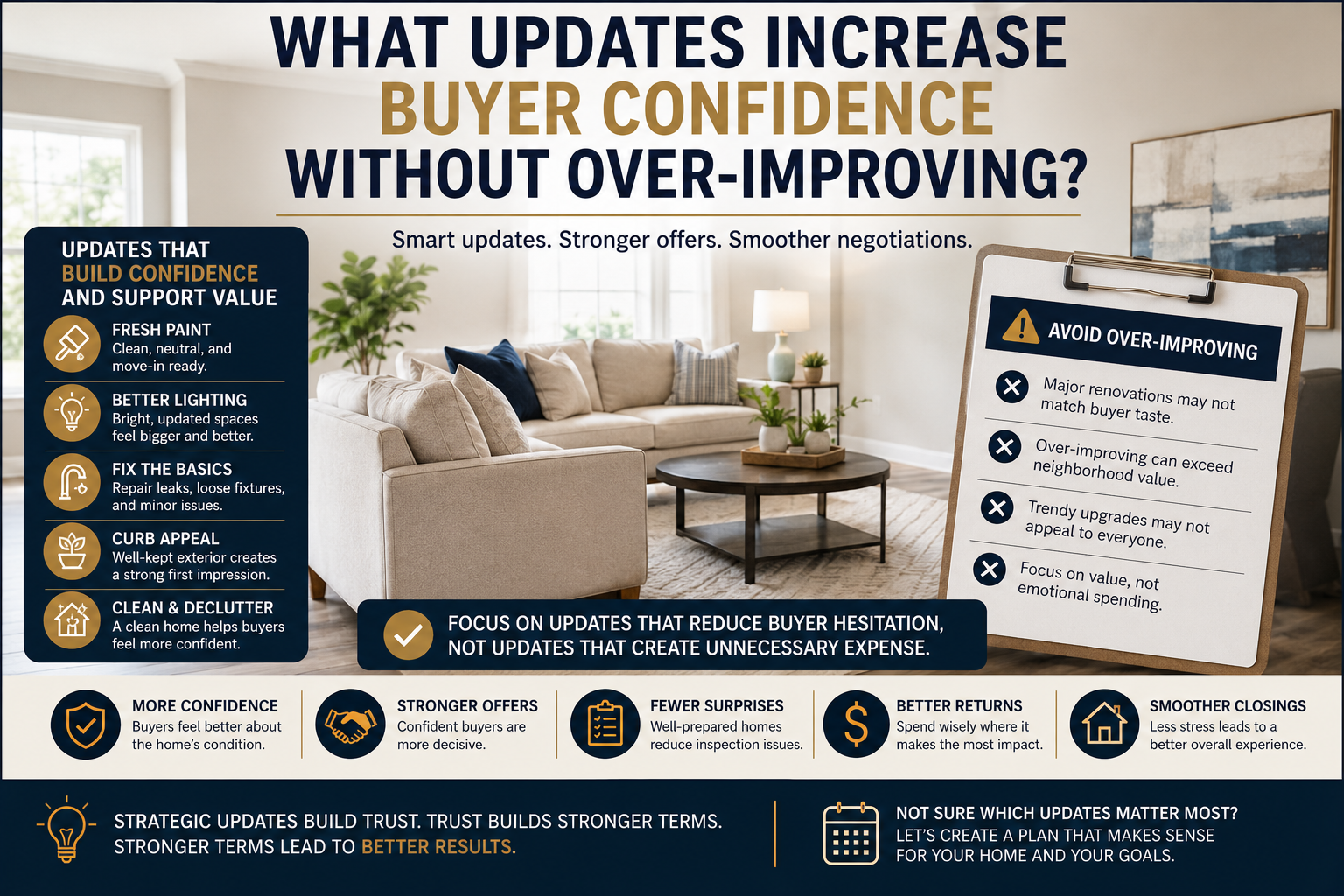
What Updates Increase Buyer Confidence Without Over-Improving?
Many homeowners preparing to sell become trapped between two fears. One is leaving visible problems unresolved and weakening buyer confidence. The other is spending large amounts of money on upgrades that never fully return their cost.
That tension creates confusion before the home even reaches the market.
Sellers often hear conflicting advice. One person recommends full renovation. Another insists buyers will remodel everything anyway. Online articles promote dramatic before-and-after transformations that may have little connection to the realities of a specific property, neighborhood, or buyer pool.
In practice, the strongest preparation strategy is usually more measured.
Most homes benefit more from selective improvements that reduce buyer hesitation than from emotionally driven renovation projects designed to chase perfection.
Buyer Confidence Usually Matters More Than Luxury-Level Upgrades
Many sellers assume buyers primarily care about high-end finishes or fully remodeled interiors. In reality, buyers often respond more strongly to signs that the home feels cared for, stable, functional, and responsibly maintained.
Confidence influences emotional comfort.
When buyers feel uncertain about maintenance, hidden costs, inspection exposure, or future repair obligations, negotiations usually become more cautious regardless of how visually attractive the home appears initially.
That is why smaller strategic improvements sometimes create more meaningful impact than expensive cosmetic remodeling.
Simple updates that improve cleanliness, consistency, lighting, maintenance visibility, and overall presentation can often calm buyer concerns before inspections begin.
For sellers trying to understand how preparation, pricing, inspections, and negotiation strength work together more broadly, our Seller Strategy and Execution hub explains how those decisions connect before listing.
Visible Maintenance Often Carries More Emotional Weight Than Style
Many buyers can tolerate outdated design more easily than visible neglect.
Worn paint, damaged trim, loose fixtures, stained surfaces, aging caulking, neglected landscaping, or inconsistent maintenance signals often create more emotional hesitation than kitchens or bathrooms that simply feel older stylistically.
That distinction matters because sellers frequently invest heavily in cosmetic modernization while overlooking the issues buyers quietly interpret as maintenance risk.
Buyers tend to ask themselves:
- Has the property been cared for consistently?
- Will hidden repairs appear later?
- How much additional work will ownership require?
- Could inspection issues become larger than expected?
Once uncertainty enters the buyer’s thinking, even attractive updates may lose some of their emotional influence.
Smaller Improvements Can Quietly Strengthen the Entire Showing Experience
Not every effective update is dramatic.
Sometimes buyer confidence improves because the home simply feels cleaner, brighter, more organized, and more stable emotionally.
Selective preparation may include:
- fresh paint in highly visible areas
- improved exterior presentation
- landscaping cleanup
- updated lighting
- minor fixture replacement
- decluttering
- deep cleaning
- correcting obvious deferred maintenance
Those improvements often help buyers emotionally relax inside the property. That calmer emotional response can affect:
- offer confidence
- inspection sensitivity
- pricing acceptance
- repair negotiations
- overall transaction stability
The goal is rarely perfection. The goal is reducing avoidable friction.
Over-Improving Can Create Unexpected Problems
Some homeowners unintentionally weaken their position by over-improving relative to the surrounding market.
Large renovation projects may create:
- budget expansion
- timeline pressure
- permit complications
- contractor delays
- design choices buyers may not prefer
- pricing expectations that exceed local support
In some situations, sellers complete expensive upgrades only to discover that buyers still compare the property against newer construction, differently updated homes, or competing inventory with stronger overall location advantages.
This is especially important in areas where buyer expectations differ significantly. A buyer evaluating homes in Boca Raton may respond differently to updates and finish quality than buyers competing in Jupiter, where lifestyle positioning, maintenance condition, and overall presentation may influence confidence differently.
Functional Confidence Usually Outperforms Cosmetic Flash
Many sellers underestimate how strongly buyers react to functional stability.
Roof condition, HVAC performance, plumbing reliability, electrical concerns, moisture exposure, maintenance consistency, and inspection preparedness often influence negotiations more heavily than decorative upgrades alone.
Buyers may admire cosmetic improvements while still negotiating aggressively if larger maintenance concerns remain unresolved.
By contrast, buyers sometimes accept older finishes more comfortably when the property feels:
- well maintained
- clean
- organized
- honestly presented
- mechanically stable
That is one reason sellers often benefit from understanding how buyers interpret inspection risk before deciding where preparation dollars should go.
Different Properties Need Different Preparation Strategies
Preparation should reflect the property itself rather than generic internet advice.
A larger family home may need different preparation than a smaller condo. An acreage property may carry different maintenance concerns than a newer suburban home. Older homes may require stronger maintenance clarity, while newer homes may face more direct comparison pressure from competing inventory.
Seller goals matter as well.
Some homeowners prioritize reducing stress and simplifying the process. Others want to maximize confidence before inspections begin. Some need to sell quickly. Others have flexibility to prepare more carefully over time.
That is why strong preparation strategy should remain:
- property-specific
- market-aware
- buyer-aware
- financially realistic
- emotionally sustainable
For homeowners evaluating how pricing and preparation affect negotiations together, it can also help to review how pricing strategy changes in a more competitive market.
Presentation Consistency Builds Emotional Stability
Buyers often interpret homes emotionally long before they analyze them logically.
If the property feels inconsistent — updated in some areas but neglected in others — buyers may become uncertain about overall care. That inconsistency can quietly affect confidence throughout the transaction.
Homes that feel visually and emotionally coherent often create smoother reactions during:
- showings
- inspections
- repair negotiations
- appraisal discussions
- closing preparation
This does not require luxury-level renovation. It requires reducing visible contradiction between:
- pricing
- condition
- presentation
- maintenance visibility
- buyer expectations
That emotional alignment frequently matters more than sellers realize before the property reaches the market.
Strategic Updates Should Reduce Stress, Not Create More
Preparation decisions become dangerous when sellers stop making strategic choices and begin reacting emotionally to pressure instead.
At that point, upgrades often expand beyond what the property realistically needs. Budgets grow. Timelines become stressful. Sellers begin chasing perfection rather than focusing on confidence, stability, and realistic positioning.
The strongest preparation plans usually feel calmer.
They focus on:
- reducing avoidable buyer hesitation
- improving maintenance visibility
- supporting inspection confidence
- creating emotional comfort during showings
- protecting negotiation stability
Not every home requires dramatic transformation before selling. Many simply require enough strategic preparation to help buyers feel more comfortable moving forward.
For sellers trying to understand how condition concerns affect negotiations later, it may also help to review what buyers actually focus on during inspections.
Review Which Updates Actually Strengthen Buyer Confidence
If you are deciding where to spend money before listing, it can help to separate meaningful preparation from unnecessary over-improvement. The goal is not to renovate blindly. The goal is to understand which updates may reduce buyer hesitation and create a more stable transaction.
- Review maintenance and presentation issues strategically
- Compare update costs against likely buyer response
- Understand where over-improving may create unnecessary expense
- Build a calmer preparation strategy before listing the property
Smarter preparation decisions usually create stronger buyer confidence later.
Frequently Asked Questions About Updating a Home Before Selling
Do I need to fully remodel my home before selling?
No. Many homes benefit more from selective preparation and maintenance improvements than large-scale remodeling. Buyers often respond more strongly to cleanliness, care consistency, and reduced uncertainty than to luxury-level cosmetic upgrades alone.
What updates usually improve buyer confidence most?
Visible maintenance improvements, fresh paint, landscaping cleanup, lighting improvements, decluttering, and correcting obvious deferred maintenance often improve buyer confidence more consistently than highly personalized renovations.
Can over-improving hurt the selling process?
In some situations, yes. Large renovation projects can create unnecessary expense, timeline pressure, and pricing expectations that may not align with the surrounding market or buyer priorities.
Why do buyers care so much about maintenance visibility?
Visible maintenance often shapes how buyers emotionally interpret risk. When homes appear well cared for, buyers are usually less likely to assume hidden problems exist behind the scenes.