When Insurance Becomes the Deciding Line
There is a particular kind of quiet that follows opening a renewal. Not alarm exactly — the household can meet it — but a recalculation happening somewhere behind the eyes. Nothing about the property changed. Nobody made a decision. The line moved anyway.
Insurance is not the only ownership line that can move without the household acting; taxes, assessments and the cost of maintenance can all shift for reasons outside the parcel. What distinguishes insurance is what it answers to. Taxes follow a published structure you can look up. Maintenance follows a schedule you influence. Assessments follow decisions made at the association level, set out in budgets and reserve documents where those are available to owners. Insurance answers to the building, its record, and conditions well outside the parcel — which is why, in our own experience with owners, it is the line within the total ownership load described in what this property actually costs you to own whose inputs are hardest to see coming.
In our own conversations with South Florida owners, the carrying-cost question now sometimes starts with insurance rather than with mortgage or taxes. Which raises a question worth answering deliberately rather than at renewal: what is this line actually responding to?
Why This Line Behaves Differently
Homeowners underwriting is not an assessment of you in the way consumer lending is. Its central subject is the structure, its exposure and its record — what it would cost to repair or rebuild, and how likely that is to be needed. Policyholder-specific inputs do enter the picture: prior claims on the property or by the applicant, the coverage limits and deductible structure chosen, and other applicant-related factors a carrier is permitted to use under its own filed guidelines and the applicable rating rules. Which of those inputs apply, and how they are weighted, is set by the individual carrier and the regulatory framework it operates under rather than by anything uniform across the market — which is why the same house can be read differently by two carriers, and why a licensed insurance professional is the right person to explain what applied in a specific case.
That has three consequences owners often feel without always naming. The first is that a strong household balance sheet does not, by itself, change what the carrier is reading in the property file. The second is that improvements which make a home nicer to live in and improvements which change how it underwrites are two different lists, overlapping only sometimes. The third is that the coverage figure and the property's market value are different measures answering different questions — replacement cost prices what it would take to rebuild the structure and generally excludes the land, while market value reflects what a buyer would pay for the whole property. The two can move independently, and a gap between them is not by itself evidence of an error. That distinction is worked through in three professionals looking at the same house.
One pattern we consistently observe: the insurance line is the one owners feel they are managing and are in fact largely responding to. The other lines answer to authorities an owner can at least look at in advance — a millage structure, a maintenance schedule, a board's budget and reserve documents. This one answers to the building, to the record attached to it, and to conditions around it, on terms set inside each carrier's own guidelines.
The Five Things Underwriting Reads
- The roof. Covering type, documented age and condition, how the deck is attached, how the roof connects to the walls, the geometry, and whether secondary water resistance is present. Florida's uniform mitigation verification inspection exists specifically to record these characteristics.
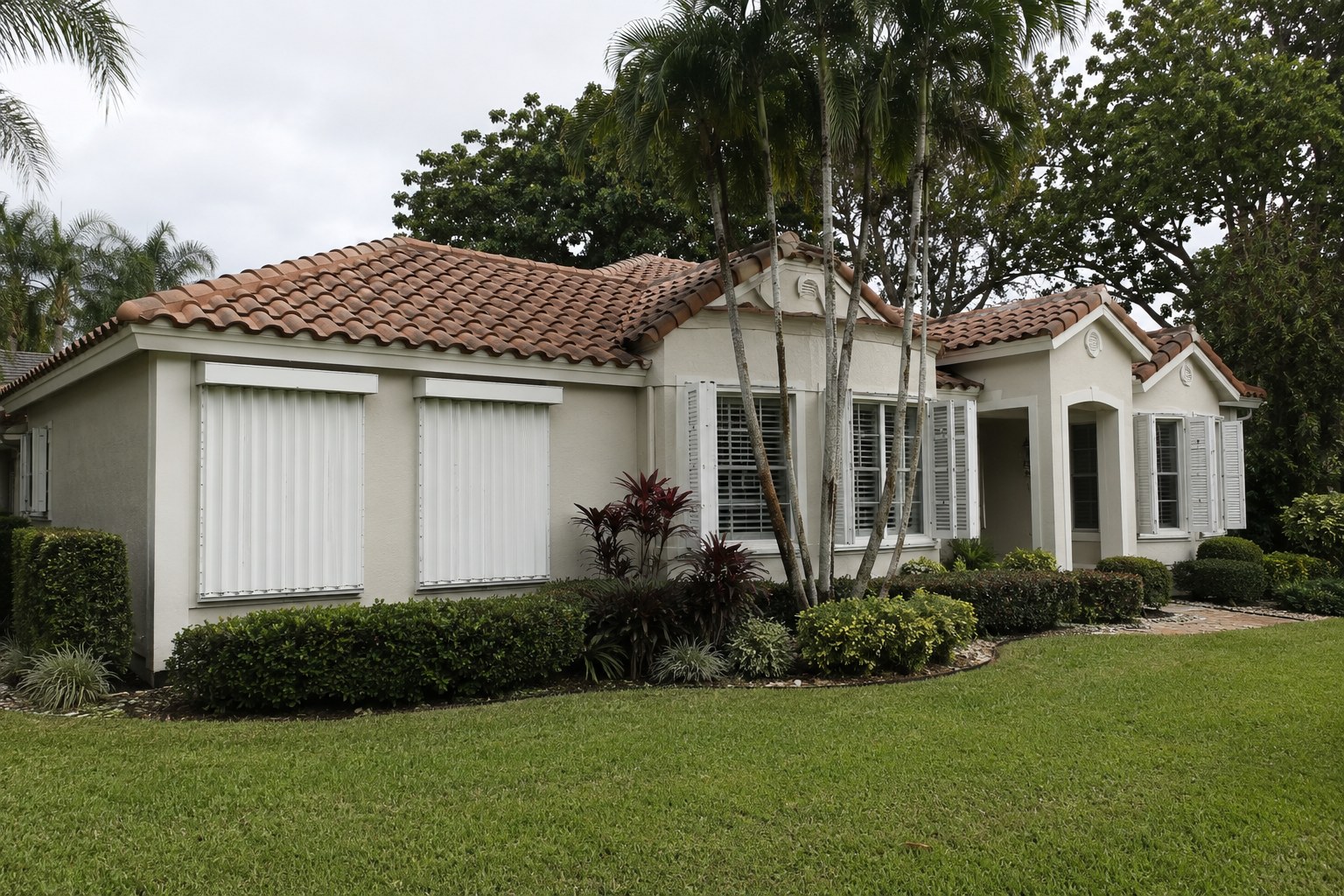
- The openings. Whether windows, doors and other openings carry protection, and of what kind. In our own conversations with owners on coastal and near-coastal property — in a coastal town such as Juno Beach, for instance — this is consistently part of the discussion rather than a detail that passes without comment.
- The water path. The mapped flood zone, elevation where an elevation certificate exists, and any prior water loss. Worth knowing plainly: flood is generally not covered by a standard homeowners policy at all — it comes through the federal programme or a private flood policy, as a separate contract.
- The systems and the structure's vintage. Electrical, plumbing and related systems, and how they were built. Lake Worth Beach, whose core neighbourhoods were laid out and built long before current code cycles, is one place where we routinely find this part of the file thin — the systems may well have been updated, but the paperwork showing when has not always travelled with the house.
- The record. Claims history — the property's and the applicant's, to the extent the carrier's guidelines take it into account — permits and their closeout status, and whether past work is documented at all. Work that is not documented is simply not evidenced in the file the carrier is reading. How a carrier responds to that gap — whether by requesting further information, by conditioning or declining coverage, by treating the component as unverified, or in some other way — is determined by that carrier's own guidelines and the applicable policy form, and is a question for a licensed insurance professional rather than something an owner should assume in advance.
One further factor sits outside the building entirely: rating commonly accounts for distance to a responding fire station and to a hydrant, which is why two structurally similar houses — one in a municipality, one on acreage out past Loxahatchee — can be read differently for reasons the owner cannot alter.
Is insurance drifting, or is it deciding?
An Ownership Sustainability Review looks at which line in your total load is moving fastest, and whether it is a line you can act on or one you can only absorb. That is a different question from whether the renewal is affordable. No obligation, and a decision to keep is a complete outcome of that conversation.
What an Owner Can Actually Influence
Some of the list above is fixed and some is not, and being clear about which is which prevents both wasted spending and misplaced resignation.
Documentation is the lever that requires no capital work. A current mitigation inspection records characteristics that may already exist on the structure but have never been evidenced to a carrier. That is not a claim that it will move a premium — what any given feature does to any given policy is between the carrier, the policy form and a licensed insurance professional, and nobody should promise otherwise. What can be said is narrower: a characteristic the carrier has no documentation of is not in the file the carrier is reading.
Capital work is the second lever, and it is the one where the ownership-economics framing matters. Roof work and opening protection are real capital events with their own cost, timing and disruption. They may also change how the structure underwrites. The mistake is to justify the spend on an assumed premium outcome; the sounder approach is to treat the underwriting effect as one input among several — alongside removing a failure risk, converting an unpredictable event into a scheduled one, and taking the monitoring off your plate. When improving genuinely reduces the load rather than just relocating it is the subject of when spending money reduces the load.
Policy structure is the third, and it is where the figure an owner carries in their head and the figure in the policy can quietly differ. The hurricane or windstorm deductible on Florida policies is commonly expressed as a percentage of the dwelling coverage limit rather than a flat amount, which means the out-of-pocket exposure after a named storm can be a different number entirely. Whether a loss settles on a replacement cost or actual cash value basis is a term of the policy, not a property fact, and it can differ by component. In Boca Raton's condominium ownership, and particularly in the coastal buildings, there is a further wrinkle: the windstorm exposure on the building itself sits with the association's master policy rather than with the unit owner's policy, so part of what an owner ultimately pays for that exposure arrives as an assessment rather than as a premium, and it responds to decisions made at the association level. Where the master policy stops and the unit owner's policy begins is set by the governing documents and applicable law — so "what am I covered for" is genuinely two questions, and the documents answer the first one.
What an owner is generally not in a position to change directly: the mapped flood zone as it currently stands, the distance to a station, the exposure of the location, and conditions in the wider insurance environment. Whether a particular mapping designation can be reviewed or amended in a specific case is a question for the relevant authority and a licensed insurance professional; for planning purposes, these are lines to absorb rather than manage.
When It Stops Being a Cost and Becomes a Decision
Most of the time insurance is a line item that moves. Occasionally it becomes the thing that decides, and the difference is worth naming before you are in it.
The threshold is not a number. It is when the line stops responding to anything you are willing or able to do — when the work that would change how the structure underwrites is disproportionate to the property's role in your life, or when the exposure is locational rather than structural and therefore not addressable at all. At that point insurance has stopped being an expense to manage and has become a characteristic of the asset, and the honest question moves from "how do I reduce this" to "is this the strongest use of the capital and capacity committed here".
That is a Keep, Improve, Reposition or Sell question, and all four remain genuinely open at that point. Keep is a complete outcome — an owner can look at it squarely and decide the property is worth what it asks, which is a materially different position from absorbing the same renewal without having examined it. Improve is the position where documentation and capital work are worth pricing properly. Reposition is worth naming because insurance characteristics travel with the structure and the location, not with the owner, and a different ownership form or a different exposure profile is a different underwriting picture.
In our own conversations with owners, the renewal is rarely the whole story. Sometimes the premium is the only question on the table. Sometimes it has arrived alongside a change in how the property is being used, or in how long it was meant to serve, and the owner describing a premium is also working through a question they have not yet put into words. The renewal is what makes the second question askable.
Common Questions
Will getting a wind mitigation inspection lower what I pay?
Nobody honest can tell you that in advance, and any specific promise about it should be treated with suspicion. What an inspection does is document characteristics of the structure — roof attachment, roof-to-wall connection, geometry, opening protection and so on — so that they can be taken into account. If those characteristics are not documented, the carrier has nothing on file to take into account. What effect the documented characteristics have on a particular policy is determined by the carrier, the policy form and current rating, and the person to ask is a licensed insurance professional. The inspection makes the conversation possible; it does not predetermine the outcome.
My premium went up and I have never made a claim. Why?
Because a claims-free record is one input among several rather than the whole picture. The structure's characteristics, the exposure of the location, the mapped flood zone, the coverage limits and deductible structure you carry, and the wider conditions carriers are operating under can all feed into rating, and several of those describe the property and its surroundings rather than you. Which of them applied in your case, and in what combination, is set by your carrier's own filed guidelines and the applicable rating rules — a licensed insurance professional can walk you through what moved. The useful response is not to relitigate the increase but to work out which parts of your file are documented, which are unknown, and which are locational and therefore not something you are in a position to change directly.
Is this a reason to sell?
On its own, no. A single renewal is one data point, and the question worth asking is directional — whether this line has been moving, how fast, and whether it responds to anything you can do. If it does respond, that is an Improve conversation with real numbers attached. If it does not, it is a characteristic of the asset rather than a problem to fix, and then it belongs in the wider assessment alongside the other lines rather than being decided on by itself. Keeping remains a complete answer at that point, provided it is one you have actually chosen.
In the conversations we have with owners, what makes this line hard is often not the money. It is a sense of lost agency — that a decision is being made about your house by people who have never seen it, on a schedule you did not set. Where an owner describes it that way, the description is not unreasonable: many of the inputs genuinely do sit outside the household. It is also worth separating from the actual question in front of you. You cannot negotiate with the exposure of a location or the year a roof was installed. You can decide, with a clear view of what is fixed and what is not, whether this property is still the right place for the capital and the attention it consumes. Making that call deliberately does not change the number on the next renewal. It changes whether the number is deciding for you. An Ownership Sustainability Review is where that view gets built.
About the Authors
Chris and Sue Kull work in real estate in Palm Beach County, Florida. The observations in this article are drawn from their own professional experience with owners and properties, and are not a substitute for advice from a licensed insurance professional.