Insights, strategy, and real estate guidance across Palm Beach County.

May 12, 2026

Why Buyers Connect With Delray Beach Faster Than Nearby

Palm-lined Delray Beach neighborhood street with mixed home styles, pedestrians, and natural South Florida residential atmosphere in daylight

Why Some Buyers Connect With Delray Beach Faster Than Nearby Alternatives

People searching for homes in South Florida often assume the decision will come down to square footage, price, or proximity to the water. Then they spend time in Delray Beach and realize the reaction is more immediate than that. Some buyers simply settle into the rhythm of the city faster than they do elsewhere nearby. That does not mean it works for everyone. In fact, the people who struggle with Delray Beach usually struggle for very specific reasons. But for buyers and owners who connect with it, the fit tends to feel less transactional and more behavioral.

That matters when discussing selling a home in Delray Beach FL because homeowners are not just selling a structure. They are often selling a version of daily life that buyers already understand emotionally before they fully explain it logically.

Compared with some surrounding areas, Delray Beach tends to create quicker emotional recognition. The city feels socially active without always feeling hurried. It feels established without becoming rigid. Buyers notice that balance early, especially those relocating from places where daily life feels either overly dense or strangely disconnected.

The City Feels Lived In Rather Than Manufactured

One reason certain buyers connect with Delray Beach faster is because the city rarely feels like it was designed all at once. Different parts of the area evolved differently, and that layered development changes how people experience it day to day.

Some neighborhoods feel walkable and socially connected. Others feel tucked away and quieter despite being minutes from activity. The transition between those environments is not always dramatic. Buyers who value flexibility in how they live tend to notice that immediately.

In conversations around Delray Beach homes for sale, people often describe a feeling that is difficult to reduce into a listing feature. The city supports routines that feel less isolated than some nearby suburban pockets while avoiding some of the constant intensity buyers experience farther south.

That balance creates faster emotional clarity for certain personalities. Particularly for buyers leaving larger metro environments, Delray Beach can feel socially alive without becoming operationally exhausting.

Explore Homes by City

If you're comparing areas, home types, or neighborhood environments, browsing homes by city can help put pricing and location tradeoffs into perspective.

Explore Homes by City

Ownership in Delray Beach Comes With Different Expectations

Buyers sometimes underestimate how much ownership psychology changes from one Palm Beach County city to another. Delray Beach owners often care deeply about lifestyle usability, not just resale metrics.

That changes how homes are maintained, renovated, and evaluated.

People moving into the city are frequently trying to create a certain kind of routine. They may want more walkability. They may want shorter transitions between work, dining, fitness, and social activity. They may want a home that supports connection rather than separation.

As a result, buyers can become unusually sensitive to layout friction, deferred maintenance, parking limitations, traffic flow, renovation quality, or neighborhood noise patterns. A home that works perfectly in another market may feel strangely disconnected here if it interrupts the lifestyle rhythm buyers are pursuing.

This becomes important for sellers because presentation strategy in Delray Beach is rarely just cosmetic. Buyers are trying to picture how the property supports daily behavior. That often shapes showing reactions more than homeowners initially expect.

Long-term owners also begin to notice how ownership responsibilities evolve differently here over time. Insurance expectations, aging infrastructure, seasonal traffic patterns, and property maintenance can affect how the city feels operationally after several years, particularly for owners transitioning into different life stages.

Some Buyers Prefer Nearby Alternatives for Very Practical Reasons

Not every buyer who likes Delray Beach ultimately chooses it.

That distinction matters.

Some buyers decide they want a quieter pace. Others realize they prioritize lower density, easier parking, less social activity, or different pricing structures. Buyers with highly routine-driven lifestyles sometimes feel more comfortable in cities where daily patterns feel more predictable.

That is where surrounding communities begin entering the conversation naturally. For example, buyers comparing Lantana homes for sale sometimes respond differently to the scale and pacing of the environment. The emotional reaction is often subtler. Less stimulation appeals to certain personalities, especially buyers prioritizing simplicity over activity.

The mistake some homeowners make when selling in Delray Beach is assuming every buyer is evaluating the city the same way. They are not. Some buyers are emotionally pulled toward the energy immediately. Others admire it while privately realizing they would not want to live inside that rhythm full time.

Understanding that distinction helps sellers interpret feedback more accurately.

Ownership Decisions in Delray Beach Often Become Lifestyle Decisions Faster

In some South Florida cities, homeowners evaluate real estate mostly through long-term financial logic. Delray Beach owners frequently evaluate through quality-of-life logic at the same time.

That changes buying and selling behavior.

People who move into the city often become highly aware of how the location affects their routines. A shorter drive to social activity changes weeknight behavior. A more connected environment changes how often people leave the house. Walkability changes how buyers think about weekends, fitness, dining, and even friendships.

At the same time, ownership can feel more emotionally tied to identity here than in more purely residential environments. Some homeowners stay longer than they expected because the city continues fitting their routine even after their housing needs change.

Others eventually reach the opposite conclusion.

The maintenance expectations, traffic patterns during season, cost increases, or evolving neighborhood dynamics may stop aligning with how they want to live moving forward. In those situations, reviewing home values and ownership options becomes less about timing the market and more about evaluating long-term compatibility.

That emotional shift is often gradual. Sellers rarely wake up suddenly wanting to leave Delray Beach. More often, they begin noticing subtle friction that did not bother them years earlier.

What This Means for Buyers and Sellers in South Florida

Buyers across Palm Beach County are becoming more behaviorally specific about where they want to live. The old assumption that location decisions revolve entirely around square footage and price has weakened. Buyers increasingly evaluate how cities affect stress levels, routines, flexibility, convenience, and emotional energy.

That trend helps explain why some buyers react strongly to Delray Beach while others quickly eliminate it despite appreciating the area.

For sellers, this means positioning matters more than generic marketing language. Buyers already understand the city has demand. What they are trying to determine is whether the property aligns with the lifestyle structure they are imagining for themselves.

It also means seller expectations need to remain realistic about buyer hesitation. Some buyers love the energy initially but become cautious once they think about parking, seasonal traffic, insurance costs, maintenance obligations, or future ownership complexity. That caution does not necessarily signal rejection. It often reflects buyers trying to evaluate long-term fit honestly.

The stronger listings in Delray Beach usually acknowledge the realities of ownership rather than pretending tradeoffs do not exist. Buyers tend to trust that approach more.

The Buyers Who Connect Fast Usually Share Certain Behavioral Traits

The people who tend to connect with Delray Beach quickly often value movement, flexibility, and environmental energy. They usually want their surroundings to feel active without requiring constant planning.

Many are comfortable with some unpredictability if the tradeoff creates more stimulation or social accessibility. They may tolerate seasonal congestion more easily because they value what the city gives them in return.

On the other hand, buyers who strongly prefer rigid quiet, highly controlled traffic flow, or deeply insulated residential environments sometimes struggle emotionally with Delray Beach even if they initially admire it.

That distinction is important because it affects long-term ownership satisfaction. A buyer who emotionally fits the city often stays engaged with the environment despite normal ownership frustrations. Buyers who never fully connect with the rhythm tend to become sensitive to inconveniences much earlier.

That behavioral fit also shapes resale dynamics. Homes positioned honestly within the context of the city tend to attract buyers who already understand what kind of environment they are choosing. Those buyers usually move forward with more confidence because the emotional expectation already matches the practical reality.

FAQ

Why do some buyers choose Delray Beach over nearby Palm Beach County cities?

Many buyers connect with Delray Beach because the city supports a more socially connected and active daily routine than some nearby alternatives. Buyers often respond to the combination of established neighborhoods, walkability, local activity, and flexible lifestyle patterns. Others prefer quieter environments with less movement and lower density. The decision usually becomes behavioral rather than purely financial because buyers are evaluating how the city will affect their day-to-day life long term.

What should homeowners understand before selling a home in Delray Beach FL?

Homeowners should understand that buyers in Delray Beach are often evaluating lifestyle compatibility as much as the home itself. Buyers pay attention to layout usability, maintenance condition, parking practicality, neighborhood rhythm, and how the property fits the routines they want to create. Sellers who position the home realistically and acknowledge ownership expectations tend to build more buyer trust than listings relying only on broad marketing language or generic luxury presentation.

Keep Exploring South Florida Real Estate

If you're comparing communities, evaluating lifestyle tradeoffs, or trying to better understand how different parts of South Florida align with your long-term goals, reviewing additional local resources can help create clearer perspective.


About the Authors

Chris and Sue Kull are South Florida real estate professionals with more than three decades of experience helping buyers, sellers, and property owners navigate real estate decisions throughout Palm Beach County and surrounding communities.


May 12, 2026

The Hidden Cost of Maintaining a Larger Florida Home Now

Hidden Cost of Maintaining a Larger South Florida Home

The Hidden Cost of Maintaining a Larger Home in South Florida

A larger home can feel like security for many years. There is room for family, guests, storage, hobbies, and the life that was being built at the time. But in South Florida, the cost of keeping a bigger house rarely stays limited to the mortgage payment. Over time, the work spreads into roof concerns, insurance pressure, landscaping, storm preparation, aging systems, pool care, exterior maintenance, and the quiet mental load of always having something else to handle. For many homeowners, the real issue is not one repair or one bill. It is the accumulation. The house may still be valuable. It may still be loved. It may even still make sense on paper. But when ownership starts requiring more energy than the home gives back, the decision becomes more personal than financial.

The Cost Is Not Always Obvious at First

The hidden cost of maintaining a larger home in South Florida often shows up slowly. A homeowner may notice the lawn service increased, then the insurance premium changed, then the air conditioner needed attention, then a roof inspection raised new questions. None of these moments alone may feel like a reason to move.

Together, they begin to change the way the home feels.

A larger property usually has more surface area to protect, more systems to monitor, more rooms to cool, more landscaping to manage, and more exterior exposure to weather. In neighborhoods around Lake Worth homes for sale, this can be especially noticeable when older homes, larger lots, mature trees, and long-term ownership all overlap. The home may have served its purpose beautifully for years, but the upkeep rhythm can become harder to ignore.

That is when the question changes from “Can I afford this?” to “Do I still want to keep carrying this much?”

Maintenance Fatigue Is Different From a Maintenance Problem

A maintenance problem is specific. Something breaks, gets inspected, gets repaired, or gets replaced.

Maintenance fatigue is different. It is the feeling that the home always needs attention. One project finishes and another appears. The pool pump, gutters, irrigation, driveway, roof, windows, fascia, appliances, electrical panel, landscaping, or storm shutters each become part of a running list that never fully clears.

South Florida adds another layer because ownership is not passive here. Heat, humidity, wind, rain, pests, salt air in some areas, insurance inspections, and hurricane preparation all place demands on a home. Even when nothing dramatic happens, the homeowner often feels responsible for staying ahead of what could happen.

Before making any decision, many homeowners want to understand the current value of the home they are maintaining. A clear estimate from a local professional can help separate emotion from numbers, especially when weighing repair costs against equity; that is why reviewing a South Florida home value can become an important first step.

If You’re Thinking About Moving, It Usually Starts Here

Most homeowners don’t randomly decide to move. It builds over time. If you’re starting to think about selling and moving into something newer or easier to maintain, it usually comes down to one of these situations. Choose the one that feels closest to you.

Your home is starting to feel like too much to manage →

Maintenance, repairs, or simply keeping up with everything may be taking more time and energy than you want to keep giving.

You’re trying to make a smarter financial move →

You may be thinking about reducing expenses, using your equity differently, or moving into a home that fits your long-term plans better.

You want something newer, simpler, and easier to live in →

Many homeowners reach a point where they want less maintenance, a more efficient layout, and a home that feels easier day to day.

The Larger the Home, the More Ownership Spreads

A bigger home does not only mean more square footage. It often means more decisions. More roofline. More windows. More flooring. More plumbing runs. More landscaping zones. More areas that need cooling, cleaning, monitoring, and updating.

That spread matters.

In South Florida, even normal ownership can feel active. Homeowners may think about shutters before storm season, tree trimming before heavy weather, moisture control during humid months, and insurance requirements when renewals come around. A larger home can turn those responsibilities into a recurring operational system.

Some homeowners in and around Royal Palm Beach homes for sale begin comparing the effort required by their current property with the possibility of a newer or more manageable home. That does not mean they are ready to sell immediately. It means they are starting to measure ownership differently.

The question becomes less about size and more about fit.

When the House Still Works but the Energy Cost Changes

One of the hardest parts of this decision is that nothing has to be “wrong” with the home.

The neighborhood may still be good. The floor plan may still be familiar. The memories may be strong. The value may be meaningful. That is why many homeowners delay even thinking about a move. They feel like the home needs to become a problem before they are allowed to question it.

But fatigue often arrives before crisis.

It shows up when projects feel heavier than they used to. It appears when another repair estimate creates more irritation than surprise. It becomes clear when the idea of updating, preparing, cleaning, maintaining, and protecting the house creates more stress than comfort.

At that point, the practical question is not whether the home is good or bad. It is whether keeping it still supports the way life works now.

What This Means for Buyers and Sellers in South Florida

For sellers, this kind of fatigue can be an early signal that it is time to evaluate options before the home demands a rushed decision. Waiting until multiple repairs pile up, insurance pressure worsens, or preparation feels overwhelming can limit flexibility. A calmer review of value, condition, timing, and next-home options often creates a better decision environment.

For buyers, the same issue matters from the other side. A larger South Florida home may look appealing, but the real cost includes maintenance patterns, insurance exposure, system age, roof condition, landscaping responsibility, and long-term usability. Buyers are not only purchasing rooms. They are inheriting an ownership structure.

This is where many homeowners have their realization moment: the home may still be valuable, but the lifestyle cost of keeping it may no longer match the life they want. For owners who are starting to feel that pressure, exploring a move from a high-maintenance home into something easier through the fatigue move pathway can help turn vague stress into a more organized decision.

The Most Expensive Part May Be Waiting Too Long

Not every homeowner who feels tired of maintenance should move. Some should repair, refresh, reorganize, or simply create a better plan for the home they already own.

Still, waiting without clarity can become expensive.

When a homeowner postpones the conversation for years, deferred maintenance may grow. Market conditions may shift. Insurance questions may become more difficult. The next home may become more expensive. Energy may run lower. What once could have been handled thoughtfully may begin to feel forced.

South Florida homeowners often benefit from looking at the decision before they are emotionally drained. That does not mean rushing to list. It means understanding what the home is worth, what it may need, what it costs to keep, and what a simpler ownership setup could look like.

Clarity is not pressure.

It is protection.

FAQ

How do I know if my larger South Florida home is becoming too much to maintain?

A larger home may be becoming too much to maintain when the work feels constant instead of occasional. Warning signs include repeated repair lists, rising service costs, stress before storm season, rooms or spaces you no longer use, and a sense that the home takes more energy than it gives back. The decision is not only financial. It is also about whether the property still supports your current lifestyle, time, comfort, and long-term plans.

Should I repair my home before deciding whether to sell?

Some repairs may protect value, while others may not return enough to justify the time, cost, or stress. Before spending heavily, it helps to understand the home’s current value, likely buyer concerns, inspection issues, and how the property compares with newer or lower-maintenance options. In many cases, the better first step is not immediately repairing everything. It is getting a realistic view of condition, equity, timing, and buyer expectations.

Keep Exploring South Florida Real Estate

If you're trying to better understand whether staying, selling, or simplifying makes sense, exploring more South Florida real estate guidance can help create clarity before making a major decision.


About the Authors

Chris and Sue Kull are South Florida real estate professionals with more than three decades of experience helping homeowners, buyers, sellers, and relocating families navigate real estate decisions throughout Palm Beach County and surrounding communities.

May 11, 2026

How Preparation, Timing, and Presentation Affect Negotiation Strength

Palm Beach County seller strategy image focused on preparation quality, presentation consistency, market timing, buyer confidence, and negotiation strength before listing a home for sale.

How Preparation, Timing, and Presentation Affect Negotiation Strength

Many sellers think negotiation strength begins when offers arrive. In reality, the emotional tone of negotiations is often established much earlier through preparation quality, market timing, presentation consistency, pricing alignment, and buyer confidence long before formal negotiations even start.

Homes that feel organized, realistically positioned, and thoughtfully prepared usually create a different emotional response than homes that feel rushed, uncertain, overpriced, or inconsistently maintained.

That emotional difference matters because buyers negotiate differently when they feel confident moving forward.

Preparation, timing, and presentation do not guarantee a perfect transaction. They do, however, influence how much uncertainty buyers carry into the process — and uncertainty is often what weakens negotiation stability most aggressively.

Buyers Begin Negotiating Emotionally Before Offers Exist

Most buyers form impressions of negotiation flexibility long before formal numbers are discussed.

They evaluate:

  • property condition
  • presentation quality
  • pricing realism
  • maintenance visibility
  • market competitiveness
  • seller preparation consistency
  • overall emotional confidence

while touring the property itself.

If the home feels neglected, overpriced, rushed, or uncertain, buyers often begin mentally preparing for future concessions before inspections even occur.

By contrast, homes that feel stable and thoughtfully prepared frequently create calmer negotiation expectations from the beginning.

For homeowners trying to understand how inspections, pricing, deferred maintenance, and preparation all interact more broadly before listing, our Seller Strategy and Execution hub explains how those decisions shape transaction stability together.

Timing Can Quietly Influence Buyer Leverage

Timing affects negotiation strength more than many sellers realize.

A seller entering the market before preparation is complete may unintentionally weaken buyer confidence immediately. Incomplete repairs, rushed presentation, inconsistent staging, unresolved maintenance concerns, or poor listing readiness can create emotional hesitation that becomes difficult to reverse later.

At the same time, waiting too long while chasing perfection can create a different type of pressure.

Markets change. Competing inventory shifts. Buyer expectations evolve. Sellers sometimes become trapped inside endless preparation cycles that create stress without meaningfully improving negotiation position.

The strongest timing strategies usually balance:

  • market conditions
  • property readiness
  • buyer expectations
  • maintenance clarity
  • emotional sustainability for the seller

rather than focusing only on theoretical optimization.

Presentation Influences Emotional Confidence Immediately

Presentation is not only about aesthetics. It is about emotional stability.

Buyers often interpret homes emotionally before they analyze them financially. Cleanliness, lighting, organization, maintenance visibility, landscaping, layout flow, and overall care consistency all contribute to whether buyers feel comfortable moving forward.

That comfort affects negotiation psychology.

When buyers feel emotionally secure inside the property, they are usually:

  • less inspection-sensitive
  • less defensive during negotiations
  • less focused on future ownership fear
  • more willing to accept imperfections calmly
  • more emotionally connected to the home itself

By contrast, homes that feel inconsistent or uncertain often trigger more aggressive buyer behavior later in the transaction.

Rushed Preparation Often Creates Inspection Vulnerability

One of the most common ways sellers weaken negotiations is through rushed preparation immediately before listing.

Incomplete repairs, cosmetic patchwork, visible shortcuts, unresolved maintenance concerns, or hurried presentation decisions often create emotional suspicion once buyers begin inspecting the home more carefully.

Buyers tend to notice inconsistency quickly.

If some areas feel highly updated while others show visible neglect, buyers frequently begin wondering whether important issues were hidden or deferred intentionally.

That emotional suspicion can change:

  • inspection negotiations
  • repair requests
  • pricing confidence
  • overall transaction stability

before major inspection findings even appear.

For sellers evaluating whether selective updates may strengthen confidence without creating unnecessary renovation pressure, it may also help to review which updates increase buyer confidence without over-improving.

Preparation and Pricing Must Feel Emotionally Aligned

One of the fastest ways sellers lose negotiation leverage is when pricing feels disconnected from the condition and preparation level of the home.

Buyers compare properties emotionally before they justify pricing mathematically.

If buyers believe:

  • maintenance concerns exist
  • presentation feels inconsistent
  • repairs appear incomplete
  • the property feels less prepared than nearby competition

then even reasonable pricing may feel emotionally unsupported.

That is especially important in areas where buyers have multiple comparable options available. A buyer evaluating homes in Delray Beach may compare preparation quality, emotional presentation, and visible maintenance consistency very differently than buyers evaluating acreage flexibility in The Acreage.

Strong negotiation positioning usually depends on alignment between:

  • price
  • condition
  • preparation
  • market competition
  • buyer expectations

Inspection Reports Amplify Existing Emotional Concerns

Inspection reports rarely exist in isolation emotionally.

Buyers interpret inspection findings through the emotional framework they already formed during showings. If the home initially felt well maintained and stable, buyers often process inspection concerns more calmly.

If the home already felt uncertain, rushed, or inconsistently prepared, inspection findings tend to feel emotionally larger.

This is why negotiation stability often depends more on early confidence than sellers expect.

Minor concerns can escalate quickly when buyers already suspect:

  • hidden maintenance problems
  • future ownership stress
  • larger repair exposure
  • insurance complications
  • overall seller inconsistency

That emotional escalation frequently affects negotiations more than the actual repair cost itself.

For homeowners trying to understand how deferred maintenance shapes buyer psychology before inspections begin, it may also help to review what deferred maintenance signals to buyers before listing.

Over-Preparing Can Create Different Problems

Not every seller benefits from aggressive preparation or long renovation timelines before listing.

Some homeowners become trapped chasing perfection while:

  • expenses increase
  • timelines stretch
  • stress compounds
  • market conditions shift
  • buyer preferences evolve

Eventually the preparation process itself becomes emotionally destabilizing.

The strongest seller strategies usually focus on reducing avoidable buyer hesitation rather than trying to create flawless perfection.

That may involve:

  • cleaner presentation
  • maintenance visibility improvements
  • selective repairs
  • better organization
  • pricing alignment
  • clearer inspection awareness

without turning the property into a major construction project before selling.

Negotiation Strength Is Usually Built Before Listing Day

The strongest negotiation outcomes are rarely created through aggressive tactics after offers arrive.

They are usually created earlier through calmer preparation, realistic positioning, maintenance clarity, pricing alignment, and stronger emotional confidence during the buyer’s initial experience with the property.

When preparation, timing, and presentation work together effectively, buyers often enter negotiations feeling more secure instead of defensive.

That emotional stability can influence:

  • offer strength
  • inspection reactions
  • repair negotiations
  • pricing flexibility
  • overall transaction smoothness

long before closing ever approaches.

Strengthen Negotiation Position Before the Home Hits the Market

If you are preparing to sell, it can help to evaluate how timing, presentation, maintenance visibility, and preparation quality may influence buyer confidence before negotiations begin. Strong leverage usually starts earlier than most sellers expect.

  • Review preparation issues that may weaken buyer confidence
  • Understand how presentation affects negotiation psychology
  • Compare preparation timing against market positioning
  • Build a calmer seller strategy before listing begins

The strongest negotiations often begin with stronger preparation long before the first offer arrives.

Review the Preparation Strategy

Frequently Asked Questions About Preparation and Negotiation Strength

How does preparation affect negotiation strength?

Preparation influences buyer confidence. Homes that feel well maintained, realistically priced, and thoughtfully presented usually create calmer negotiations because buyers perceive less uncertainty and future ownership risk.

Can rushed preparation hurt the transaction later?

Yes. Incomplete repairs, inconsistent updates, visible shortcuts, or rushed presentation often create emotional suspicion that can weaken inspection negotiations and overall transaction stability.

Why does presentation matter so much to buyers?

Buyers often respond emotionally before analyzing a property logically. Cleanliness, maintenance visibility, organization, lighting, and overall care consistency strongly influence how secure buyers feel moving forward.

Should sellers delay listing until everything feels perfect?

Not necessarily. Over-preparing can create unnecessary expense, timeline stress, and emotional exhaustion. Strong preparation is usually about reducing avoidable buyer hesitation rather than achieving flawless perfection.

May 11, 2026

What Sellers Should Understand About Deferred Maintenance Before Listing

Palm Beach County seller strategy image focused on deferred maintenance, buyer psychology, inspection sensitivity, pricing confidence, and negotiation stability before listing a home for sale.

What Sellers Should Understand About Deferred Maintenance Before Listing

Deferred maintenance affects more than the physical condition of a home. It affects how buyers emotionally interpret risk before negotiations even begin.

Many sellers assume buyers will simply calculate repair costs rationally and move forward accordingly. In reality, visible maintenance issues often create emotional uncertainty that extends far beyond the actual cost of the repair itself.

A home can still be highly livable and functionally sound while quietly creating hesitation during showings, inspections, and negotiations because buyers begin wondering what other problems may exist beneath the surface.

That is why deferred maintenance deserves careful attention before listing — not because every issue must be repaired, but because buyer confidence is strongly influenced by how maintenance condition is perceived overall.

Buyers Often Use Visible Clues to Estimate Hidden Risk

Most buyers are not contractors, inspectors, or construction experts. They rely heavily on visible signals when trying to estimate how well a property has been maintained over time.

Water stains, worn exterior paint, damaged trim, neglected landscaping, aging caulking, cracked surfaces, loose fixtures, or inconsistent upkeep may appear relatively minor individually. Together, however, they can create an emotional impression that larger hidden concerns may exist behind the scenes.

Once buyers begin interpreting the property through that lens, every additional issue uncovered during inspections tends to feel larger emotionally.

This reaction is psychological as much as financial.

Buyers naturally ask themselves:

  • What else has not been maintained?
  • Will additional costs appear later?
  • Could inspection surprises become more serious?
  • Has the property been cared for consistently?
  • How much future work will ownership require?

That emotional uncertainty often shapes negotiations more than sellers realize.

For homeowners trying to understand how preparation, inspections, leverage, and pricing work together more broadly before listing, our Seller Strategy and Execution hub explains how those decisions connect throughout the selling process.

Deferred Maintenance Does Not Automatically Mean Major Problems

One of the biggest mistakes sellers make is assuming visible maintenance concerns automatically destroy the value of the home.

That is rarely true.

Most buyers expect some imperfections, especially in older homes or properties that have been occupied for many years. The issue is not whether the property is flawless. The issue is whether buyers feel confident about the overall level of care.

A well-maintained older home with some visible aging often creates stronger buyer confidence than a newer-looking property that feels inconsistently maintained or poorly cared for beneath the surface.

Buyers tend to distinguish between:

  • normal aging
  • visible neglect
  • functional concerns
  • ownership care consistency
  • larger maintenance risk

That distinction becomes important once inspection negotiations begin.

Visible Maintenance Influences Pricing Psychology

Deferred maintenance often affects pricing indirectly through buyer confidence.

Even when sellers believe pricing is mathematically reasonable, buyers may still emotionally discount the home if visible maintenance creates uncertainty about future ownership cost.

For example, buyers may quietly factor in:

  • future repair exposure
  • insurance concerns
  • inspection negotiations
  • contractor coordination
  • ownership stress
  • unexpected maintenance surprises

before deciding how aggressively to pursue the property.

That emotional calculation frequently affects:

  • offer strength
  • concession expectations
  • repair requests
  • inspection sensitivity
  • overall negotiation stability

For sellers trying to understand how pricing strategy changes when buyers become more selective, it may also help to review how pricing strategy changes in a more competitive market.

Not Every Deferred Maintenance Issue Requires Repair

Preparation should remain strategic.

Some maintenance concerns deserve attention before listing because they create visible emotional resistance during showings or inspections. Others may not justify the cost, timeline, or disruption required to repair them before selling.

The challenge is knowing which category each issue belongs to.

In many situations, sellers benefit more from:

  • improving cleanliness
  • reducing visual clutter
  • correcting obvious maintenance concerns
  • improving presentation consistency
  • pricing realistically
  • understanding likely inspection reactions

than from beginning large renovation projects with uncertain return.

The strongest preparation plans usually reduce buyer hesitation without creating unnecessary emotional or financial strain for the seller.

Deferred Maintenance Feels Different in Different Markets

Buyer reactions to maintenance visibility vary depending on property type, price range, neighborhood expectations, and competing inventory.

A buyer evaluating homes in Palm Beach Gardens may react differently to visible maintenance concerns than buyers evaluating acreage properties in Loxahatchee, where land use, outbuildings, fencing, drainage, and overall property maintenance may shape buyer expectations differently.

Likewise, luxury buyers, relocation buyers, investors, and first-time buyers often evaluate deferred maintenance through very different emotional frameworks.

That is why seller preparation should remain:

  • market-aware
  • buyer-aware
  • property-specific
  • financially realistic
  • emotionally practical

Generic advice rarely captures the full psychology behind how buyers interpret maintenance condition.

Inspection Reports Amplify Existing Buyer Concerns

Inspection reports often become emotionally larger when buyers already entered the transaction expecting maintenance problems.

If visible deferred maintenance was apparent during showings, buyers frequently approach inspections already anticipating negative findings. Once the inspection confirms even a few concerns, emotional reactions tend to intensify quickly.

Minor findings may suddenly feel like evidence of broader ownership risk.

This does not mean sellers must eliminate every imperfection before listing. It means sellers benefit from understanding which visible maintenance issues are likely to shape buyer expectations before inspections begin.

That awareness often creates calmer negotiations later because fewer concerns feel emotionally surprising to the buyer once escrow begins.

Long-Term Homeowners Often Experience Maintenance Differently

People naturally stop noticing certain condition issues after living in a property for many years.

What feels familiar to the seller may feel uncertain to a buyer seeing the home for the first time.

At the same time, some sellers become emotionally overwhelmed by maintenance concerns and begin assuming every visible issue requires expensive correction before listing.

Both reactions can create problems.

The strongest seller strategies usually come from stepping back and evaluating:

  • which issues truly affect buyer confidence
  • which concerns may create inspection sensitivity
  • which repairs improve stability
  • which updates may not justify the cost

That clearer perspective often helps sellers avoid unnecessary stress while still protecting negotiation position.

For homeowners deciding whether preparation or as-is positioning makes more sense overall, it may also help to review whether selling as-is or preparing the home first creates a stronger outcome.

Preparation Is Usually About Stability, Not Perfection

The strongest preparation strategies are rarely built around trying to create a flawless property.

They are usually built around reducing avoidable uncertainty.

When buyers feel more confident about:

  • maintenance consistency
  • inspection expectations
  • future ownership exposure
  • pricing alignment
  • overall property care

the transaction often becomes calmer from the very beginning.

Deferred maintenance should not automatically trigger panic or massive renovation projects. It should trigger a thoughtful evaluation of which concerns are likely to influence buyer psychology most strongly before the home reaches the market.

Understand Which Maintenance Concerns Actually Affect Buyer Confidence

If you are preparing to sell, it can help to evaluate deferred maintenance strategically before deciding what to repair, what to improve, and what may not require immediate attention. The goal is not perfection. The goal is reducing avoidable uncertainty that may weaken buyer confidence later.

  • Review visible maintenance concerns through buyer perspective
  • Understand how deferred maintenance affects pricing and negotiations
  • Compare repair priorities against likely buyer reactions
  • Build a calmer preparation strategy before listing the property

Smarter preparation decisions often create stronger negotiation stability later.

Review the Property Condition Strategically

Frequently Asked Questions About Deferred Maintenance Before Selling

Does deferred maintenance automatically lower a home’s value?

Not necessarily. Most buyers expect some imperfections, especially in older homes. The larger issue is usually how maintenance condition affects buyer confidence, inspection expectations, and emotional perception of future ownership risk.

Should every visible maintenance issue be repaired before listing?

No. Some issues deserve attention because they create strong buyer hesitation, while others may not justify the cost or disruption required to repair them before selling. Preparation decisions should remain strategic rather than emotional.

Why do buyers react strongly to visible maintenance concerns?

Buyers often use visible maintenance signals to estimate hidden risk. Multiple small issues together may create emotional concern about future repairs, inspection surprises, or overall ownership cost.

Can deferred maintenance affect negotiations even before inspections?

Yes. Buyers frequently begin forming emotional opinions about maintenance condition during showings. That early perception can influence pricing sensitivity, offer confidence, and negotiation behavior later in the transaction.

May 11, 2026

How Pricing Strategy Changes in a More Competitive Market

Palm Beach County seller strategy image focused on pricing psychology, buyer comparison behavior, market competition, preparation quality, and negotiation leverage before listing a home for sale.

How Pricing Strategy Changes in a More Competitive Market

Many homeowners assume pricing is mostly about choosing a number based on nearby sales. In reality, pricing strategy changes significantly when buyers become more selective, inventory increases, or competing properties begin creating stronger comparison pressure.

In more competitive conditions, pricing is no longer simply about value. It becomes deeply connected to buyer psychology, presentation quality, preparation strategy, maintenance visibility, inspection expectations, and the emotional confidence buyers feel while evaluating the property.

A home may technically support a certain price range and still struggle if buyers believe competing options create less uncertainty, stronger presentation, or better overall positioning.

That is why pricing strategy must adapt to the market environment itself rather than relying only on historical sales data.

Buyers Compare Emotionally Before They Compare Mathematically

Many sellers think buyers evaluate homes through spreadsheets and exact pricing logic. Most buyers begin much earlier than that emotionally.

They compare:

  • overall condition
  • presentation consistency
  • maintenance visibility
  • layout functionality
  • emotional comfort
  • future repair exposure
  • inspection risk perception

before they fully rationalize pricing differences.

This becomes especially important when buyers can easily compare multiple similar homes within the same market.

A property that feels overpriced relative to its condition often creates immediate emotional resistance. Once buyers begin viewing the listing through that lens, negotiations usually become more difficult later.

For homeowners trying to understand how preparation, inspections, leverage, and buyer psychology all connect before listing, our broader Seller Strategy and Execution guidance explains how those decisions influence pricing strength together.

Competitive Markets Punish Uncertainty More Aggressively

When buyers have more options, uncertainty becomes more expensive.

Visible deferred maintenance, inconsistent preparation, unclear pricing logic, aging systems, inspection-sensitive concerns, or emotional overpricing tend to create stronger resistance once buyers begin comparing alternatives.

In stronger seller markets, buyers sometimes tolerate those issues more easily because inventory pressure limits choice. In more competitive conditions, buyers often move toward whichever property feels:

  • more stable
  • better prepared
  • less risky
  • more realistically positioned
  • emotionally easier to move forward with

That emotional comfort frequently affects negotiation behavior before formal negotiations even begin.

Pricing Too High Often Creates a Chain Reaction

Overpricing rarely affects only showing activity.

Once buyers believe a property is priced above its preparation level, maintenance condition, or competition, the listing often becomes emotionally vulnerable in several ways at once.

Buyers may:

  • scrutinize defects more aggressively
  • become more inspection-sensitive
  • expect larger concessions
  • compare the home more harshly against alternatives
  • question seller motivation or realism

Even small maintenance concerns can feel amplified when pricing already feels emotionally uncomfortable to buyers.

That reaction is especially common in markets where newer inventory, renovated homes, or stronger presentation standards increase comparison pressure.

For sellers evaluating how buyer confidence influences negotiations later, it may also help to review how sellers lose leverage before the home even hits the market.

Pricing Strategy Must Reflect Preparation Reality

The strongest pricing strategy usually aligns honestly with the actual condition and preparation level of the property.

This does not mean sellers must underprice the home. It means pricing should acknowledge how buyers are likely to emotionally interpret the property once they compare it against nearby alternatives.

For example:

  • a fully updated home may support stronger emotional pricing confidence
  • a clean but older home may require stronger value positioning
  • a property with visible deferred maintenance may require more pricing flexibility
  • a highly prepared home may reduce negotiation sensitivity later

Pricing works best when the number feels emotionally believable to buyers the moment they walk through the property.

When pricing and condition feel disconnected, resistance tends to grow throughout the transaction.

Different Markets Create Different Pricing Pressures

Pricing sensitivity varies significantly across Palm Beach County and surrounding markets.

A buyer evaluating homes in Wellington may compare family functionality, property upkeep, layout flow, and neighborhood consistency differently than buyers searching in Stuart, where lifestyle positioning, coastal influence, and inventory variety may shape comparison behavior differently.

Likewise, acreage properties, luxury homes, older homes, and newer suburban inventory each create their own pricing dynamics.

That is why strong pricing strategy should remain:

  • market-specific
  • buyer-aware
  • condition-aware
  • competition-aware
  • emotionally realistic

Generic pricing assumptions rarely hold up well once buyers begin comparing properties directly.

Inspection Expectations Quietly Influence Pricing Power

Pricing strength is often connected to how much risk buyers believe exists beyond the visible showing itself.

If buyers suspect future inspection problems, insurance concerns, or deferred maintenance exposure, they frequently build that uncertainty into how they evaluate price before making offers.

That is why inspection preparation matters even when discussing pricing.

Homes that feel:

  • well maintained
  • cleanly presented
  • organized
  • mechanically stable
  • honestly positioned

often create stronger pricing confidence because buyers perceive less hidden risk.

Meanwhile, homes showing inconsistent care may create pricing resistance even when the asking price appears mathematically reasonable on paper.

For sellers trying to understand which maintenance concerns influence buyer psychology most, it may also help to review what buyers actually focus on during inspections.

Price Reductions Can Change Buyer Psychology

Once a property sits on the market longer than buyers expect, emotional interpretation often changes.

Buyers may begin asking:

  • What is wrong with the property?
  • Why has it not sold?
  • Are inspection concerns likely?
  • Is the seller unrealistic?
  • Will additional price reductions happen later?

Even when those assumptions are inaccurate, they still affect behavior.

This is why early pricing strategy matters so much. Sellers who begin too aggressively sometimes spend months chasing the market downward while buyer confidence weakens gradually over time.

That does not mean pricing low automatically solves everything. It means emotional alignment between:

  • price
  • condition
  • competition
  • presentation
  • buyer expectations

usually creates stronger transaction stability from the beginning.

Pricing Strategy Should Support Stability, Not Ego

Pricing conversations often become emotional because sellers naturally connect the home to years of ownership, memories, improvements, and financial expectations.

Buyers do not experience the property through that same lens.

They compare it against:

  • available alternatives
  • future ownership cost
  • maintenance exposure
  • inspection risk
  • emotional comfort
  • perceived long-term value

The strongest pricing strategies acknowledge that emotional difference without creating unnecessary conflict between seller expectations and buyer behavior.

When pricing feels realistic, preparation feels aligned, and the home creates confidence early, negotiations often become calmer throughout the transaction itself.

Build a Pricing Strategy That Matches the Market Reality

If you are preparing to sell in a more competitive environment, it can help to evaluate how buyers are likely to interpret pricing, condition, preparation, and comparison pressure before the home reaches the market. Strong pricing is not only about numbers. It is about buyer confidence.

  • Review pricing strategy alongside preparation and condition
  • Understand how buyers compare competing inventory emotionally
  • Identify concerns that may weaken pricing confidence later
  • Build a calmer negotiation position before listing begins

The strongest pricing strategies usually feel believable to buyers immediately.

Review the Pricing Position

Frequently Asked Questions About Pricing Strategy in a Competitive Market

Why does pricing strategy change when the market becomes more competitive?

When buyers have more options, they become more selective about condition, presentation, maintenance visibility, and perceived risk. Pricing must align more carefully with buyer expectations and competing inventory.

Can overpricing hurt negotiations even if the home eventually sells?

Yes. Overpricing often changes buyer psychology early. Buyers may become more inspection-sensitive, compare defects more aggressively, or expect larger concessions later in the transaction.

How does preparation affect pricing strength?

Preparation influences buyer confidence. Homes that feel well maintained, organized, and realistically positioned often create stronger emotional support for pricing than homes showing visible uncertainty or deferred maintenance.

Why do buyers react emotionally to pricing?

Buyers compare homes emotionally before they fully rationalize price mathematically. If a property feels overpriced relative to condition, preparation, or competition, hesitation often begins immediately.

May 11, 2026

What Updates Increase Buyer Confidence Without Over-Improving?

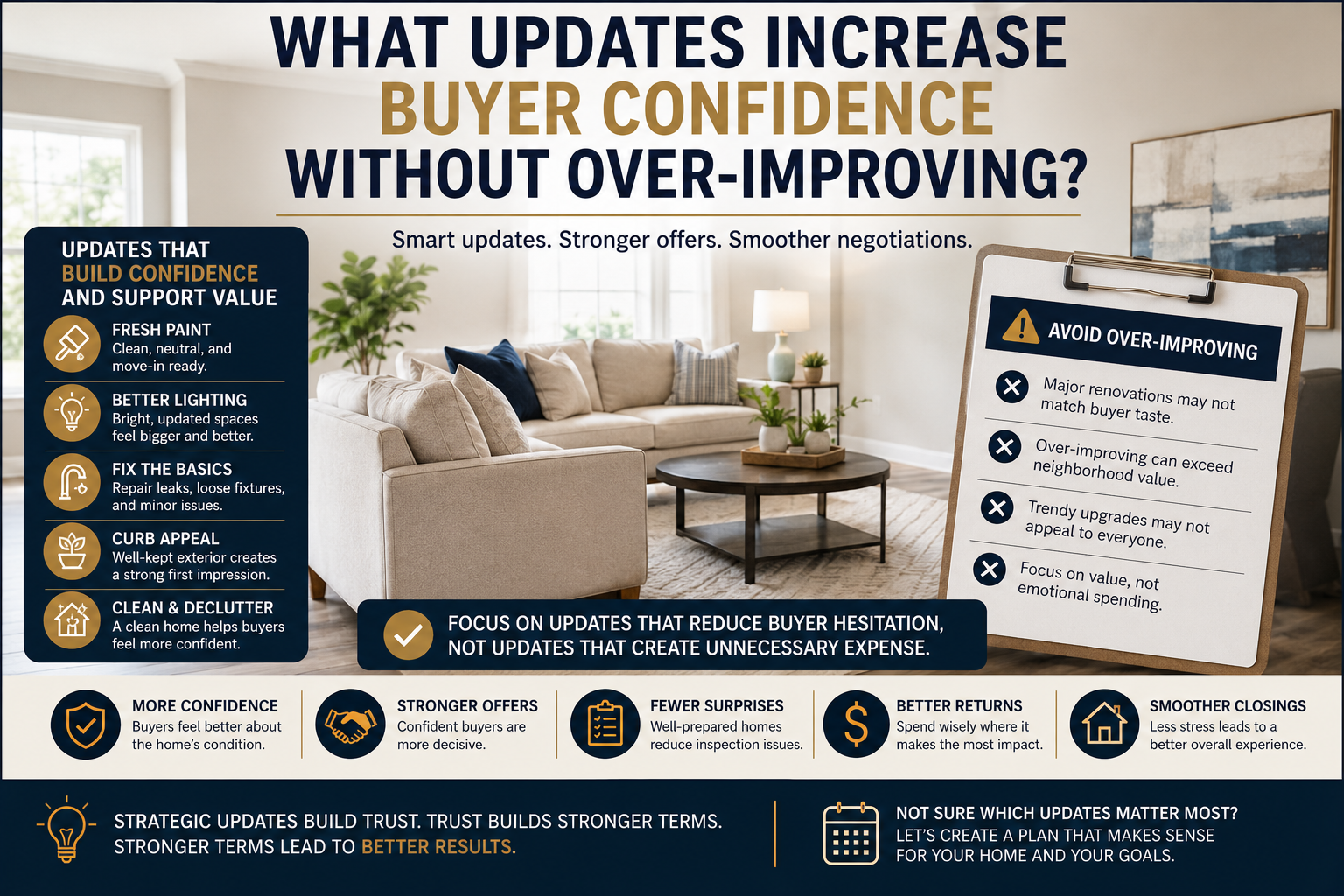
Palm Beach County seller strategy image focused on strategic home updates, buyer confidence, maintenance visibility, selective preparation, and avoiding unnecessary renovation costs before listing a property.

What Updates Increase Buyer Confidence Without Over-Improving?

Many homeowners preparing to sell become trapped between two fears. One is leaving visible problems unresolved and weakening buyer confidence. The other is spending large amounts of money on upgrades that never fully return their cost.

That tension creates confusion before the home even reaches the market.

Sellers often hear conflicting advice. One person recommends full renovation. Another insists buyers will remodel everything anyway. Online articles promote dramatic before-and-after transformations that may have little connection to the realities of a specific property, neighborhood, or buyer pool.

In practice, the strongest preparation strategy is usually more measured.

Most homes benefit more from selective improvements that reduce buyer hesitation than from emotionally driven renovation projects designed to chase perfection.

Buyer Confidence Usually Matters More Than Luxury-Level Upgrades

Many sellers assume buyers primarily care about high-end finishes or fully remodeled interiors. In reality, buyers often respond more strongly to signs that the home feels cared for, stable, functional, and responsibly maintained.

Confidence influences emotional comfort.

When buyers feel uncertain about maintenance, hidden costs, inspection exposure, or future repair obligations, negotiations usually become more cautious regardless of how visually attractive the home appears initially.

That is why smaller strategic improvements sometimes create more meaningful impact than expensive cosmetic remodeling.

Simple updates that improve cleanliness, consistency, lighting, maintenance visibility, and overall presentation can often calm buyer concerns before inspections begin.

For sellers trying to understand how preparation, pricing, inspections, and negotiation strength work together more broadly, our Seller Strategy and Execution hub explains how those decisions connect before listing.

Visible Maintenance Often Carries More Emotional Weight Than Style

Many buyers can tolerate outdated design more easily than visible neglect.

Worn paint, damaged trim, loose fixtures, stained surfaces, aging caulking, neglected landscaping, or inconsistent maintenance signals often create more emotional hesitation than kitchens or bathrooms that simply feel older stylistically.

That distinction matters because sellers frequently invest heavily in cosmetic modernization while overlooking the issues buyers quietly interpret as maintenance risk.

Buyers tend to ask themselves:

  • Has the property been cared for consistently?
  • Will hidden repairs appear later?
  • How much additional work will ownership require?
  • Could inspection issues become larger than expected?

Once uncertainty enters the buyer’s thinking, even attractive updates may lose some of their emotional influence.

Smaller Improvements Can Quietly Strengthen the Entire Showing Experience

Not every effective update is dramatic.

Sometimes buyer confidence improves because the home simply feels cleaner, brighter, more organized, and more stable emotionally.

Selective preparation may include:

  • fresh paint in highly visible areas
  • improved exterior presentation
  • landscaping cleanup
  • updated lighting
  • minor fixture replacement
  • decluttering
  • deep cleaning
  • correcting obvious deferred maintenance

Those improvements often help buyers emotionally relax inside the property. That calmer emotional response can affect:

  • offer confidence
  • inspection sensitivity
  • pricing acceptance
  • repair negotiations
  • overall transaction stability

The goal is rarely perfection. The goal is reducing avoidable friction.

Over-Improving Can Create Unexpected Problems

Some homeowners unintentionally weaken their position by over-improving relative to the surrounding market.

Large renovation projects may create:

  • budget expansion
  • timeline pressure
  • permit complications
  • contractor delays
  • design choices buyers may not prefer
  • pricing expectations that exceed local support

In some situations, sellers complete expensive upgrades only to discover that buyers still compare the property against newer construction, differently updated homes, or competing inventory with stronger overall location advantages.

This is especially important in areas where buyer expectations differ significantly. A buyer evaluating homes in Boca Raton may respond differently to updates and finish quality than buyers competing in Jupiter, where lifestyle positioning, maintenance condition, and overall presentation may influence confidence differently.

Functional Confidence Usually Outperforms Cosmetic Flash

Many sellers underestimate how strongly buyers react to functional stability.

Roof condition, HVAC performance, plumbing reliability, electrical concerns, moisture exposure, maintenance consistency, and inspection preparedness often influence negotiations more heavily than decorative upgrades alone.

Buyers may admire cosmetic improvements while still negotiating aggressively if larger maintenance concerns remain unresolved.

By contrast, buyers sometimes accept older finishes more comfortably when the property feels:

  • well maintained
  • clean
  • organized
  • honestly presented
  • mechanically stable

That is one reason sellers often benefit from understanding how buyers interpret inspection risk before deciding where preparation dollars should go.

Different Properties Need Different Preparation Strategies

Preparation should reflect the property itself rather than generic internet advice.

A larger family home may need different preparation than a smaller condo. An acreage property may carry different maintenance concerns than a newer suburban home. Older homes may require stronger maintenance clarity, while newer homes may face more direct comparison pressure from competing inventory.

Seller goals matter as well.

Some homeowners prioritize reducing stress and simplifying the process. Others want to maximize confidence before inspections begin. Some need to sell quickly. Others have flexibility to prepare more carefully over time.

That is why strong preparation strategy should remain:

  • property-specific
  • market-aware
  • buyer-aware
  • financially realistic
  • emotionally sustainable

For homeowners evaluating how pricing and preparation affect negotiations together, it can also help to review how pricing strategy changes in a more competitive market.

Presentation Consistency Builds Emotional Stability

Buyers often interpret homes emotionally long before they analyze them logically.

If the property feels inconsistent — updated in some areas but neglected in others — buyers may become uncertain about overall care. That inconsistency can quietly affect confidence throughout the transaction.

Homes that feel visually and emotionally coherent often create smoother reactions during:

  • showings
  • inspections
  • repair negotiations
  • appraisal discussions
  • closing preparation

This does not require luxury-level renovation. It requires reducing visible contradiction between:

  • pricing
  • condition
  • presentation
  • maintenance visibility
  • buyer expectations

That emotional alignment frequently matters more than sellers realize before the property reaches the market.

Strategic Updates Should Reduce Stress, Not Create More

Preparation decisions become dangerous when sellers stop making strategic choices and begin reacting emotionally to pressure instead.

At that point, upgrades often expand beyond what the property realistically needs. Budgets grow. Timelines become stressful. Sellers begin chasing perfection rather than focusing on confidence, stability, and realistic positioning.

The strongest preparation plans usually feel calmer.

They focus on:

  • reducing avoidable buyer hesitation
  • improving maintenance visibility
  • supporting inspection confidence
  • creating emotional comfort during showings
  • protecting negotiation stability

Not every home requires dramatic transformation before selling. Many simply require enough strategic preparation to help buyers feel more comfortable moving forward.

For sellers trying to understand how condition concerns affect negotiations later, it may also help to review what buyers actually focus on during inspections.

Review Which Updates Actually Strengthen Buyer Confidence

If you are deciding where to spend money before listing, it can help to separate meaningful preparation from unnecessary over-improvement. The goal is not to renovate blindly. The goal is to understand which updates may reduce buyer hesitation and create a more stable transaction.

  • Review maintenance and presentation issues strategically
  • Compare update costs against likely buyer response
  • Understand where over-improving may create unnecessary expense
  • Build a calmer preparation strategy before listing the property

Smarter preparation decisions usually create stronger buyer confidence later.

Get Preparation Clarity

Frequently Asked Questions About Updating a Home Before Selling

Do I need to fully remodel my home before selling?

No. Many homes benefit more from selective preparation and maintenance improvements than large-scale remodeling. Buyers often respond more strongly to cleanliness, care consistency, and reduced uncertainty than to luxury-level cosmetic upgrades alone.

What updates usually improve buyer confidence most?

Visible maintenance improvements, fresh paint, landscaping cleanup, lighting improvements, decluttering, and correcting obvious deferred maintenance often improve buyer confidence more consistently than highly personalized renovations.

Can over-improving hurt the selling process?

In some situations, yes. Large renovation projects can create unnecessary expense, timeline pressure, and pricing expectations that may not align with the surrounding market or buyer priorities.

Why do buyers care so much about maintenance visibility?

Visible maintenance often shapes how buyers emotionally interpret risk. When homes appear well cared for, buyers are usually less likely to assume hidden problems exist behind the scenes.

May 11, 2026

Should You Sell As-Is or Prepare the Home First?

Palm Beach County seller strategy image comparing selling a home as-is versus preparing it before listing, including buyer confidence, deferred maintenance, pricing, and negotiation considerations.

Should You Sell As-Is or Prepare the Home First?

Many homeowners eventually reach the same difficult question before selling: should the property be sold exactly as it sits, or should time and money be invested into preparation first?

The answer is rarely simple because every home carries a different combination of condition, maintenance history, buyer expectations, timeline pressure, financial flexibility, and emotional exhaustion.

Some sellers become overwhelmed by repair conversations and immediately lean toward an as-is sale. Others begin planning major upgrades before fully understanding whether those improvements are likely to strengthen the outcome meaningfully.

Most homes require a more balanced conversation than either extreme allows.

The strongest decision usually comes from understanding how buyers are likely to interpret the property in its current condition, how preparation may affect confidence and negotiation stability, and whether certain repairs or improvements are likely to create measurable strategic benefit before the home reaches the market.

As-Is Does Not Mean “No Strategy”

One of the biggest misconceptions about selling as-is is the assumption that preparation no longer matters.

Even when a seller chooses not to complete repairs, buyers still evaluate:

  • maintenance visibility
  • overall presentation
  • pricing alignment
  • inspection risk
  • cleanliness and organization
  • property care consistency
  • future ownership exposure

As-is only changes the repair commitment itself. It does not eliminate buyer psychology.

A property sold as-is can still create strong confidence if buyers feel the seller has approached the process honestly, realistically, and thoughtfully. By contrast, a poorly prepared property with unclear condition concerns can create emotional hesitation that weakens negotiations quickly.

For homeowners evaluating the broader relationship between preparation, inspections, pricing, and negotiation stability, our main Seller Strategy and Execution hub explains how those decisions interact before the listing process begins.

Preparation Is Often More Selective Than Sellers Expect

Preparing a home for sale does not automatically mean full renovation.

Many sellers incorrectly assume they must either:

  • completely remodel the home
  • or do absolutely nothing

In reality, strong preparation is often much more targeted.

Some homes benefit from:

  • minor repairs
  • maintenance cleanup
  • improved landscaping
  • better lighting
  • decluttering
  • paint correction
  • functional updates
  • inspection-risk reduction

Those changes may improve buyer confidence significantly without turning the process into an expensive renovation project.

The important question is not:

“Should the home be perfect?”

The stronger question is:

“Which preparation decisions are most likely to reduce avoidable buyer hesitation?”

Buyer Expectations Change by Market and Property Type

The as-is versus preparation decision often depends heavily on the type of property and the market surrounding it.

A buyer comparing larger properties in The Acreage may approach maintenance, land condition, drainage, fencing, septic systems, or outbuildings differently than a buyer evaluating homes in Royal Palm Beach where presentation consistency and neighborhood comparisons may carry different emotional weight.

Likewise, buyers evaluating newer competing inventory may react differently than buyers searching for older homes with character, acreage flexibility, or renovation potential.

That is why seller strategy should remain local and property-specific.

The same preparation approach that works well in one market may create unnecessary expense or limited return in another.

Visible Deferred Maintenance Often Changes Buyer Psychology

Buyers usually tolerate imperfections more calmly when the property still feels responsibly maintained overall.

Problems arise when visible deferred maintenance creates doubt about how the home has been cared for over time.

Water stains, neglected exterior areas, damaged screens, aging paint, overgrown landscaping, visible wear, or unresolved maintenance concerns may lead buyers to assume larger hidden issues exist behind the scenes.

Once buyers begin interpreting the property through that lens, negotiations often become more cautious and more emotionally reactive.

This does not necessarily mean every issue must be corrected before listing. It means sellers benefit from understanding how visible condition affects confidence long before inspection reports appear.

For homeowners deciding which concerns matter most before listing, it may also help to review whether repairs should be completed before selling.

Preparation Can Reduce Emotional Negotiation Pressure

Many sellers focus primarily on whether preparation increases price. In practice, preparation often influences something equally important: transaction stability.

Buyers who feel uncertain about the property usually negotiate differently than buyers who feel confident entering escrow.

Once buyers begin expecting:

  • future repairs
  • hidden maintenance problems
  • insurance complications
  • larger ownership costs
  • inspection surprises

the emotional tone of negotiations can shift quickly.

Sometimes small preparation improvements reduce enough uncertainty to create a noticeably smoother transaction later.

That smoother process may matter more than maximizing theoretical value through larger renovations with uncertain return.

Major Renovations Often Create Their Own Risks

Some sellers begin large renovation projects assuming they are automatically increasing market value. Occasionally that happens. In many situations, however, major renovations create new complications instead.

Projects can expand in cost. Timelines can become unpredictable. Permit issues may emerge. Contractor schedules may shift. Design choices may not align with actual buyer preferences.

Meanwhile, the market itself may continue changing while the work is underway.

This is why sellers should be careful about making emotionally driven renovation decisions before listing. Not every update produces meaningful negotiation advantage.

In some situations, selective preparation paired with realistic pricing creates a stronger overall outcome than aggressive renovation efforts.

Some Sellers Benefit From a Cleaner As-Is Strategy

There are absolutely situations where selling as-is makes sense.

Inherited properties, relocation timelines, financial limitations, aging homes requiring extensive work, emotional exhaustion, or major deferred maintenance may all make large preparation efforts unrealistic.

However, even a strong as-is strategy benefits from:

  • clear pricing logic
  • honest property positioning
  • organized presentation
  • cleanliness and accessibility
  • understanding likely buyer concerns
  • inspection awareness

The strongest as-is sellers are usually the ones who understand the property clearly rather than simply avoiding the preparation conversation entirely.

Preparation Should Support Clarity, Not Stress

Many homeowners become emotionally overwhelmed before the home even reaches the market. Repair lists grow. Contractor opinions conflict. Online advice becomes contradictory. Pricing conversations create pressure.

At some point, sellers often stop asking:

“What strategy actually makes sense for this property?”

and begin reacting emotionally to the stress itself.

That is usually when unnecessary spending, rushed decisions, or unstable expectations begin affecting the process.

The strongest seller preparation strategies are rarely built around perfection. They are built around clarity.

When sellers understand:

  • what buyers are likely to notice
  • what repairs may matter most
  • what preparation may create confidence
  • what improvements may not justify the cost
  • what pricing realistically supports

the entire transaction usually becomes calmer and more stable.

For sellers trying to understand how preparation affects leverage later, it can also help to review what deferred maintenance may signal to buyers before listing.

Compare the Preparation Path Before Making Expensive Decisions

If you are deciding between selling as-is or preparing the home first, it can help to review the property strategically before committing to repairs, upgrades, or pricing decisions. The goal is not perfection. The goal is understanding which approach creates the strongest position for your situation.

  • Review buyer-confidence concerns tied to current condition
  • Compare repair costs against likely negotiation impact
  • Understand how preparation may affect pricing and inspections
  • Build a calmer seller strategy before the property goes active

No pressure. Just a clearer understanding of which path makes the most sense for the property.

Compare the Available Paths

Frequently Asked Questions About Selling As-Is Versus Preparing a Home

Does selling as-is mean I should avoid all preparation?

No. Even as-is sales benefit from organization, cleanliness, pricing strategy, and understanding buyer expectations. As-is changes repair obligations, but it does not eliminate buyer psychology or negotiation dynamics.

Should I renovate before selling my home?

Not always. Some renovations improve buyer confidence, while others create unnecessary expense with limited return. Sellers should evaluate preparation decisions based on condition, market competition, buyer expectations, and likely negotiation impact.

What preparation usually matters most before listing?

Visible maintenance consistency, cleanliness, presentation quality, and reducing obvious buyer concerns often matter more than luxury-level upgrades. Buyers usually respond more strongly to confidence and care than cosmetic perfection alone.

Can selling as-is still create strong offers?

Yes. Buyers can still respond positively to as-is properties when pricing feels realistic, presentation feels organized, and condition concerns are understood clearly. Strong as-is positioning usually depends on preparation clarity rather than avoidance.

May 11, 2026

How Sellers Lose Leverage Before the Home Even Hits the Market

Palm Beach County seller strategy image focused on pricing alignment, deferred maintenance, preparation quality, inspection awareness, and negotiation confidence before listing a home for sale.

How Sellers Lose Leverage Before the Home Even Hits the Market

Many sellers believe negotiation leverage begins once offers arrive. In reality, leverage is often shaped long before the property becomes active.

Pricing decisions, preparation quality, maintenance visibility, inspection awareness, presentation consistency, and emotional readiness all influence how buyers respond from the very beginning. A home that enters the market with avoidable uncertainty may quietly lose negotiating strength before serious conversations even start.

This does not mean every home needs expensive upgrades or perfect presentation. It means buyers respond to signals. The way a property feels, the way condition is interpreted, and the way preparation aligns with pricing all affect confidence before negotiations officially begin.

Strong leverage usually comes from reducing uncertainty earlier in the process rather than reacting emotionally once buyers begin raising concerns.

Leverage Often Depends on Buyer Confidence

Many sellers think leverage is created through aggressive negotiation tactics. More often, leverage comes from how confident buyers feel about the property itself.

Buyers who believe the home is well-positioned, realistically priced, responsibly maintained, and thoughtfully prepared tend to negotiate differently than buyers who already feel cautious before inspections even begin.

Confidence affects behavior.

A buyer who feels secure may compete more aggressively, negotiate more selectively, or tolerate imperfections more calmly. A buyer who feels uncertain often becomes more price-sensitive, more inspection-sensitive, and more emotionally reactive throughout escrow.

That emotional difference frequently determines how stable negotiations become later.

For homeowners trying to understand the larger relationship between preparation, pricing, inspections, and negotiation strength, our broader Seller Strategy and Execution guidance explains how those decisions connect before a listing goes live.

Overpricing Can Quietly Damage Negotiation Positioning

One of the fastest ways sellers lose leverage is by entering the market with unrealistic pricing expectations.

Overpricing does more than reduce showing activity. It changes buyer psychology.

When buyers believe a home is priced above its condition, preparation level, or competition, they often begin searching for reasons to justify lower offers. Inspection findings feel larger. Maintenance concerns receive more scrutiny. Negotiations become less collaborative and more defensive.

Even sellers who later reduce the price may discover that early buyer hesitation changed the emotional tone of the listing itself.

That is especially important in markets where buyers have stronger comparative visibility across competing inventory. A buyer reviewing homes in West Palm Beach may quickly compare condition, presentation, updates, and pricing against multiple nearby alternatives before deciding how aggressively to pursue the property.

Deferred Maintenance Weakens Trust Before Inspections Begin

Many negotiation problems begin long before the buyer’s inspector arrives.

Visible deferred maintenance often changes buyer perception during the first showing itself. Water stains, worn paint, neglected landscaping, damaged exterior areas, aging fixtures, cracked surfaces, or inconsistent upkeep can quietly shape how buyers interpret the home’s overall care.

Once buyers begin noticing those signals, they often assume additional problems exist beyond what they can immediately see.

That assumption creates vulnerability later.

Inspection reports feel more threatening when buyers already suspect hidden maintenance concerns. Minor findings become emotionally amplified because the buyer entered the process expecting trouble.

That is one reason sellers preparing older homes may benefit from understanding how preparation, timing, and presentation influence negotiation strength before the property reaches the market.

Poor Preparation Creates Emotional Negotiations

Negotiations become more unstable when buyers feel emotionally unsettled by the property itself.

This often happens when:

  • maintenance appears inconsistent
  • presentation feels rushed
  • pricing feels disconnected from condition
  • inspection concerns appear avoidable
  • seller disclosures create confusion
  • repairs feel incomplete or improvised

Once uncertainty builds, negotiations stop feeling like a normal transaction and start feeling like risk management.

That emotional shift usually weakens the seller’s position.

Buyers who feel uncertain tend to:

  • ask for larger concessions
  • become more cautious during inspections
  • push harder on credits or repairs
  • second-guess pricing
  • become more likely to walk away

In many transactions, the strongest negotiation leverage comes from making the property feel dependable before buyers begin searching for problems.

Presentation and Organization Influence Buyer Psychology

Buyers form emotional conclusions quickly.

A property that feels organized, cared for, and thoughtfully prepared often creates more confidence before buyers consciously analyze the details. Cleanliness, lighting, landscaping, maintenance consistency, and visual organization all contribute to that reaction.

This is not about staging perfection. It is about emotional stability.

When a property feels chaotic, neglected, unfinished, or uncertain, buyers tend to enter negotiations with greater caution. They start mentally budgeting for future repairs, complications, or hidden surprises.

That mindset influences:

  • offer strength
  • inspection sensitivity
  • repair requests
  • concession expectations
  • overall transaction confidence

For homeowners evaluating preparation choices before listing, it can also help to understand how pricing strategy changes in a more competitive market because pricing and presentation often shape leverage together.

Inspection Surprises Can Shift the Entire Transaction

Most buyers expect some imperfections. Problems arise when inspection findings feel inconsistent with the way the home was presented initially.

If buyers feel surprised by condition concerns, negotiations often become emotionally reactive very quickly.

That does not necessarily mean sellers must repair everything before listing. It means the seller benefits from understanding which concerns buyers are likely to view as meaningful before the transaction reaches inspection.

Preparation sometimes involves:

  • minor repairs
  • improved disclosure clarity
  • pricing adjustments
  • cleaner presentation
  • better maintenance visibility
  • pre-listing awareness of likely buyer concerns

When those issues are addressed earlier, sellers are usually less vulnerable to emotional renegotiation later.

Seller Stress Can Quietly Affect Negotiation Outcomes

Sellers under emotional pressure often lose leverage unintentionally.

When preparation happens late, timelines feel rushed, repairs remain unresolved, or expectations become unrealistic, sellers may enter negotiations already exhausted before inspections even occur.

Buyers often sense that pressure.

A seller who appears reactive, uncertain, defensive, or overwhelmed may unintentionally encourage more aggressive negotiation behavior from the other side.

That is why calmer preparation matters operationally as much as emotionally.

Sellers who understand the property clearly before listing typically make more stable decisions during negotiations because fewer surprises disrupt the process later.

Leverage Is Usually Built Before the Listing Goes Live

The strongest negotiation position rarely appears by accident.

It is often created through preparation decisions that quietly improve buyer confidence before the first showing occurs. Pricing alignment, maintenance consistency, presentation quality, inspection awareness, and realistic expectations all shape how buyers emotionally experience the property.

That does not guarantee every negotiation will be easy. Every property and every buyer situation is different.

What preparation can do is reduce avoidable instability before the transaction reaches its most fragile stages.

In competitive or emotionally sensitive markets like Delray Beach, that stability can influence the entire tone of the transaction from the beginning.

Strengthen the Seller Position Before Negotiations Begin

If you are preparing to sell, it can help to understand where negotiation leverage is gained — and where it is quietly lost before the home even reaches the market. The goal is not perfection. It is reducing avoidable uncertainty that may weaken buyer confidence later.

  • Review preparation issues that may affect negotiation strength
  • Understand how buyers interpret pricing and condition together
  • Identify concerns that may create inspection-related pressure
  • Build a more stable seller strategy before listing begins

Understanding buyer confidence early can reduce negotiation pressure later.

Build a Smarter Listing Plan

Frequently Asked Questions About Seller Negotiation Leverage

How do sellers lose leverage before listing a home?

Sellers often lose leverage through unrealistic pricing, visible deferred maintenance, rushed preparation, unclear disclosures, inspection surprises, or presentation issues that reduce buyer confidence before negotiations even begin.

Does pricing affect buyer confidence?

Yes. When pricing feels disconnected from the property’s condition, preparation level, or competition, buyers often become more cautious and more aggressive during negotiations. Pricing and confidence are closely connected.

Why do inspection surprises create negotiation problems?

Inspection surprises can shift buyer psychology quickly. When buyers feel concerns were hidden, overlooked, or underestimated, negotiations often become more emotional and less stable throughout escrow.

Can preparation improve negotiation strength without major renovations?

In many situations, yes. Cleanliness, maintenance consistency, selective repairs, realistic pricing, and stronger presentation often improve buyer confidence more effectively than large renovation projects with uncertain return.

May 11, 2026

What Actually Matters to Buyers During Home Inspections?

Florida home inspection discussion between buyer and inspector reviewing property condition before sale.

What Actually Matters to Buyers During Home Inspections?

Many sellers misunderstand what buyers are truly reacting to during the inspection process. Some homeowners become preoccupied with cosmetic imperfections that barely affect negotiations. Others underestimate the impact of maintenance issues, aging systems, moisture concerns, or visible signs of deferred care that quietly change buyer confidence once the inspection report arrives.

The inspection process is not only about identifying technical defects. It is also about how buyers emotionally interpret risk.

A home can show well during the initial showing and still become vulnerable once inspections begin. Buyers who felt confident walking through the property may suddenly begin questioning future costs, insurance concerns, maintenance exposure, or whether additional hidden problems exist beyond what appears in the report itself.

That shift matters because many transactions become unstable after inspection, not before it.

Understanding what buyers tend to focus on during inspections can help sellers prepare more intelligently before the home reaches the market.

Buyers Often React to Patterns, Not Just Individual Problems

One isolated issue rarely destroys buyer confidence on its own. What often changes the emotional tone of the transaction is the accumulation of concerns.

A buyer may initially tolerate an older water heater, a minor plumbing issue, or worn exterior paint individually. However, once multiple maintenance items begin appearing together inside an inspection report, buyers often start interpreting the property differently.

The report begins to feel less like a manageable list and more like evidence of broader neglect.

This reaction is emotional as much as financial.

Buyers frequently ask themselves:

  • What else has not been maintained?
  • Will additional costs appear later?
  • How much work will ownership require immediately?
  • Are insurance complications likely?
  • Did the seller overlook larger issues?

That emotional escalation can affect negotiation leverage quickly.

For sellers preparing before listing, our broader Seller Strategy and Execution guidance explains how inspections, pricing, preparation, and negotiation stability all connect before the property goes active.

Roof Age and Insurance Concerns Carry More Weight in Florida

South Florida buyers often evaluate homes differently than buyers in other markets because insurance realities can influence long-term affordability almost immediately.

Even when the roof is functioning properly, buyers may become cautious if they believe replacement timing could affect insurance eligibility or future costs. The same concern can extend to electrical systems, plumbing materials, HVAC age, water intrusion history, or visible exterior wear.

That does not mean older systems automatically prevent a successful sale. It means uncertainty tends to create hesitation.

Sellers who understand likely buyer concerns ahead of time are usually better positioned to:

  • price realistically
  • prepare disclosures properly
  • anticipate negotiation requests
  • reduce emotional surprise during inspections
  • protect transaction stability

In many cases, buyers respond better to transparency and preparation than to perfection.

Visible Maintenance Influences Buyer Confidence Immediately

Some inspection concerns technically appear minor but still affect how buyers emotionally experience the property.

Loose fixtures, damaged screens, water stains, worn caulking, neglected landscaping, cracked exterior areas, aging paint, or inconsistent maintenance signals can quietly change how buyers interpret overall care.

Once buyers begin noticing visible maintenance concerns, they often become more sensitive to every additional issue uncovered during inspections.

That reaction is rarely logical in a purely mathematical sense. It is psychological.

People naturally use visible clues to estimate unseen risk.

This is especially important for sellers competing in markets where buyer expectations are higher. A buyer evaluating homes in Jupiter may respond differently than a buyer comparing properties in Palm Beach Gardens, even when the technical inspection findings appear similar.

Inspection Reports Can Change Negotiation Psychology

Many sellers assume negotiations are primarily about numbers. In reality, negotiations are often driven by confidence.

Buyers who feel secure about the property usually negotiate differently than buyers who feel overwhelmed by uncertainty. Once inspection reports begin introducing fear, buyers may become more aggressive, more cautious, or more emotionally reactive.

That is why inspection preparation matters long before the buyer hires an inspector.

Sellers who already understand the property’s likely concerns often approach negotiations more calmly because fewer surprises emerge during escrow. That preparation can reduce defensive reactions, rushed decision-making, or emotional escalation once repair requests appear.

In many situations, the strongest benefit of preparation is not necessarily increasing value. It is preserving stability once the transaction reaches its most fragile stage.

Cosmetic Perfection Usually Matters Less Than Functional Confidence

Sellers often spend heavily trying to create visual perfection while overlooking the issues buyers may care about far more once inspections begin.

Most buyers can tolerate outdated finishes more easily than unresolved uncertainty.

An older kitchen may not concern a buyer nearly as much as active moisture intrusion, aging electrical concerns, visible deferred maintenance, or unclear roof life expectancy. Cosmetic preferences are often viewed as future personalization projects. Functional concerns feel more immediate and emotionally threatening.

This is one reason sellers should be careful about over-improving before listing.

Some renovations create limited practical negotiation benefit while consuming significant time, energy, and budget. Sellers trying to decide where preparation dollars should go may also benefit from reviewing which updates increase buyer confidence without over-improving.

Older Homes Require Different Buyer Expectations

Buyers evaluating older homes usually expect some level of imperfection. The issue is not whether the property is flawless. The issue is whether the home feels responsibly maintained.

Well-maintained older homes often create stronger confidence than newer homes showing signs of neglected care.

Buyers tend to distinguish between:

  • normal aging
  • deferred maintenance
  • functional risk
  • ownership neglect

That distinction matters because inspection negotiations often become less emotional when buyers believe the seller has cared for the property responsibly over time.

Long-term homeowners sometimes underestimate how much presentation and maintenance consistency shape that perception. Buyers who sense organization, upkeep, and transparency are usually less likely to assume hidden problems exist.

Pre-Listing Awareness Can Reduce Emotional Reactions Later

Sellers do not need to eliminate every issue before listing a property. Most homes have imperfections. What matters more is understanding which concerns are likely to affect buyer confidence once inspections begin.

That awareness gives sellers more control over:

  • repair prioritization
  • pricing strategy
  • disclosure preparation
  • buyer expectation management
  • negotiation planning

Sometimes small corrections create disproportionate confidence improvements. In other situations, sellers may decide pricing adjustments make more sense than repairs themselves.

The advantage comes from understanding the situation before buyers emotionally define it for you.

Inspection Anxiety Often Starts Before the Inspection Happens

Many buyers begin forming inspection concerns long before the actual inspection date arrives.

If showings reveal inconsistent maintenance, visible wear, unresolved damage, or signs of deferred care, buyers often enter the inspection process already expecting problems. Once that expectation exists, inspection findings tend to feel larger emotionally.

By contrast, homes that feel cared for usually create a more stable emotional starting point. Buyers still inspect carefully, but they are less likely to interpret every item as evidence of broader risk.

That difference can quietly affect:

  • repair negotiations
  • buyer confidence
  • concession requests
  • transaction stability
  • the likelihood of emotional escalation

For homeowners trying to reduce avoidable surprises before listing, understanding how sellers lose leverage before the home even hits the market often becomes part of the same larger preparation strategy.

Reduce Inspection Surprises Before Buyers Begin Asking Questions

If you are preparing to sell, it can help to understand how buyers are likely to interpret the property before inspections begin. The goal is not to create perfection. It is to reduce avoidable uncertainty that could weaken confidence or create unnecessary negotiation pressure later.

  • Review visible maintenance and inspection-sensitive concerns
  • Understand how buyers may interpret condition patterns
  • Compare repair, pricing, and preparation options strategically
  • Build a more stable negotiation position before listing

A calmer strategy often creates a smoother transaction later.

Review the Property Situation

Frequently Asked Questions About Buyer Reactions During Inspections

What concerns buyers most during a home inspection?

Buyers often react most strongly to issues that suggest future cost, insurance difficulty, moisture concerns, maintenance neglect, or uncertainty about major systems. Roof age, electrical concerns, plumbing issues, HVAC condition, and visible deferred maintenance frequently affect buyer confidence more than cosmetic imperfections.

Do cosmetic issues matter during inspections?

Cosmetic issues alone usually matter less than functional concerns. However, visible maintenance problems can still influence how buyers emotionally interpret the property. Multiple small issues together may create the impression that larger hidden concerns exist.

Should sellers get a pre-listing inspection?

In some situations, a pre-listing inspection helps sellers understand likely buyer concerns before the property goes active. This can improve preparation decisions, disclosure clarity, pricing strategy, and negotiation readiness before buyers begin their own inspection process.

Why do inspections create so much negotiation pressure?

Inspection reports often change buyer psychology. Once buyers begin feeling uncertain about future repairs, maintenance exposure, or hidden costs, negotiations can become more emotional. Preparation and awareness before listing often help reduce that instability.

May 11, 2026

Should You Repair the Home Before Selling in Palm Beach County?

Palm Beach County homeowner reviewing repair decisions and home preparation before listing a property for sale.

Should You Repair the Home Before Selling in Palm Beach County?

One of the most difficult parts of preparing to sell a home is deciding what actually needs to be repaired before the property goes on the market. Some homeowners assume everything should be updated first. Others become so overwhelmed by the process that they consider selling completely as-is without understanding how buyers may respond.

Most homes fall somewhere between those two extremes.

The challenge is not simply deciding whether repairs should happen. The challenge is understanding which repairs may protect buyer confidence, which issues may create inspection problems later, and which improvements are unlikely to produce enough return to justify the cost.

That conversation has become even more important in Palm Beach County, where buyer expectations can vary dramatically depending on location, property type, age of the home, insurance realities, competing inventory, and visible maintenance condition.

Sellers who approach repairs strategically often place themselves in a calmer position before negotiations begin. Sellers who guess their way through the process may spend unnecessary money, leave obvious concerns unresolved, or create pricing problems before the home even becomes active.

Repair Decisions Should Support Strategy, Not Panic

Many sellers begin making repairs emotionally. A contractor recommends a long list of updates. A friend says buyers expect fully renovated homes. An online article warns that everything must look perfect before listing.

That kind of pressure can quickly lead to expensive decisions that do not necessarily improve the outcome.

Strong preparation is usually more selective than people expect. The goal is not to renovate the home into something unrecognizable. The goal is to reduce avoidable buyer hesitation while protecting the seller from unnecessary spending.

Some repairs are about functionality. Others are about confidence. Some are highly visible during showings. Others become more important once inspections begin. The strongest approach is understanding which category each issue falls into before making decisions.

For homeowners still evaluating the broader preparation process, our main Seller Strategy and Execution hub explains how pricing, inspections, timing, preparation, and negotiation strength all connect before the property reaches the market.

Not Every Repair Carries the Same Weight

A small cosmetic issue rarely affects buyers the same way a major system concern does. At the same time, visible deferred maintenance can quietly shape how buyers interpret the entire property.

For example, worn paint, neglected landscaping, broken fixtures, damaged screens, stained ceilings, or aging exterior areas may not be catastrophic individually. Together, however, they can create uncertainty about overall maintenance.

Buyers often react emotionally before they react analytically.

If the home feels neglected, many buyers begin assuming larger problems exist behind the scenes. That perception can weaken pricing confidence, create lower offers, or increase inspection sensitivity later.

By contrast, some expensive renovations may have very limited influence on the actual transaction outcome. A seller may spend heavily remodeling areas that buyers only view as personal style differences rather than meaningful value improvements.

The right repair decisions usually involve separating:

  • functional concerns
  • inspection-related concerns
  • presentation concerns
  • buyer-confidence concerns
  • over-improvement risks

Why Palm Beach County Creates Different Repair Conversations

Repair strategy in South Florida is rarely one-size-fits-all.

A Wellington buyer evaluating a larger family home may pay close attention to landscaping, roof condition, maintenance consistency, and overall presentation continuity. A Boca Raton buyer may respond more strongly to updating pressure, interior finish expectations, and visible modernization.

In acreage communities, buyers may focus on fencing, drainage, septic systems, well equipment, outbuildings, or maintenance visibility across the property itself. Coastal-influenced buyers in Jupiter or Juno Beach may place heavier emphasis on presentation quality, exterior wear, and long-term maintenance exposure.

That is why local seller preparation matters.

Repair decisions should reflect:

  • the likely buyer pool
  • the property’s condition
  • the surrounding competition
  • the price range
  • the neighborhood expectations
  • the age and style of the home

For example, sellers preparing homes in Wellington may face different preparation decisions than sellers competing in Boca Raton.

Inspection Concerns Often Matter More Than Cosmetic Perfection

Many sellers focus heavily on visual updates while overlooking the issues that tend to create the largest negotiation problems later.

Inspection concerns frequently carry more weight than cosmetic styling.

Roof age, electrical concerns, plumbing issues, HVAC performance, moisture problems, insurance-related concerns, and visible deferred maintenance can quickly change the tone of a transaction once inspection reports arrive.

That does not mean every older system must be replaced before listing. It means sellers should understand what buyers are likely to question before those conversations begin.

Sometimes a seller benefits more from:

  • clear disclosure
  • pre-listing awareness
  • pricing adjustments
  • minor functional corrections
  • improved presentation

than from major renovations with uncertain return.

Buyers often tolerate older finishes more easily than uncertainty. That is one reason understanding deferred maintenance before listing can become more important than chasing cosmetic perfection.

The Emotional Side of Repair Decisions

Long-term homeowners often experience repair decisions differently than buyers do.

After living in a property for many years, certain condition issues begin to feel normal. Sellers may stop noticing them entirely. On the other hand, some homeowners become overly focused on flaws that buyers may barely care about.

That imbalance creates stress.

It becomes difficult to know whether repairs are genuinely necessary or simply emotionally amplified by the selling process itself.

This is where objective preparation guidance becomes valuable. A seller should not feel pressured into unnecessary spending. At the same time, sellers benefit from understanding which visible issues may quietly affect buyer confidence once showings begin.

In many cases, calmer preparation creates smoother negotiations later.

Should You Complete Major Renovations Before Selling?

Large renovation projects deserve careful scrutiny before listing a home.

Some updates can improve buyer response. Others create delays, budget expansion, contractor stress, permit complications, or design choices that may not align with buyer preferences anyway.

Sellers sometimes begin major projects believing they are “adding value,” only to discover that the market still compares the home against newer competing inventory differently than expected.

That does not mean updates never help. It means updates should be strategic rather than emotional.

In many situations, sellers are better served by:

  • improving cleanliness and presentation
  • correcting visible maintenance issues
  • reducing inspection risk
  • improving lighting and curb appeal
  • making selective functional improvements
  • pricing realistically for remaining condition

The strongest outcome is not always produced by the largest renovation budget.

How Buyers Interpret “As-Is” Listings

Selling as-is does not automatically scare buyers away. However, buyers interpret as-is differently depending on how the home is presented, priced, and maintained.

A clean, organized property with visible care may still attract confidence even when sold as-is. A poorly maintained home with unclear condition may create fear-based assumptions that extend beyond the actual issues.

That distinction matters.

An as-is strategy should still involve preparation. The seller still needs to understand:

  • likely buyer reactions
  • pricing sensitivity
  • inspection expectations
  • market competition
  • visible maintenance concerns

Sellers weighing that path may also benefit from reviewing whether selling as-is or preparing the home first makes more sense.

Preparation Often Creates Negotiation Stability

The strongest reason to address the right repairs before listing is not always about increasing price.

Sometimes it is about protecting stability.

Buyers who feel confident entering a transaction are less likely to panic during inspections, renegotiate aggressively, or walk away unexpectedly. A home that feels cared for often creates a smoother emotional environment throughout the transaction itself.

That matters because many deals become unstable not from one catastrophic issue, but from accumulated uncertainty.

Sellers cannot eliminate every concern. They can reduce preventable surprises before the home reaches the market.

Understand Which Repairs Actually Matter Before Listing

If you are unsure whether to repair, update, prepare lightly, or sell as-is, it can help to review the property strategically before making expensive decisions. The goal is not to over-improve the home. The goal is to understand what may affect buyer confidence, inspection reactions, and negotiation stability.

  • Review visible maintenance and buyer-perception concerns
  • Compare repair priorities against likely market response
  • Understand what may matter during inspections and negotiations
  • Build a calmer preparation strategy before the property goes active

Start with preparation clarity before making expensive decisions.

Understand the Preparation Options

Frequently Asked Questions About Repairs Before Selling

Do I need to fully renovate my home before selling?

No. Many homes benefit more from selective preparation than large-scale renovation. Sellers should focus on issues that affect buyer confidence, visible maintenance perception, inspection sensitivity, and overall presentation rather than assuming every area must be fully updated.

Which repairs usually matter most to buyers?

Functional concerns and visible maintenance issues often matter more than cosmetic styling alone. Roof condition, HVAC performance, plumbing concerns, electrical issues, moisture problems, and overall maintenance consistency can affect buyer confidence more than decorative preferences.

Should I complete repairs before a pre-listing inspection?

Not necessarily. In some situations, a pre-listing inspection helps clarify which issues deserve attention before the seller spends money unnecessarily. The inspection process can help separate meaningful concerns from lower-priority cosmetic items.

Can selling as-is still work in Palm Beach County?

Yes, but presentation, pricing, and visible condition still influence buyer perception. An as-is strategy usually works best when the seller understands likely buyer reactions, local competition, inspection concerns, and the tradeoffs between preparation and pricing flexibility.