Insights, strategy, and real estate guidance across Palm Beach County.

May 11, 2026

Should You Repair the Home Before Selling in Palm Beach County?

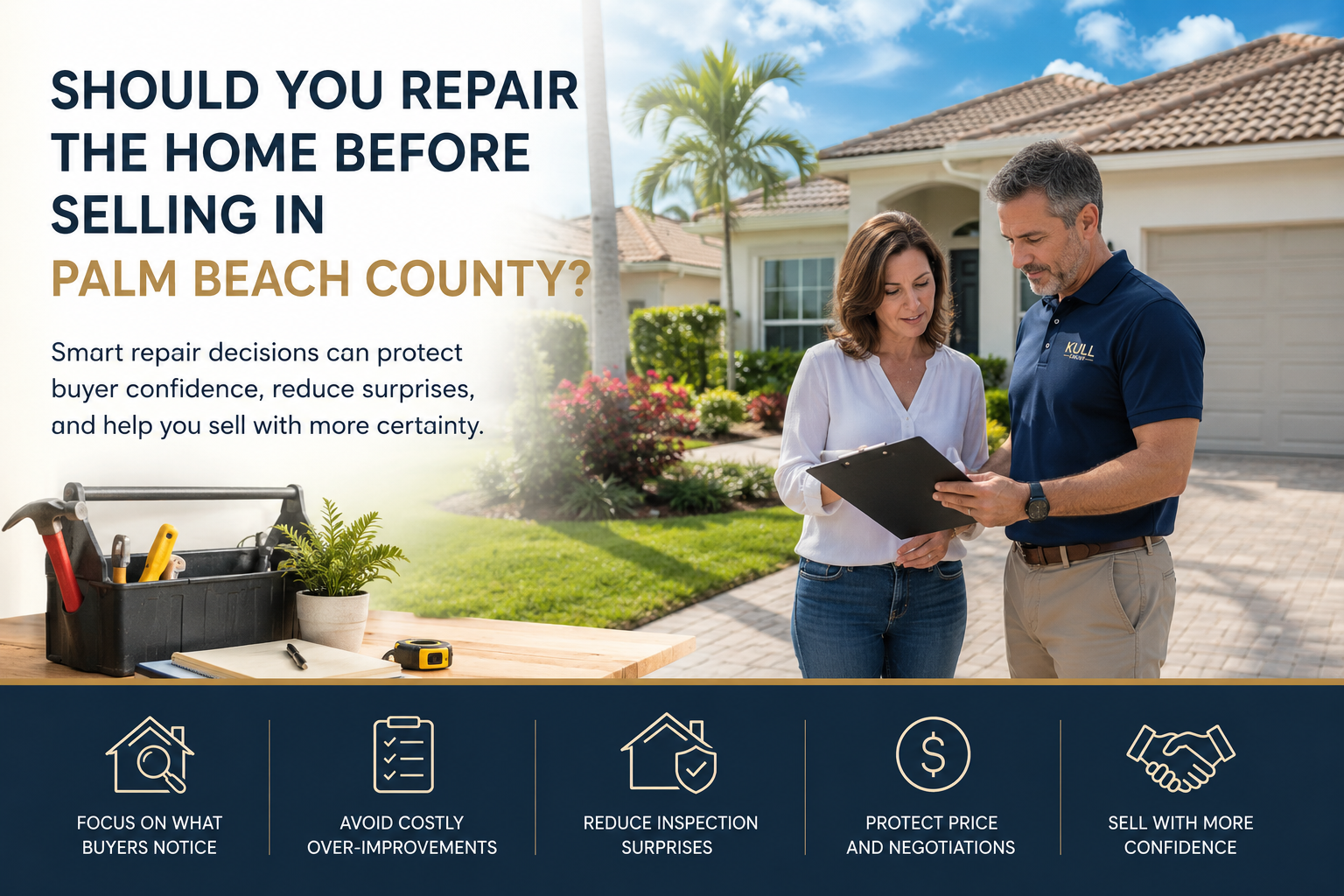
Palm Beach County homeowner reviewing repair decisions and home preparation before listing a property for sale.

Should You Repair the Home Before Selling in Palm Beach County?

One of the most difficult parts of preparing to sell a home is deciding what actually needs to be repaired before the property goes on the market. Some homeowners assume everything should be updated first. Others become so overwhelmed by the process that they consider selling completely as-is without understanding how buyers may respond.

Most homes fall somewhere between those two extremes.

The challenge is not simply deciding whether repairs should happen. The challenge is understanding which repairs may protect buyer confidence, which issues may create inspection problems later, and which improvements are unlikely to produce enough return to justify the cost.

That conversation has become even more important in Palm Beach County, where buyer expectations can vary dramatically depending on location, property type, age of the home, insurance realities, competing inventory, and visible maintenance condition.

Sellers who approach repairs strategically often place themselves in a calmer position before negotiations begin. Sellers who guess their way through the process may spend unnecessary money, leave obvious concerns unresolved, or create pricing problems before the home even becomes active.

Repair Decisions Should Support Strategy, Not Panic

Many sellers begin making repairs emotionally. A contractor recommends a long list of updates. A friend says buyers expect fully renovated homes. An online article warns that everything must look perfect before listing.

That kind of pressure can quickly lead to expensive decisions that do not necessarily improve the outcome.

Strong preparation is usually more selective than people expect. The goal is not to renovate the home into something unrecognizable. The goal is to reduce avoidable buyer hesitation while protecting the seller from unnecessary spending.

Some repairs are about functionality. Others are about confidence. Some are highly visible during showings. Others become more important once inspections begin. The strongest approach is understanding which category each issue falls into before making decisions.

For homeowners still evaluating the broader preparation process, our main Seller Strategy and Execution hub explains how pricing, inspections, timing, preparation, and negotiation strength all connect before the property reaches the market.

Not Every Repair Carries the Same Weight

A small cosmetic issue rarely affects buyers the same way a major system concern does. At the same time, visible deferred maintenance can quietly shape how buyers interpret the entire property.

For example, worn paint, neglected landscaping, broken fixtures, damaged screens, stained ceilings, or aging exterior areas may not be catastrophic individually. Together, however, they can create uncertainty about overall maintenance.

Buyers often react emotionally before they react analytically.

If the home feels neglected, many buyers begin assuming larger problems exist behind the scenes. That perception can weaken pricing confidence, create lower offers, or increase inspection sensitivity later.

By contrast, some expensive renovations may have very limited influence on the actual transaction outcome. A seller may spend heavily remodeling areas that buyers only view as personal style differences rather than meaningful value improvements.

The right repair decisions usually involve separating:

  • functional concerns
  • inspection-related concerns
  • presentation concerns
  • buyer-confidence concerns
  • over-improvement risks

Why Palm Beach County Creates Different Repair Conversations

Repair strategy in South Florida is rarely one-size-fits-all.

A Wellington buyer evaluating a larger family home may pay close attention to landscaping, roof condition, maintenance consistency, and overall presentation continuity. A Boca Raton buyer may respond more strongly to updating pressure, interior finish expectations, and visible modernization.

In acreage communities, buyers may focus on fencing, drainage, septic systems, well equipment, outbuildings, or maintenance visibility across the property itself. Coastal-influenced buyers in Jupiter or Juno Beach may place heavier emphasis on presentation quality, exterior wear, and long-term maintenance exposure.

That is why local seller preparation matters.

Repair decisions should reflect:

  • the likely buyer pool
  • the property’s condition
  • the surrounding competition
  • the price range
  • the neighborhood expectations
  • the age and style of the home

For example, sellers preparing homes in Wellington may face different preparation decisions than sellers competing in Boca Raton.

Inspection Concerns Often Matter More Than Cosmetic Perfection

Many sellers focus heavily on visual updates while overlooking the issues that tend to create the largest negotiation problems later.

Inspection concerns frequently carry more weight than cosmetic styling.

Roof age, electrical concerns, plumbing issues, HVAC performance, moisture problems, insurance-related concerns, and visible deferred maintenance can quickly change the tone of a transaction once inspection reports arrive.

That does not mean every older system must be replaced before listing. It means sellers should understand what buyers are likely to question before those conversations begin.

Sometimes a seller benefits more from:

  • clear disclosure
  • pre-listing awareness
  • pricing adjustments
  • minor functional corrections
  • improved presentation

than from major renovations with uncertain return.

Buyers often tolerate older finishes more easily than uncertainty. That is one reason understanding deferred maintenance before listing can become more important than chasing cosmetic perfection.

The Emotional Side of Repair Decisions

Long-term homeowners often experience repair decisions differently than buyers do.

After living in a property for many years, certain condition issues begin to feel normal. Sellers may stop noticing them entirely. On the other hand, some homeowners become overly focused on flaws that buyers may barely care about.

That imbalance creates stress.

It becomes difficult to know whether repairs are genuinely necessary or simply emotionally amplified by the selling process itself.

This is where objective preparation guidance becomes valuable. A seller should not feel pressured into unnecessary spending. At the same time, sellers benefit from understanding which visible issues may quietly affect buyer confidence once showings begin.

In many cases, calmer preparation creates smoother negotiations later.

Should You Complete Major Renovations Before Selling?

Large renovation projects deserve careful scrutiny before listing a home.

Some updates can improve buyer response. Others create delays, budget expansion, contractor stress, permit complications, or design choices that may not align with buyer preferences anyway.

Sellers sometimes begin major projects believing they are “adding value,” only to discover that the market still compares the home against newer competing inventory differently than expected.

That does not mean updates never help. It means updates should be strategic rather than emotional.

In many situations, sellers are better served by:

  • improving cleanliness and presentation
  • correcting visible maintenance issues
  • reducing inspection risk
  • improving lighting and curb appeal
  • making selective functional improvements
  • pricing realistically for remaining condition

The strongest outcome is not always produced by the largest renovation budget.

How Buyers Interpret “As-Is” Listings

Selling as-is does not automatically scare buyers away. However, buyers interpret as-is differently depending on how the home is presented, priced, and maintained.

A clean, organized property with visible care may still attract confidence even when sold as-is. A poorly maintained home with unclear condition may create fear-based assumptions that extend beyond the actual issues.

That distinction matters.

An as-is strategy should still involve preparation. The seller still needs to understand:

  • likely buyer reactions
  • pricing sensitivity
  • inspection expectations
  • market competition
  • visible maintenance concerns

Sellers weighing that path may also benefit from reviewing whether selling as-is or preparing the home first makes more sense.

Preparation Often Creates Negotiation Stability

The strongest reason to address the right repairs before listing is not always about increasing price.

Sometimes it is about protecting stability.

Buyers who feel confident entering a transaction are less likely to panic during inspections, renegotiate aggressively, or walk away unexpectedly. A home that feels cared for often creates a smoother emotional environment throughout the transaction itself.

That matters because many deals become unstable not from one catastrophic issue, but from accumulated uncertainty.

Sellers cannot eliminate every concern. They can reduce preventable surprises before the home reaches the market.

Understand Which Repairs Actually Matter Before Listing

If you are unsure whether to repair, update, prepare lightly, or sell as-is, it can help to review the property strategically before making expensive decisions. The goal is not to over-improve the home. The goal is to understand what may affect buyer confidence, inspection reactions, and negotiation stability.

  • Review visible maintenance and buyer-perception concerns
  • Compare repair priorities against likely market response
  • Understand what may matter during inspections and negotiations
  • Build a calmer preparation strategy before the property goes active

Start with preparation clarity before making expensive decisions.

Understand the Preparation Options

Frequently Asked Questions About Repairs Before Selling

Do I need to fully renovate my home before selling?

No. Many homes benefit more from selective preparation than large-scale renovation. Sellers should focus on issues that affect buyer confidence, visible maintenance perception, inspection sensitivity, and overall presentation rather than assuming every area must be fully updated.

Which repairs usually matter most to buyers?

Functional concerns and visible maintenance issues often matter more than cosmetic styling alone. Roof condition, HVAC performance, plumbing concerns, electrical issues, moisture problems, and overall maintenance consistency can affect buyer confidence more than decorative preferences.

Should I complete repairs before a pre-listing inspection?

Not necessarily. In some situations, a pre-listing inspection helps clarify which issues deserve attention before the seller spends money unnecessarily. The inspection process can help separate meaningful concerns from lower-priority cosmetic items.

Can selling as-is still work in Palm Beach County?

Yes, but presentation, pricing, and visible condition still influence buyer perception. An as-is strategy usually works best when the seller understands likely buyer reactions, local competition, inspection concerns, and the tradeoffs between preparation and pricing flexibility.

May 10, 2026

How to Buy a Home That Still Fits Your Life Five Years From Now

Buyer strategy infographic about choosing a home that supports long-term lifestyle flexibility, future adaptability, financial comfort, and sustainable ownership in South Florida.

How to Buy a Home That Still Fits Your Life Five Years From Now

Many buyers search for a home based primarily on current needs. The challenge is that life rarely stays exactly the same after closing.

Work changes. Families evolve. Schedules shift. Commute patterns adjust. Financial priorities move. Children grow. Maintenance tolerance changes. Travel habits evolve. Health considerations become more important. Lifestyle expectations mature.

A home that fits perfectly today may feel limiting later if the ownership structure cannot adapt alongside life itself.

That is why some of the strongest buying decisions come from evaluating not only immediate comfort, but long-term flexibility.

The strongest ownership decisions usually happen when buyers choose homes that support both current life and future adaptability.

Most Buyers Underestimate How Much Life Changes

During the search process, buyers often focus on visible features:

  • bedroom count
  • square footage
  • upgrades
  • community appearance
  • amenities
  • price

Those details matter.

But over time, many buyers realize that long-term satisfaction is often shaped more heavily by:

  • layout flexibility
  • commute sustainability
  • maintenance demands
  • financial comfort
  • future adaptability
  • daily operational simplicity
  • lifestyle alignment

The strongest ownership environments tend to adapt with life instead of forcing life to constantly adapt around the property.

Flexibility Often Matters More Than Perfection

Many buyers search for the “perfect” home. In reality, long-term satisfaction usually comes from flexibility rather than perfection.

A home that adapts well over time may support:

  • remote work changes
  • family growth
  • downsizing transitions
  • aging-in-place considerations
  • financial shifts
  • future resale flexibility
  • schedule changes
  • healthcare access

A home that looks ideal today but creates rigidity later may eventually feel more stressful than expected.

The strongest buying decisions often come from choosing a home that remains supportive as life evolves.

Buyers evaluating those long-term tradeoffs may also benefit from reviewing how daily life differs across Palm Beach County communities.

Compare Homes Based on Long-Term Lifestyle Sustainability

One of the strongest ways to avoid future ownership frustration is to compare homes through the lens of adaptability rather than only immediate excitement.

Some buyers eventually realize they should have compared:

  • future flexibility versus maximum square footage
  • maintenance simplicity versus property size
  • commute sustainability versus purchase price alone
  • layout functionality versus cosmetic upgrades
  • operational simplicity versus emotional impulse
  • long-term adaptability versus short-term excitement

Once buyers understand which ownership structure can realistically support future life changes, the search process becomes much more strategic.

Compare Homes by City

Port St. Lucie Often Appeals to Buyers Seeking Long-Term Flexibility

Many buyers exploring Port St. Lucie are evaluating more than immediate affordability.

They may also be prioritizing:

  • newer construction
  • future room to grow
  • larger homes
  • greater financial flexibility
  • lower pricing pressure
  • longer-term ownership sustainability

For some buyers, that ownership structure creates valuable breathing room both financially and operationally.

For others, the longer commute patterns or distance from core activity centers may eventually outweigh the space advantages.

The strongest decisions usually happen when buyers evaluate how the ownership environment may feel years later instead of focusing only on present-day excitement.

Buyers evaluating those tradeoffs may benefit from exploring Port St. Lucie buyer strategy guidance.

Layout Functionality Often Matters More Over Time

Some of the most important ownership features are not always obvious during the showing process.

Over time, buyers may care far more about:

  • how the home flows daily
  • privacy between rooms
  • workspace flexibility
  • guest accommodations
  • future aging considerations
  • maintenance accessibility
  • storage functionality
  • how adaptable the space feels

Cosmetic finishes may feel emotionally exciting during the purchase process, but layout functionality often shapes long-term comfort more heavily once ordinary life resumes.

Buyers evaluating those ownership patterns may also benefit from reviewing how maintenance expectations affect long-term ownership comfort.

Future Financial Flexibility Matters Too

A home that stretches a buyer financially during the purchase phase may reduce flexibility later.

That pressure can affect:

  • travel flexibility
  • career choices
  • family planning
  • maintenance planning
  • retirement goals
  • stress levels
  • unexpected life changes

That does not mean buyers should avoid meaningful investments in their lifestyle or long-term goals.

But sustainable ownership usually feels emotionally calmer because the property supports life rather than constantly pressuring it.

Stuart Often Appeals to Buyers Prioritizing Lifestyle Pace

Some buyers eventually realize they are not only searching for a home. They are searching for a different pace of life.

Stuart often appeals to buyers who prioritize:

  • slower lifestyle rhythm
  • water-oriented living
  • smaller-community feel
  • reduced intensity
  • greater decompression
  • long-term lifestyle sustainability

For the right buyer, that environment can create strong long-term ownership satisfaction.

For another buyer, greater distance from Palm Beach County activity centers or professional infrastructure may feel limiting over time.

The strongest ownership decisions usually happen when buyers evaluate whether the lifestyle environment will still feel supportive years later.

Buyers evaluating those lifestyle patterns may benefit from exploring Stuart buyer strategy guidance.

Future Maintenance Tolerance Should Be Considered Early

One of the biggest ownership changes many buyers experience over time is maintenance tolerance.

A property that feels exciting today may feel exhausting later if it requires:

  • constant upkeep
  • heavy landscaping
  • large exterior maintenance
  • ongoing repair management
  • high operational involvement

Some buyers genuinely enjoy hands-on ownership. Others eventually prioritize simplicity, travel flexibility, lower maintenance pressure, or easier daily management.

The strongest ownership structures usually align with how the buyer expects life to evolve over time.

Buyers evaluating those flexibility patterns may also benefit from reviewing how lifestyle flexibility shapes long-term ownership satisfaction.

Homes Should Support Life — Not Limit It

At its core, long-term ownership fit is about support.

The home should support:

  • daily routines
  • future adaptability
  • financial comfort
  • emotional sustainability
  • changing family needs
  • career flexibility
  • maintenance tolerance
  • future life stages

That does not require predicting the future perfectly.

It simply requires choosing an ownership structure flexible enough to evolve alongside life instead of becoming restrictive as circumstances change.

Buyers wanting a broader ownership-fit framework may also benefit from reviewing buyer strategy and area fit guidance for Palm Beach County.

Trying to Choose a Home That Will Still Support Your Life Years From Now?

If you are comparing different ownership environments, maintenance structures, commute patterns, layout styles, or long-term flexibility priorities, a buyer strategy consultation can help clarify which ownership structure may continue fitting your lifestyle well after the purchase itself.

  • Compare homes based on long-term adaptability and sustainability
  • Evaluate future flexibility alongside current lifestyle needs
  • Understand how ownership structure affects future life stages
  • Clarify which environments may support long-term comfort and stability

No pressure. Just practical guidance designed to help buyers choose ownership environments that remain supportive as life evolves over time.

Schedule a Buyer Strategy Consultation

Frequently Asked Questions About Long-Term Home Fit and Future Flexibility

Why do buyers often outgrow homes emotionally even if the house itself is still attractive?

Life changes over time. Commute patterns, maintenance tolerance, work structure, financial priorities, family needs, and lifestyle expectations may evolve in ways the original ownership structure no longer supports comfortably.

Why is flexibility more important than perfection when buying a home?

Flexible homes adapt more easily to changing work patterns, family structures, financial conditions, travel habits, and long-term lifestyle shifts. Perfect homes on paper may become restrictive later if they lack adaptability.

How does Port St. Lucie appeal to buyers thinking long term?

Port St. Lucie often appeals to buyers seeking newer homes, affordability flexibility, more space, and long-term ownership sustainability, though commute tradeoffs still need to be evaluated realistically.

Why does layout functionality matter more over time?

Layout affects how comfortably the home supports daily life, privacy, work-from-home needs, storage, aging considerations, maintenance accessibility, and long-term adaptability after the excitement of closing fades.

What is one of the best ways to evaluate whether a home will still fit years later?

One of the strongest approaches is to evaluate whether the ownership structure supports future flexibility, maintenance sustainability, financial comfort, and realistic lifestyle adaptability instead of focusing only on current emotional excitement.

May 10, 2026

Location, Home Size, or Lifestyle Flexibility? | Buyer Strategy

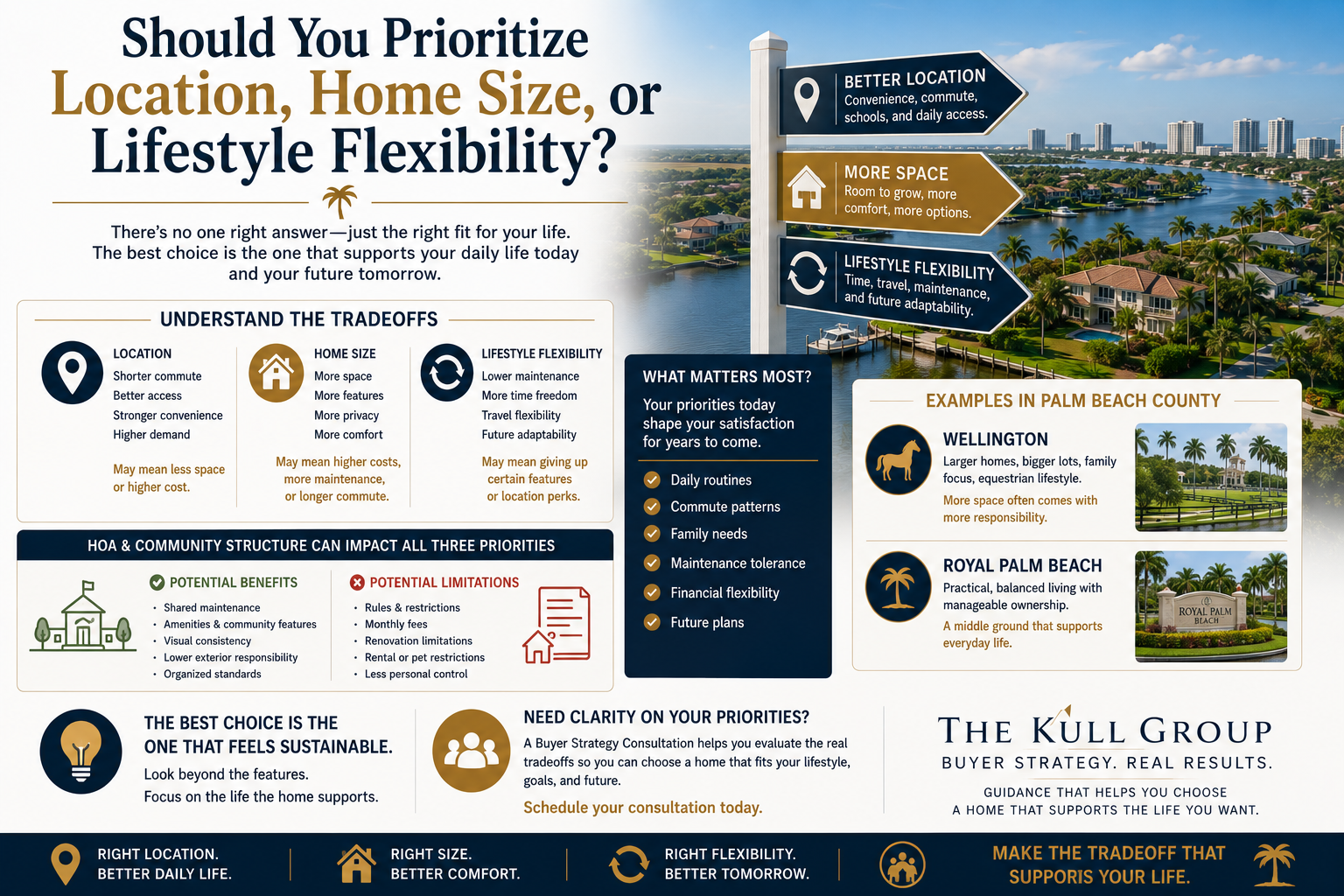
Buyer strategy infographic comparing location, home size, and lifestyle flexibility tradeoffs for home buyers in Palm Beach County and South Florida.

Should You Prioritize Location, Home Size, or Lifestyle Flexibility?

Most buyers eventually face the same difficult question: should they prioritize location, home size, or lifestyle flexibility?

It sounds simple until the tradeoffs become real.

A better location may mean a smaller home. A larger home may mean a longer commute. A lower-maintenance property may mean less space. A more flexible lifestyle may require giving up features that looked important early in the search.

That is why buyers often struggle when they compare homes only by price, square footage, or appearance. The real decision is usually about which tradeoff will feel most sustainable after closing.

The best answer is not the same for every buyer.

The strongest decision depends on how the home will support daily routines, future needs, emotional comfort, maintenance tolerance, commute patterns, and long-term ownership goals.

The strongest buying decisions usually happen when buyers stop trying to maximize every feature and start identifying which tradeoff supports the life they actually want to live.

Location Usually Affects Daily Life More Than Buyers Expect

Location does not only affect resale value or convenience. It affects ordinary life every day.

Location can shape:

  • commute time
  • school routines
  • access to healthcare
  • shopping and service convenience
  • social activity
  • travel flexibility
  • energy levels
  • how easy or difficult daily movement feels

Some buyers realize over time that a slightly smaller home in a better-fitting location creates more long-term comfort than a larger home that adds pressure to everyday routines.

Others are genuinely happier accepting a longer drive or less central location because the additional space, privacy, or affordability matters more to them.

The key is knowing which tradeoff fits your actual life instead of assuming there is one universally correct answer.

Home Size Can Be Valuable, But Only If It Supports Real Use

More space can improve quality of life when the space solves a real problem.

A larger home may make sense for buyers who need:

  • dedicated work-from-home areas
  • room for children or extended family
  • storage
  • guest space
  • hobby areas
  • outdoor room
  • more privacy inside the home

But extra space also creates responsibility.

Larger homes may involve more cleaning, higher utility costs, greater maintenance exposure, larger roofs, more landscaping, more furnishing costs, and more time spent managing the property itself.

For some buyers, that tradeoff is entirely worthwhile. For others, the additional space eventually becomes more burden than benefit.

Buyers evaluating those patterns may also benefit from reviewing how buyers sometimes choose the wrong area for their lifestyle.

Compare Homes by the Tradeoff That Matters Most

Once buyers understand which priority matters most, the search process becomes more focused. Instead of comparing every home against every possible feature, buyers can compare homes through the lens of their real ownership priorities.

Some buyers begin comparing:

  • central location versus larger homes farther out
  • low-maintenance living versus more property control
  • walkability versus quiet residential space
  • affordability versus commute convenience
  • HOA structure versus ownership flexibility
  • current needs versus future adaptability

Compare Homes by City

Lifestyle Flexibility Is Often the Hidden Priority

Many buyers do not initially describe their goal as “lifestyle flexibility.”

They may say they want a certain number of bedrooms, a specific location, a garage, a pool, a gated community, or a particular price point.

But underneath those features, many buyers are really trying to protect flexibility.

They want:

  • time flexibility
  • financial flexibility
  • travel flexibility
  • family flexibility
  • work flexibility
  • future resale flexibility
  • maintenance flexibility

A home that technically meets the search criteria may still reduce flexibility if it creates too much cost, upkeep, commute pressure, or operational complexity.

The stronger decision usually comes from understanding which home supports the buyer’s life without boxing them in unnecessarily.

Wellington Is a Strong Example of Space Versus Responsibility

Wellington often appeals to buyers who want larger homes, larger lots, family-oriented neighborhoods, school-centered planning, equestrian influence, and a more decompressed residential environment.

For many buyers, that ownership style can be an excellent fit.

But Wellington also illustrates the importance of evaluating responsibility alongside space.

Buyers may gain:

  • larger living areas
  • more outdoor space
  • family-oriented neighborhood structure
  • residential stability
  • greater decompression

They may also take on:

  • more maintenance
  • longer commute patterns
  • larger landscaping demands
  • higher operating costs
  • more property management responsibility

For the right buyer, that tradeoff feels worthwhile. For another buyer, a more compact or centrally located ownership environment may be a better fit.

Buyers evaluating that decision may benefit from exploring Wellington buyer strategy guidance.

Royal Palm Beach Often Represents a Practical Middle Ground

Some buyers do not want the largest home, the most active lifestyle environment, or the highest-profile location. They want a practical ownership structure that supports ordinary life without creating unnecessary pressure.

Royal Palm Beach often appeals to buyers looking for that type of balance.

The area may support buyers who value:

  • practical suburban living
  • manageable ownership demands
  • family-oriented routines
  • balanced commute access
  • moderate lifestyle pressure
  • long-term operational sustainability

For some buyers, that middle-ground ownership structure creates more lasting satisfaction than chasing the largest home or most prestigious location.

Buyers comparing practical ownership environments may benefit from exploring Royal Palm Beach buyer strategy guidance.

HOA Structure Can Affect All Three Priorities

HOA and community structure can influence location, home size, and lifestyle flexibility at the same time.

An HOA-managed community may provide:

  • shared maintenance
  • amenities
  • visual consistency
  • organized community standards
  • lower exterior responsibility

But it may also create:

  • rules
  • fees
  • renovation limits
  • rental restrictions
  • pet or vehicle limitations
  • less personal control

For some buyers, the structure adds convenience. For others, it reduces the flexibility they actually need.

Buyers weighing that decision may also benefit from reviewing what buyers should understand about HOA and community restrictions before buying.

The Best Choice Usually Depends on Your Current Life Stage

A buyer’s best priority often changes depending on life stage.

A growing family may value space and school planning. A healthcare professional may prioritize commute reliability. A downsizing buyer may value lower maintenance. A remote worker may prioritize home functionality. A second-home buyer may value simplicity and management structure.

That is why generic buyer advice often fails.

The right decision depends on:

  • how you work
  • how often you travel
  • how much maintenance you want
  • how your family may change
  • how much flexibility you need
  • how much commute pressure you can tolerate
  • how long you expect to own the home

The strongest ownership outcomes usually happen when buyers choose based on life fit rather than feature comparison alone.

The Right Tradeoff Should Feel Sustainable

Every buyer makes a tradeoff.

Some trade space for location. Some trade location for affordability. Some trade flexibility for structure. Some trade maintenance simplicity for privacy. Some trade walkability for quiet.

The issue is not whether a tradeoff exists.

The issue is whether the tradeoff feels sustainable after the initial excitement fades.

A strong ownership decision usually feels:

  • realistic
  • manageable
  • emotionally calmer
  • financially sustainable
  • aligned with daily routines
  • supportive of future flexibility

Buyers looking for a broader decision framework may also benefit from reviewing buyer strategy and area fit guidance for Palm Beach County.

Trying to Decide Which Tradeoff Makes the Most Sense?

If you are deciding between location, home size, maintenance responsibility, HOA structure, commute patterns, and long-term flexibility, a buyer strategy consultation can help clarify which ownership tradeoff best supports the life you actually want after closing.

  • Compare location, space, and flexibility tradeoffs realistically
  • Evaluate how different choices affect daily life over time
  • Understand which ownership structure fits your current and future needs
  • Clarify which priorities should lead your home search

No pressure. Just practical guidance designed to help buyers choose the tradeoff that feels sustainable long term.

Schedule a Buyer Strategy Consultation

Frequently Asked Questions About Location, Home Size, and Lifestyle Flexibility

Should buyers prioritize location or home size?

It depends on how the tradeoff affects daily life. Some buyers are happier with a smaller home in a better-fitting location, while others value additional space enough to accept longer commutes or greater maintenance responsibility.

Why does lifestyle flexibility matter when buying a home?

Lifestyle flexibility affects how easily the home supports changing work patterns, family needs, travel, maintenance tolerance, financial comfort, and long-term ownership goals.

How can a larger home become a problem for some buyers?

A larger home can create more cleaning, maintenance, utility costs, landscaping responsibility, furnishing needs, and long-term operating costs than buyers initially expect.

How does HOA structure affect lifestyle flexibility?

HOA structure may create consistency, shared maintenance, and amenities, but it can also limit renovations, rentals, pets, parking, exterior changes, and how freely the owner can use the property.

What is the best way to decide which priority should lead the search?

The best approach is to evaluate which tradeoff will feel most sustainable after closing based on commute patterns, maintenance expectations, daily routines, financial comfort, and future flexibility.

May 10, 2026

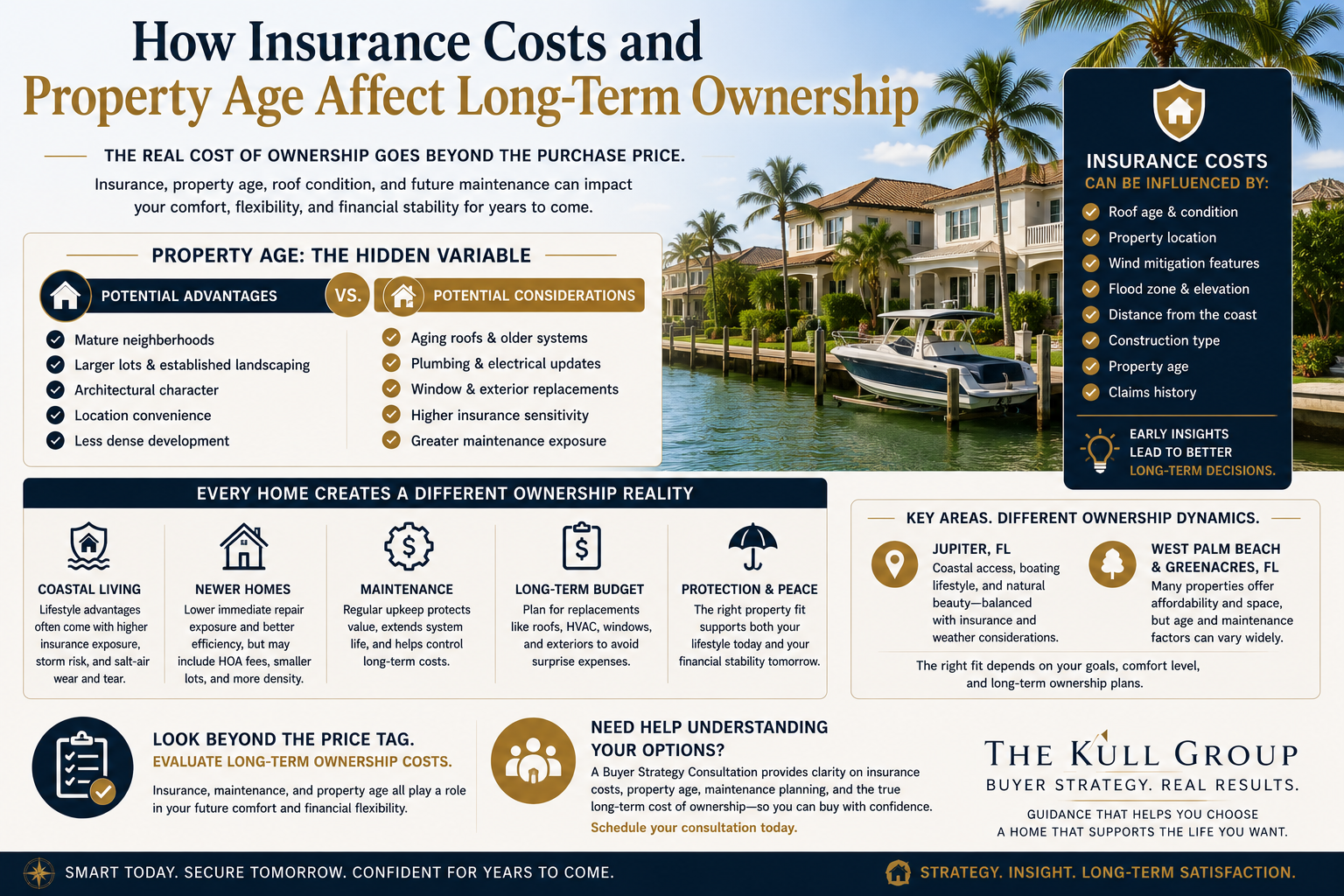
How Insurance Costs and Property Age Affect Long-Term Ownership

Buyer strategy infographic explaining how insurance costs, property age, roof condition, maintenance exposure, and coastal ownership realities affect long-term homeownership sustainability in Florida.

How Insurance Costs and Property Age Affect Long-Term Ownership

Many buyers focus heavily on purchase price during the home search process. Far fewer evaluate how insurance costs, property age, roof condition, system age, and long-term replacement planning may affect ownership years after closing.

That difference can significantly change how sustainable a home feels over time.

Two homes may appear similarly attractive during the buying process while creating completely different long-term ownership experiences once insurance premiums, maintenance exposure, weather vulnerability, and aging systems begin affecting the monthly reality of ownership.

The issue is not simply affordability.

It is ownership sustainability.

The strongest ownership decisions usually happen when buyers evaluate not only what a home costs to purchase, but what it may realistically cost to operate, insure, maintain, and protect over time.

Property Age Often Changes Ownership Dynamics

Older homes can offer meaningful advantages:

  • mature neighborhoods
  • larger lots
  • architectural character
  • established landscaping
  • location convenience
  • less dense development patterns

For many buyers, those qualities are highly attractive.

But older homes may also involve:

  • aging roofs
  • older plumbing systems
  • electrical updates
  • window replacement planning
  • higher insurance sensitivity
  • greater long-term maintenance exposure

None of those realities automatically make older homes a poor decision. The key is understanding how the ownership structure fits the buyer’s comfort level, financial flexibility, and long-term plans.

Insurance Costs Can Affect Lifestyle Flexibility

Insurance is often treated as a closing detail during the search process. In reality, it can become one of the largest ongoing ownership expenses over time.

Insurance exposure may be influenced by:

  • roof age
  • property location
  • wind mitigation features
  • flood exposure
  • distance from the coast
  • construction type
  • property age
  • claims history

For some buyers, those costs remain manageable relative to the lifestyle advantages the property provides.

For others, the long-term ownership pressure eventually feels heavier than expected.

The strongest ownership outcomes usually happen when buyers evaluate insurance sustainability early rather than treating it as an afterthought.

Buyers evaluating those operational realities may also benefit from reviewing how ownership tradeoffs affect long-term lifestyle satisfaction.

Compare Ownership Costs Alongside Homes

One of the strongest ways to avoid long-term ownership pressure is to compare not only the homes themselves, but the operational realities attached to them.

Some buyers eventually realize they should have compared:

  • older homes versus newer construction
  • coastal access versus insurance exposure
  • larger properties versus maintenance costs
  • lower HOA environments versus higher owner responsibility
  • property character versus long-term operational simplicity
  • short-term affordability versus long-term sustainability

Once buyers understand how operational costs interact with lifestyle goals, the search process becomes far more realistic and useful.

Compare Homes by City

Coastal Ownership Often Creates Different Insurance Considerations

Many buyers are naturally drawn toward coastal communities because of lifestyle access, walkability, water proximity, boating culture, and outdoor living.

Those advantages can create an exceptional ownership experience for the right buyer.

But coastal ownership may also involve:

  • higher insurance exposure
  • salt-air wear
  • storm vulnerability
  • higher maintenance frequency
  • flood-zone considerations
  • greater long-term exterior upkeep

Some buyers happily accept those realities because the lifestyle fit feels worthwhile. Others eventually realize the operational pressure affects long-term comfort more than expected.

The strongest decisions usually happen when buyers evaluate both the emotional appeal and the ownership realities together.

Buyers evaluating those coastal ownership patterns may benefit from exploring Jupiter buyer strategy guidance.

Newer Homes Often Create Different Ownership Advantages

Many buyers prioritize newer homes because they expect:

  • lower immediate repair exposure
  • better energy efficiency
  • updated construction standards
  • newer roofs and systems
  • potential insurance advantages
  • simpler maintenance planning

Those advantages can significantly improve ownership comfort for some buyers.

At the same time, newer communities may also involve:

  • higher HOA structure
  • smaller lots
  • greater density
  • ongoing nearby development
  • less mature landscaping
  • less property individuality

The strongest ownership fit depends on which tradeoffs support the buyer’s actual lifestyle priorities.

Buyers evaluating those maintenance and flexibility tradeoffs may also benefit from reviewing how long-term lifestyle fit affects ownership decisions.

West Palm Beach and Greenacres Can Create Different Ownership Patterns

Different Palm Beach County areas often create different operational ownership realities.

For example, buyers comparing West Palm Beach and Greenacres may encounter very different combinations of:

  • property age
  • insurance exposure
  • HOA structure
  • maintenance responsibility
  • density
  • property style
  • replacement planning

Neither environment is automatically better.

The strongest ownership outcomes usually happen when buyers evaluate which operational structure feels sustainable financially and emotionally over time.

Buyers comparing those ownership environments may benefit from exploring West Palm Beach buyer strategy guidance.

Roof Age Often Matters More Than Buyers Expect

One of the most important ownership variables in Florida is roof condition.

Roof age may affect:

  • insurance availability
  • premium pricing
  • future replacement planning
  • wind mitigation credits
  • long-term budgeting
  • overall ownership stability

Many buyers focus primarily on aesthetics during showings and underestimate how much roofing condition may affect ownership years later.

The strongest decisions usually happen when buyers evaluate both visible appeal and structural longevity together.

Operational Simplicity Creates Emotional Stability

One of the most overlooked parts of homeownership is how operational pressure affects emotional comfort.

For some buyers, ownership feels most comfortable when:

  • maintenance is manageable
  • insurance feels sustainable
  • replacement planning feels realistic
  • monthly ownership pressure stays controlled
  • unexpected costs feel less disruptive

For others, a more complex property still feels worthwhile because the lifestyle fit outweighs the operational demands.

The right ownership decision depends on whether the buyer’s financial structure, maintenance tolerance, flexibility goals, and long-term plans align with the property’s ongoing realities.

Buyers wanting a broader ownership-fit framework may also benefit from reviewing buyer strategy and area fit guidance for Palm Beach County.

Trying to Understand How Long-Term Ownership Costs May Affect Your Lifestyle?

If you are comparing older homes, newer construction, coastal properties, suburban communities, or different Palm Beach County ownership environments, a buyer strategy consultation can help clarify how insurance exposure, property age, maintenance planning, and long-term operational costs may affect ownership comfort after closing.

  • Compare older homes with newer construction realistically
  • Evaluate insurance exposure and long-term maintenance planning
  • Understand how operational costs affect lifestyle sustainability
  • Clarify which ownership structure feels financially and emotionally manageable long term

No pressure. Just practical guidance designed to help buyers choose ownership environments that remain sustainable well after the excitement of the purchase fades.

Schedule a Buyer Strategy Consultation

Frequently Asked Questions About Insurance Costs and Property Age

Why does property age affect long-term ownership costs?

Older homes may involve aging roofs, plumbing systems, electrical systems, windows, and long-term maintenance planning that can affect insurance costs, repair exposure, and operational budgeting over time.

Do newer homes always create lower ownership costs?

Not always. Newer homes may reduce immediate repair exposure and improve energy efficiency, but buyers should still evaluate HOA structure, density, future development, and long-term ownership flexibility.

Why do coastal homes often involve different insurance considerations?

Coastal properties may involve greater storm exposure, flood-zone considerations, salt-air wear, and higher insurance sensitivity compared to inland ownership environments.

How important is roof age when buying a home in Florida?

Roof age can significantly affect insurance availability, premium pricing, replacement planning, wind mitigation credits, and overall ownership stability long term.

What is one of the biggest mistakes buyers make regarding ownership costs?

Many buyers focus heavily on purchase price while underestimating how insurance, maintenance planning, replacement costs, and operational sustainability may affect daily life after closing.

May 10, 2026

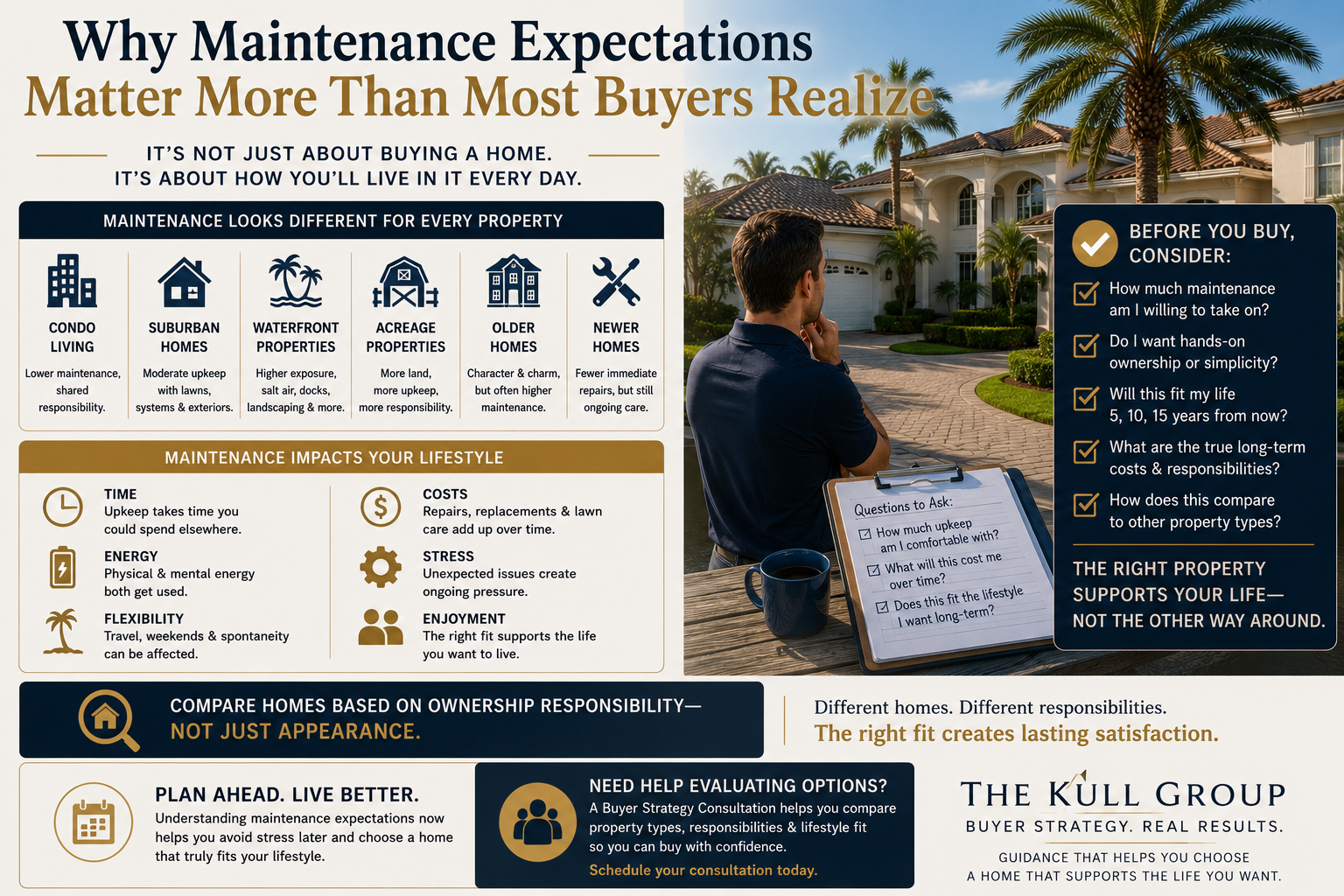
Why Maintenance Expectations Matter More Than Most Buyers Realize

Buyer strategy infographic explaining how maintenance expectations, property upkeep, ownership responsibility, and lifestyle fit affect long-term home satisfaction in Palm Beach County.

Why Maintenance Expectations Matter More Than Most Buyers Realize

Many buyers evaluate a home based on how it looks during the showing process. Far fewer evaluate what it will actually require to maintain over the next five, ten, or fifteen years.

That gap creates more ownership stress than many people expect.

A property can feel exciting during the purchase phase and slowly become emotionally draining once the realities of upkeep, repairs, landscaping, aging systems, exterior exposure, or ongoing maintenance begin affecting ordinary life.

For some homeowners, those responsibilities feel rewarding. For others, they quietly consume time, energy, weekends, and financial flexibility in ways that were never fully evaluated before closing.

The issue is not whether maintenance is good or bad.

The issue is whether the ownership responsibility matches the lifestyle the buyer actually wants long term.

The strongest ownership decisions usually happen when buyers evaluate maintenance tolerance honestly instead of assuming they will “figure it out later.”

Different Properties Create Very Different Ownership Demands

Not all homes require the same level of ongoing attention.

A buyer comparing:

  • a condo
  • a townhome
  • a newer suburban home
  • a waterfront property
  • an acreage property
  • an older character home

…is not simply comparing square footage or aesthetics.

They are comparing entirely different ownership responsibilities.

Some homes create:

  • larger landscaping obligations
  • more exterior upkeep
  • greater weather exposure
  • higher system replacement costs
  • drainage management concerns
  • more cleaning and maintenance labor

Others create:

  • lower maintenance intensity
  • shared maintenance structures
  • reduced exterior responsibility
  • simpler day-to-day ownership
  • greater schedule flexibility

The strongest ownership outcomes usually happen when buyers understand which version of ownership actually fits how they want life to operate after closing.

Some Buyers Enjoy Hands-On Ownership

One of the most important realities in homeownership is that maintenance tolerance varies dramatically from one buyer to another.

Some homeowners genuinely enjoy:

  • yard projects
  • landscaping
  • outdoor upgrades
  • property improvement projects
  • managing acreage
  • maintaining larger homes

For those buyers, maintenance may feel satisfying rather than stressful.

Other buyers prioritize:

  • travel flexibility
  • simpler routines
  • reduced upkeep
  • less operational responsibility
  • more schedule freedom
  • lower ongoing property management

Neither approach is better.

The problem appears when buyers purchase a level of responsibility that conflicts with how they actually prefer to live.

Buyers evaluating those lifestyle patterns may also benefit from reviewing how daily life differs across Palm Beach County communities.

Compare Homes Based on Ownership Responsibility — Not Just Appearance

One of the strongest ways to avoid ownership stress later is to compare homes based on how much responsibility they create after closing.

Some buyers eventually realize they should have compared:

  • maintenance-light ownership versus hands-on ownership
  • condo living versus single-family upkeep
  • larger lots versus reduced maintenance
  • newer systems versus older property character
  • waterfront exposure versus simplified ownership
  • privacy versus operational simplicity

Once buyers understand the type of ownership responsibility they are genuinely comfortable managing, the search process becomes significantly more effective.

Compare Homes by City

The Acreage and Loxahatchee Are Strong Examples of Maintenance Reality

Many buyers are naturally attracted to The Acreage and Loxahatchee because of:

  • space
  • privacy
  • reduced density
  • larger lots
  • rural decompression
  • greater property flexibility

For the right buyer, those environments can create an outstanding ownership experience.

But they also often require:

  • more landscaping management
  • drainage awareness
  • larger exterior upkeep
  • equipment management
  • more hands-on ownership involvement
  • greater long-term maintenance planning

Some buyers thrive in that environment because they enjoy managing space and independence. Others eventually realize the operational demands are heavier than expected.

The strongest decisions usually happen when buyers evaluate both the emotional appeal and the ongoing responsibility honestly.

Buyers evaluating those ownership environments may benefit from exploring The Acreage buyer strategy guidance.

Older Homes Can Create Different Maintenance Patterns

Some buyers are naturally drawn toward older homes because of character, architecture, mature neighborhoods, or location advantages.

Those properties can create highly rewarding ownership experiences.

But buyers should still evaluate:

  • roof age
  • plumbing systems
  • electrical systems
  • window condition
  • drainage
  • foundation movement
  • insurance implications
  • future replacement planning

Older homes do not automatically create problems. But they often require more long-term ownership awareness than buyers initially expect.

Buyers evaluating those long-term ownership realities may also benefit from reviewing how property age affects ownership costs and insurance considerations.

Maintenance Pressure Can Affect Lifestyle Satisfaction

Many buyers think about maintenance financially but underestimate the emotional side of ownership responsibility.

Over time, constant upkeep can affect:

  • weekend flexibility
  • stress levels
  • travel freedom
  • schedule management
  • energy recovery
  • overall emotional comfort

For some buyers, maintaining a larger or more complex property feels rewarding and grounding.

For others, it eventually feels like the home is controlling their time instead of supporting their life.

The strongest ownership environments usually feel sustainable emotionally, not just affordable financially.

Newer Homes Often Create Different Tradeoffs

Many buyers prioritize newer homes because they expect:

  • fewer immediate repairs
  • newer systems
  • lower maintenance pressure
  • better energy efficiency
  • simpler ownership

Those advantages can be meaningful.

But newer homes may also involve:

  • HOA restrictions
  • smaller lots
  • less mature landscaping
  • higher density
  • future development nearby
  • less property flexibility

The right ownership fit depends on which tradeoffs matter most to the buyer’s lifestyle priorities.

Buyers evaluating those flexibility patterns may also benefit from reviewing how lifestyle flexibility affects long-term ownership satisfaction.

Maintenance Fit Is Really a Lifestyle Fit Question

At its core, maintenance tolerance is not simply a financial issue.

It is a lifestyle issue.

Buyers should ask themselves:

  • How much time do I realistically want to spend managing property?
  • Do I enjoy hands-on ownership or prefer simplicity?
  • How important is flexibility and travel freedom?
  • Do I want more space even if it creates more responsibility?
  • Will this ownership structure still fit my life years from now?

The strongest ownership outcomes usually happen when buyers choose the level of responsibility that genuinely supports the way they want to live after closing.

Buyers looking for a broader ownership-fit framework may also benefit from reviewing buyer strategy and area fit guidance for Palm Beach County.

Trying to Decide How Much Ownership Responsibility Actually Fits Your Lifestyle?

If you are comparing condos, newer suburban homes, waterfront properties, acreage homes, or larger-lot ownership environments, a buyer strategy consultation can help clarify how maintenance expectations may affect daily life, flexibility, stress levels, and long-term ownership satisfaction.

  • Compare maintenance-light ownership with hands-on property environments
  • Evaluate how upkeep responsibilities affect long-term lifestyle fit
  • Understand the operational realities behind different property types
  • Clarify how much ownership responsibility feels sustainable for your life

No pressure. Just practical guidance designed to help buyers avoid choosing a property structure that creates more long-term responsibility than they truly want.

Schedule a Buyer Strategy Consultation

Frequently Asked Questions About Maintenance Expectations Before Buying a Home

Why do maintenance expectations affect long-term home satisfaction?

Maintenance responsibilities affect daily routines, flexibility, stress levels, travel freedom, energy management, and overall ownership comfort. Over time, those operational demands can shape how sustainable ownership feels.

Do larger homes always create more maintenance responsibility?

Not always, but larger homes, larger lots, waterfront properties, acreage environments, and older homes often involve greater upkeep, exterior maintenance, and long-term operational responsibility.

Why are The Acreage and Loxahatchee important examples of maintenance reality?

Those areas often provide space, privacy, and flexibility, but they may also require more landscaping management, drainage awareness, equipment upkeep, and hands-on ownership involvement than buyers initially expect.

Do newer homes automatically eliminate maintenance concerns?

No. Newer homes may reduce immediate repair exposure, but buyers should still evaluate HOA structure, future development, density, lot size, long-term maintenance planning, and overall ownership flexibility.

How should buyers evaluate whether a property’s maintenance level fits their lifestyle?

Buyers should honestly evaluate how much time, responsibility, flexibility, and operational involvement they want their ownership environment to require after closing.

May 10, 2026

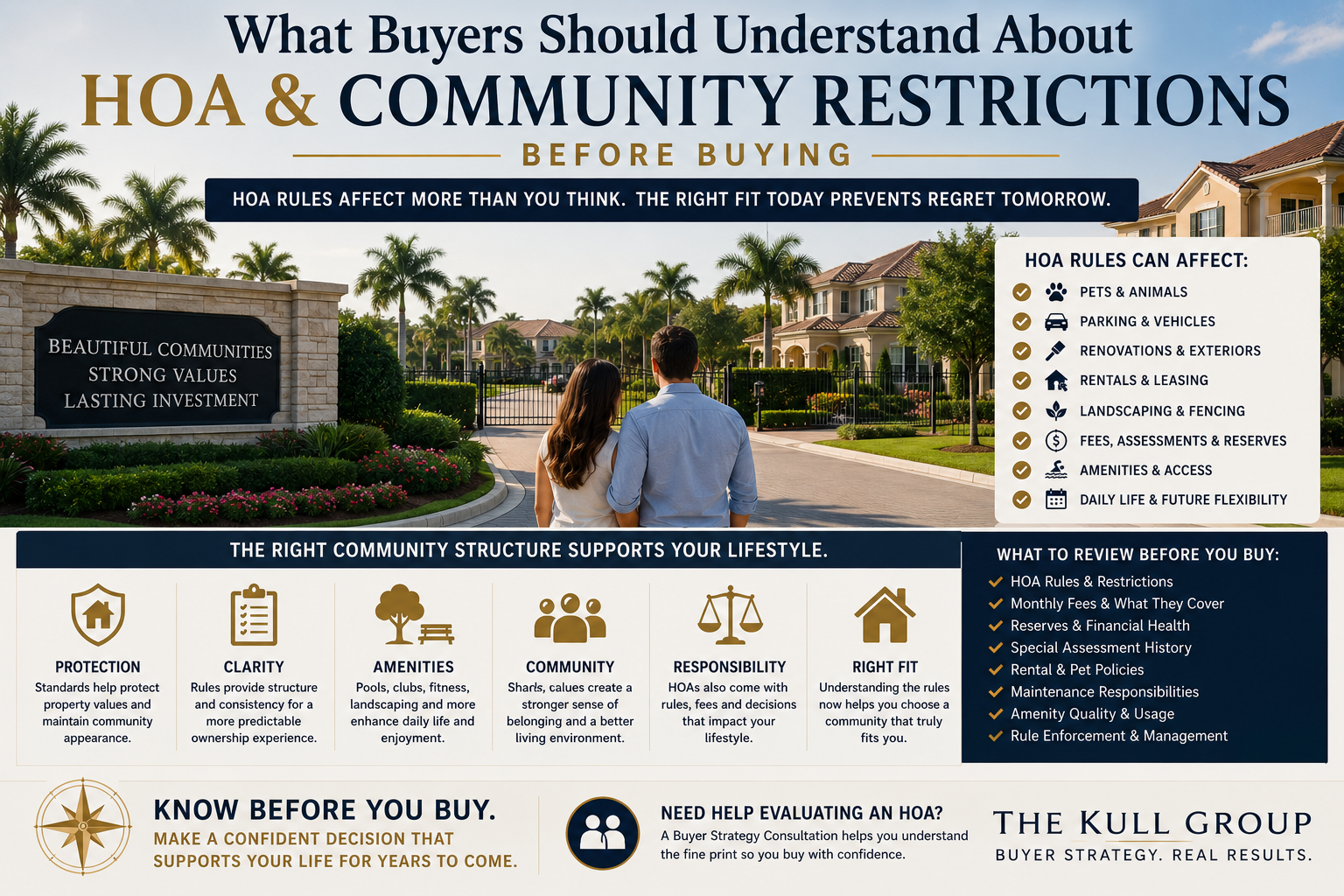
HOA and Community Restrictions Before Buying | Buyer Strategy

Buyer strategy infographic explaining HOA rules, community restrictions, fees, reserves, maintenance responsibilities, and lifestyle fit considerations before buying a home in

What Buyers Should Understand About HOA and Community Restrictions Before Buying

HOA rules are easy to treat as paperwork during the buying process. Buyers may glance at the monthly fee, review the amenities, and assume the rest can be handled later.

That can be a costly mistake.

Community restrictions often shape daily life more than buyers realize. They can affect how a home is used, what changes can be made, where vehicles can be parked, whether pets are allowed, how rentals are handled, how exterior maintenance is managed, and how much control the owner actually has after closing.

For some buyers, that structure creates comfort. For others, it slowly becomes frustrating.

The issue is not whether an HOA is good or bad. The issue is whether the structure fits the way the buyer actually wants to live.

The strongest HOA buying decisions usually happen when buyers evaluate community rules as lifestyle infrastructure, not just as monthly fees or neighborhood paperwork.

HOA Structure Can Support the Right Buyer

Some buyers thrive in HOA-managed communities because the structure reduces uncertainty. Rules, standards, maintenance expectations, and shared amenities can create a more predictable ownership environment.

That may appeal to buyers who want:

  • consistent community appearance
  • shared maintenance responsibility
  • amenity access
  • landscaping standards
  • reduced exterior decision-making
  • neighborhood organization
  • a more managed ownership experience

For buyers who value simplicity, structure, and consistency, HOA communities can feel supportive rather than restrictive.

The problem begins when buyers choose that structure without understanding how it will affect their daily habits, future plans, renovation goals, or tolerance for community oversight.

Rules Matter More When They Affect Real Life

Many buyers review HOA rules abstractly. They may understand that restrictions exist but not think through how those restrictions may affect ordinary life.

That is where friction can appear later.

Restrictions may affect:

  • work vehicles
  • guest parking
  • pets
  • fencing
  • paint colors
  • landscaping changes
  • exterior renovations
  • short-term or seasonal rentals
  • boat, trailer, or RV storage

For one buyer, those rules may barely matter. For another, they may affect daily convenience, future flexibility, or even whether the community fits their lifestyle at all.

Buyers evaluating how community rules affect lifestyle should also review what daily life feels like in different Palm Beach County communities.

Compare Homes by Community Structure Before You Commit

Once buyers understand how much structure or flexibility they want, the home search becomes more useful. Instead of comparing only price, photos, and square footage, buyers can compare how each community may function after closing.

Some buyers begin comparing:

  • HOA-managed communities versus lower-restriction neighborhoods
  • condos and townhomes versus single-family homes
  • gated communities versus open neighborhoods
  • club communities versus non-club ownership
  • shared maintenance versus direct owner responsibility
  • amenity-heavy communities versus simpler ownership environments

Compare Homes by City

Fees Are Only One Part of the HOA Decision

Many buyers focus heavily on the monthly HOA fee because it is easy to compare. A lower fee may appear more attractive, while a higher fee may feel like an unnecessary burden.

But the fee alone does not tell the full story.

Buyers should understand:

  • what the fee covers
  • what the homeowner remains responsible for
  • whether reserves are healthy
  • whether assessments may be likely
  • how maintenance is managed
  • whether insurance is included or separate
  • how rules are enforced
  • whether amenities are actually useful to the buyer

A low fee with weak reserves or unclear maintenance responsibility may create more future uncertainty than a higher fee in a well-managed community.

A higher fee may be worthwhile if it meaningfully reduces maintenance responsibility or supports the lifestyle the buyer truly wants.

Palm Beach Gardens Is a Strong Example of Structure-Driven Ownership

Palm Beach Gardens includes many communities where HOA structure, club expectations, gated access, landscaping standards, and amenity environments can significantly shape ownership.

For some buyers, that is exactly the appeal. They want a polished, organized environment where community standards support the lifestyle they are choosing.

For others, the combination of fees, rules, club expectations, and maintenance responsibilities may feel more complex than expected.

The strongest decisions usually happen when buyers understand whether the community structure feels supportive or restrictive before they become emotionally attached to a specific home.

Buyers comparing structured ownership environments may benefit from exploring Palm Beach Gardens buyer strategy guidance.

HOA Rules Can Affect Future Flexibility

Buyers often evaluate a home based on current needs. But HOA structure can also affect future adaptability.

Rules may influence whether a buyer can:

  • rent the property later
  • renovate the exterior
  • add certain improvements
  • change landscaping
  • keep additional vehicles
  • accommodate changing family needs
  • use the property seasonally

That future flexibility matters because life rarely stays exactly the same after closing.

A community that fits well today may become restrictive later if the buyer’s family structure, work situation, ownership goals, or lifestyle needs change.

Buyers evaluating future adaptability may also benefit from reviewing whether location, home size, or lifestyle flexibility should come first.

Boca Raton Shows How HOA Fit Can Differ by Community

Boca Raton includes many ownership environments where HOA structure ranges from highly managed club communities to less restrictive residential neighborhoods.

That variation matters because two homes in the same city may create completely different ownership experiences.

One buyer may want the consistency and structure of a gated or club environment. Another may prefer more control, fewer rules, or lower monthly obligations.

The strongest Boca Raton buying decisions usually happen when buyers evaluate how community structure affects daily life, not just how desirable the area looks from the outside.

Buyers comparing those ownership differences may benefit from exploring Boca Raton buyer strategy guidance.

Condo and Townhome Buyers Need Extra Clarity

HOA review becomes especially important for condo and townhome buyers because the ownership structure may involve shared systems, common elements, building reserves, insurance arrangements, and collective decision-making.

Buyers should understand:

  • building maintenance responsibility
  • roof and exterior obligations
  • insurance structure
  • reserve studies
  • special assessment history
  • rental restrictions
  • pet restrictions
  • parking rules
  • amenity upkeep

For some buyers, this structure creates simplicity. For others, it creates dependency on association decisions and community-wide financial planning.

The best fit depends on the buyer’s comfort with shared responsibility.

HOA Fit Is Really a Lifestyle Fit Question

At its core, HOA fit is not just financial. It is behavioral.

Buyers should ask themselves:

  • Do I want structure or flexibility?
  • Do I value consistency or control?
  • Do I want shared maintenance or personal responsibility?
  • Do I want amenities or lower obligations?
  • Do I want community standards or more independence?
  • Will these rules still fit my life several years from now?

There is no universal right answer.

The right answer depends on whether the community structure supports the buyer’s actual lifestyle after closing.

Buyers who want a broader strategy framework may also benefit from reviewing buyer strategy and area fit guidance for Palm Beach County.

Need Help Understanding Whether an HOA Community Fits Your Lifestyle?

If you are comparing HOA communities, gated neighborhoods, condos, townhomes, or lower-restriction homes, a buyer strategy consultation can help clarify how community structure may affect daily life, future flexibility, maintenance responsibility, and long-term ownership satisfaction.

  • Compare HOA-managed communities with lower-restriction ownership options
  • Understand fees, rules, reserves, and maintenance responsibilities
  • Evaluate whether community structure supports your lifestyle goals
  • Clarify how much flexibility or structure you actually want after closing

No pressure. Just practical guidance designed to help buyers avoid choosing a community structure that does not fit the way they actually live.

Schedule a Buyer Strategy Consultation

Frequently Asked Questions About HOA and Community Restrictions Before Buying

Are HOA communities a good fit for every buyer?

No. HOA communities can be a strong fit for buyers who value structure, shared maintenance, amenities, and community standards. They may feel restrictive for buyers who want more control, flexibility, or independence.

What should buyers review before purchasing in an HOA community?

Buyers should review fees, rules, reserves, maintenance responsibility, rental policies, pet restrictions, parking rules, architectural guidelines, assessment history, and what the association actually covers.

Can HOA rules affect future flexibility?

Yes. HOA rules can affect rentals, renovations, exterior changes, vehicle storage, pets, leasing options, and how the home can be used as life changes over time.

Why do HOA fees not tell the full story?

Monthly fees are only one part of the decision. Buyers should also understand what the fee covers, reserve strength, future assessment risk, maintenance obligations, insurance structure, and community management quality.

How should buyers decide if an HOA fits their lifestyle?

Buyers should evaluate whether they prefer structure, consistency, shared maintenance, and community standards or whether they need more flexibility, control, and lower restrictions in daily ownership.

May 10, 2026

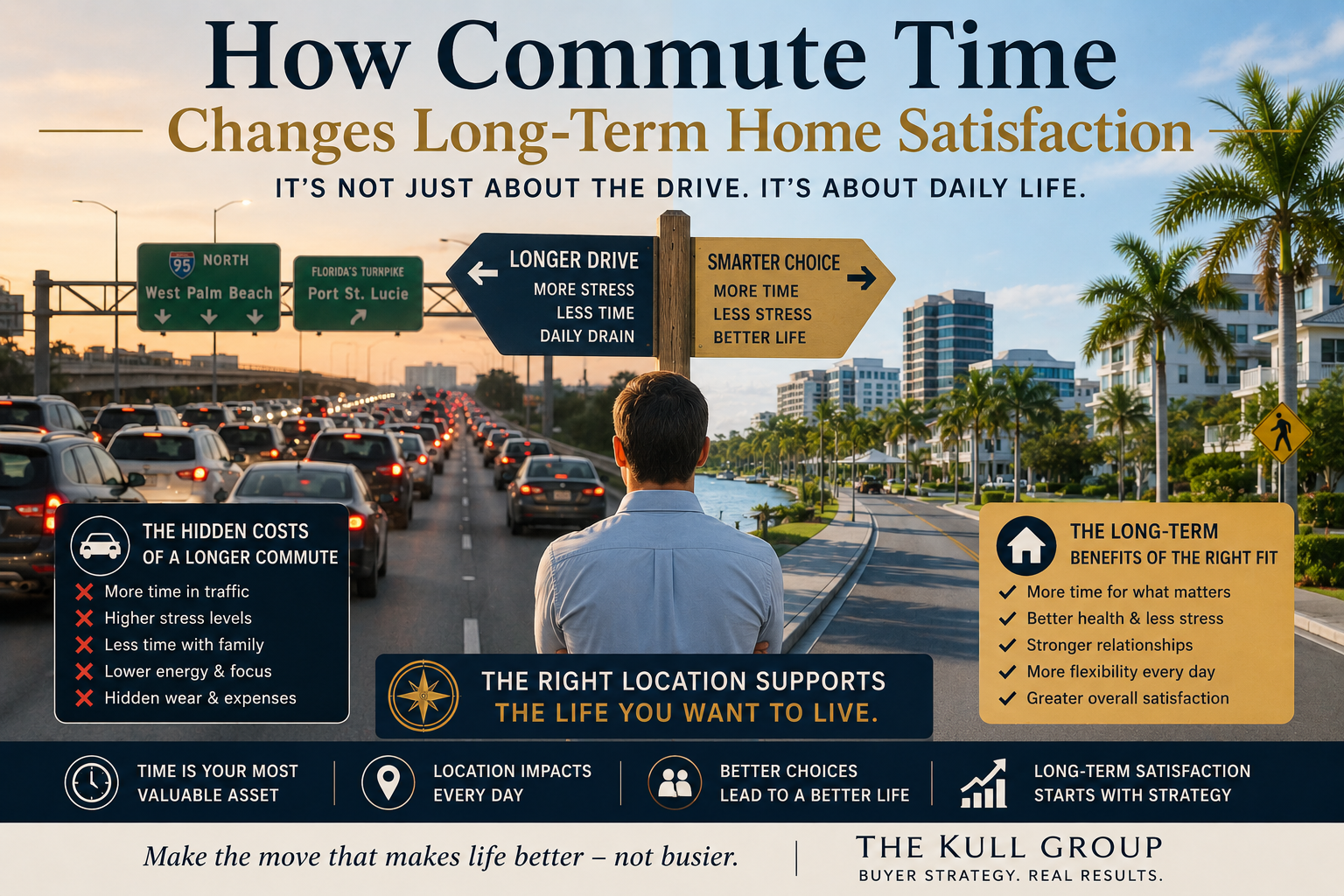
How Commute Time Changes Long-Term Home Satisfaction

Visual representation of how commute time affects long-term home satisfaction, lifestyle balance, stress levels, and ownership fit in Palm Beach County.

How Commute Time Changes Long-Term Home Satisfaction

Many buyers calculate commute time during the search process. Far fewer calculate what that commute will feel like emotionally six months or three years after closing.

That difference matters more than many homeowners initially expect.

A longer drive may appear manageable during occasional test runs or weekend showings. But ownership is experienced through ordinary repetition. The route becomes part of daily energy management, scheduling flexibility, stress levels, family routines, and emotional recovery time.

Some buyers happily trade commute efficiency for additional space, affordability, privacy, or lifestyle decompression. Others slowly realize the drive is affecting their quality of life far more than the extra square footage or lower purchase price is improving it.

The issue is not whether a longer commute is “good” or “bad.”

The issue is whether the ownership tradeoff genuinely aligns with how the buyer wants daily life to function long term.

The strongest ownership decisions usually happen when buyers evaluate commute patterns as part of lifestyle sustainability — not just transportation logistics.

Commute Time Affects More Than Driving

Many buyers evaluate commute distance in terms of mileage or estimated travel time. But the real effect of commuting is usually cumulative.

Over time, commute patterns influence:

  • energy levels
  • stress recovery
  • family time
  • schedule flexibility
  • morning routines
  • social availability
  • exercise habits
  • weekend recovery patterns

Some homeowners adapt extremely well to longer drives because they prioritize other ownership advantages more heavily. Others eventually realize the additional movement changes how daily life feels in ways they underestimated initially.

The strongest ownership outcomes usually happen when buyers evaluate not only whether the drive is possible, but whether the lifestyle surrounding the drive feels sustainable.

Different Buyers Experience Commutes Very Differently

One reason commute decisions can become complicated is because different buyers tolerate movement differently.

Some buyers naturally prioritize:

  • larger homes
  • larger lots
  • more privacy
  • quieter ownership environments
  • newer construction
  • greater affordability flexibility

Others prioritize:

  • reduced driving
  • walkability
  • daily convenience
  • professional access
  • social connectivity
  • schedule efficiency

Neither preference is automatically correct.

The problem usually appears when buyers choose a lifestyle structure that conflicts with how they naturally manage time, energy, and stress.

Buyers evaluating those ownership tradeoffs may also benefit from reviewing how buyers sometimes choose the wrong area for their lifestyle.

Compare Commute Tradeoffs Before Comparing Homes

One of the most effective ways to evaluate ownership fit is to compare how different locations affect ordinary daily movement.

Some buyers eventually realize they should have compared:

  • space versus commute efficiency
  • newer homes versus central access
  • quiet residential environments versus convenience
  • larger lots versus reduced driving time
  • lower pricing pressure versus daily movement demands
  • suburban decompression versus professional accessibility

Once buyers understand which tradeoffs genuinely matter most to them, the home search itself becomes far more focused.

Compare Homes by City

West Palm Beach Often Appeals to Buyers Prioritizing Accessibility

For many buyers, West Palm Beach creates long-term value because of convenience and connectivity rather than maximum square footage.

The area often appeals to buyers prioritizing:

  • reduced commute pressure
  • professional access
  • airport proximity
  • walkability in certain districts
  • healthcare access
  • greater scheduling flexibility

For some homeowners, reducing daily movement creates a measurable improvement in overall lifestyle sustainability.

Buyers evaluating those accessibility patterns may also benefit from exploring West Palm Beach buyer strategy guidance.

Longer Commutes Can Feel Different Over Time

Some buyers initially tolerate longer drives very comfortably because the ownership advantages feel exciting during the purchase phase.

Over time, however, repetitive movement patterns can begin affecting:

  • morning stress
  • time availability
  • energy management
  • traffic frustration
  • family interaction
  • schedule flexibility
  • overall emotional bandwidth

That does not mean longer commutes are automatically negative. Some buyers remain extremely happy with larger homes, quieter environments, acreage properties, or newer construction farther from activity centers.

The strongest ownership decisions usually happen when buyers evaluate whether the long-term tradeoff genuinely supports how they want ordinary life to feel.

Port St. Lucie Often Represents a Space Versus Proximity Tradeoff

Port St. Lucie is a strong example of how commute patterns interact with ownership goals.

Many buyers moving north prioritize:

  • larger homes
  • newer construction
  • greater affordability leverage
  • more physical space
  • lower pricing pressure

For some homeowners, those advantages outweigh additional driving comfortably.

For others, the longer movement patterns eventually affect lifestyle satisfaction more heavily than expected.

The correct answer depends entirely on how the buyer prioritizes:

  • space
  • time
  • privacy
  • energy management
  • financial flexibility
  • daily convenience

Buyers evaluating those tradeoffs may also benefit from exploring Palm Springs buyer strategy guidance.

Remote and Hybrid Work Have Changed Commute Psychology

One reason commute tradeoffs feel different today is because remote and hybrid work have changed how buyers experience movement.

Some buyers now tolerate longer distances more comfortably because they:

  • commute less frequently
  • control their schedules more flexibly
  • prioritize home environment over daily movement
  • travel during non-peak hours

Others still require:

  • consistent office access
  • frequent travel
  • healthcare-system proximity
  • client-facing mobility
  • daily regional movement

That difference significantly affects which ownership environments feel sustainable long term.

Buyers evaluating those flexibility patterns may also benefit from reviewing how ownership costs and long-term practicality shape lifestyle sustainability.

The Right Commute Usually Feels Emotionally Sustainable

One of the strongest indicators of ownership fit is whether the movement pattern feels emotionally manageable after ordinary life resumes.

The right ownership environment usually supports:

  • reasonable recovery time
  • schedule flexibility
  • manageable stress levels
  • consistent routines
  • energy sustainability
  • long-term lifestyle balance

The wrong movement pattern often creates subtle ongoing pressure that gradually affects overall satisfaction even when the home itself remains attractive.

That difference becomes more important over time because commuting is not experienced occasionally. It becomes part of the structure of daily life itself.

Trying to Balance Commute Efficiency With the Lifestyle You Actually Want?

If you are comparing different Palm Beach County ownership environments, a buyer strategy consultation can help clarify how commute patterns, lifestyle pace, space requirements, maintenance expectations, and long-term ownership priorities may affect daily life after closing.

  • Compare commute tradeoffs realistically before purchasing
  • Evaluate convenience versus space and affordability priorities
  • Understand how different ownership environments affect daily routines
  • Clarify which movement patterns feel sustainable long term

No pressure. Just practical guidance designed to help buyers choose ownership environments that support long-term lifestyle sustainability.

Schedule a Buyer Strategy Consultation

Frequently Asked Questions About Commute Time and Home Satisfaction

Why does commute time affect long-term home satisfaction so much?

Commute patterns affect daily energy levels, scheduling flexibility, stress management, family time, and overall emotional sustainability. Over time, those repetitive movement patterns can significantly shape how ownership feels.

Is a longer commute always a bad decision?

No. Some buyers happily trade commute efficiency for additional space, newer homes, affordability flexibility, or quieter ownership environments. The strongest decision depends on the buyer’s personal priorities and lifestyle structure.

How does West Palm Beach appeal to buyers concerned about commute pressure?

West Palm Beach often appeals to buyers prioritizing professional accessibility, reduced driving, airport proximity, healthcare access, and greater scheduling flexibility.

Why do some buyers underestimate commute stress during the search process?

Many buyers evaluate the commute emotionally during the excitement of the purchase process instead of evaluating how repetitive movement patterns may feel after ordinary routines return.

What is one of the best ways to evaluate commute fit before buying?

One of the strongest approaches is to evaluate how the movement pattern supports ordinary daily life, not just whether the drive itself is technically manageable.

May 10, 2026

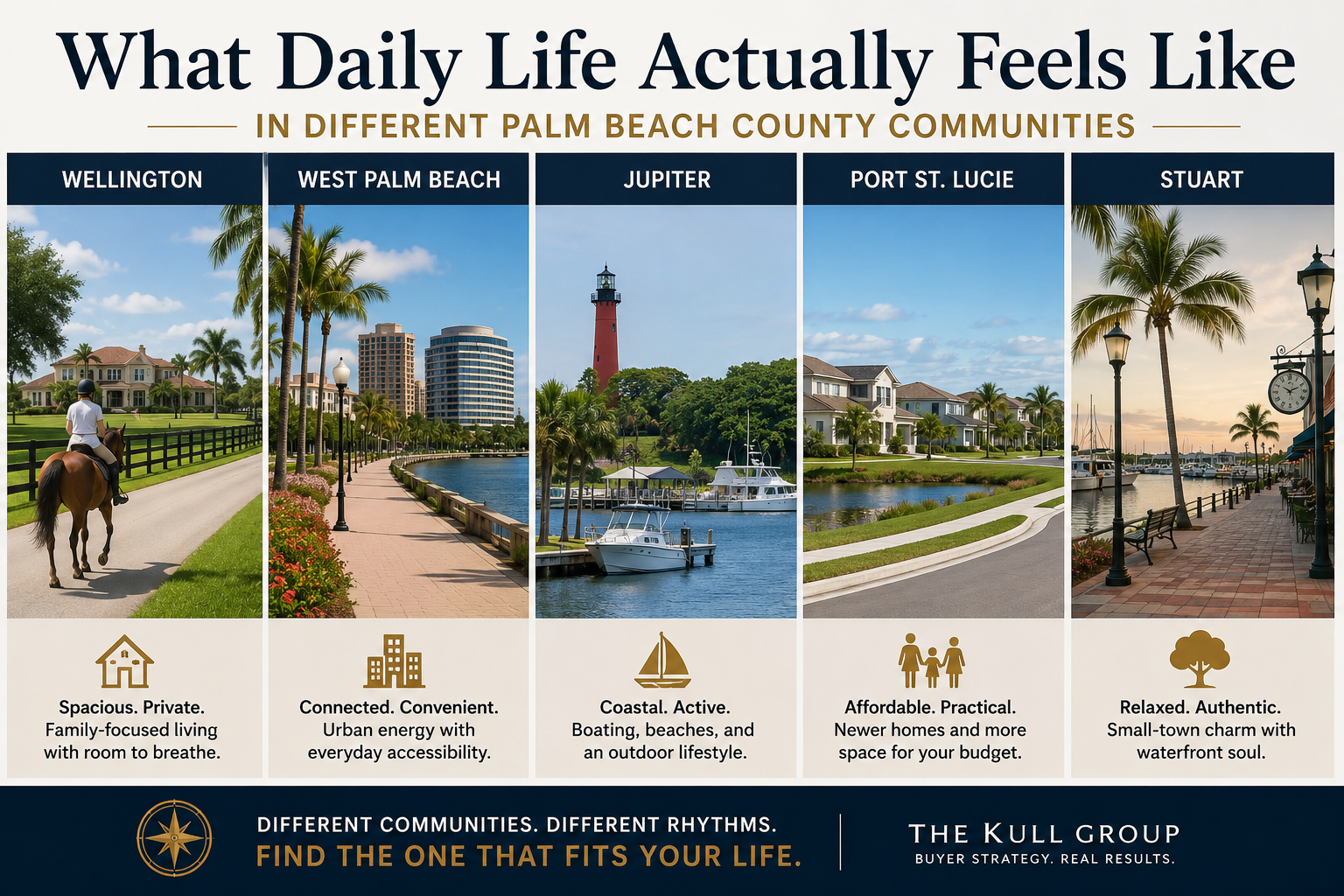
What Daily Life Actually Feels Like in Different Palm Beach County Communities

Comparison of different Palm Beach County community lifestyles including Wellington, West Palm Beach, Jupiter, Port St. Lucie, and Stuart to help buyers understand ownership and lifestyle fit.

What Daily Life Actually Feels Like in Different Palm Beach County Communities

Many buyers search for homes by price, square footage, school ratings, or visual presentation. Those factors matter. But they often fail to answer the question that shapes long-term ownership satisfaction more than buyers initially expect:

What does daily life actually feel like there?

That answer is rarely visible during a thirty-minute showing.

Two communities may appear equally attractive online while producing completely different emotional experiences once ordinary routines begin. One environment may feel calm, functional, and sustainable. Another may slowly create stress through commute friction, maintenance pressure, noise, isolation, congestion, or lifestyle mismatch.

In many cases, buyers are not choosing between “good” and “bad” areas.

They are choosing between different versions of daily life.

The strongest ownership decisions usually happen when buyers evaluate how a community supports the life they actually live — not just how the homes look during the search process.

Different Communities Create Different Emotional Rhythms

One reason buyers struggle with long-term ownership fit is because communities affect people emotionally in different ways.

Some ownership environments feel:

  • quiet
  • decompressed
  • slow-moving
  • private
  • structured
  • routine-oriented

Others feel:

  • active
  • social
  • walkable
  • high-energy
  • movement-oriented
  • highly connected

Neither structure is automatically better.

The problem usually appears when buyers choose an environment that conflicts with how they naturally prefer to live day to day.

A buyer who values calm and decompression may eventually feel exhausted in a dense, constantly active environment. A buyer who values movement and convenience may eventually feel isolated in a slower, farther-out ownership environment.

Wellington Often Feels Different Than West Palm Beach

For example, Wellington and West Palm Beach can create very different daily-life experiences even when both areas appeal to the same buyer initially.

Wellington often attracts buyers prioritizing:

  • larger homes
  • larger lots
  • family-centered routines
  • school planning
  • residential decompression
  • equestrian influence

West Palm Beach often attracts buyers prioritizing:

  • reduced commute pressure
  • walkability in select areas
  • professional access
  • lifestyle flexibility
  • lower-maintenance ownership options
  • greater day-to-day connectivity

Both ownership environments can work extremely well for the right buyer. But they usually support very different daily rhythms.

Buyers comparing those ownership patterns may also benefit from exploring West Palm Beach buyer strategy guidance.

Compare Communities Based on Daily-Life Fit

One of the most effective ways to compare Palm Beach County communities is to stop asking which area is “best” and start asking which ownership environment supports the routines, energy levels, and priorities you actually want long term.

Some buyers eventually realize they should have compared:

  • space versus convenience
  • quiet versus connectivity
  • maintenance-light living versus larger-property ownership
  • coastal access versus commute efficiency
  • walkability versus residential decompression
  • HOA structure versus ownership flexibility

Once buyers understand the type of daily rhythm they want, the home search itself becomes much more useful.

Compare Homes by City

Jupiter Often Appeals to Buyers Who Want Lifestyle Access

Jupiter attracts many buyers because daily life often revolves around outdoor movement, coastal access, boating culture, golf, and lifestyle flexibility.

For some homeowners, that environment feels energizing and emotionally aligned. For others, the pricing pressure, insurance exposure, or seasonal activity levels may eventually feel less comfortable than expected.

What matters most is not whether Jupiter is objectively desirable.

What matters is whether the ownership structure aligns with how the buyer wants ordinary life to function after closing.

Buyers evaluating those coastal ownership patterns may also benefit from exploring Jupiter buyer strategy guidance.

Some Buyers Prioritize Calm More Than They Initially Realize

One of the more common ownership discoveries happens after buyers leave highly compressed environments.

Some buyers initially believe they want:

  • constant activity
  • maximum walkability
  • dense entertainment access
  • high-energy surroundings

Then later realize they actually value:

  • quiet evenings
  • reduced noise
  • larger personal space
  • slower movement
  • lower emotional stimulation
  • more decompression time

The reverse can also happen. Some buyers leave more active areas expecting to enjoy quieter ownership environments and later realize they miss the convenience and movement they previously took for granted.

The strongest ownership outcomes usually happen when buyers evaluate how they recharge emotionally and function practically during ordinary weeks.

Maintenance Expectations Shape Daily Life More Than Buyers Expect

Daily life is not shaped only by location. It is also shaped by how much ownership responsibility the property creates.

A buyer living in a larger home, acreage property, waterfront environment, or older home may experience daily life very differently than someone living in a managed condo or smaller maintenance-light property.

Some buyers genuinely enjoy:

  • yard projects
  • property maintenance
  • outdoor upkeep
  • hands-on ownership
  • larger-space responsibility

Others feel emotionally drained by those same obligations.

That difference becomes increasingly important over time because ownership is not experienced only during weekends or vacations. It affects ordinary life continuously.

Buyers evaluating those ownership responsibilities may also benefit from reviewing why maintenance expectations matter more than many buyers realize.

Some Communities Feel More Structured Than Others

HOA-managed communities, golf environments, condo buildings, and gated neighborhoods can create a more organized ownership experience for some buyers.

That structure may provide:

  • visual consistency
  • amenity access
  • shared maintenance
  • reduced exterior responsibilities
  • community standards

For other buyers, the same environment may eventually feel restrictive.

The strongest ownership decisions usually happen when buyers understand whether they want:

  • freedom
  • simplicity
  • control
  • reduced responsibility
  • social activity
  • privacy

Different ownership environments support those priorities differently.

Buyers evaluating those community structures may also benefit from reviewing how long-term lifestyle fit affects ownership satisfaction.

Daily Life Usually Matters More Than Buyers Expect

One of the most consistent long-term ownership patterns is that daily routines eventually matter more than the emotional excitement of the purchase itself.

The home becomes part of:

  • morning routines
  • traffic patterns
  • maintenance habits
  • social energy
  • family logistics
  • stress management
  • time management
  • personal recovery time

That is why the strongest buying decisions usually happen when buyers evaluate not only the property itself, but the emotional and operational rhythm surrounding the property.

Trying to Compare Which Palm Beach County Lifestyle Actually Fits You?

If you are comparing different Palm Beach County communities, a buyer strategy consultation can help clarify how commute patterns, neighborhood rhythm, maintenance expectations, HOA structure, lifestyle pace, and ownership responsibilities may affect daily life after closing.

  • Compare communities based on real daily-life fit
  • Evaluate commute, maintenance, and lifestyle tradeoffs realistically
  • Understand how different ownership environments may feel long term
  • Clarify which community structure supports your lifestyle most comfortably

No pressure. Just practical guidance designed to help buyers choose ownership environments that feel sustainable after the excitement of the purchase fades.

Schedule a Buyer Strategy Consultation

Frequently Asked Questions About Daily Life in Palm Beach County Communities

Why do some buyers feel comfortable in one community but not another?

Different communities create different emotional and operational rhythms. Commute patterns, noise levels, maintenance demands, walkability, social activity, and ownership structure all influence how daily life feels over time.

Does lifestyle fit matter as much as the home itself?

Yes. Many buyers eventually realize the surrounding lifestyle structure affects long-term ownership satisfaction just as much as the property itself.

How does West Palm Beach differ from Wellington in daily life?

West Palm Beach often supports greater convenience, connectivity, and commute efficiency. Wellington more often supports larger homes, more residential decompression, family-centered routines, and suburban separation.

Why do maintenance expectations affect lifestyle satisfaction?

Ownership responsibilities affect ordinary daily life continuously. Some buyers enjoy hands-on property ownership while others prefer lower-maintenance environments that reduce ongoing upkeep demands.

What is one of the most overlooked parts of choosing a community?

One of the most overlooked factors is how the area supports ordinary daily routines after the excitement of the purchase fades. Long-term satisfaction usually depends on whether the ownership environment feels emotionally and operationally sustainable.

May 10, 2026

How Buyers Choose the Wrong Area for Their Lifestyle in Palm Beach County

#PalmBeachCountyHomes #PalmBeachCountyRealEstate #FloridaHomeBuyers #BuyerStrategy #PalmBeachCountyLiving #SouthFloridaHomes #LifestyleFit #HomeBuyingTips #WestPalmBeachRealEstate #TheKullGroup

How Buyers Choose the Wrong Area for Their Lifestyle in Palm Beach County

Some buyers purchase the wrong home because they ignored condition, financing, or inspection issues. Others purchase the wrong home because they misunderstood how ownership would actually feel once daily life returned to normal.

That second category is far more common than many people realize.

A buyer may love the appearance of a neighborhood during a weekend showing and slowly realize months later that the commute feels exhausting, the maintenance demands feel overwhelming, the community structure feels restrictive, or the surrounding lifestyle simply does not align with how they actually live.

In many cases, the home itself is not the problem.

The mismatch comes from choosing a lifestyle structure that never truly fit the buyer’s daily routines, energy patterns, priorities, or long-term goals.

The strongest buying decisions usually happen when buyers stop asking, “Which home do I like most?” and start asking, “Which ownership environment fits how I actually want life to function after closing?”

Many Buyers Shop Emotionally Before They Evaluate Operationally

Most buyers begin the search process by reacting emotionally to visible features:

  • updated kitchens
  • high ceilings
  • large pools
  • waterfront views
  • clubhouse amenities
  • new construction finishes
  • walkable entertainment districts

Those features matter. But emotional attraction alone rarely determines whether ownership will feel comfortable long term.

A buyer may fall in love with a larger home and later realize the maintenance demands are far heavier than expected. Another buyer may prioritize a lower price point and later discover the commute is draining more energy than the savings feel worth.

Some buyers choose highly active lifestyle environments and eventually realize they prefer more quiet and decompression. Others buy farther from activity centers to gain space and later feel disconnected from the routines they valued most.

The strongest ownership outcomes usually happen when buyers evaluate emotional appeal and operational reality together instead of treating them as separate decisions.

The Wrong Lifestyle Fit Often Reveals Itself Slowly

Many ownership mismatches do not become obvious immediately.

During the early stages of ownership, buyers are still emotionally energized by the purchase itself. The excitement of moving, decorating, upgrading, or settling into a new environment can temporarily mask deeper lifestyle friction.

The problems often emerge gradually:

  • the commute becomes more exhausting over time
  • the HOA structure begins to feel restrictive
  • the property upkeep consumes more weekends than expected
  • the neighborhood rhythm no longer feels comfortable
  • the home feels too isolated or too active
  • the cost of maintaining the lifestyle becomes emotionally draining

In many cases, buyers did not necessarily make a “bad” purchase.

They simply purchased a version of life that did not align with how they actually function day to day.

Buyers evaluating those long-term lifestyle patterns may also benefit from reviewing how commute patterns affect long-term home satisfaction.

Compare Ownership Environments Before Comparing Homes

One of the most effective ways to avoid the wrong lifestyle fit is to compare ownership environments first and individual homes second.

Some buyers eventually realize they should have compared:

  • walkability versus space
  • maintenance-light living versus property control
  • coastal access versus insurance exposure
  • commute convenience versus larger homes farther away
  • quiet residential structure versus activity-centered living
  • HOA-managed communities versus ownership flexibility

Once buyers understand the type of ownership rhythm they want, the home search itself becomes much more effective.

Compare Homes by City

Different Palm Beach County Areas Support Very Different Daily Routines

One reason buyers struggle with lifestyle fit is because Palm Beach County ownership environments vary dramatically.

A buyer who thrives in one area may feel deeply uncomfortable in another even if both homes appear attractive on paper.

For example:

  • buyers prioritizing decompression and larger lots may feel more comfortable in Wellington or Loxahatchee
  • buyers prioritizing flexibility and reduced commute pressure may prefer West Palm Beach
  • buyers prioritizing coastal access may naturally gravitate toward Jupiter or Juno Beach
  • buyers prioritizing affordability flexibility may feel more comfortable in Port St. Lucie
  • buyers prioritizing a slower pace may feel more aligned with Stuart

The strongest decisions usually happen when buyers evaluate how their routines, energy levels, and long-term priorities align with the surrounding ownership environment.

Buyers evaluating those ownership differences may also benefit from exploring Wellington buyer strategy guidance.

Maintenance Tolerance Is One of the Most Overlooked Lifestyle Factors

Some buyers genuinely enjoy maintaining larger homes, outdoor space, pools, boats, landscaping, or acreage properties.

Others do not.

But many buyers never evaluate that difference honestly before purchasing.

A buyer may initially love:

  • the appearance of a larger property
  • the privacy of acreage living
  • waterfront access
  • older character homes
  • large outdoor entertaining areas

Then later realize the maintenance responsibility feels emotionally exhausting rather than rewarding.

The reverse can also happen. Some buyers purchase highly managed or maintenance-light environments and later realize they miss having more property control or outdoor space.

The goal is not to avoid responsibility. The goal is to match the ownership structure to the buyer’s actual lifestyle preferences.

Buyers evaluating those ownership responsibilities may also benefit from reviewing how lifestyle flexibility affects long-term ownership satisfaction.

Some Buyers Overvalue the Home and Undervalue the Location

Another common mistake is over-prioritizing the house itself while underestimating how much location shapes emotional well-being after closing.

A buyer may gain:

  • more square footage
  • a larger yard
  • newer finishes
  • more upgrades
  • a lower purchase price

But simultaneously lose:

  • daily convenience
  • energy efficiency in daily routines
  • social access
  • walkability
  • reduced commute time
  • lifestyle flexibility

That tradeoff is not automatically wrong. Some buyers happily choose more space over convenience.

The problem occurs when buyers fail to evaluate the tradeoff consciously before purchasing.

HOA Structure Can Affect Lifestyle More Than Buyers Expect

Many buyers focus on monthly HOA fees while underestimating how community structure affects daily life.

For some homeowners, HOA-managed environments create simplicity and consistency. For others, the restrictions eventually feel emotionally restrictive.

Buyers should evaluate:

  • parking rules
  • pet restrictions
  • rental policies
  • maintenance obligations
  • amenity expectations
  • community culture
  • reserve planning

The strongest ownership outcomes usually happen when buyers understand whether they want convenience, flexibility, control, structure, or some combination of all four.

Buyers evaluating those ownership structures may also benefit from reviewing how property age and long-term ownership costs affect lifestyle sustainability.

The Right Ownership Environment Often Feels Emotionally Calmer

One of the most overlooked signs of strong lifestyle fit is emotional calm.

The right ownership environment often feels:

  • sustainable
  • manageable
  • comfortable
  • realistic
  • aligned with daily routines
  • supportive of long-term goals

The wrong ownership environment often creates subtle ongoing friction:

  • too much driving
  • too much upkeep
  • too much density
  • too much isolation
  • too much financial pressure
  • too many operational complications

That difference becomes increasingly important after the excitement of the purchase fades and ordinary life resumes.

Trying to Figure Out Which Ownership Environment Actually Fits Your Lifestyle?

If you are comparing different Palm Beach County areas, a buyer strategy consultation can help clarify how commute patterns, maintenance expectations, HOA structure, neighborhood rhythm, insurance exposure, and long-term lifestyle goals may affect daily life after closing.

  • Compare different ownership environments based on real lifestyle fit
  • Evaluate commute, maintenance, and HOA tradeoffs realistically
  • Understand how different areas may affect long-term daily routines
  • Clarify which ownership structure fits your life most comfortably

No pressure. Just practical guidance designed to help buyers avoid choosing the wrong lifestyle for the way they actually want to live.

Schedule a Buyer Strategy Consultation

Frequently Asked Questions About Choosing the Right Area in Palm Beach County

Why do buyers sometimes regret the area they chose even if they like the home?

Many buyers evaluate the home itself more carefully than the surrounding lifestyle structure. Commute patterns, maintenance expectations, HOA rules, neighborhood rhythm, and daily convenience often affect long-term satisfaction more than buyers initially expect.

How important is commute time when choosing where to live?

Commute patterns can significantly affect long-term lifestyle satisfaction. Some buyers eventually realize that additional driving changes their energy levels, scheduling flexibility, and overall comfort more than expected.

Do different Palm Beach County areas create very different ownership experiences?

Yes. Coastal communities, suburban neighborhoods, acreage properties, urban-oriented areas, and newer-growth markets can create dramatically different ownership rhythms, maintenance demands, and daily-life experiences.

Should buyers prioritize the home itself or the lifestyle surrounding the home?

Both matter, but many buyers underestimate how much the surrounding ownership environment shapes life after closing. The strongest decisions usually happen when buyers evaluate the home and the lifestyle structure together.

What is one of the biggest mistakes buyers make when choosing an area?

One of the most common mistakes is choosing a lifestyle that looks appealing emotionally without evaluating whether it aligns with the buyer’s actual routines, maintenance tolerance, commute needs, and long-term priorities.

May 10, 2026

Selling a West Palm Beach Home and Ownership Realities Now

Sunny residential neighborhood in West Palm Beach Florida with palm trees, landscaped homes, and bright South Florida natural light.

How Daily Life Shapes Selling a Home in West Palm Beach, FL

Selling a home in West Palm Beach FL is rarely just a pricing decision. The city has a way of making ownership feel different depending on the street, building type, commute pattern, insurance profile, and daily rhythm around the property. A homeowner near the urban core may think about value differently than someone in a quieter residential pocket. A buyer comparing neighborhoods may be drawn to access, but still hesitate over parking, condition, HOA fees, roof age, flood considerations, or future maintenance. West Palm Beach carries strong appeal because it sits close to business, culture, water, transportation, and established neighborhoods, yet that same access can create complexity. Daily life matters here. The home is not evaluated in isolation. Buyers are trying to understand what it will feel like to live with the location, the costs, the routines, and the ownership responsibilities after the excitement of the search fades.

West Palm Beach Has More Than One Ownership Rhythm

Some cities are easy to explain in broad strokes. West Palm Beach is not one of them.

The experience of owning a home here can change quickly from one area to another. There are older homes with character, condo buildings with association structures, neighborhoods close to downtown energy, quieter residential streets, waterfront-influenced areas, and pockets where convenience is the main advantage. A seller who talks about West Palm Beach as if every buyer wants the same thing will miss the point.

People buy here for different reasons.

Some want access. Some want a shorter commute. Some want to be near restaurants, offices, cultural activity, medical services, or the water. Others want the city’s central position without giving up a calmer residential setting. The attraction is rarely one-dimensional.

That is also why value can be misunderstood. A home may be worth more because of location, but location alone does not erase condition issues, association costs, parking limitations, insurance concerns, or layout problems. Buyers notice those details, especially when they are comparing several types of housing within the same city.

Daily Convenience Can Be Valuable, but It Has to Be Lived Honestly

West Palm Beach often appeals to people who want life to feel connected. The city can reduce some of the friction that comes from living farther out: long drives for work, longer routes to services, fewer nearby choices, or a sense of being removed from the center of activity.

That convenience has real value.

Still, convenience is not the same for every household. A buyer who works downtown may see a home differently than someone commuting south, west, or north. A person who enjoys active streets may feel energized by the location. Someone who wants quiet every evening may need to be more selective. Small daily details become important here: traffic flow, parking, noise, building rules, walkability, access to major roads, and how the area feels during different times of day.

A home can look ideal online and feel different after two weeks of routine.

That is why buyers reviewing West Palm Beach homes for sale should think beyond the address. The better question is how the home will support ordinary life when work schedules, errands, visitors, weather, and seasonal activity all become part of the pattern.

Sellers Need to Understand What Buyers Are Really Testing

When a West Palm Beach homeowner prepares to sell, it is easy to focus on visible presentation. Paint. Landscaping. Photos. Cleaning. Staging. Those things matter, but buyers are testing something deeper.

They are testing confidence.

Can they understand the home’s condition? Can they make sense of the ongoing costs? Does the property feel manageable? Are the updates meaningful or cosmetic? Will the roof, insurance, HOA, maintenance history, or association rules create problems later?

In West Palm Beach, buyer caution often comes from the range of property types and ownership environments. A condo buyer may care deeply about association health, fees, reserves, rules, and building condition. A single-family buyer may be focused on roof age, drainage, windows, insurance, remodeling quality, and the street’s long-term feel. A buyer considering an older home may love the character but still need practical reassurance.

Sellers who understand this can position a home more intelligently. The strongest listings do not simply look polished. They reduce uncertainty.

If a homeowner is unsure how current value lines up with condition, local demand, and buyer expectations, a private review of current home value can help separate emotional assumptions from market reality.

What This Means for Buyers and Sellers in South Florida

For buyers, West Palm Beach requires a careful distinction between appeal and fit. A location may be attractive because it feels close to everything, but the long-term experience depends on the ownership structure behind the property. Insurance, taxes, HOA fees, maintenance needs, traffic patterns, building condition, and daily convenience all become part of the real decision.

That is why buyer caution should not be mistaken for lack of interest. Many buyers are interested. They are simply evaluating more carefully.

For sellers, this changes the strategy. A home in West Palm Beach should not be positioned only around city access or broad lifestyle appeal. The listing needs to help buyers understand how the property functions: what has been maintained, what makes the location useful, what the ownership costs look like, and why the home makes sense compared with other options nearby.

South Florida buyers are more sensitive to carrying costs than they were a few years ago. They may still pay for the right location, but they want fewer surprises. They are weighing the home against insurance pressure, renovation costs, association rules, and the possibility that the next few years of ownership may be more expensive than expected.

That makes seller clarity a market advantage.

Explore Homes by City

If you're comparing areas, home types, or neighborhood environments, browsing homes by city can help put pricing and location tradeoffs into perspective.

Explore Homes by City

The Greenacres Comparison Shows Why Lifestyle Tradeoffs Matter

West Palm Beach is often chosen for access, identity, and centrality. Greenacres tends to create a different conversation.

That comparison can be useful because it reveals what buyers are really choosing. Someone looking at Greenacres homes for sale may be prioritizing a more inland residential pattern, different price points, different density, or a quieter everyday routine. Someone focused on West Palm Beach may accept more complexity in exchange for access, energy, and location.

Neither choice is automatically better.

The buyer who wants central convenience may be willing to manage higher traffic, tighter parking, older housing stock, or more association complexity. Another buyer may prefer a simpler ownership environment even if it means giving up some proximity. These are not only financial differences. They are routine differences.

Sellers in West Palm Beach should pay attention to that. A buyer comparing neighboring cities may be deciding between convenience and ease, character and predictability, access and quiet, older charm and newer practicality. The listing has to explain where the property fits inside those tradeoffs.

Long-Term Value Is Connected to How the Home Functions

West Palm Beach home values and ownership are tied to more than broad market movement. The homes that hold attention tend to make sense after the showing ends.

A buyer may remember a kitchen, a courtyard, a view, or a location. But they also remember friction. The awkward parking setup. The unclear renovation history. The high fees. The roof question. The road noise. The association concern. The feeling that the home might be attractive but complicated.

Small doubts can grow quickly.

For owners thinking about selling, this is important. Preparing the home is not only about making it look better. It is about making the decision easier for the buyer. That may involve documentation, repair decisions, pricing discipline, pre-listing clarity, or simply being honest about what the property is and what kind of buyer it serves.

West Palm Beach has enough demand drivers to create opportunity. But opportunity does not remove the need for precision. A home that is positioned too broadly can blur into the market. A home that is positioned around its real strengths can feel more understandable, especially to a buyer trying to compare very different options.

The Best Selling Strategy Starts With the Buyer’s Daily Life

A seller may think the main question is, “What is my home worth?”

That matters. But the better strategic question is often, “Who will this home make sense for, and why?”

A West Palm Beach condo may appeal to someone seeking access and lower exterior maintenance, but only if the association picture feels manageable. A historic or older home may attract a buyer who values character, but only if the condition story feels credible. A centrally located single-family home may appeal to someone wanting convenience, but only if the daily routine feels workable.

Buyers do not just purchase features. They purchase a version of their next life.

That is where seller strategy becomes more thoughtful. The goal is not to make the property sound perfect. The goal is to help the right buyer understand the tradeoffs clearly enough to move forward with confidence. In West Palm Beach, that kind of clarity matters because the city itself contains many different versions of ownership.

The homes that sell well usually do more than attract attention. They answer the questions buyers were already carrying.

Frequently Asked Questions

What should I understand before selling a home in West Palm Beach?

Sellers should understand that West Palm Beach buyers often evaluate more than price and location. They look closely at condition, insurance considerations, HOA fees, roof age, parking, commute patterns, and how the home will function day to day. A strong listing should reduce uncertainty by clearly showing the property’s practical strengths and helping buyers understand why the home fits their lifestyle and ownership expectations.

Do West Palm Beach home values depend more on location or condition?

Both matter, but the balance depends on the property. Location can create demand, especially near downtown, coastal access, major roads, or established neighborhoods. Condition can either support that value or weaken buyer confidence. In West Palm Beach, buyers often compare very different property types, so a well-maintained home with a clear ownership story may stand out more than one relying on location alone.

Keep Exploring South Florida Real Estate

If you're comparing communities, evaluating lifestyle tradeoffs, or trying to better understand how different parts of South Florida align with your long-term goals, reviewing additional local resources can help create clearer perspective.


About the Authors

Chris and Sue Kull are South Florida real estate professionals with more than three decades of experience helping buyers, sellers, and property owners navigate real estate decisions throughout Palm Beach County and surrounding communities.