
Insights, strategy, and real estate guidance across Palm Beach County.

Feb. 25, 2026

Wallpaper Is Back

thekullgroup/south-florida-home-powder-room-wallpaper-design-trend-2026

Wallpaper Is Back — and It’s Changing How South Florida Homes Show in 2026

Wallpaper is no longer the loud, overwhelming design choice many homeowners remember from decades past. In 2026, wallpaper is reemerging as a strategic, intentional design element — and in South East Florida real estate, it’s quietly becoming a powerful staging tool.

Instead of covering entire rooms in bold prints, designers are using wallpaper to create moments. Inside built-ins. On powder room walls. Framed within architectural panels. Even on ceilings — often called the “fifth wall.” The result is depth, texture, and personality without overpowering a space.

For homeowners preparing to sell, and for buyers looking to personalize without full renovation, wallpaper is playing a meaningful role in presentation. And in a competitive Florida housing market, presentation still matters.

Let’s look at why wallpaper is trending again — and how it’s influencing home staging and resale strategy across Palm Beach County and beyond.


From Feature Wall to Focal Detail

The biggest shift in wallpaper design is restraint.

In previous design eras, wallpaper often dominated entire rooms. Today’s approach is more curated. Designers are placing wallpaper in areas where it enhances architecture rather than competes with it.

Popular placements include:

  • Inside bookshelves or built-ins

  • Powder rooms and small bathrooms

  • Entryway alcoves

  • Framed wall panels

  • Dining room accent walls

  • Ceilings

These smaller applications allow homeowners to add character without overwhelming buyers during showings.

In real estate, subtle design decisions often create the strongest emotional responses.

See What’s on the Market Right Now

If you're researching homes in Palm Beach County or anywhere in South Florida, explore current listings by city and see what’s available right now.

Explore Homes by City

Why Wallpaper Works in South Florida Homes

South East Florida homes benefit particularly well from textured design elements. Many properties feature:

  • High ceilings

  • Open-concept layouts

  • White or neutral interior palettes

  • Abundant natural light

While these features photograph beautifully, they can sometimes feel flat in person.

Wallpaper introduces dimension.

Tweed-like textures add warmth to home offices and dens. Vintage-inspired florals soften powder rooms. Scenic panels bring visual interest to otherwise simple dining spaces.

In bright Florida interiors, wallpaper can anchor a room without darkening it.


The Rise of the Powder Room Statement

One of the most impactful staging upgrades in 2026 is wallpaper in the powder room.

Why?

Because small spaces allow bold design without long-term risk.

Buyers expect powder rooms to feel slightly elevated. A patterned wallpaper paired with updated lighting and a modern mirror can create a memorable moment during a showing.

In many Palm Beach County homes, powder rooms are located near main living areas. Adding texture there enhances overall presentation with minimal cost compared to kitchen or bathroom remodels.


Wallpaper Inside Built-Ins and Niches

Another growing trend is wallpaper inside shelving units or recessed niches.

In open-concept homes, built-ins often frame family rooms or offices. Adding wallpaper behind shelving:

  • Creates depth

  • Highlights decorative items

  • Adds architectural interest

  • Photographs exceptionally well

This approach works especially well in South Florida homes where white cabinetry dominates.

It’s a small detail — but buyers notice small details.


The “Fifth Wall” Trend: Ceiling Applications

Wallpaper on ceilings is gaining traction among designers seeking understated drama.

Rather than painting ceilings bright colors, textured wallpaper can add warmth while maintaining balance.

In homes with tray ceilings or architectural detailing, wallpaper above can subtly define space without closing it in.

This technique works best in:

  • Primary bedrooms

  • Dining rooms

  • Formal sitting rooms

When executed correctly, it feels intentional — not trendy.


Vintage Florals and Textured Neutrals

Wallpaper trends in 2026 lean toward texture over loud pattern.

Vintage-inspired florals bring softness without overwhelming the room. Tweed-like weaves introduce subtle movement. Grasscloth textures create a natural feel that pairs well with Florida’s indoor-outdoor lifestyle.

Designers are also gravitating toward:

  • Small-scale patterns

  • Scenic murals in muted tones

  • Dimensional prints

  • Nature-inspired motifs

These selections complement South Florida’s tropical landscaping and coastal influences without appearing overly thematic.

Curious What Your Home Might Be Worth?

Home values across Palm Beach County and South Florida change constantly. See what buyers may currently be willing to pay for homes in your neighborhood.

Check Your Home Value

How Wallpaper Impacts Home Staging

Home staging is about emotional connection.

In South East Florida’s competitive housing market, buyers are often touring multiple homes in one afternoon. The properties that stand out tend to include small, memorable touches.

Wallpaper can:

  • Differentiate a listing

  • Elevate perceived design quality

  • Suggest care and attention

  • Make photography more engaging

Importantly, wallpaper is less expensive than full remodeling projects.

For sellers unwilling to renovate kitchens or bathrooms before listing, wallpaper can be a strategic cosmetic upgrade.


When Wallpaper Works — and When It Doesn’t

While wallpaper is trending, it must be applied thoughtfully.

It works best when:

  • Used sparingly

  • Paired with neutral furniture

  • Installed professionally

  • Complementing existing finishes

It can detract when:

  • Patterns overwhelm the space

  • Colors clash with flooring or cabinetry

  • Application appears uneven

  • The design feels too personal

Buyers appreciate texture. They resist distraction.

In resale preparation, subtlety wins.


Wallpaper vs Paint: A Strategic Choice

Paint remains the most common pre-listing update. But wallpaper can sometimes achieve more impact.

Consider:

  • A textured wallpaper may hide minor wall imperfections better than flat paint.

  • Wallpaper inside built-ins can create depth paint cannot replicate.

  • Scenic panels can replace artwork in staged spaces.

For homeowners planning to stay long term, wallpaper offers personalization without structural change.

For sellers, removable wallpaper options now exist, providing flexibility.


The Psychology of Texture

Why does wallpaper resonate again?

Because texture creates warmth.

In highly neutral modern homes, surfaces can feel sterile. Wallpaper introduces tactile variation. Even when subtle, that variation changes how a room feels.

Buyers often describe homes with thoughtful design as “finished” or “put together.” Wallpaper can help create that impression without dramatic renovation.

In South Florida, where natural light is abundant, textured walls capture shadow and depth beautifully.


Investment Considerations

For homeowners evaluating return on investment, wallpaper falls into the category of modest cosmetic enhancement.

Costs are significantly lower than:

  • Cabinet replacement

  • Flooring overhaul

  • Major structural upgrades

Yet it can enhance perceived value, particularly in competitive price brackets.

If applied strategically in high-visibility areas, wallpaper may help listings photograph better online — where most buyers begin their search.

In today’s digital-first real estate environment, photography quality directly influences showing volume.


Long-Term Personalization

For homeowners not preparing to sell, wallpaper offers creative flexibility.

Unlike tile or built-in cabinetry, wallpaper can be updated without construction. Trends may evolve, but modern installation techniques and peel-and-stick options allow easier replacement.

In South Florida homes with high humidity, professional installation and appropriate materials are important to prevent peeling or bubbling.

Selecting moisture-resistant options for bathrooms and kitchens ensures longevity.


Final Thoughts

Wallpaper is no longer an afterthought in 2026. It has evolved into a design tool used intentionally to add texture, warmth, and architectural emphasis.

In South East Florida real estate, where natural light and open layouts dominate, wallpaper can subtly elevate presentation without overwhelming buyers.

For sellers, it’s a strategic enhancement.
For homeowners, it’s a personalization opportunity.
For buyers, it’s a sign that a home has been thoughtfully designed.

The key isn’t covering every wall.

It’s choosing one moment — and letting it speak.

Real Estate Resources for South Florida

If you're researching homes or following the South Florida real estate market, exploring listings and property values can provide helpful context for understanding local neighborhoods and housing trends across Palm Beach County.


About the Authors

Chris and Sue Kull are South Florida real estate professionals with more than three decades of experience helping buyers, sellers, and property owners navigate the housing market throughout Palm Beach County and surrounding communities.

Their work focuses on providing clear information, local market insight, and practical guidance so clients can make confident real estate decisions. Over the years they have built a trusted network of industry professionals—including lenders, inspectors, contractors, and legal specialists—to support every stage of the real estate process.

You can explore additional resources, community guides, and real estate tools at www.TheKullGroup.com.

If you have questions about buying, selling, or understanding the local real estate market, you can reach out through our contact page.

Feb. 24, 2026

Florida’s Tourism Surge and What It Means for South East Florida Real Estate in 2026

thekullgroup/south-florida-coastal-community-tourism-driven-housing-demand-2026

Florida’s Tourism Surge and What It Means for South East Florida Real Estate in 2026

Florida just posted another record-breaking year for tourism — and that headline carries more weight than many realize for homeowners, buyers, and investors across South East Florida.

With 143.3 million visitors traveling to the Sunshine State in 2025, including more than 33 million in the fourth quarter alone, Florida continues to dominate as the #1 domestic travel destination in the United States. The overwhelming majority of those visitors — more than 131 million — came from within the U.S., while millions more arrived from overseas and Canada.

Tourism headlines don’t just belong in hospitality reports. Strong visitor numbers ripple through local economies — influencing short-term rentals, retail demand, employment growth, infrastructure investment, and ultimately housing markets.

For homeowners and buyers in Palm Beach County and surrounding areas, Florida’s tourism momentum is more than a travel statistic. It’s an economic signal.

Let’s unpack what this sustained tourism growth means for South East Florida real estate in 2026 and beyond.


Florida’s Record Tourism Numbers: A Quick Snapshot

Florida welcomed 143.3 million visitors in 2025 — the highest annual total on record.

Key highlights include:

  • 33.5 million visitors in Q4 alone (highest fourth quarter ever)

  • 131.1 million domestic U.S. travelers

  • 9.3 million overseas visitors

  • 2.9 million Canadian travelers

Domestic travel continues to be the dominant driver. That matters because U.S.-based travelers often convert into repeat visitors — and in many cases, future property buyers.

Florida isn’t just a vacation state. It’s a pipeline state.

See What’s on the Market Right Now

If you're researching homes in Palm Beach County or anywhere in South Florida, explore current listings by city and see what’s available right now.

Explore Homes by City

Why Tourism Matters to Real Estate

At first glance, tourism and real estate might seem loosely connected. But in Florida — especially in South East Florida — the relationship is direct and measurable.

Here’s how tourism influences housing demand:

1. Short-Term Rental Performance

High visitor counts support demand for vacation rentals. Investors evaluating markets like West Palm Beach, Palm Beach Gardens, Jupiter, Wellington, and even inland acreage communities benefit when tourism remains strong.

Sustained occupancy supports:

  • Higher nightly rates

  • Consistent booking calendars

  • Increased investor confidence

  • Expanded rental property acquisitions

Even homeowners who don’t operate short-term rentals benefit from neighborhood-level demand stability.

2. Retail and Service Expansion

Visitors spend money. That spending supports restaurants, retail centers, entertainment venues, and service businesses.

When tourism is strong:

  • Local job markets stabilize

  • Small businesses expand

  • Commercial development increases

  • Infrastructure investment accelerates

A healthy service economy strengthens residential real estate indirectly through employment growth and consumer confidence.

3. Migration Pipeline

One of Florida’s most overlooked real estate drivers is repeat visitation.

Many long-term residents first visited Florida on vacation.

Tourism acts as a trial experience. Visitors return seasonally, then purchase second homes, then eventually relocate permanently.

South East Florida, in particular, benefits from:

  • Northeast U.S. migration

  • Midwest relocation

  • Canadian snowbirds

  • International second-home buyers

Tourism feeds housing demand years before a purchase occurs.


South East Florida’s Unique Advantage

Not all Florida regions benefit equally from tourism growth.

South East Florida holds a particularly strong position because it offers:

  • Beach access

  • Golf communities

  • Waterfront living

  • Acreage lifestyle options

  • Tax advantages

  • International airport access

Markets like Palm Beach County combine resort appeal with residential infrastructure. Visitors don’t just come for theme parks — they experience daily life here.

That exposure matters.


Tourism and Housing Demand: The Confidence Factor

Consumer behavior in real estate is heavily influenced by confidence.

When Florida continues setting tourism records, it reinforces several psychological signals:

  • The state remains desirable.

  • Infrastructure investments are ongoing.

  • Public safety and environmental priorities remain visible.

  • Economic activity is stable.

Buyers feel more comfortable purchasing in markets that demonstrate sustained appeal.

Tourism data acts as a macro-level confidence booster.


Impact on Second Homes and Seasonal Ownership

South East Florida has long attracted seasonal owners. Strong domestic travel reinforces the second-home market.

When visitors return annually, many begin evaluating:

  • Long-term rental costs vs ownership

  • Snowbird alternatives

  • Tax residency shifts

  • Retirement transitions

In Palm Beach County, seasonal buyers often begin with short-term rentals before purchasing condos, townhomes, or single-family residences.

Tourism feeds this transition cycle.

Curious What Your Home Might Be Worth?

Home values across Palm Beach County and South Florida change constantly. See what buyers may currently be willing to pay for homes in your neighborhood.

Check Your Home Value

The Short-Term Rental Question

In high-demand visitor markets, short-term rental performance becomes a critical data point.

However, responsible investors must evaluate:

  • Local zoning regulations

  • HOA restrictions

  • Insurance costs

  • Seasonal booking patterns

  • Property management availability

Strong tourism does not automatically mean unrestricted rental freedom.

In some communities, particularly HOA-governed subdivisions, short-term rentals may be limited or prohibited. Acreage communities may allow more flexibility but come with different infrastructure considerations.

Strategic property selection remains essential.


Retail Growth and Housing Stability

Visitor spending supports retail development, which supports long-term residential appeal.

In South East Florida, strong tourism helps justify:

  • New shopping centers

  • Road improvements

  • Public facility upgrades

  • Expanded medical services

  • Hospitality development

Infrastructure improvements tend to enhance surrounding property values over time.

Real estate markets rarely operate in isolation from tourism-driven investment.


Tourism and Employment

Florida’s tourism industry supports hundreds of thousands of jobs.

In South East Florida specifically, hospitality, food service, retail, and event industries create local employment opportunities.

Employment stability influences:

  • Mortgage qualification rates

  • Household formation

  • Rental demand

  • Homeownership transitions

When tourism numbers remain elevated, job markets remain more predictable — supporting broader housing demand.


International Travel: A Key Variable

While domestic travel drives the majority of Florida visitation, international travel remains significant.

Overseas visitors and Canadian travelers have historically played important roles in South Florida’s second-home market.

International buyers often prioritize:

  • Waterfront properties

  • Luxury condos

  • Gated communities

  • Tax planning considerations

As international travel normalizes and expands, those demand channels may strengthen further.


Could Strong Tourism Overheat Housing?

It’s a fair question.

In some Florida markets, rapid tourism growth has contributed to:

  • Investor-driven competition

  • Short-term rental pricing pressure

  • Affordability concerns

  • Insurance and regulatory adjustments

However, South East Florida benefits from market diversity.

The region includes:

  • Coastal luxury

  • Suburban communities

  • Acreage properties

  • Urban condos

  • Golf course neighborhoods

That diversity spreads demand across segments rather than concentrating it entirely in one category.

Balanced supply and demand remain key.


2026 Outlook: What to Watch

As we move deeper into 2026, tourism strength should be evaluated alongside:

  • Mortgage rate movement

  • Insurance market stabilization

  • Construction activity

  • Migration trends

  • Regulatory changes affecting rentals

If tourism remains strong and interest rates stabilize or decline modestly, housing activity in South East Florida could see steady, sustainable growth.

If infrastructure investment continues, long-term value prospects remain supported.


Practical Takeaways for Buyers and Sellers

For Buyers

  • Consider how tourism may influence rental potential.

  • Evaluate long-term appreciation tied to infrastructure growth.

  • Focus on neighborhoods benefiting from retail expansion.

  • Understand rental regulations before purchasing investment properties.

For Sellers

  • Highlight proximity to visitor-friendly amenities.

  • Showcase outdoor living spaces.

  • Emphasize lifestyle appeal.

  • Position property for both end-users and seasonal buyers.

Tourism-driven interest can expand your buyer pool.


Final Thoughts

Florida’s record-breaking tourism year is more than a travel headline. It’s a reinforcement of demand, desirability, and economic resilience.

For South East Florida real estate, strong visitor numbers help sustain:

  • Rental markets

  • Retail development

  • Employment growth

  • Seasonal migration

  • Long-term relocation pipelines

While housing markets respond to many factors, sustained tourism remains one of Florida’s most consistent economic pillars.

When millions continue choosing Florida for vacation, a percentage inevitably choose it for home.

And that’s where real estate opportunity begins.

Real Estate Resources for South Florida

If you're researching homes or following the South Florida real estate market, exploring listings and property values can provide helpful context for understanding local neighborhoods and housing trends across Palm Beach County.


About the Authors

Chris and Sue Kull are South Florida real estate professionals with more than three decades of experience helping buyers, sellers, and property owners navigate the housing market throughout Palm Beach County and surrounding communities.

Their work focuses on providing clear information, local market insight, and practical guidance so clients can make confident real estate decisions. Over the years they have built a trusted network of industry professionals—including lenders, inspectors, contractors, and legal specialists—to support every stage of the real estate process.

You can explore additional resources, community guides, and real estate tools at www.TheKullGroup.com.

If you have questions about buying, selling, or understanding the local real estate market, you can reach out through our contact page.
Feb. 24, 2026

Space Changes Everything: Why Buyers Are Choosing The Acreage, FL Real Estate for a Different Pace of Life

thekullgroup/the-acreage-fl-one-acre-home-detached-garage-lifestyle

Space Changes Everything: Why Buyers Are Choosing The Acreage, FL Real Estate for a Different Pace of Life

Introduction

The Acreage, FL real estate attracts buyers who want more than square footage — they want breathing room. Located in western Palm Beach County, this community offers a lifestyle shaped by land, light, and independence rather than density and congestion. People don’t move to The Acreage for nightlife or high-rise convenience. They move here for quiet mornings, open skies, and the ability to shape their property around how they actually live.

If you are relocating within South Florida, leaving a more compact suburb, or arriving from out of state, The Acreage presents a distinct shift in daily rhythm. The roads feel wider. The lots stretch further. Even the pace of errands changes.

Understanding The Acreage means understanding motivation. Buyers here are not chasing trends — they are choosing space on purpose.

See What’s on the Market Right Now

If you're researching homes in Palm Beach County or anywhere in South Florida, explore current listings by city and see what’s available right now.

Explore Homes by City

Living in The Acreage, FL

The Acreage sits west of Royal Palm Beach and north of Wellington, extending toward the natural preserves that define this part of Palm Beach County. It is unincorporated, which gives it a different personality from master-planned developments nearby.

Location and Regional Context

The community is primarily residential, with most retail and dining accessed via Southern Boulevard or Northlake Boulevard. Drivability defines daily life. Residents expect to get in the car for groceries, restaurants, and professional services.

For many, that’s part of the appeal.

Instead of walking to storefronts, evenings are spent in backyard spaces. Instead of traffic noise, there is distance between homes. The Acreage doesn’t compete with coastal convenience — it offers a deliberate alternative.

Commuters heading east toward West Palm Beach, Palm Beach Gardens, or even Broward County factor in drive time, but many residents work remotely or operate home-based businesses that benefit from acreage and flexible zoning.

Neighborhood Feel and Housing Styles

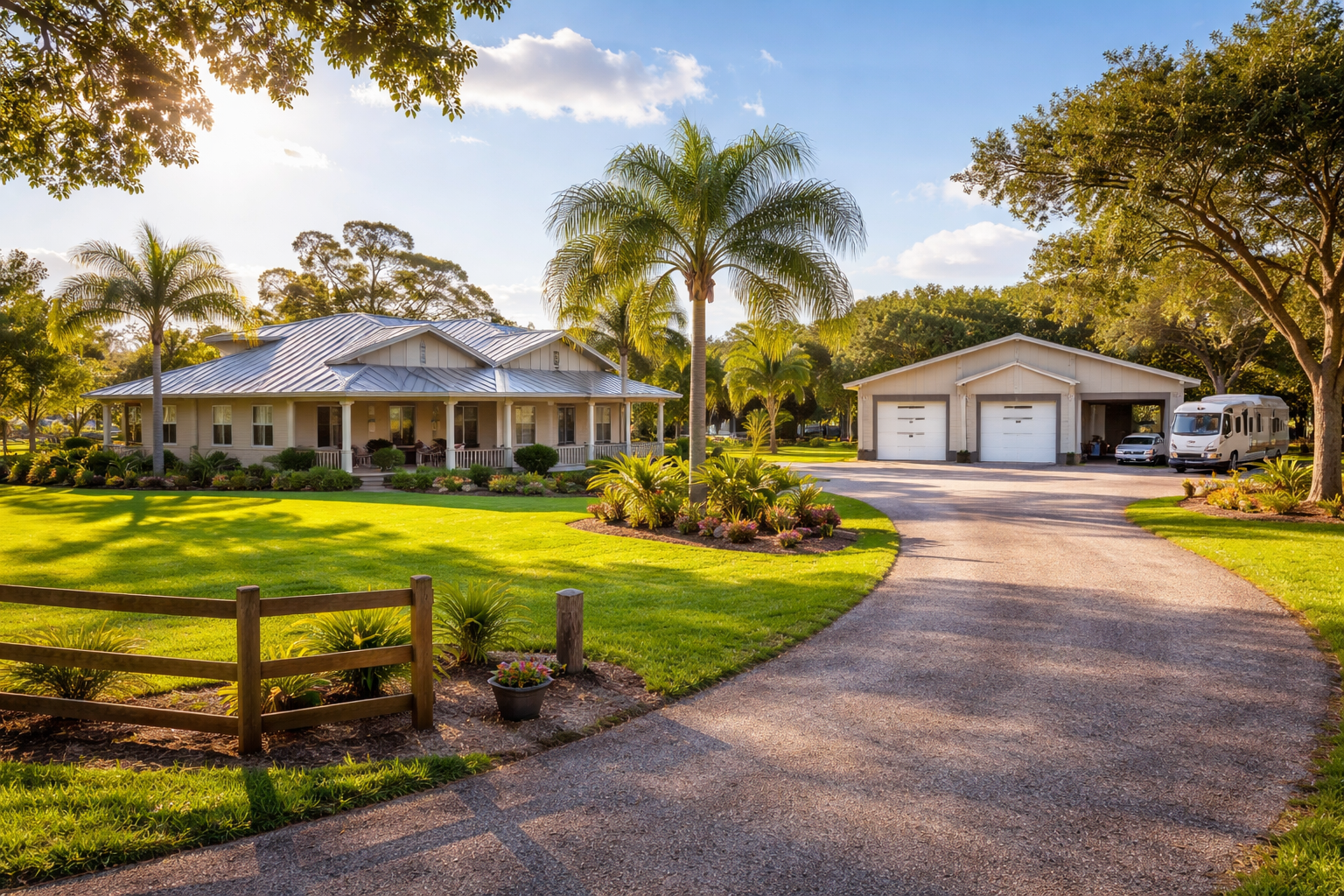
The Acreage is known for its one-acre parcels, and that pattern shapes the environment. You will see:

  • Ranch-style homes

  • Custom-built properties

  • Detached garages and workshops

  • Long private driveways

  • Fenced lots for pets or equipment

There are no towering buildings or tightly packed townhome rows. Instead, the landscape feels open and practical.

Because many homes sit back from the road, privacy is built into the design. You notice trees, open lawns, and utility rather than decorative density.

Lifestyle and Community Atmosphere

Daily life in The Acreage leans toward independence. Residents often:

  • Store boats or trailers on-site

  • Maintain gardens or small agricultural spaces

  • Build outdoor kitchens and patios

  • Use detached structures for hobbies or work

Weekends frequently revolve around property upkeep, outdoor projects, and neighborhood familiarity. You may not see constant organized community events, but you will find neighbors who value stability and consistency.

The lifestyle rhythm is intentional. Mornings feel spacious. Evenings feel quiet.

That emotional reset is one of the primary reasons buyers choose this area.


The Acreage, FL Real Estate Market Overview

The Acreage, FL real estate market operates on different drivers than coastal condo markets or HOA-heavy subdivisions.

Pricing Patterns

Home values typically reflect land size, home upgrades, and infrastructure improvements. Acreage carries intrinsic value, especially in South Florida where density continues to increase elsewhere.

Properties with updated interiors, impact windows, and modern systems tend to command stronger interest. However, buyers also evaluate drainage, fencing, and outbuilding condition carefully.

Because properties are unique, pricing requires detailed comparable analysis.

Inventory Conditions

Inventory generally moves at a measured pace. Buyers are often intentional and patient. Sellers, in turn, understand that their property’s appeal lies in fit rather than urgency.

New construction exists in nearby communities, but The Acreage itself maintains its larger-lot identity.

The absence of dense overbuilding supports long-term stability.

Market Activity Tone

Activity is steady rather than speculative. Buyers entering this market usually intend to stay for years. That mindset affects negotiation strategy and pricing expectations.

The Acreage rewards thoughtful positioning more than aggressive marketing language.


Buying a Home in The Acreage, FL

Purchasing here involves evaluating how land supports lifestyle.

Buyer Expectations

Prospective buyers should anticipate reviewing:

  • Well and septic systems

  • Drainage grading

  • Fencing condition

  • Utility access

  • Permitting history for outbuildings

Because many homes are not governed by strict HOA structures, personal responsibility plays a larger role.

This appeals to buyers who value autonomy.

Common Property Types

The Acreage is dominated by single-family homes on approximately one-acre lots. Detached garages and workshops are common. Some properties allow for agricultural uses or equipment storage.

It is not unusual to see recreational vehicles, work trucks, or trailers parked on-site — something restricted in more regulated subdivisions.

Buyers motivated by flexibility tend to gravitate here.

Local Considerations

Drivability should be part of the decision-making process. If daily errands must be walkable, this may not be the right fit. If space outweighs proximity, The Acreage becomes compelling.

Flood zone awareness and insurance requirements also require careful evaluation, particularly in South Florida.

Ultimately, buying here is less about market timing and more about lifestyle alignment.

Curious What Your Home Might Be Worth?

Home values across Palm Beach County and South Florida change constantly. See what buyers may currently be willing to pay for homes in your neighborhood.

Check Your Home Value

Selling a Home in The Acreage, FL

Selling successfully means highlighting usable space.

Seller Considerations

Buyers respond to:

  • Clean, cleared acreage

  • Maintained fencing

  • Functional outbuildings

  • Updated mechanical systems

  • Practical outdoor living spaces

Photography should capture scale. Wide-angle images of land and driveway approach matter as much as interior design.

Preparation Strategy

Providing documentation for septic service, well inspections, roof maintenance, and permitting history builds confidence.

Buyers seeking acreage are detail-oriented. They want transparency.

Market Psychology

This is not typically an impulse-driven buyer pool. Sellers who price realistically and present their property thoroughly tend to experience smoother transactions.

Patience supports stronger results.


Frequently Asked Questions About The Acreage, FL Real Estate

1. Is The Acreage expensive to live in?

Pricing reflects land value and home condition. While acreage can command higher overall purchase prices compared to smaller lots, buyers often find value in the space and autonomy they gain. Costs may shift from HOA fees to property maintenance and infrastructure upkeep.

2. Is The Acreage good for families?

Many families appreciate the room for outdoor play, hobbies, and privacy. The larger lot structure creates physical separation from neighbors, which appeals to households seeking calmer surroundings. Daily routines revolve around home-based living rather than community density.

3. How far is The Acreage from major employment centers?

The Acreage is west of major retail and employment corridors. Commutes to West Palm Beach or Palm Beach Gardens are manageable but require planning. Most residents rely on vehicle transportation rather than walkability.

4. What types of homes are common in The Acreage?

Single-family homes on one-acre parcels dominate. Many include detached garages, workshops, and expanded driveways. Architectural styles vary, but ranch and custom builds are common.

5. Is The Acreage a good place to buy or sell a home?

For buyers seeking land and flexibility, it can be an excellent long-term choice. Sellers who present usable acreage and updated systems typically attract motivated interest. The market favors thoughtful preparation over aggressive timing.


Conclusion

The Acreage, FL real estate is less about square footage and more about breathing room. It appeals to buyers who want to feel settled, not stacked. The rhythm of daily life shifts here — mornings start quieter, evenings feel wider, and weekends revolve around property and projects rather than parking garages and elevators.

If your motivation centers on autonomy, land, and a slower pace without leaving Palm Beach County, The Acreage offers a compelling alternative.

It is not built for everyone.

But for those who choose it intentionally, it tends to feel exactly right.

Real Estate Resources for South Florida

If you're researching homes or following the South Florida real estate market, exploring listings and property values can provide helpful context for understanding local neighborhoods and housing trends across Palm Beach County.


About the Authors

Chris and Sue Kull are South Florida real estate professionals with more than three decades of experience helping buyers, sellers, and property owners navigate the housing market throughout Palm Beach County and surrounding communities.

Their work focuses on providing clear information, local market insight, and practical guidance so clients can make confident real estate decisions. Over the years they have built a trusted network of industry professionals—including lenders, inspectors, contractors, and legal specialists—to support every stage of the real estate process.

You can explore additional resources, community guides, and real estate tools at www.TheKullGroup.com.

If you have questions about buying, selling, or understanding the local real estate market, you can reach out through our contact page.

Feb. 24, 2026

Where Daily Life Slows Down: Building a Steady Future in Loxahatchee, FL Real Estate

thekullgroup/loxahatchee-fl-one-acre-family-home-detached-workshop

Where Daily Life Slows Down: Building a Steady Future in Loxahatchee, FL Real Estate

Introduction

Loxahatchee, FL real estate attracts a very specific type of homeowner — someone thinking beyond the next year and focusing instead on the next decade. This is not a market built on flash or fast turnover. It is a place where people buy with intention, settle into routines, and build a lifestyle around space, predictability, and long-term ownership.

Located in western Palm Beach County, Loxahatchee offers something increasingly rare in South Florida: breathing room. Larger lots, quieter roads, and fewer density-driven developments shape how daily life unfolds here. Buyers relocating from more urban areas often notice the shift immediately — mornings feel less rushed, evenings quieter, and weekends more centered around home.

If you are considering buying, selling, or relocating, understanding how people actually live in Loxahatchee is far more important than watching short-term headlines. This is a community designed for stability.


Living in Loxahatchee, FL

Loxahatchee sits west of Wellington and Royal Palm Beach, extending toward the edge of the Loxahatchee National Wildlife Refuge. While still firmly within Palm Beach County, it feels distinct from the coastal cities and high-density suburban developments.

Location and Regional Context

Residents typically access major retail, dining, and services in nearby Wellington or Royal Palm Beach, both within a short drive. Commuters traveling east toward West Palm Beach or south toward Broward County use Southern Boulevard or Okeechobee Boulevard as primary corridors. While it is not a walkable community in the traditional sense, its layout favors drivability and privacy.

The appeal lies in space — many homes sit on one acre or more, creating separation between neighbors. This spacing influences everything from noise levels to outdoor routines.

Neighborhood Feel and Housing Styles

Homes in Loxahatchee range from custom-built residences to ranch-style properties and newer construction estates. You will not find tightly packed subdivisions dominating the landscape. Instead, expect:

  • Long driveways

  • Detached workshops or garages

  • Room for boats, RVs, or trailers

  • Space for gardening or animals

  • Fewer HOA restrictions in many areas

This setup fosters independence. People landscape intentionally, build out outdoor kitchens, add fencing, or design detached structures without navigating layers of association approval in many cases.

Lifestyle and Community Atmosphere

Daily life here revolves around predictability. School drop-offs involve less congestion than denser cities. Evening walks mean open skies rather than crowded sidewalks. Weekend projects — whether gardening, working in a workshop, or maintaining acreage — are part of the rhythm.

Community engagement tends to be practical and neighborly rather than event-driven. Residents value reliability and long-term presence. It is common to see homeowners who have lived in the area for many years.

Loxahatchee appeals to families, tradespeople, remote workers, and those seeking a measured pace without leaving Palm Beach County.

See What’s on the Market Right Now

If you're researching homes in Palm Beach County or anywhere in South Florida, explore current listings by city and see what’s available right now.

Explore Homes by City

Loxahatchee, FL Real Estate Market Overview

The Loxahatchee, FL real estate market behaves differently from coastal condo-driven areas. It is less volatile and more lifestyle anchored.

Pricing Tone

Home values generally reflect lot size and structural upgrades rather than proximity to nightlife or beachfront amenities. Larger parcels naturally command higher prices, especially when paired with updated interiors or outbuildings.

Because many properties are unique, comparable sales analysis requires careful evaluation. Two homes on adjacent streets can differ significantly based on acreage, fencing, drainage systems, or additional structures.

Inventory Conditions

Inventory tends to move at a steady pace rather than in dramatic spikes. Buyers entering this market often do so with a long-term mindset. As a result, turnover is measured.

New construction has expanded in certain pockets, but Loxahatchee still maintains a semi-rural pattern that prevents rapid density growth.

Market Activity Tone

Transactions typically involve buyers planning to stay for years, not flip quickly. That affects negotiation psychology. Sellers understand the value of patience, and buyers approach purchases with due diligence.

This stability supports long-term equity accumulation rather than short-term speculation.


Buying a Home in Loxahatchee, FL

Buying here is about aligning lifestyle with property capability.

Buyer Expectations

Buyers should expect to evaluate:

  • Well and septic systems

  • Drainage considerations

  • Fencing and land use

  • Flood zone mapping

  • Outbuilding permits

Unlike tightly managed subdivisions, property responsibility here often extends beyond the structure itself.

Common Property Types

You will frequently see:

  • Single-family homes on one-acre lots

  • Equestrian-oriented properties

  • Homes with detached workshops

  • Properties designed for storage or hobby use

Many homes include expansive outdoor areas that function as daily living space.

Local Considerations

Some areas operate without HOA oversight, while others may have minimal guidelines. New construction communities do exist, offering more traditional layouts and paved road access.

Timing matters less than fit. Buyers typically prioritize land quality and home functionality over trying to “time” price movement.

Long-term ownership perspective is central.


Selling a Home in Loxahatchee, FL

Selling in this market requires understanding buyer psychology.

Seller Considerations

Presentation should highlight:

  • Lot usability

  • Outdoor infrastructure

  • Storage capacity

  • Maintenance records

  • Drainage improvements

Buyers evaluating Loxahatchee properties are looking at total lifestyle potential.

Preparation Strategy

Because properties vary widely, detailed documentation is essential. Septic inspections, well testing, and survey availability can streamline transactions.

Professional photography should capture land scale, not just interior upgrades.

Market Timing Psychology

Seasonal shifts may influence showing traffic, but buyers in this market are often needs-based rather than impulse-driven. Patience and accurate pricing typically produce stronger outcomes than aggressive positioning.

Long-term equity stories resonate more than urgency.

Curious What Your Home Might Be Worth?

Home values across Palm Beach County and South Florida change constantly. See what buyers may currently be willing to pay for homes in your neighborhood.

Check Your Home Value

Frequently Asked Questions About Loxahatchee, FL Real Estate

1. Is Loxahatchee expensive to live in?

Loxahatchee pricing reflects lot size and property independence. While homes can command higher prices due to acreage, many buyers find value in the space they receive compared to more condensed areas. Carrying costs may include well and septic maintenance rather than HOA fees. Overall affordability depends on land size and upgrades rather than density-driven premiums.

2. Is Loxahatchee good for families?

Many families choose Loxahatchee for its predictable environment and space. Larger yards allow for outdoor play, gardening, and recreational storage. School access typically routes through Palm Beach County systems, and daily routines are less congested than denser communities. The slower pace and privacy appeal to households seeking stability.

3. How far is Loxahatchee from major employment centers?

Loxahatchee is west of Wellington and Royal Palm Beach. Commutes to West Palm Beach generally take under an hour depending on traffic, while access to southern employment corridors requires longer planning. Most residents rely on vehicle travel, and proximity to main roadways influences convenience.

4. What types of homes are common in Loxahatchee?

Single-family homes on one-acre or larger lots dominate. Many include detached garages, workshops, or agricultural allowances. Custom builds and ranch-style properties are common, with newer construction appearing in select developments. Outdoor usability is a defining feature.

5. Is Loxahatchee a good place to buy or sell a home?

For buyers seeking long-term livability and space, Loxahatchee offers consistency. For sellers, well-maintained properties with documented improvements tend to attract serious interest. The market favors thoughtful preparation and steady ownership rather than quick turnover.


Conclusion

Loxahatchee, FL real estate is built around routine and resilience. It is not designed for rapid cycling or density-driven trends. Instead, it rewards buyers who value space, predictability, and the ability to shape their property over time.

Families establish roots here. Homeowners invest gradually in improvements. Outdoor living becomes part of daily life rather than a weekend luxury.

If your priority is long-term livability — the kind that supports steady routines and controlled growth — Loxahatchee deserves careful consideration.

The strength of this community lies not in rapid expansion, but in its ability to remain consistent.

Real Estate Resources for South Florida

If you're researching homes or following the South Florida real estate market, exploring listings and property values can provide helpful context for understanding local neighborhoods and housing trends across Palm Beach County.


About the Authors

Chris and Sue Kull are South Florida real estate professionals with more than three decades of experience helping buyers, sellers, and property owners navigate the housing market throughout Palm Beach County and surrounding communities.

Their work focuses on providing clear information, local market insight, and practical guidance so clients can make confident real estate decisions. Over the years they have built a trusted network of industry professionals—including lenders, inspectors, contractors, and legal specialists—to support every stage of the real estate process.

You can explore additional resources, community guides, and real estate tools at www.TheKullGroup.com.

If you have questions about buying, selling, or understanding the local real estate market, you can reach out through our contact page.

Feb. 23, 2026

Before You Bet on a Fixer-Upper: What Florida Buyers Should Know Before Renovating

south-florida-fixer-upper-home-renovation-project-2026

Before You Bet on a Fixer-Upper: What Florida Buyers Should Know Before Renovating

There’s something undeniably appealing about a fixer-upper. The lower price tag. The vision of transforming outdated rooms into something personal. The possibility of building equity through smart renovations.

In South East Florida, where desirable neighborhoods can carry premium price points, the idea of buying a home below market value and improving it yourself feels strategic — even empowering.

But before you bet on a fixer-upper, it’s important to understand what you’re really buying.

At The Kull Group, we’ve helped buyers successfully transform renovation projects into strong long-term investments. We’ve also seen renovation plans stretch budgets, timelines, and patience. The difference between success and stress often comes down to preparation.

Here’s what to weigh before committing to a home with renovation potential.

See What’s on the Market Right Now

If you're researching homes in Palm Beach County or anywhere in South Florida, explore current listings by city and see what’s available right now.

Explore Homes by City

What Is a Fixer-Upper?

A fixer-upper is typically an older home that lacks updates, curb appeal, or functional modern systems. These properties often require cosmetic upgrades — and sometimes structural repairs.

They are usually priced lower than comparable renovated homes in the same area. That pricing gap is what attracts buyers.

Common characteristics include:

  • Outdated kitchens and bathrooms

  • Worn flooring or finishes

  • Aging roofs or HVAC systems

  • Electrical or plumbing upgrades needed

  • Deferred maintenance

In some cases, the home is structurally sound but cosmetically dated. In others, deeper issues may exist beneath the surface.

Understanding the difference is critical.


Who Is a Good Candidate for a Fixer-Upper?

Not every buyer should pursue a renovation project.

Budget-Conscious Buyers with Skills

If you have construction knowledge or the ability to manage projects effectively, a fixer-upper can allow you to build sweat equity and stretch your purchasing power.

Investors

Investors who analyze after-renovation value (ARV) carefully can capitalize on underpriced properties in desirable locations.

Buyers Seeking Customization

If you want to design your own layout, finishes, and style — and are willing to endure renovation timelines — a fixer-upper can provide a blank canvas.

However, buyers who prefer turnkey convenience or who lack renovation reserves may find the process overwhelming.


Focus on Location First

You can remodel a kitchen. You can replace flooring. You can reconfigure walls.

You cannot change the location.

In South Florida, neighborhood desirability drives long-term value. School zones, flood zones, proximity to highways, walkability, and community amenities matter significantly.

Before calculating renovation costs, evaluate:

  • Neighborhood trends

  • Comparable home values

  • Local development plans

  • Insurance requirements

  • Future resale appeal

A dated home in a strong neighborhood often performs better than an upgraded home in a struggling area.

Location remains the foundation of real estate value.


Understanding After-Renovation Value (ARV)

ARV is the projected market value of a home after renovations are completed.

Estimating ARV requires:

  • Reviewing recently sold comparable properties

  • Evaluating finish quality expectations for the neighborhood

  • Assessing price ceilings in the area

Over-improving a home beyond neighborhood standards can limit return on investment.

In South East Florida markets, buyers often expect certain baseline features — impact windows, modern kitchens, updated bathrooms, energy-efficient systems. Renovations should align with neighborhood norms, not exceed them excessively.


Budgeting for the Unexpected

Renovation budgets almost always expand.

Hidden water damage, outdated wiring, plumbing complications, or permitting delays can quickly add cost.

Industry professionals often recommend adding at least 20% to your renovation budget as a contingency.

If your renovation estimate is $50,000, plan for $60,000.

Florida-specific considerations can increase costs:

  • Hurricane code upgrades

  • Insurance-required improvements

  • Permit fees

  • HOA approvals

  • Flood mitigation requirements

Underestimating expenses is the most common renovation mistake.

Curious What Your Home Might Be Worth?

Home values across Palm Beach County and South Florida change constantly. See what buyers may currently be willing to pay for homes in your neighborhood.

Check Your Home Value

Renovation Disruption: Are You Prepared?

Living in a renovation is not glamorous.

Dust, noise, delayed materials, and unexpected setbacks are part of the process. Supply chain disruptions and contractor availability can extend timelines.

Ask yourself:

  • Can you live without a functioning kitchen temporarily?

  • Do you work from home?

  • Do you have young children?

  • Can you manage contractor schedules effectively?

If disruption is unacceptable, consider phased renovations or temporary relocation.

Mindset matters as much as budget.


Always Get a Professional Inspection

Never skip inspection on a fixer-upper.

A licensed inspector should evaluate:

  • Foundation integrity

  • Roofing condition

  • HVAC systems

  • Electrical wiring

  • Plumbing systems

  • Environmental concerns

  • Crawl spaces and insulation

In some cases, specialized inspections are advisable:

  • Pest inspections (termite damage is common in Florida)

  • Sewer line scopes

  • Thermal imaging for hidden moisture

  • Mold assessments

Cosmetic flaws are easy to correct. Structural issues are not.


Financing a Fixer-Upper

Financing renovation projects requires careful planning.

Traditional mortgages may not cover renovation costs, but specialized options exist.

Fannie Mae HomeStyle Renovation Loan

This loan allows buyers to roll renovation costs into a single mortgage. Funds are placed in escrow and disbursed to contractors directly. Renovation costs can reach up to 75% of post-renovation value.

Freddie Mac CHOICERenovation Loan

Another conventional option that combines purchase and renovation financing. It accommodates both major and smaller-scale improvements.

FHA 203(k) Loan

Popular among buyers with lower credit scores or smaller down payments, FHA 203(k) loans allow renovation costs to be financed into one loan. There are limited and standard options depending on scope.

USDA and VA Renovation Loans

For eligible rural properties or military borrowers, these loans can combine purchase and improvement costs into one mortgage.

Each option has credit score, debt-to-income, and documentation requirements.

Consulting a knowledgeable lender early in the process is essential.


The Risk of Foreclosures and Distressed Properties

Foreclosures may appear attractive due to lower prices, but they carry additional risk.

Potential complications include:

  • Unknown property condition

  • Occupancy issues

  • Delayed closing timelines

  • Title concerns

Thorough due diligence is critical before purchasing distressed properties.


Market Timing and Strategy

In South East Florida, fixer-uppers can offer entry into neighborhoods that might otherwise be unaffordable.

However, the housing market in 2026 remains sensitive to:

  • Mortgage rate movement

  • Insurance costs

  • Inventory levels

  • Buyer confidence

If rates decline further, demand may increase, potentially narrowing price gaps between renovated homes and fixer-uppers.

That could enhance equity potential — but only if renovation costs are managed effectively.


When a Fixer-Upper Makes Sense

A fixer-upper can be a smart decision when:

  • Location is strong

  • ARV supports renovation cost

  • Budget includes contingency

  • Timeline flexibility exists

  • Financing is secured properly

  • Structural integrity is confirmed

It may not make sense when:

  • Renovation costs exceed value gain

  • Major foundation or environmental issues exist

  • You lack contingency reserves

  • Neighborhood ceiling prices limit appreciation


Final Thoughts

Before you bet on a fixer-upper, evaluate more than the sticker price.

Renovation projects can build equity and personalization — but they require financial discipline, realistic timelines, and strong professional guidance.

In South Florida’s dynamic real estate market, strategic planning separates profitable projects from costly miscalculations.

A lower price tag can hide bigger decisions.

Approach fixer-uppers with optimism — and thorough preparation.

Real Estate Resources for South Florida

If you're researching homes or following the South Florida real estate market, exploring listings and property values can provide helpful context for understanding local neighborhoods and housing trends across Palm Beach County.


About the Authors

Chris and Sue Kull are South Florida real estate professionals with more than three decades of experience helping buyers, sellers, and property owners navigate the housing market throughout Palm Beach County and surrounding communities.

Their work focuses on providing clear information, local market insight, and practical guidance so clients can make confident real estate decisions. Over the years they have built a trusted network of industry professionals—including lenders, inspectors, contractors, and legal specialists—to support every stage of the real estate process.

You can explore additional resources, community guides, and real estate tools at www.TheKullGroup.com.

If you have questions about buying, selling, or understanding the local real estate market, you can reach out through our contact page.

Feb. 23, 2026

The Home Sales Conundrum: If More Buyers Qualify, Why Aren’t They Moving?

thekullgroup/south-florida-homebuyer-evaluating-market-conditions-2026

The Home Sales Conundrum: If More Buyers Qualify, Why Aren’t They Moving?

Mortgage rates have eased. Millions more households can now qualify for a home loan compared to last year. Affordability metrics are improving incrementally.

So why aren’t buyers flooding the market?

That’s the housing conundrum unfolding in early 2026. National data shows pending home sales — which track signed contracts before closings — essentially flatlined in January. Contracts dipped slightly month over month and year over year, even as mortgage qualification expanded meaningfully.

For buyers and sellers in South East Florida, this raises an important question: if affordability is improving, what’s holding the market back?

At The Kull Group, we closely track these shifts because housing momentum is rarely driven by one factor alone. Let’s break down what’s happening — nationally and locally — and what it means for Florida real estate moving forward.

See What’s on the Market Right Now

If you're researching homes in Palm Beach County or anywhere in South Florida, explore current listings by city and see what’s available right now.

Explore Homes by City

The Qualification Surge That Hasn’t Sparked a Rush

With mortgage rates hovering near 6%, approximately 5.5 million more U.S. households can now qualify for a mortgage compared to when rates were near 7% last year.

On paper, that should ignite demand.

Historically, when rates decline, a portion of newly qualified households enters the market. Economists estimate that roughly 10% of newly qualifying buyers eventually act — potentially adding more than half a million buyers nationwide over the next year.

But the word eventually matters.

Buyer behavior does not change overnight.


Why Buyers Aren’t Jumping In

Even with improved qualification standards, several forces are slowing immediate action.

1. Psychological Fatigue

After years of volatile rates, bidding wars, and affordability strain, many buyers are cautious. They want clarity — not just slightly better numbers.

2. Price Anchoring

Home prices remain elevated. National median sales prices continue to set records, even if appreciation has slowed. Buyers may qualify, but that doesn’t mean they feel confident paying current valuations.

3. Inventory Hesitation

Existing home inventory remains relatively tight. While supply improved last year, gains have cooled. Without a significant influx of listings, buyers may struggle to find options that justify moving.

4. Seasonal Factors

Winter markets are often subdued, and severe weather played a role nationally. However, weather alone does not explain the broader holding pattern.

In short: qualification has improved, but confidence has not fully followed.


The Supply Puzzle

Housing supply remains the core issue.

Inventory levels nationally are up modestly year over year but remain far from robust. Realtor.com estimates the U.S. housing deficit at nearly 4 million homes.

If even a fraction of newly qualified buyers enter the market without a corresponding increase in supply, price pressure could re-emerge quickly.

This is the balancing act:

  • More buyers = potential demand surge.

  • Limited inventory = potential price acceleration.

In South East Florida, this dynamic is especially important. Migration from higher-tax states, lifestyle appeal, and international demand continue to create baseline support.

Unless new construction meaningfully expands supply, affordability improvements from lower rates may be partially offset by rising prices.


South Florida’s Position in the Data

Notably, the Miami-Fort Lauderdale-West Palm Beach metro posted one of the strongest annual increases in pending home sales in January, up nearly 7%.

That’s significant.

While national numbers appear flat, certain markets are clearly gaining momentum — and South Florida is among them.

This suggests that even amid national hesitation, localized demand drivers remain powerful here:

  • Domestic migration

  • Tax advantages

  • Climate appeal

  • Employment growth

  • International interest

Florida markets rarely move in perfect alignment with national averages.


Equity: The Silent Driver

Another underappreciated factor is homeowner equity.

Since 2020, the typical homeowner has accumulated substantial housing wealth. That equity creates flexibility:

  • Move-up purchases

  • Investment acquisitions

  • Down payment support for family

  • Financial confidence

Yet equity can also contribute to immobility.

Many homeowners locked in ultra-low rates during 2020–2021. Even with improved qualification conditions today, replacing a 3% mortgage with a 6% mortgage feels financially uncomfortable.

This “rate lock” effect reduces listing activity — keeping supply tight and reinforcing the conundrum.


What This Means for Florida Buyers

For buyers in Palm Beach County and surrounding markets, the current environment presents a nuanced opportunity.

Opportunity

  • Less frenzy than peak pandemic years

  • Moderate negotiation leverage

  • Slightly improved rate environment

  • Expanding qualification pool

Risk

  • Inventory constraints

  • Potential demand resurgence

  • Price stabilization or renewed appreciation

The key is preparation.

Buyers who secure strong pre-approval and monitor local inventory closely can capitalize on measured conditions. Waiting indefinitely for dramatic rate drops may not materially improve outcomes.

If 10% of newly qualified households begin entering the market later this year, competition could intensify.

Curious What Your Home Might Be Worth?

Home values across Palm Beach County and South Florida change constantly. See what buyers may currently be willing to pay for homes in your neighborhood.

Check Your Home Value

What This Means for Florida Sellers

For sellers, this is not a weak market — it’s a selective one.

Buyers are active but deliberate.

To succeed:

  • Price realistically based on recent comparables.

  • Invest in presentation and maintenance.

  • Highlight upgrades that reduce long-term ownership costs.

  • Be prepared for informed negotiation.

Homes that align with affordability expectations are moving. Homes priced aspirationally without justification are lingering.

Spring activity may increase, particularly if rates hold steady or ease slightly further.


The Role of New Construction and Policy

The recently advanced Housing for the 21st Century Act reflects bipartisan acknowledgment that supply expansion is necessary.

Policy solutions can:

  • Encourage development

  • Remove regulatory barriers

  • Support adaptive reuse

  • Increase density flexibility

In Florida, builders are already responding by:

  • Offering sales incentives

  • Adjusting pricing

  • Incorporating flexible designs

  • Expanding mixed-density communities

If supply expands meaningfully over the next few years, affordability may stabilize more sustainably.

But supply responses take time.


Markets That Are Heating Up

Despite national softness, several metros posted strong gains in pending sales. South Florida ranked among them.

This reinforces an important truth: real estate is hyper-local.

National headlines can mask regional momentum. Buyers and sellers should evaluate local data rather than relying solely on national sentiment.

In South East Florida, lifestyle demand and demographic shifts continue to drive activity.


Practical Guidance for 2026

If you’re buying:

  • Focus on long-term affordability rather than short-term rate speculation.

  • Monitor neighborhood-level inventory.

  • Move decisively when value aligns with budget.

  • Factor insurance and tax costs into your calculations.

If you’re selling:

  • Understand buyer sensitivity to total monthly payment.

  • Price according to current demand realities.

  • Prepare your home thoroughly.

  • Remain flexible.

The conundrum is not stagnation — it’s hesitation.

Markets rarely remain paused indefinitely.


Final Thoughts

The home sales conundrum of 2026 is defined by contrast.

More households can qualify for mortgages. Rates have improved compared to last year. Equity levels remain high. Yet contract activity has not surged.

Why?

Because housing decisions are influenced by more than qualification math. Confidence, supply, pricing psychology, and economic clarity all play roles.

In South East Florida, momentum appears steadier than national averages suggest. As affordability gradually improves and buyers adjust expectations, activity is likely to build — perhaps unevenly, but steadily.

The question is not whether buyers will move.

It’s when.

Real Estate Resources for South Florida

If you're researching homes or following the South Florida real estate market, exploring listings and property values can provide helpful context for understanding local neighborhoods and housing trends across Palm Beach County.


About the Authors

Chris and Sue Kull are South Florida real estate professionals with more than three decades of experience helping buyers, sellers, and property owners navigate the housing market throughout Palm Beach County and surrounding communities.

Their work focuses on providing clear information, local market insight, and practical guidance so clients can make confident real estate decisions. Over the years they have built a trusted network of industry professionals—including lenders, inspectors, contractors, and legal specialists—to support every stage of the real estate process.

You can explore additional resources, community guides, and real estate tools at www.TheKullGroup.com.

If you have questions about buying, selling, or understanding the local real estate market, you can reach out through our contact page.
Feb. 23, 2026

Interest Rate Cuts in 2026: The One Economic Signal That Could Shape Florida’s Housing Market

thekullgroup/south-florida-homebuyer-reviewing-mortgage-rate-and-inflation-data-2026

Interest Rate Cuts in 2026: The One Economic Signal That Could Shape Florida’s Housing Market

Every time the Federal Reserve meets, the housing market listens.

For buyers and sellers across South East Florida, the question isn’t just whether the Fed will cut rates — it’s when. After several rate reductions late last year, the central bank has paused. And according to recent meeting minutes, one economic factor stands squarely between today’s policy and any future cuts: inflation.

While mortgage rates are not set directly by the Federal Reserve, Fed policy heavily influences broader borrowing costs. If inflation continues to cool, additional interest rate cuts may follow. If inflation remains stubborn, mortgage rate relief could take longer than many buyers hope.

At The Kull Group, we pay close attention to these signals because they directly affect affordability, buyer psychology, and inventory movement in Florida’s real estate market. Let’s unpack what the latest Fed developments mean — and how to position yourself strategically.

See What’s on the Market Right Now

If you're researching homes in Palm Beach County or anywhere in South Florida, explore current listings by city and see what’s available right now.

Explore Homes by City

The Federal Reserve’s Current Stance

At its most recent meeting, the Federal Reserve chose to keep its benchmark interest rate steady at approximately 3.6%. This came after three rate cuts late last year. While some officials favored additional cuts, the majority signaled caution.

The central issue? Inflation.

Federal Reserve officials noted that while the labor market appears stable and unemployment remains relatively low, inflation has not yet fallen convincingly to the Fed’s 2% target.

Consumer prices recently increased 2.4% year over year based on one measure, while the Fed’s preferred inflation gauge is expected to hover closer to 3%. That gap matters.

If inflation remains above target, cutting rates too aggressively could reignite price pressures. For that reason, many policymakers prefer to hold rates steady for now.


Why Inflation Is the Gatekeeper

Inflation influences nearly every aspect of the economy. When prices rise too quickly, purchasing power declines. Central banks raise interest rates to cool economic activity and slow inflation.

Now that inflation has moderated compared to its peak, policymakers face a delicate balancing act:

  • Cut too early, and inflation could resurge.

  • Hold too long, and economic growth could slow unnecessarily.

In the Fed’s most recent discussions, officials described the labor market as stabilizing. Hiring has improved modestly, and unemployment remains historically low.

That stability reduces urgency for additional rate cuts.

In simple terms: if inflation falls closer to 2%, rate cuts become more likely. If inflation stalls above that level, policy may remain unchanged.


How Fed Policy Affects Mortgage Rates

Mortgage rates are influenced by bond markets, inflation expectations, and investor sentiment — not just the Fed’s benchmark rate. However, the central bank’s direction strongly shapes broader financial conditions.

When the Fed cuts rates:

  • Bond yields often decline.

  • Mortgage rates may ease.

  • Borrowing costs for consumers and businesses decrease.

When the Fed pauses or signals potential hikes:

  • Markets may adjust upward.

  • Mortgage rates can stabilize or rise.

Currently, mortgage rates have eased compared to last year but remain near 6%. Buyers hoping for a rapid drop back to pandemic-era rates may need to recalibrate expectations.


What This Means for South East Florida Buyers

For buyers in Palm Beach County, Broward, and surrounding markets, the Fed’s cautious stance suggests:

  1. Rate relief may be gradual, not dramatic.

  2. Waiting for significant cuts could carry opportunity costs.

  3. Inventory and pricing may shift before rates do.

Many buyers delayed purchases in anticipation of lower borrowing costs. But if inflation declines slowly, rates may only ease incrementally.

Meanwhile, if rates fall even modestly and buyer confidence improves, demand could increase — placing renewed pressure on inventory.

In South Florida, where migration trends and lifestyle appeal continue to support demand, modest rate improvement can quickly translate to heightened activity.


What This Means for Sellers

For sellers, the Fed’s pause creates a transitional environment.

Buyers are active — but cautious.

If rates fall further, more buyers may qualify and re-enter the market. That could strengthen showing activity and contract volume.

However, if inflation remains elevated and the Fed delays cuts, mortgage rates may hold steady for months.

This reinforces the importance of realistic pricing and strategic preparation. Sellers who align with current affordability levels — rather than peak-pandemic pricing — are positioned more competitively.


The Labor Market Factor

The Fed’s recent minutes emphasized that the job market appears stable. Hiring improved in January, and unemployment ticked slightly lower.

Why does this matter?

The Fed typically cuts rates when economic growth slows or unemployment rises significantly. A stable labor market reduces pressure to stimulate the economy through rate cuts.

In Florida, job growth in key sectors such as healthcare, tourism, construction, and finance has supported housing demand.

As long as employment remains stable, the housing market maintains a foundational level of resilience — even if borrowing costs stay near current levels.


The Political Noise

There have been public calls for aggressive rate cuts, but Federal Reserve policy operates independently of political pressure.

While some policymakers have expressed openness to further cuts if inflation continues declining, others prefer maintaining current levels “for some time.”

This divergence underscores that policy decisions are data-driven, not sentiment-driven.

For real estate participants, this means watching economic indicators rather than headlines.

Curious What Your Home Might Be Worth?

Home values across Palm Beach County and South Florida change constantly. See what buyers may currently be willing to pay for homes in your neighborhood.

Check Your Home Value

How Buyers Should Respond in 2026

If you are considering purchasing in South East Florida:

  • Focus on total affordability, not just rate speculation.

  • Secure lender pre-approval early.

  • Evaluate rate lock options.

  • Monitor inflation trends and bond market movements.

  • Move decisively when the right property aligns with your budget.

Trying to time the perfect rate bottom can result in missed opportunities — especially in supply-sensitive markets.

Even if rates decline later, refinancing remains a potential option if you purchase at today’s levels.


How Sellers Should Respond in 2026

If you are planning to sell:

  • Prepare your property thoroughly.

  • Emphasize upgrades and maintenance.

  • Price according to current market conditions.

  • Understand buyer sensitivity to monthly payment.

  • Remain flexible during negotiation.

In an environment where rates are stable but not dramatically falling, buyers remain analytical.

Presentation and pricing discipline will matter more than ever.


The Bigger Picture for Florida Real Estate

Florida’s housing market operates within national economic conditions — but also has unique dynamics:

  • Continued domestic migration

  • International buyer interest

  • Tax advantages

  • Climate and lifestyle appeal

  • Insurance reform developments

Even if the Fed delays additional rate cuts, Florida’s underlying demand drivers remain intact.

The question is not whether housing activity will continue. It’s how it will adjust to incremental policy shifts.

If inflation cools convincingly, additional rate cuts could stimulate buyer activity into late 2026.

If inflation remains sticky, housing may continue at a measured pace.

Either way, preparation and informed decision-making remain central.


Final Thoughts

Interest rate cuts in 2026 depend on one key economic signal: inflation.

The Federal Reserve has made it clear that further reductions hinge on continued progress toward its 2% target. While the labor market appears stable and hiring remains steady, inflation data will guide future decisions.

For buyers and sellers in South East Florida, this means patience — and strategy.

Rate relief may come, but likely gradually. The housing market will continue evolving within that framework.

Understanding the economic signals shaping policy allows you to move forward confidently — not reactively

Real Estate Resources for South Florida

If you're researching homes or following the South Florida real estate market, exploring listings and property values can provide helpful context for understanding local neighborhoods and housing trends across Palm Beach County.


About the Authors

Chris and Sue Kull are South Florida real estate professionals with more than three decades of experience helping buyers, sellers, and property owners navigate the housing market throughout Palm Beach County and surrounding communities.

Their work focuses on providing clear information, local market insight, and practical guidance so clients can make confident real estate decisions. Over the years they have built a trusted network of industry professionals—including lenders, inspectors, contractors, and legal specialists—to support every stage of the real estate process.

You can explore additional resources, community guides, and real estate tools at www.TheKullGroup.com.

If you have questions about buying, selling, or understanding the local real estate market, you can reach out through our contact page.

Feb. 23, 2026

The Who and What Behind 2026 Housing: How Affordability Is Reshaping Florida Real Estate

thekullgroup/south-florida-modern-home-with-flex-space-and-outdoor-living-2026.

The Who and What Behind 2026 Housing: How Affordability Is Reshaping Florida Real Estate

The housing market in 2026 is not just about mortgage rates or inventory levels. It’s about people — who can afford to buy, how they live, and what kind of homes builders are designing to meet new realities.

Across Florida and the nation, affordability pressures have significantly reshaped the buyer profile. Home prices have climbed sharply over the past several years, while income growth has lagged behind. As a result, the share of first-time buyers has declined dramatically compared to historical norms, and the median age of first-time homebuyers has reached record highs.

Here in South East Florida, we are seeing those national trends reflected in local markets. At The Kull Group, we work with buyers and sellers across Palm Beach County and beyond, and one theme is clear: the 2026 housing market is defined by adaptation.

Let’s break down who is buying, what is being built, and how affordability is influencing everything from home size to community design.

See What’s on the Market Right Now

If you're researching homes in Palm Beach County or anywhere in South Florida, explore current listings by city and see what’s available right now.

Explore Homes by City

Who Is Buying Homes in 2026?

The profile of the American homebuyer has shifted significantly.

Older First-Time Buyers

Historically, first-time buyers entered the market in their late 20s. Today, the median age of first-time buyers has climbed to 40. Rising prices, student loan debt, delayed marriage, and career shifts have all contributed to this change.

In Florida, especially in high-demand coastal markets, younger buyers often require:

  • Dual incomes

  • Co-buying arrangements

  • Financial support from family

  • Flexible work arrangements

Many buyers now enter the market later in life, after years of renting or living with family to build savings.

Fewer Traditional Households

More adults are living alone. Marriage rates have declined. Fertility rates have shifted. These demographic changes affect housing demand in subtle but important ways.

Smaller households may not require large suburban homes. Instead, buyers often prioritize:

  • Functional layouts

  • Low maintenance living

  • Walkable communities

  • Flexible spaces

This shift influences both resale demand and new construction strategy.


What Gets Built in 2026?

Builders are adjusting.

Median home size has leveled off after years of expansion. While homes are not necessarily shrinking dramatically, the era of consistently increasing square footage appears to be stabilizing.

Instead of simply building bigger homes, builders are focusing on smarter use of space.

Flex Spaces and Transitional Areas

Modern buyers value adaptability. Builders are incorporating:

  • Drop zones near entryways

  • Multipurpose rooms

  • Convertible home office spaces

  • Flexible guest areas

As remote and hybrid work remain common, dedicated offices continue to be important — but flexibility is key.

Outdoor Living as Essential Space

Outdoor living areas are no longer optional amenities — they are core lifestyle features.

In South Florida, where weather supports year-round outdoor enjoyment, patios, rooftop decks, covered lanais, and expanded backyard areas add meaningful livable space without dramatically increasing home footprint.

Community design is also evolving. Rather than oversized clubhouses, some developments emphasize:

  • Walking trails

  • Pocket parks

  • Natural landscape integration

  • Wellness-focused amenities

Wellness and mobility are influencing design decisions.


Affordability Pressures and Builder Responses

Housing affordability remains the central issue in 2026.

As price-to-income ratios widen, builders and sellers are adopting strategies to attract buyers.

Common approaches include:

  • Sales incentives

  • Interest rate buydowns

  • Price adjustments

  • Offering mixed-density housing options

  • Adaptive reuse of commercial spaces

Mixed densities — townhomes, condominiums, and smaller lot single-family homes — provide entry points for buyers priced out of traditional large-lot neighborhoods.

In South East Florida, especially inland markets, townhome developments and compact single-family designs are becoming more common.


Entry-Level vs. High-End Buyer Preferences

Affordability pressures have widened the gap between entry-level and high-end buyers.

Entry-Level Buyers

These buyers tend to prioritize:

  • Budget alignment

  • Efficient layouts

  • Traditional architectural styles

  • Low maintenance features

They often focus on monthly payment predictability rather than luxury amenities.

High-End Buyers

Higher-end buyers continue to seek:

  • Energy-efficient certifications

  • Smart home systems

  • Advanced kitchen storage

  • Soundproofing

  • Wellness-oriented design

  • Community walkability

In luxury South Florida markets, contemporary elevation styles are popular, though traditional architecture remains preferred in certain established communities.

Authenticity matters. Buyers want homes that align with the character of the surrounding area

Curious What Your Home Might Be Worth?

Home values across Palm Beach County and South Florida change constantly. See what buyers may currently be willing to pay for homes in your neighborhood.

Check Your Home Value

How Inventory Moves in 2026

Inventory movement is shaped by three primary forces:

  1. Affordability

  2. Demographics

  3. Builder adaptation

When affordability is strained, homes at accessible price points move faster. Higher-end properties may require more strategic pricing and marketing.

Older first-time buyers entering the market may prioritize long-term ownership over quick turnover. That can reduce overall housing churn.

At the same time, aging baby boomers may begin transitioning to smaller homes or low-maintenance communities, gradually shifting inventory patterns.

The result is a market that moves — but differently than previous cycles.


Florida-Specific Dynamics

South East Florida’s housing market has unique characteristics:

  • Continued migration from higher-tax states

  • Strong international interest

  • Climate-driven lifestyle appeal

  • Insurance and regulatory considerations

  • Condominium market restructuring

Affordability challenges are more acute in coastal areas, where price points remain elevated. Inland and suburban markets offer more flexibility for entry-level buyers.

Adaptive reuse — such as converting commercial properties into residential units — may become more common as Florida cities seek to expand housing supply without expanding land footprint.


Practical Takeaways for Buyers

If you are considering purchasing in 2026:

  • Focus on long-term affordability rather than short-term price speculation.

  • Evaluate flex space and layout adaptability.

  • Consider townhomes or mixed-density communities as viable entry points.

  • Factor total cost of ownership, including insurance and HOA fees.

  • Think about how lifestyle patterns influence your space needs.

The modern buyer’s success lies in clarity and flexibility.


Practical Takeaways for Sellers

If you are preparing to sell:

  • Understand your buyer audience — entry-level or move-up.

  • Highlight adaptable spaces and outdoor living features.

  • Emphasize energy efficiency and smart upgrades where applicable.

  • Price realistically based on affordability constraints.

  • Prepare for longer decision cycles from cautious buyers.

In 2026, pricing strategy and presentation are more important than ever.


The Long-Term View

Housing cycles evolve, but fundamental drivers remain consistent: demographics, income, and supply.

As affordability pressures reshape who can buy and what gets built, the market becomes more intentional. Larger homes may not dominate future construction. Flexibility and efficiency may define new demand patterns.

South Florida’s appeal — climate, lifestyle, and economic opportunity — continues to anchor demand. But success in this environment requires adaptation.

The housing market of 2026 is not shrinking. It is recalibrating.

Understanding that recalibration helps buyers make informed decisions and sellers position their homes effectively.

Real Estate Resources for South Florida

If you're researching homes or following the South Florida real estate market, exploring listings and property values can provide helpful context for understanding local neighborhoods and housing trends across Palm Beach County.


About the Authors

Chris and Sue Kull are South Florida real estate professionals with more than three decades of experience helping buyers, sellers, and property owners navigate the housing market throughout Palm Beach County and surrounding communities.

Their work focuses on providing clear information, local market insight, and practical guidance so clients can make confident real estate decisions. Over the years they have built a trusted network of industry professionals—including lenders, inspectors, contractors, and legal specialists—to support every stage of the real estate process.

You can explore additional resources, community guides, and real estate tools at www.TheKullGroup.com.

If you have questions about buying, selling, or understanding the local real estate market, you can reach out through our contact page.
Feb. 20, 2026

Mortgage Rates Hit a Three-Year Low: What 6% Means for Florida Buyers and Sellers This Spring

thekullgroup/south-florida-homebuyer-reviewing-mortgage-rates-spring-2026

Mortgage Rates Hit a Three-Year Low: What 6% Means for Florida Buyers and Sellers This Spring

After years of volatility, mortgage rates have finally dipped to a level that many buyers have been watching closely. The average 30-year fixed mortgage rate recently fell to 6.01%, its lowest point in more than three years. The 15-year fixed rate also declined to 5.35%, offering additional opportunity for refinancing and accelerated payoff strategies.

For buyers, sellers, and real estate professionals across South East Florida, this shift matters — not because rates are dramatically low by historical standards, but because they signal improved borrowing conditions heading into the spring homebuying season.

At The Kull Group, we view rate movement not as headline noise, but as a key driver of housing psychology. And right now, the message is clear: borrowing costs are easing, and that could influence housing activity in the months ahead.

Let’s break down what this means for Florida’s real estate market.


Why the 6% Threshold Matters

While 6% may not sound historically “low” compared to the ultra-low rates of 2020 and 2021, context matters. Just one year ago, the average 30-year rate was hovering near 6.85%. That difference significantly impacts affordability.

Even modest rate shifts can meaningfully change monthly payments. For buyers calculating debt-to-income ratios, qualifying thresholds, or long-term ownership costs, every fraction of a percentage point counts.

Rates nearing 6% may also carry psychological importance. When rates dipped below 6% back in 2022, it was the last time buyers experienced sub-6 borrowing costs. That memory still lingers.

Crossing that level again — even slightly — signals movement in the right direction.

See What’s on the Market Right Now

If you're researching homes in Palm Beach County or anywhere in South Florida, explore current listings by city and see what’s available right now.

Explore Homes by City

How Lower Mortgage Rates Affect Buyer Demand

Mortgage rates directly impact purchasing power. When rates fall:

  • Monthly payments decline

  • Debt-to-income ratios improve

  • More buyers qualify

  • Hesitant shoppers re-enter the market

  • Move-up buyers reconsider selling

Even if rates remain within a narrow band, downward momentum encourages engagement.

Historically, improved affordability conditions lead to increased contract activity within 30 to 60 days. In Florida, where seasonal patterns amplify spring demand, the timing of this decline could amplify its impact.

However, there is an important caveat.

Lower rates alone do not automatically trigger surges in sales. Buyers also evaluate:

  • Home prices

  • Insurance costs

  • Property taxes

  • HOA and condo fees

  • Consumer confidence

Rate movement is one piece of a broader affordability puzzle.


What This Means for Florida Buyers

For buyers across South East Florida — from Palm Beach County to Broward and Miami-Dade — the current rate environment presents opportunity.

Improved Qualification

With rates closer to 6%, more households can qualify compared to last year. Lenders calculate affordability using debt-to-income ratios, and small improvements in rates can shift borrowers into stronger qualification brackets.

Strategic Timing

The spring season typically brings increased inventory. Buyers who prepare early — securing pre-approval and understanding budget limits — may benefit from both expanding supply and improved financing conditions.

Negotiation Leverage

While demand may strengthen, the market is no longer defined by the extreme bidding wars of 2021. Buyers can often negotiate inspections, credits, and contingencies in ways that were previously unavailable.

The key is preparation.

Lower rates reduce pressure — but disciplined budgeting remains essential, especially in Florida where insurance premiums and total carrying costs influence affordability as much as principal and interest.


What This Means for Florida Sellers

For sellers, declining mortgage rates may provide welcome momentum.

Many homeowners have been reluctant to list because they secured ultra-low rates during the pandemic. This “rate lock-in effect” has reduced housing turnover nationwide.

However, as rates moderate and buyers re-engage, sellers may find:

  • More showing activity

  • Increased contract traffic

  • Improved confidence in pricing stability

  • Shorter time on market

Importantly, sellers should not assume that lower rates automatically justify overpricing. Today’s buyers remain data-driven and cautious.

Well-prepared homes — priced correctly and presented thoughtfully — are positioned to benefit most from improving financing conditions.


The Refinance Conversation: 15-Year Opportunities

The 15-year fixed rate falling to 5.35% is also significant. Homeowners who purchased at higher rates in the past two years may find refinancing opportunities emerging.

Refinancing strategies may include:

  • Shortening loan term

  • Reducing monthly payment

  • Converting adjustable-rate loans to fixed

  • Eliminating mortgage insurance

In South Florida, where home equity has appreciated significantly in many areas, refinancing may also allow homeowners to restructure debt strategically.

However, closing costs and long-term plans should always factor into the decision.

Curious What Your Home Might Be Worth?

Home values across Palm Beach County and South Florida change constantly. See what buyers may currently be willing to pay for homes in your neighborhood.

Check Your Home Value

Spring Market Dynamics in South Florida

Spring historically represents the most active homebuying season. Families aim to move before summer, and seasonal migration trends influence demand.

In South East Florida, additional drivers include:

  • Continued domestic migration

  • International buyer interest

  • Lifestyle appeal

  • Tax advantages

  • Employment growth in key sectors

When mortgage rates decline heading into spring, activity often increases.

But supply matters.

If more buyers enter the market without a corresponding increase in inventory, pricing pressure could re-emerge.

Conversely, if new listings rise in tandem with buyer activity, the market may stabilize in a healthier equilibrium.


Affordability Remains the Core Issue

Even at 6%, affordability challenges persist. Insurance premiums, property taxes, and HOA assessments significantly influence total monthly cost in Florida.

Buyers must evaluate:

  • Total payment (principal, interest, taxes, insurance)

  • Reserve requirements

  • Association financial health

  • Long-term maintenance expectations

Sellers must recognize that buyers calculate total ownership cost — not just purchase price.

Lower rates improve one variable, but the broader financial equation remains central.


Consumer Confidence and Market Psychology

Housing markets respond not only to economic fundamentals but also to sentiment.

A steady decline in mortgage rates can:

  • Improve buyer optimism

  • Reduce hesitation

  • Encourage sellers to list

  • Create forward momentum

Conversely, rate volatility can stall activity.

Stability, even within a narrow range, provides clarity. Right now, rates appear to be settling rather than spiking — and that stability may be the most important signal.


Practical Guidance for 2026

If you are buying:

  • Secure pre-approval early.

  • Lock rates strategically.

  • Monitor neighborhood-level inventory.

  • Focus on long-term affordability, not short-term rate speculation.

If you are selling:

  • Price according to current comparables.

  • Invest in pre-listing preparation.

  • Highlight upgrades and energy efficiency.

  • Be ready to negotiate thoughtfully.

Markets reward preparation more than prediction.


Final Thoughts

Mortgage rates hitting a three-year low is meaningful — not because we are returning to pandemic-era borrowing costs, but because conditions are improving at a critical time of year.

For Florida buyers, lower borrowing costs may expand opportunity. For sellers, they may bring renewed traffic and steadier momentum.

The market is not overheated. It is recalibrating.

As we move into spring, watch inventory levels, rate stability, and consumer confidence. Together, these forces will shape activity across South East Florida.

Lower rates open doors. Smart strategy determines what you do once they do.

Real Estate Resources for South Florida

If you're researching homes or following the South Florida real estate market, exploring listings and property values can provide helpful context for understanding local neighborhoods and housing trends across Palm Beach County.


About the Authors

Chris and Sue Kull are South Florida real estate professionals with more than three decades of experience helping buyers, sellers, and property owners navigate the housing market throughout Palm Beach County and surrounding communities.

Their work focuses on providing clear information, local market insight, and practical guidance so clients can make confident real estate decisions. Over the years they have built a trusted network of industry professionals—including lenders, inspectors, contractors, and legal specialists—to support every stage of the real estate process.

You can explore additional resources, community guides, and real estate tools at www.TheKullGroup.com.

If you have questions about buying, selling, or understanding the local real estate market, you can reach out through our contact page.

Feb. 20, 2026

Home Contracts Slip Modestly Nationwide: What Pending Sales Mean for Florida Buyers and Sellers

thekullgroup/south-florida-home-under-contract-real-estate-market-2026

Home Contracts Slip Modestly Nationwide: What Pending Sales Mean for Florida Buyers and Sellers

The housing market rarely moves in a straight line. Some months bring surges in activity. Others bring modest pullbacks. The latest national data shows a slight cooling in home contracts, but the story beneath the surface is more nuanced — especially for Florida.

According to the most recent Pending Home Sales Report, contracts to purchase homes slipped slightly month over month nationwide. In the South, which includes Florida, pending sales declined compared to the previous month but showed improvement year over year. That combination signals uneven momentum — not collapse, not boom, but transition.

For buyers and sellers across South Florida, understanding what pending home sales mean — and how they differ from closed sales — can provide valuable insight into what may unfold in the months ahead.

See What’s on the Market Right Now

If you're researching homes in Palm Beach County or anywhere in South Florida, explore current listings by city and see what’s available right now.

Explore Homes by City

What Are Pending Home Sales and Why Do They Matter?

Pending home sales measure contracts signed on existing homes. These are not closed transactions yet — they are homes under contract. Most will close within 30 to 60 days, making pending data a leading indicator of future sales activity.

When pending sales rise, it usually signals strengthening buyer demand. When they fall, it may indicate hesitation due to interest rates, affordability concerns, inventory shifts, or seasonal factors.

In January, nationwide pending sales dipped slightly compared to the previous month and were essentially flat year over year. Regionally, the Midwest and West saw monthly increases, while the Northeast and South saw declines. Year over year, however, the South and West posted gains.

For Florida markets, this mix suggests a market that is stabilizing — not accelerating dramatically, but not deteriorating either.


Mortgage Rates and Buyer Qualification

One of the most significant factors influencing pending sales is mortgage rates. With rates hovering near 6%, affordability remains stretched compared to the ultra-low rate era of 2020–2021.

However, lower rates compared to last year have expanded qualification for many households. Economists estimate that millions of additional households now qualify for a mortgage who did not qualify one year ago. Historically, when qualification improves, a portion of those households enter the market.

The key word is portion.

Not everyone who newly qualifies rushes out immediately. In past cycles, about 10% of newly qualified buyers eventually entered the market. That potential influx could create meaningful demand in 2026 — particularly in supply-constrained areas like parts of South Florida.


Why the South Shows Uneven Momentum

Florida remains one of the most watched housing markets in the country. Migration trends, tax advantages, lifestyle appeal, and job growth continue to attract buyers from other states and internationally.

At the same time, Florida faces unique affordability challenges:

  • Higher homeowners insurance premiums

  • Rising property taxes

  • Increased HOA and condo association fees

  • Elevated home prices in desirable coastal markets

These factors can slow contract activity month to month, especially when buyers feel uncertain about economic signals or federal policy shifts.

Yet year-over-year improvement in pending sales across the South indicates underlying resilience. Buyers are still active — just more selective.


Supply: The Pressure Point

If more qualified buyers re-enter the market and housing supply does not expand, pricing pressure could return quickly.

Supply remains the long-term issue.

Without additional new construction and zoning reform, inventory shortages can keep prices elevated. Federal legislation aimed at expanding housing supply signals recognition of the problem, but supply solutions take time.

In Florida, new construction has increased in certain regions, particularly in suburban and inland markets. However, coastal and established areas often face limited land availability.

If buyer demand increases even modestly while inventory remains tight, price stabilization may give way to renewed upward pressure.


What This Means for Florida Buyers

For buyers in South Florida, the current environment presents both opportunity and caution.

Opportunity

  • Slight moderation in contract activity can reduce bidding wars.

  • Sellers may be more open to negotiation.

  • Homes may remain on market slightly longer than during peak frenzy years.

  • Financing conditions are improving compared to last year.

Caution

  • If rates drop further, competition could increase quickly.

  • Supply constraints could re-tighten pricing.

  • Insurance and carrying costs must be factored carefully.

The key for buyers is preparation. Understanding your budget, securing lender pre-approval early, and identifying target neighborhoods in advance allows you to act decisively when the right property appears.

Curious What Your Home Might Be Worth?

Home values across Palm Beach County and South Florida change constantly. See what buyers may currently be willing to pay for homes in your neighborhood.

Check Your Home Value

What This Means for Florida Sellers

For sellers, modest national pullbacks in pending sales should not trigger alarm — but they should encourage strategy.

Buyers are more analytical today. They compare properties closely. They factor total monthly cost, not just price.

Successful sellers in this environment focus on:

  • Realistic pricing

  • Strong presentation

  • Updated maintenance

  • Insurance-friendly upgrades

  • Clear documentation of improvements

With inventory improving in some segments, overpricing can lead to stagnation. Proper positioning remains critical.


The Psychology of a Transitional Market

Markets that are neither overheated nor collapsing often create the most confusion. Buyers hesitate, thinking prices may drop further. Sellers hesitate, hoping for renewed acceleration.

Yet transitional markets often provide the healthiest environment for long-term stability.

Moderate contract activity can mean:

  • Fewer rushed decisions

  • More thoughtful negotiations

  • Balanced inspections

  • Sustainable price movement

Florida’s year-over-year gains in pending sales suggest demand remains present. The modest monthly dip signals normalization rather than crisis.


South Florida Market Dynamics

While national reports provide context, local markets tell the real story.

In Southeast Florida, key drivers include:

  • Continued domestic migration

  • International buyer interest

  • Luxury market resilience

  • Condominium regulatory changes

  • Insurance reform efforts

Certain segments may experience more volatility than others. Condos, for example, have faced regulatory adjustments impacting association reserves and buyer underwriting.

Single-family homes in desirable school zones and lifestyle-driven communities continue to see steady interest.

Understanding submarket trends is essential — national data alone does not define local outcomes.


Looking Ahead to the 2026 Selling Season

The spring season traditionally brings increased activity. If consumer confidence improves and rates remain stable or decline modestly, contract activity could strengthen.

However, affordability remains the defining theme.

Even if more households qualify for mortgages, high home prices combined with insurance and tax considerations will shape buyer decisions.

If supply expands meaningfully, pricing may stabilize. If supply remains constrained, renewed buyer activity could create upward pressure.

The housing market remains sensitive to both economic signals and legislative shifts.


Practical Guidance for 2026

Whether you are buying or selling in South Florida, here are key considerations:

For Buyers:

  • Lock rate options strategically.

  • Factor insurance and taxes into total monthly payment.

  • Monitor neighborhood-level inventory.

  • Move decisively when value aligns with budget.

For Sellers:

  • Price based on current comparable data, not peak-era pricing.

  • Invest in minor repairs that strengthen inspection confidence.

  • Highlight upgrades and energy efficiency.

  • Prepare for negotiation flexibility.

The goal is not timing the market perfectly. It is aligning your strategy with present conditions.


Final Thoughts

Home contracts slipping modestly nationwide does not signal collapse. It reflects a market adjusting to affordability realities and shifting consumer sentiment.

Florida remains uniquely positioned due to its migration patterns, tax structure, and lifestyle appeal. Year-over-year gains in pending sales across the South suggest continued interest beneath short-term fluctuations.

As we move through 2026, watch three forces closely: mortgage rate trends, consumer confidence, and housing supply.

In transitional markets, preparation matters more than prediction.

Understanding where the momentum lies — both nationally and locally — allows buyers and sellers to move with clarity instead of emotion.

Real Estate Resources for South Florida

If you're researching homes or following the South Florida real estate market, exploring listings and property values can provide helpful context for understanding local neighborhoods and housing trends across Palm Beach County.


About the Authors

Chris and Sue Kull are South Florida real estate professionals with more than three decades of experience helping buyers, sellers, and property owners navigate the housing market throughout Palm Beach County and surrounding communities.

Their work focuses on providing clear information, local market insight, and practical guidance so clients can make confident real estate decisions. Over the years they have built a trusted network of industry professionals—including lenders, inspectors, contractors, and legal specialists—to support every stage of the real estate process.

You can explore additional resources, community guides, and real estate tools at www.TheKullGroup.com.

If you have questions about buying, selling, or understanding the local real estate market, you can reach out through our contact page.