Insights, strategy, and real estate guidance across Palm Beach County.

April 28, 2026

Selling a Home in Wellington FL: Strategy Guide

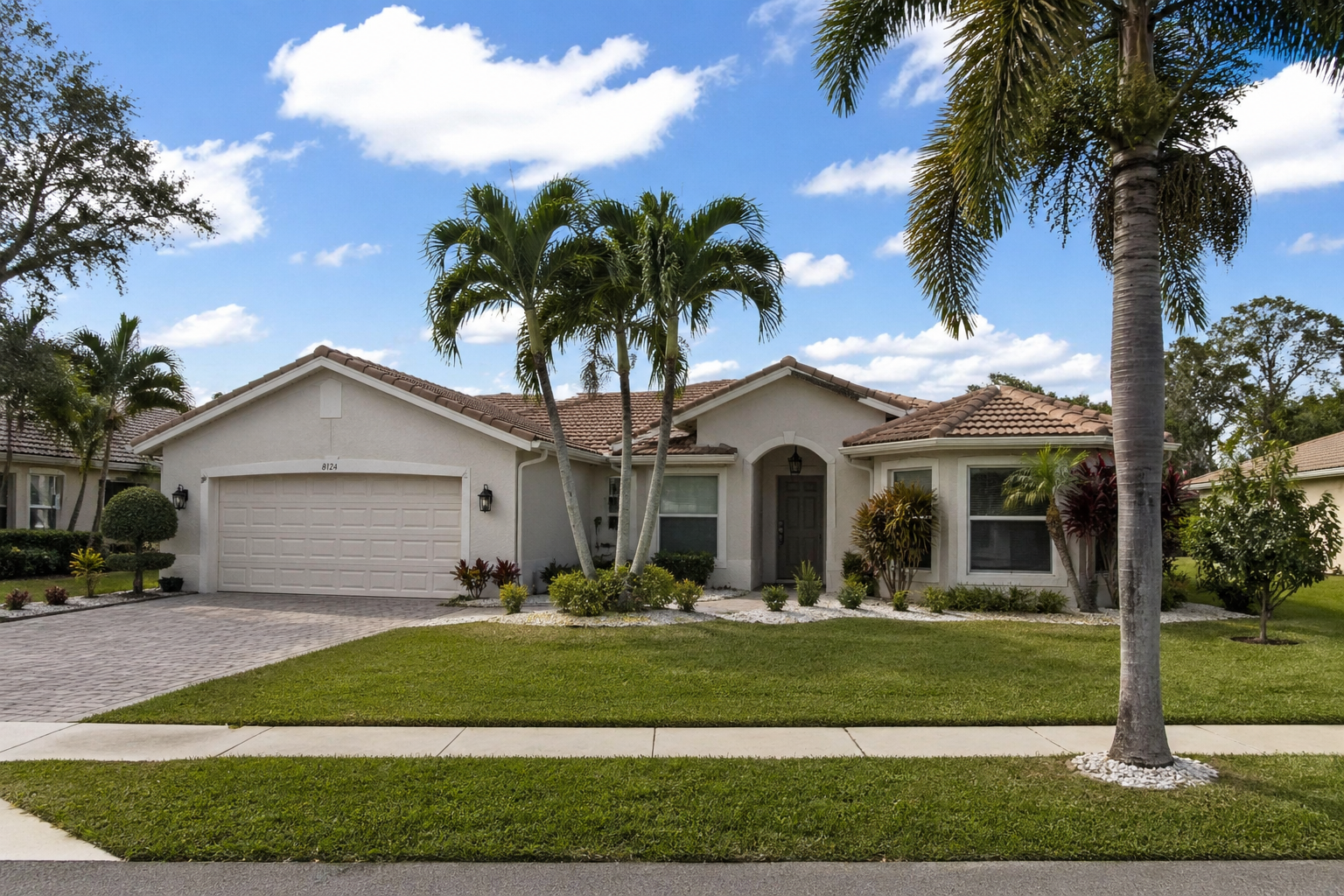
A bright suburban Wellington Florida home representing selling a home in Wellington FL with clean exterior landscaping and long-term ownership appeal

Wellington, FL: Ownership Strategy in a Market Built for Stability

There are markets that reward speed, and there are markets that reward patience. Wellington falls squarely into the latter. When people start thinking about selling a home in Wellington FL, the conversation usually isn’t about urgency—it’s about positioning. Timing matters here, but not in the short-term sense most sellers expect. It’s about aligning lifestyle shifts, equity cycles, and buyer demand that tends to move with purpose rather than emotion.

Compared to nearby coastal markets, Wellington operates on a different rhythm. It’s less volatile than areas like Delray Beach, yet more structured than purely suburban alternatives. The result is a place where ownership decisions tend to be deliberate, and outcomes often reward those who think beyond immediate conditions. Whether you're evaluating your next move or simply assessing long-term value, Wellington offers a version of South Florida that is built around continuity, not fluctuation.

How Wellington Balances Daily Life With Long-Term Stability

Wellington’s appeal isn’t rooted in trend cycles. It’s rooted in consistency. The neighborhoods are designed around usability—schools, green space, and residential planning that supports routine rather than disruption. That matters more than it might seem. Markets that are easy to live in tend to be easier to hold, and properties that are easier to hold often perform more predictably over time.

There’s a reason many homeowners stay here longer than expected. The layout of the community reduces friction in daily life. Commutes are manageable. Amenities are embedded into neighborhoods rather than requiring travel. Over time, that creates a form of stability that translates directly into ownership behavior—less turnover, fewer forced sales, and a more measured pace of inventory entering the market.

That structure is a key factor behind Wellington home values and ownership trends. When fewer homeowners feel pressure to sell, pricing tends to hold more consistently. Not necessarily faster growth, but steadier ground.

Explore Homes in This Area

If you're considering a move, browsing available homes can help you understand pricing, layouts, and what’s currently on the market in this area.

Search Homes by City

The Market Structure Behind Wellington Home Values and Ownership

Wellington doesn’t typically behave like a momentum-driven market. It’s less influenced by rapid swings and more influenced by layered demand. Families, seasonal residents, and equestrian buyers all interact with the market differently—and at different times. That segmentation creates a stabilizing effect.

Compare that to a market like Boynton Beach homes for sale, where pricing and turnover can be more sensitive to broader buyer trends. Wellington, by contrast, absorbs changes more gradually. That doesn’t mean values don’t move—it means they tend to move with more resistance in both directions.

For owners, this creates a specific kind of advantage. You’re less exposed to abrupt shifts, but you also need to be more intentional when positioning a sale. Buyers here are typically informed. They’re comparing lifestyle fit, not just price per square foot. That changes how homes compete.

If you’re evaluating your current position, understanding your property’s place within that structure is more useful than watching headline trends. A well-timed valuation can give you a clearer picture of where you stand relative to current demand. You can start that process here: home value estimate.

Buying Into Wellington: A Decision Built Around Longevity

Buyers entering Wellington tend to have a longer time horizon than in many surrounding markets. They’re not just looking for access—they’re looking for alignment. That affects how homes are evaluated and, ultimately, how pricing holds over time.

Properties that support long-term living—functional layouts, stable neighborhoods, proximity to core amenities—tend to outperform those that are more dependent on short-term appeal. That’s not always obvious in listing photos, but it becomes clear in how quickly homes move and how consistently they maintain value.

When compared to options like Wellington homes for sale, buyers often recognize that they’re not just purchasing a home—they’re buying into a system that supports continuity. That’s part of what sustains the ownership patterns seen here.

This also means that buyers who stretch beyond what fits their long-term plan can feel pressure later. The market doesn’t always provide quick exits at premium pricing. It rewards alignment more than speculation.

Selling Strategy: Positioning Within a Thoughtful Market

Selling a home in Wellington FL is less about catching a moment and more about presenting clarity. Buyers here tend to move forward when they understand how a property fits into their long-term plan. That means pricing, presentation, and timing need to work together—not just independently.

Homes that are positioned correctly tend to attract serious buyers quickly. Not necessarily large numbers of them, but the right ones. Overpricing, on the other hand, tends to stall momentum more noticeably here than in faster-moving markets. The buyer pool is selective, and once a property loses its initial positioning advantage, it can take longer to recover.

Preparation plays a larger role than many sellers expect. Small adjustments—layout flow, condition, and how the home is presented—can have a disproportionate impact on outcome. Because buyers are evaluating for long-term fit, they’re often more sensitive to details that affect livability rather than just aesthetics.

The sellers who achieve the strongest results are usually the ones who treat the process as a strategic transition, not a transaction. They understand that the goal isn’t just to sell—it’s to align timing, pricing, and next steps in a way that supports the broader move.

Understand What Your Home Might Sell For

If you're thinking about selling in this area, knowing your home’s current value is the first step toward understanding your options.

Check Your Home Value

What This Means for Buyers and Sellers in South Florida

Wellington represents a specific kind of opportunity within the broader South Florida landscape. It doesn’t always lead in price acceleration, but it often leads in stability. For buyers, that means entering a market where decisions tend to hold up over time. For sellers, it means working within a structure that rewards preparation and clarity rather than urgency.

In a region where some markets are driven by momentum and others by affordability, Wellington sits in a middle position—one that prioritizes livability and long-term ownership. That positioning won’t appeal to every buyer or seller, but for those aligned with it, the outcomes tend to be more predictable.

Understanding that distinction is what allows both sides of the market to make stronger decisions. It shifts the focus from reacting to conditions toward planning around them.

Conclusion: A Market That Rewards Alignment Over Timing

Wellington isn’t a market where short-term moves define outcomes. It’s a market where alignment—between lifestyle, property, and timing—shapes results. Whether you’re entering or exiting, the advantage comes from understanding how the market functions beneath the surface.

That’s what separates a good decision from a durable one. And in Wellington, durability is often where the real value shows up.

Keep Exploring South Florida Real Estate

If you're comparing communities, reviewing local real estate trends, or exploring where you might want to live next, continue exploring to better understand your options.

Frequently Asked Questions About Wellington Real Estate

Is Wellington a good market for long-term homeownership?

Wellington tends to favor long-term ownership due to its stable demand and community structure. Buyers often choose the area for lifestyle consistency rather than short-term gains, which supports more predictable home values. While appreciation may not spike as quickly as in trend-driven markets, the steadier trajectory can reduce volatility and create a more reliable ownership experience over time.

How do Wellington home values compare to nearby cities?

Wellington home values often sit in a balanced position relative to surrounding markets. They typically don’t fluctuate as aggressively as coastal areas but maintain strong stability due to consistent demand. This makes the market less reactive to short-term changes while still benefiting from broader regional growth patterns.

What should sellers focus on when listing a home in Wellington?

Sellers should focus on positioning rather than speed. Pricing accuracy, property condition, and clear presentation are critical. Buyers in Wellington tend to evaluate homes for long-term livability, so small details that impact usability can influence decisions more than cosmetic upgrades alone.

Are buyers in Wellington typically primary residents or seasonal?

The buyer pool in Wellington is a mix, but many are primary residents seeking stability and lifestyle alignment. There is also a seasonal and equestrian-driven segment that contributes to demand. This diversity helps create a layered market that doesn’t rely on a single buyer type.

Is it harder to sell a home in Wellington compared to faster-moving markets?

It’s not necessarily harder, but it requires a different approach. Wellington buyers tend to be more deliberate, so homes that are not priced or presented correctly can take longer to sell. However, well-positioned properties often attract serious buyers quickly, leading to strong outcomes when strategy is aligned.
April 27, 2026

Delray Beach Real Estate: What Buyers Miss at First

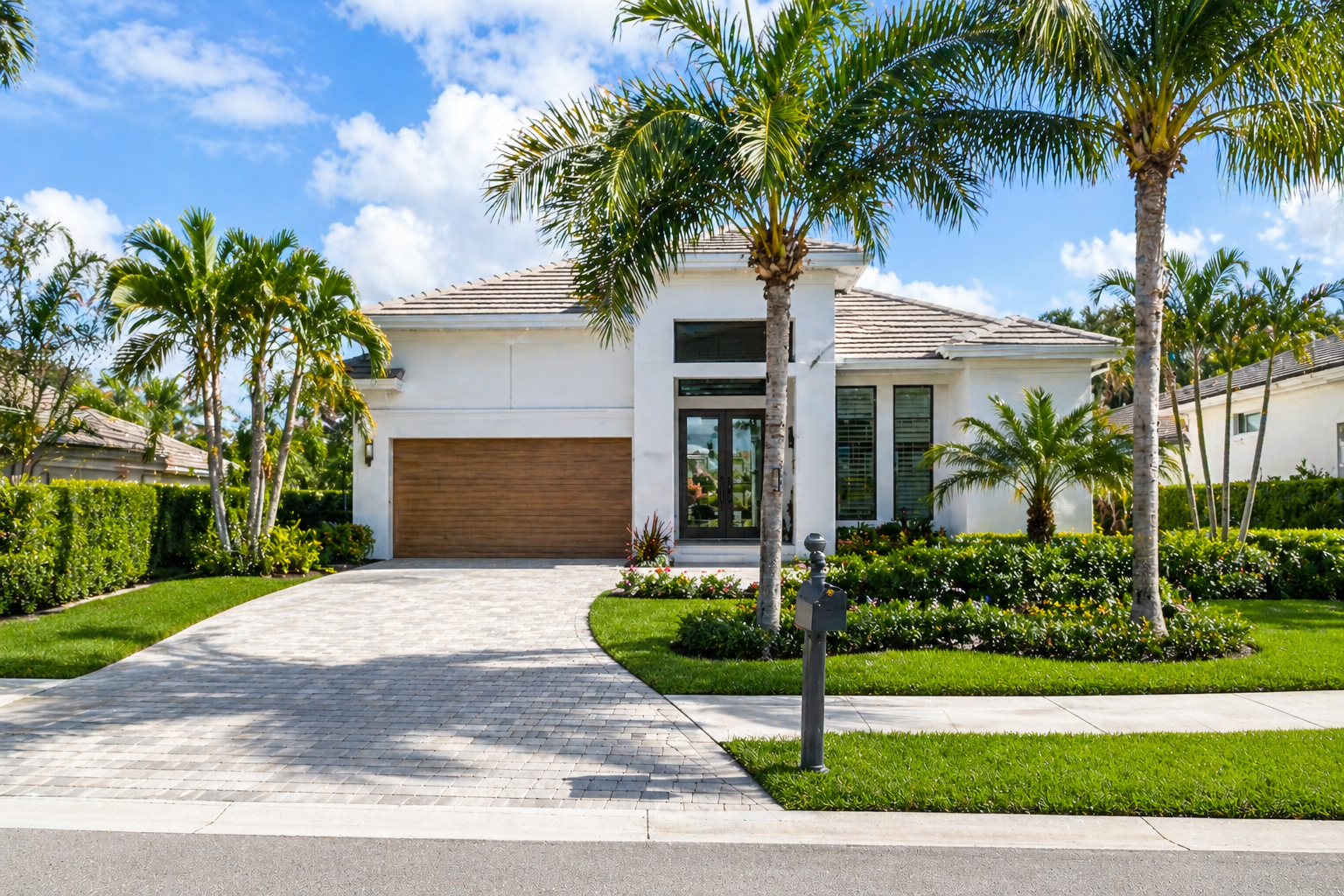
Modern home in Delray Beach FL with palm trees and bright daylight representing local real estate lifestyle and residential setting

Delray Beach FL Real Estate: What You Only Notice Once You’re Paying Attention

At first glance, Delray Beach presents itself in a very specific way—vibrant, walkable, and centered around an energy that feels different from much of Palm Beach County. But what often goes unnoticed is how layered that experience really is. The version you see on a weekend along Atlantic Avenue isn’t the same version people live in day to day. And that gap matters more than most buyers and sellers realize.

Understanding Delray Beach FL real estate isn’t just about price points or inventory—it’s about how lifestyle, location, and timing intersect in ways that don’t always show up in listings. Compared to nearby areas, Delray tends to attract buyers who are looking for a specific feel, not just a home. That makes it one of the more emotionally driven markets in South Florida, which influences everything from pricing to how quickly decisions happen.

If you’re considering living in Delray Beach FL, the real clarity comes from looking beyond surface impressions and understanding how the city actually functions.

The Lifestyle People Picture vs. the One They Actually Live

There’s a reason Delray Beach stands out. The downtown core, access to the water, and the mix of restaurants and walkability create a lifestyle that feels active and connected. But that’s only one layer.

Many residents don’t live directly in the center of that activity. Instead, they choose neighborhoods that offer more space, quieter streets, or different price points while still being within reach of everything that makes Delray appealing. The experience shifts depending on where you land.

This is where comparisons become useful. For example, some buyers who initially focus on Lantana homes for sale end up drawn to Delray for its lifestyle density, while others move the opposite direction when they realize they prefer a more relaxed pace.

What matters is not whether Delray is “better,” but whether the version of Delray you’re imagining matches how you actually want to live day to day.

Explore Homes in This Area

If you're considering a move, browsing available homes can help you understand pricing, layouts, and what’s currently on the market in this area.

Search Homes by City

How the Market Behaves When Lifestyle Drives Demand

Not all real estate markets move the same way. In Delray Beach, demand is often tied to perception and experience as much as it is to fundamentals. That can create pricing patterns that feel inconsistent if you’re looking at it strictly from a numbers standpoint.

Homes closer to the lifestyle core—whether that’s downtown proximity or coastal access—tend to carry a premium that isn’t always linear. Meanwhile, properties just a short distance away may offer more space or value, but appeal to a slightly different buyer mindset.

When browsing Delray Beach homes for sale, this becomes clear quickly. Two homes with similar features can perform very differently depending on how they align with what buyers emotionally connect with.

This is one of the reasons timing matters more here than in more uniform markets. When demand is driven by experience, small shifts in buyer behavior can influence how quickly homes move and how aggressively they’re priced.

Buying Here Means Deciding What You Value Most

For buyers, Delray Beach isn’t a place where you can optimize for everything at once. There’s usually a tradeoff—proximity to activity, home size, privacy, or price point.

Some buyers prioritize being able to walk to restaurants and events, accepting smaller spaces or higher costs. Others look slightly outside the core to gain square footage or newer construction while still being a short drive away.

The challenge isn’t finding options—it’s choosing which version of the lifestyle matters most to you. Without that clarity, it’s easy to feel like nothing quite fits, even when there are strong opportunities available.

That’s why many buyers start by understanding their financial position first. Seeing how your current home factors into your next move can simplify those decisions. A clear starting point helps: check your home value.

Once that piece is defined, the rest of the decision becomes more focused and less overwhelming.

Selling in Delray Is About Positioning, Not Just Pricing

Selling in Delray Beach requires a slightly different mindset. Because buyers are often driven by how a property feels—not just what it offers—presentation and positioning play a larger role than many expect.

Homes that align clearly with a specific lifestyle tend to perform better. That could mean emphasizing walkability, outdoor space, or the overall flow of the home. It’s less about listing features and more about showing how the property fits into the life a buyer is imagining.

At the same time, pricing strategy has to reflect the micro-location and the type of buyer it attracts. A property near the center of activity may behave differently than one in a quieter residential pocket, even if the homes themselves are comparable.

This is where understanding the nuances of the market becomes more valuable than simply following general trends.

Understand What Your Home Might Sell For

If you're thinking about selling in this area, knowing your home’s current value is the first step toward understanding your options.

Check Your Home Value

What This Means for Buyers and Sellers in South Florida

Delray Beach sits in an interesting position within South Florida. It’s neither purely lifestyle-driven nor purely value-driven—it’s a blend of both, which creates opportunity but also requires more thoughtful decision-making.

For buyers, it means taking the time to understand not just what’s available, but how different areas within the city actually feel once you’re living there. The right choice is rarely the most obvious one at first glance.

For sellers, it means recognizing that your home isn’t just competing on features—it’s competing on how well it aligns with a buyer’s vision of life in Delray. That alignment often determines both speed and outcome.

When approached with that level of clarity, the process becomes less about reacting to the market and more about using it strategically.

Frequently Asked Questions About Living in Delray Beach FL

Is Delray Beach more lifestyle-focused than other nearby cities?

Yes, but it depends on what you compare it to. Delray has a stronger concentration of walkability, dining, and social activity than many surrounding areas, which shapes how people experience the city. That lifestyle appeal draws a specific type of buyer, which also influences pricing and demand. However, quieter residential areas still exist within Delray, offering a different pace while maintaining access to the core attractions.

How competitive is the Delray Beach real estate market?

The level of competition can vary depending on the type of property and location within the city. Homes that align closely with the lifestyle buyers are seeking—such as those near downtown or with updated features—tend to attract more attention. Properties outside those preferences may move at a different pace. Understanding what buyers are prioritizing at any given time is key to navigating the market effectively.

Are there good options for buyers who want space but still want Delray access?

Yes, but it often requires looking just outside the most visible areas. Neighborhoods slightly removed from the downtown core can offer more square footage, newer construction, or quieter surroundings while still being within a short drive. These areas appeal to buyers who want flexibility—access to the lifestyle without being fully immersed in it every day.

What should sellers focus on when listing a home in Delray Beach?

Presentation and positioning are critical. Buyers in this market often respond to how a home feels rather than just its specifications. Highlighting how the property fits into the Delray lifestyle—whether that’s entertaining space, proximity to activity, or ease of living—can make a meaningful difference. Pricing should also reflect the specific buyer profile the home is most likely to attract.

Is Delray Beach a good long-term real estate decision?

For many homeowners, it can be, particularly due to its consistent demand and strong identity within South Florida. However, the right decision depends on your goals. Some buyers prioritize lifestyle and are willing to pay for it, while others focus more on long-term value. Understanding where you fall on that spectrum will help determine whether Delray aligns with your plans over time.

Keep Exploring South Florida Real Estate

If you're comparing communities, reviewing local real estate trends, or exploring where you might want to live next, continue exploring to better understand your options.

April 27, 2026

Move to Newer Home Without Raising Monthly Costs

South Florida homeowner reviewing finances to move into a newer home without increasing expenses in a modern suburban setting

Can You Move Into a Newer Home Without Increasing Your Expenses?

Across South Florida, a quiet shift is happening. Homeowners in places like Lake Worth and Royal Palm Beach are starting to question whether staying put still makes financial sense. It’s not always about wanting more space or a different neighborhood—it’s often about reducing complexity, controlling long-term costs, and making smarter use of equity that’s already built up.

If you’ve owned your home for several years, there’s a good chance your property has appreciated significantly. At the same time, maintenance, insurance, and upkeep may be rising. That combination creates a very specific question: is it possible to move into something newer and easier without actually increasing your monthly financial burden?

The answer isn’t obvious—but in many cases, it’s more achievable than most homeowners think.

The Misconception That Keeps People Stuck

One of the most common assumptions is that moving into a newer home automatically means higher payments. That’s understandable—newer construction, updated finishes, and lower maintenance all sound like upgrades that come with a premium.

But that thinking ignores one critical factor: the equity you already have.

In areas like Lake Worth homes for sale, many homeowners are sitting on substantial gains without fully realizing how that equity can be repositioned. The conversation shifts when you stop looking at the purchase price alone and start evaluating the entire financial picture.

In practical terms, the right move isn’t about “buying more house.” It’s about reallocating your existing position into something that works better going forward.

Where the Opportunity Actually Comes From

The ability to move without increasing expenses comes from how the pieces interact—not from any single factor.

For example, selling a home that requires ongoing maintenance, aging systems, or higher insurance costs can eliminate unpredictable expenses. At the same time, moving into a newer property often brings improved efficiency, fewer repairs, and more stable long-term costs.

There’s also the structure of the transaction itself. Depending on timing, financing, and how much equity is applied, some homeowners find that their monthly payment remains very close—or in certain cases, even decreases.

This is why many people start by getting a clear understanding of their current position. A realistic valuation of your property is often the first step toward seeing what’s actually possible. You can get a more accurate picture here: check your home value.

Once those numbers are grounded in reality, the decision becomes far less abstract.

If You’re Thinking About Moving, It Usually Starts Here

Most homeowners don’t randomly decide to move. It builds over time. If you’re starting to think about selling and moving into something newer or easier to maintain, it usually comes down to one of these situations. Choose the one that feels closest to you.

Your home is starting to feel like too much to manage →

Maintenance, repairs, or simply keeping up with everything may be taking more time and energy than you want to keep giving.

You’re trying to make a smarter financial move →

You may be thinking about reducing expenses, using your equity differently, or moving into a home that fits your long-term plans better.

You want something newer, simpler, and easier to live in →

Many homeowners reach a point where they want less maintenance, a more efficient layout, and a home that feels easier day to day.

Why “Newer” Often Means More Financial Control

There’s a subtle but important distinction between cost and control. Many homeowners focus strictly on the monthly payment, but overlook how unpredictable expenses shape the real financial experience.

An older home may have a lower fixed payment but comes with variable costs—repairs, insurance adjustments, system replacements—that are harder to plan for. Over time, those variables can create financial friction.

Newer homes tend to reduce that unpredictability. Updated construction standards, energy efficiency, and lower immediate maintenance needs create a more stable financial environment.

For homeowners transitioning out of properties in areas like Royal Palm Beach homes for sale, this shift isn’t about upgrading for the sake of it—it’s about simplifying the financial picture moving forward.

That stability is often what people are actually looking for, even if they initially frame it as wanting something “newer.”

The Moment Most People Realize It’s Possible

There’s usually a turning point in this process. It’s not when someone starts browsing listings—it’s when they see how the numbers align in a realistic scenario.

That might look like comparing their current total monthly cost (including maintenance and repairs) against a projected cost in a newer home. Or it could be seeing how much equity they could apply toward reducing a new loan balance.

At that point, the conversation changes from “Can I afford to move?” to “Does it make more sense to stay?”

For homeowners exploring that shift, the next logical step is understanding how timing, equity, and market positioning come together. This is where a more structured look at your situation becomes valuable: explore your financial move options.

Clarity tends to remove hesitation—and hesitation is often what keeps people in homes that no longer fit.

What This Means for Buyers and Sellers in South Florida

South Florida’s market dynamics create a unique window for this type of move. Long-term homeowners often have strong equity positions, while newer inventory in surrounding areas offers options that didn’t exist years ago.

For sellers, it means your current home may be working harder for you than you realize. That equity isn’t just a number—it’s leverage that can be redirected into a more efficient living situation.

For buyers—especially those transitioning from another home—it’s less about entering the market and more about repositioning within it. The goal isn’t simply to purchase something new, but to align your housing with your financial priorities.

That alignment is where better decisions tend to happen. Not rushed decisions, not emotional decisions—just clearer ones.

FAQ: Real Questions Homeowners Are Asking

Is it realistic to move into a newer home without increasing my monthly payment?

It can be, depending on your equity position, the type of home you move into, and how the transaction is structured. Many homeowners find that by applying equity strategically and choosing a property with lower maintenance and insurance costs, their overall monthly expense remains similar. The key is evaluating the full financial picture—not just the mortgage payment, but the total cost of ownership over time.

How do I know if staying or moving makes more financial sense?

The most effective way is to compare your current total costs against a realistic scenario for a potential move. This includes maintenance, insurance, taxes, and long-term expenses. When you see both sides clearly, the decision usually becomes more straightforward. Without that comparison, it’s easy to default to staying simply because it feels safer—even when it may not be the better financial choice.

April 24, 2026

West Palm Beach FL Real Estate and Living Guide

A bright South Florida home in West Palm Beach FL real estate market with palm trees and clean exterior under sunny blue sky

West Palm Beach FL Real Estate: How the City Fits Real Life Day to Day

There’s a difference between a place that looks good on paper and a place that actually works in your day-to-day life. West Palm Beach sits right in that conversation. It’s often compared to its coastal neighbors or quieter inland communities, but the real question isn’t which city is “better”—it’s which one fits how you live. For buyers and sellers evaluating West Palm Beach FL real estate, the decision usually comes down to rhythm: commute patterns, lifestyle habits, and how much activity or simplicity you want built into your routine. West Palm Beach tends to land somewhere in the middle—more active than purely residential areas, but more flexible than the highly structured coastal markets. That balance is what makes it worth a closer look.

What Living in West Palm Beach Actually Feels Like

West Palm Beach isn’t a single lifestyle—it’s a collection of them layered together. Some areas move at a steady suburban pace, where mornings are predictable and weekends revolve around local routines. Other pockets feel more connected to downtown energy, where restaurants, events, and waterfront access are part of everyday life rather than occasional outings.

That mix creates flexibility. You can build a routine that leans structured and quiet or one that stays connected to activity without leaving the city. Commute patterns reflect that too. Access to major roadways and proximity to employment centers make it workable for professionals who need mobility without committing to a longer-distance lifestyle.

For buyers comparing nearby options, Wellington homes for sale tend to offer a more consistently residential feel, while West Palm Beach provides a wider range of day-to-day environments depending on where you land.

Explore Homes in This Area

If you're considering a move, browsing available homes can help you understand pricing, layouts, and what’s currently on the market in this area.

Search Homes by City

How the Real Estate Market Positions Itself Here

The structure of the market in West Palm Beach reflects its flexibility. You’ll find a wider range of price points and property types than in more tightly defined cities. That includes everything from established neighborhoods with larger lots to newer communities with more predictable layouts and maintenance expectations.

Because of that range, pricing doesn’t move in a single direction. Some segments respond quickly to demand shifts, while others move more gradually depending on inventory and buyer profile. That gives both buyers and sellers room to position strategically instead of reacting to a single market trend.

If you're evaluating timing or trying to understand where your property sits within that range, taking a closer look at your home’s current value can help clarify how the broader market applies to your specific situation.

For buyers, the key takeaway is that options exist—but they require clarity. The more specific you are about lifestyle and routine, the easier it becomes to narrow down which part of the market actually fits.

What Buyers Need to Think About Before Choosing West Palm Beach

Buying here isn’t about choosing the city—it’s about choosing the version of the city that aligns with how you operate daily. Two homes at similar price points can offer completely different experiences depending on location, community structure, and proximity to what matters most to you.

Some buyers prioritize convenience—being close to work, schools, or frequently visited areas. Others prioritize space, privacy, or long-term flexibility. West Palm Beach accommodates both, but not always in the same places.

Another consideration is how much structure you want built into your environment. Certain communities offer consistency and predictability, while others provide more independence. Neither is better—it simply depends on how you want your routine to function.

Buyers who take the time to define those preferences early tend to move through the process with more confidence. Without that clarity, the number of options can feel overwhelming rather than helpful.

How Sellers Should Approach the Market in This Area

Selling in West Palm Beach requires a slightly different mindset than in more uniform markets. Because buyers are coming in with varied expectations, positioning becomes more important than simply listing and waiting for activity.

Presentation plays a role, but so does context. Buyers are evaluating how a property fits into their lifestyle, not just how it compares on paper. That means pricing, condition, and timing all need to align with the type of buyer most likely to see value in that specific home.

Sellers who approach the process with a clear understanding of who their likely buyer is—and what that buyer is trying to accomplish—tend to see stronger outcomes. It’s less about attracting everyone and more about attracting the right person.

Understand What Your Home Might Sell For

If you're thinking about selling in this area, knowing your home’s current value is the first step toward understanding your options.

Check Your Home Value

What This Means for Buyers and Sellers in South Florida

West Palm Beach sits in a position that makes it relevant to a wide range of decisions. For buyers, it offers flexibility without forcing a specific lifestyle direction. For sellers, it provides access to a broad pool of potential buyers—but only if the property is positioned correctly within that landscape.

Across South Florida, the most important decisions tend to come down to alignment. Not just with price, but with how a property fits into a person’s life. West Palm Beach works well when that alignment is clear. It becomes more difficult when expectations are vague or based on assumptions rather than real-world use.

That’s why clarity matters more than comparison. Instead of asking how the city stacks up against others, it’s more useful to ask how it fits your routine, your priorities, and your next step. That’s where the real decision gets made.

Frequently Asked Questions About Living in West Palm Beach FL

Is West Palm Beach better for full-time living or seasonal use?

West Palm Beach supports both, but the experience differs depending on how you plan to use the property. Full-time residents often prioritize location relative to daily routines like work, schools, and services. Seasonal owners tend to focus more on convenience, accessibility, and ease of maintenance. The city offers options that work for each approach, but identifying your intended use upfront helps narrow the right areas and property types.

How does West Palm Beach compare to nearby cities for buyers?

Compared to nearby areas, West Palm Beach generally offers more variety in both pricing and lifestyle options. Some cities lean more consistently toward residential or luxury markets, while West Palm Beach blends multiple segments together. That creates more flexibility but also requires clearer decision-making from buyers. It’s less about finding the “best” city and more about finding the right fit within this broader range.

Is the market competitive in West Palm Beach right now?

Competition varies by segment. Certain price points and property types move quickly, especially those that align well with current buyer demand. Other segments offer more negotiating room depending on inventory levels and timing. Buyers and sellers both benefit from understanding where their specific situation fits within the broader market instead of relying on general trends.

What should sellers focus on before listing a home here?

Sellers should focus on positioning rather than just preparation. That includes pricing accurately for the specific segment, presenting the home in a way that aligns with buyer expectations, and timing the listing to match demand patterns. Understanding the likely buyer profile for the home helps guide these decisions and often leads to a smoother and more effective sale.

Does West Palm Beach work for buyers relocating from out of state?

Yes, but success usually depends on how well the buyer defines their priorities before choosing a location. West Palm Beach offers multiple lifestyle paths, which can be beneficial but also overwhelming without clarity. Buyers relocating from out of state should focus on how they want their daily routine to function rather than relying solely on general descriptions of the area.

For those actively exploring options, reviewing West Palm Beach homes for sale can provide a clearer picture of how different neighborhoods and property types align with your goals.

Keep Exploring South Florida Real Estate

If you're comparing communities, reviewing local real estate trends, or exploring where you might want to live next, continue exploring to better understand your options.

April 24, 2026

South Florida Real Estate Fraud Red Flags to Know

South Florida home with warning concept representing real estate fraud risks and red flags for buyers and sellers

How to Spot Real Estate Fraud Red Flags in South Florida

Real estate fraud isn’t just a headline issue—it shows up in everyday transactions, especially in fast-moving markets like South Florida. When prices are strong and demand stays active, it creates the perfect environment for bad actors to insert themselves into deals that feel legitimate on the surface. Buyers wiring deposits, sellers transferring ownership, and even landlords listing properties can all be targeted. What makes this especially relevant locally is the volume of out-of-state buyers, remote transactions, and investor activity across Palm Beach County. Those dynamics increase the risk of miscommunication—and that’s where fraud often begins. Knowing what to look for isn’t about being suspicious of every step; it’s about recognizing when something doesn’t align with how real transactions actually work here.

Why South Florida Is a Target for Real Estate Scams

Fraud tends to follow opportunity. In South Florida, that opportunity comes from a mix of high-value properties, relocation-driven buyers, and a steady flow of transactions involving people who aren’t physically present. When buyers are purchasing remotely or sellers are handling transactions from another state, communication becomes fragmented. That fragmentation is where scams take hold.

Another factor is timing pressure. When a property attracts multiple offers or a seller is trying to close quickly, people tend to move faster than they normally would. Fraud doesn’t rely on complexity—it relies on urgency. If someone feels rushed to sign, wire funds, or confirm details without full verification, that’s where the risk increases.

In practical terms, fraud in this market isn’t always sophisticated. It’s often a simple shift in communication—an email that looks legitimate, a payment instruction that feels routine, or a listing that appears normal but isn’t connected to the rightful owner.

The Most Common Red Flags Buyers and Sellers Miss

One of the clearest warning signs is a sudden change in how money is being handled. If wire instructions are sent late in the process, revised unexpectedly, or communicated through a different channel than originally established, that’s not something to “double check later.” That’s something to stop and verify immediately.

Another issue shows up in identity gaps. If a person involved in the transaction avoids direct communication, refuses standard documentation, or relies entirely on text or email without a verifiable presence, that creates risk. Real estate transactions involve multiple parties—agents, title companies, lenders—and each one should be traceable and confirmable.

Listings can also be manipulated. A property that seems priced well below comparable homes, especially in areas with consistent demand, isn’t always a “good find.” It may be a duplicated listing, a hijacked photo set, or a property being marketed by someone without authority to sell or lease it.

Buyers should also be cautious when access is restricted in unusual ways. If a showing can’t happen, documentation feels incomplete, or explanations don’t match how properties are typically handled in the area, it’s worth slowing down before moving forward.

How Fraud Actually Happens During a Transaction

Most real estate fraud doesn’t start at the beginning—it enters the transaction once trust is already established. That’s what makes it effective. A buyer may receive legitimate emails from a title company for weeks, then receive one fraudulent message that looks identical, asking for funds to be wired to a different account. If that change isn’t verified, the money is gone before anyone realizes what happened.

Sellers face a different version of this. Ownership can be impersonated, especially with vacant properties or investment homes. Fraudsters may attempt to list and sell a property they don’t own, relying on limited oversight and digital communication to push the process forward.

In both cases, the pattern is the same: something small shifts, and if no one questions it, the transaction continues as if everything is normal. The fraud works because it blends into the process—not because it stands out.

Explore South Florida Real Estate by City

If you're comparing areas, home types, or market conditions, browsing homes by city can help put local pricing and location tradeoffs into perspective.

Explore Homes by City

What This Means for Buyers and Sellers in South Florida

For buyers, the biggest takeaway is that no financial step should ever rely on a single point of communication. If wiring funds, confirming deposits, or receiving instructions, those details should always be verified through a second, known channel—preferably a direct phone call to a verified number. That extra step isn’t optional in this market; it’s part of the process.

For sellers, especially those managing property from a distance, identity protection becomes critical. Ensuring that your property is listed through trusted professionals and monitoring how it’s being marketed can prevent unauthorized activity. Vacant homes, rental properties, and inherited homes are especially vulnerable if no one is actively overseeing them.

Across both sides, the common thread is control. When you know who you’re working with, how information is being shared, and where each step is coming from, fraud becomes much harder to execute.

Even when browsing listings like Wellington homes for sale, understanding how legitimate properties are presented—accurate pricing, clear access, and verifiable representation—helps you recognize when something doesn’t fit the pattern.

Practical Steps That Reduce Risk Without Slowing You Down

You don’t need to overcomplicate your process to stay protected. The most effective safeguards are simple and consistent. Confirm all financial instructions verbally with a trusted source. Avoid clicking on links or downloading documents from unexpected emails, even if they appear familiar. And make sure every party involved in the transaction is clearly identified and accessible.

It also helps to understand what a normal transaction looks like in your market. When expectations are clear—how offers are submitted, how funds are handled, how communication flows—anything outside of that becomes easier to spot.

In South Florida, where transactions often involve multiple moving parts and remote participants, clarity is what protects you. Not hesitation, not fear—just clarity.

FAQ: Real Estate Fraud Concerns in South Florida

How can I safely verify wire instructions during a real estate transaction?

The safest approach is to confirm wiring details through a direct phone call using a known, trusted number—never one provided in the same email as the instructions. Title companies and brokers expect this step and will not view it as unnecessary. Avoid relying solely on email confirmations, even if the message looks legitimate. Taking an extra minute to verify can prevent a financial loss that is often irreversible once funds are sent.

Are certain types of properties more vulnerable to fraud in South Florida?

Yes, properties that are vacant, investor-owned, or managed remotely tend to carry higher risk. These situations often involve less direct oversight, which makes it easier for fraudulent activity to go unnoticed. Inherited homes or properties owned by out-of-state sellers can also be targeted. Maintaining active oversight, using trusted professionals, and monitoring listing activity helps reduce the likelihood of unauthorized transactions or misrepresentation.

Keep Exploring South Florida Real Estate

If you're researching market trends, comparing communities, or trying to better understand how broader real estate topics affect local decisions, reviewing more South Florida resources can help put the market into context.


About the Authors

Chris and Sue Kull are South Florida real estate professionals with more than three decades of experience helping buyers, sellers, and property owners navigate real estate decisions throughout Palm Beach County and surrounding communities.

April 22, 2026

How to Use Your Equity to Move Into a Better Situation

South Florida home representing use of home equity to move into a better financial and lifestyle situation

How to Use Your Equity to Move Into a Better Situation

Equity is not just a number attached to your home. It is stored positioning.

For many Palm Beach County homeowners, the real issue is not whether the property increased in value. The issue is whether that value can still be converted into a stronger overall situation before the market relationship between selling and buying changes.

A home can appreciate significantly while the opportunity attached to that appreciation quietly narrows.

Equity Only Matters If It Improves the Next Position

A strong sale price by itself does not automatically create a strong outcome.

The real value of equity shows up after the sale, when the homeowner begins evaluating what that equity can realistically accomplish in the next move. Sometimes it creates lower monthly pressure. Sometimes it creates flexibility. Sometimes it allows a homeowner to move into a newer property with fewer long-term ownership demands.

What matters is not simply extracting equity from the current home. What matters is whether the next position becomes more stable, more manageable, or more strategically aligned afterward.

That is why understanding whether Palm Beach County sellers still have timing on their side matters before assuming today’s value automatically translates into tomorrow’s advantage.

What Equity Can Actually Change

The strongest equity decisions usually improve one of three areas.

First, equity can reduce long-term pressure. A homeowner may move from a higher-cost ownership structure into something with lower maintenance exposure, fewer carrying costs, or a more predictable monthly profile.

Second, equity can increase control. Instead of waiting until rising costs, insurance pressure, or property fatigue force a reaction later, the homeowner uses current leverage to choose the next move from a stronger position.

Third, equity can create flexibility. That flexibility may appear in the form of a larger down payment, cleaner financing, stronger negotiation ability, or more room to avoid overextending on the next purchase.

Used correctly, equity changes far more than a bank balance. It changes the structure surrounding the next stage of ownership.

Why Location Changes the Entire Strategy

Not every equity position functions the same way because not every market creates the same level of leverage.

A homeowner selling from a stronger Palm Beach County location may enter the next move with significantly more flexibility than someone selling from a softer or slower-moving segment.

For example, someone evaluating a Boca Raton sell high, buy smart move may be carrying a very different equity profile than someone coming from a more price-sensitive market. That difference influences how aggressively the homeowner can negotiate, how much optionality exists on the buy side, and how much pressure remains after the move.

The market you are leaving matters because it determines how much strength you are able to carry into the next decision.

Where Many Homeowners Miscalculate the Opportunity

The mistake is rarely having too little equity.

The mistake is assuming the sale itself solves the problem.

A homeowner may see strong proceeds on paper while underestimating replacement costs, financing structure, insurance, taxes, maintenance exposure, or how quickly the buy side may tighten during the transition.

That creates a dangerous gap between perceived leverage and usable leverage.

Equity can absolutely improve the next move, but only when the entire transition is structured around what happens after the sale closes—not just what happens at the closing table.

Why Buyer Flexibility Still Matters Right Now

The reason this strategy continues to exist is because the buy side has not fully tightened everywhere at the same pace.

Some Port St. Lucie opportunities still provide negotiation room through pricing adjustments, longer days on market, motivated sellers, builder competition, or properties that create leverage through condition or positioning.

That does not mean every listing represents value.

It means certain situations still allow Palm Beach County equity to stretch further than many homeowners expect.

A closer look at where buyers are still finding leverage in Port St. Lucie explains why the purchase side deserves just as much strategic attention as the sale itself.

What Quietly Happens When Timing Starts Shifting

Equity is influenced by more than appreciation.

It is influenced by what that appreciation can still accomplish.

If selling conditions soften while buying conditions become more restrictive, the same homeowner may still hold substantial equity while losing flexibility in how that equity can be deployed.

That is the part many sellers miss.

The value inside the home may remain strong while the practical advantage attached to that value becomes smaller.

By the time the market shift becomes obvious to everyone, much of the positioning advantage may already be reduced.

How the Sell High, Buy Smart Strategy Connects the Two Sides

This is where the larger strategy becomes important.

The decision is not only about selling successfully or purchasing carefully. It is about aligning both sides of the move so the equity carries maximum usefulness into the next stage.

The broader Sell High, Buy Smart strategy is built around that relationship: using current seller strength in Palm Beach County while portions of the Treasure Coast still provide buyer flexibility.

When both sides remain aligned, equity becomes more than appreciation. It becomes repositioning power.

What This Really Comes Down To

The better question is not how much equity you have.

The better question is what that equity allows you to improve.

If the move lowers pressure, creates flexibility, simplifies ownership, improves monthly predictability, or places you in a stronger long-term structure, then the equity may be doing meaningful work.

If it simply transfers from one property into another without improving the overall position, the advantage may be smaller than it first appears.

Before You Decide How to Use It

Every equity decision ultimately depends on the same variables: realistic value, remaining loan balance, timing, replacement costs, insurance, financing structure, maintenance exposure, and long-term ownership goals.

The strongest homeowners do not rush to use equity simply because it exists.

They evaluate whether the market still allows that equity to create a meaningfully better next position before the opportunity attached to it becomes harder to access.

How Far Can Your Equity Actually Take You?

Most sellers underestimate what their current position allows them to do.

  • What your home could realistically sell for in today’s market
  • How much usable equity you actually have
  • What that translates to in Port St. Lucie right now
  • How to structure the move without overextending

No pressure. Just clarity before you make a move.

See Your Options

Frequently Asked Questions

How do I know if my equity is enough to make a move worthwhile?

The amount of equity matters, but the more important calculation is what that equity still allows you to accomplish after sale costs, replacement housing, insurance, financing, taxes, and long-term ownership costs are fully evaluated together.

Is using equity to move risky?

It can become risky when homeowners focus only on the sale proceeds without structuring the purchase side carefully. Most problems come from timing mismatches, underestimating future ownership costs, or assuming the next purchase automatically improves the overall position.

April 22, 2026

Should You Sell First or Buy First in Today’s Market?

Infographic comparing selling first versus buying first in today’s Florida real estate market showing strategy, timing, and decision considerations

Should You Sell First or Buy First in Today’s Market?

This is where a lot of homeowners pause.

The reason is not usually lack of motivation. They may already know the current home is no longer the best long-term fit. They may already see the appeal of moving into something newer, simpler, or more manageable.

The problem is sequence.

Selling first protects one side of the move. Buying first protects another. Both can work. Both can also create pressure if the timing, equity, financing, and purchase options are not aligned before the first decision is made.

Why the Order Matters More in a Two-Market Move

When both markets are calm and flexible, the order of selling and buying is more forgiving.

That is not the environment most homeowners are dealing with now.

Palm Beach County may still give many sellers a strong position, while Port St. Lucie and surrounding areas may still offer selective buying flexibility. The advantage exists in the overlap between those two conditions. If one side moves before the other is understood, that overlap can narrow quickly.

That is why how you coordinate the sale and purchase matters before choosing which step comes first.

What Selling First Actually Protects

Selling first gives you certainty around the current home.

You know the sale price. You know the usable equity. You know what the proceeds actually look like after costs, payoff, timing, and closing details are accounted for.

For homeowners who need sale proceeds to fund the next purchase, that clarity can be extremely valuable.

The tradeoff comes immediately afterward.

Once the home is sold, the purchase side begins carrying more weight. If the next property has not been identified, or if the target market has tightened, certainty on the sale side can turn into pressure on the buy side.

What Buying First Actually Protects

Buying first protects the destination.

You know where you are going before releasing the current home. That can reduce emotional uncertainty and prevent the stress of selling without a clear next step.

But the risk shifts.

The current home now has to perform within a timeline. Pricing, negotiation, preparation, and buyer response all become more sensitive because the purchase has already created a deadline.

This is where understanding how your equity supports the next move becomes important. Buying first can work when the equity, financing, liquidity, and risk tolerance support it. Without that structure, it can become exposed quickly.

The Real Decision Is About Exposure

The question is not simply which option sounds more comfortable.

The stronger question is which sequence leaves you less exposed.

That exposure depends on several variables:

  • How much usable equity is available after sale costs and payoff
  • How flexible your financing is before the current home sells
  • How predictable the current sale timeline appears to be
  • How difficult the next purchase may be to secure
  • How much temporary overlap or transition pressure you can tolerate

Preference matters. Exposure matters more.

Local Market Strength Changes the Sequence

A homeowner selling from a stable or high-demand pocket may be able to take a different approach than someone selling from a slower or more condition-sensitive market.

For example, a homeowner evaluating a Royal Palm Beach sell high, buy smart move may be working from a stable position, but the timing profile may differ from a coastal, luxury, acreage, or higher-inventory property.

That local sale profile affects how much risk can reasonably be carried into the purchase side.

A strong selling position may make one sequence workable. A less predictable sale may require more caution, stronger preparation, or a different timing structure entirely.

The Purchase Side Can Quietly Take Control

Many homeowners assume the sale is the complicated part.

Sometimes it is.

In this type of move, however, the purchase side often determines whether the strategy holds together. If the desired homes in Port St. Lucie or nearby areas are tightening, selling first can leave the homeowner with fewer choices once the equity is available.

Buying first can protect the target home, but only if the current property can be sold without discounting, rushing, or weakening negotiation leverage.

This is where the move stops being a simple order-of-operations question and becomes a transition-control question.

How the Sell High, Buy Smart Strategy Frames the Sequence

The broader Sell High, Buy Smart framework is built around preserving the gap between seller strength and buyer flexibility.

The sequence matters because it determines whether that gap remains useful.

Done well, the sale and purchase support each other. The current home creates leverage, the next purchase uses that leverage carefully, and the timing keeps the homeowner from being forced into reactive decisions.

Done poorly, one side can erase the advantage created by the other.

What This Decision Really Comes Down To

The decision is not really sell first or buy first.

It is how to move without giving either side too much control over you.

Some homeowners can sell first and still buy with enough flexibility. Some can buy first because their equity, financing, and sale position are strong enough to manage the overlap. Others need a more careful structure before either path makes sense.

The strongest answer is rarely generic.

Before You Choose the Sequence

Every situation depends on equity, property type, financing, timing tolerance, sale predictability, and the availability of the next home.

Before choosing a path, the goal is to understand how both sequences would actually behave in your situation. Not in theory. Not based on a headline market opinion. Based on the pressure points that would matter once the transition starts.

Review the Sequence Before Pressure Enters the Move

If you are unsure whether to sell first or buy first, the most useful step is understanding which path protects your position before the move becomes active.

  • Evaluate whether your equity supports selling first, buying first, or a more controlled sequence.
  • Understand how current Palm Beach County conditions affect your sale timing.
  • Review whether the purchase side still gives you enough flexibility.
  • Structure the move before either side starts forcing decisions.

No pressure. Just clarity before you choose the path.

Review Your Move Sequence

Frequently Asked Questions

Is it better to sell first or buy first?

The risk is assuming one sequence is automatically safer. Selling first gives more certainty around equity, while buying first gives more certainty around the destination. The control principle is choosing the path that creates the least exposure based on your equity, financing, sale predictability, and purchase-side options. The execution reality is that the right sequence can change from one homeowner to another even inside the same market.

What is the biggest risk when buying and selling at the same time?

The risk is losing control of the timeline. If the sale side or purchase side begins forcing decisions, pricing, negotiation, and property selection can all become reactive. The control principle is structuring both sides before pressure builds. The execution reality is that most timing problems happen when homeowners treat the sale and purchase as separate events instead of one connected transition.

April 22, 2026

Why Inventory Is Shrinking in Both Markets and What It Means

South Florida homes representing shrinking housing inventory and increasing competition in real estate market

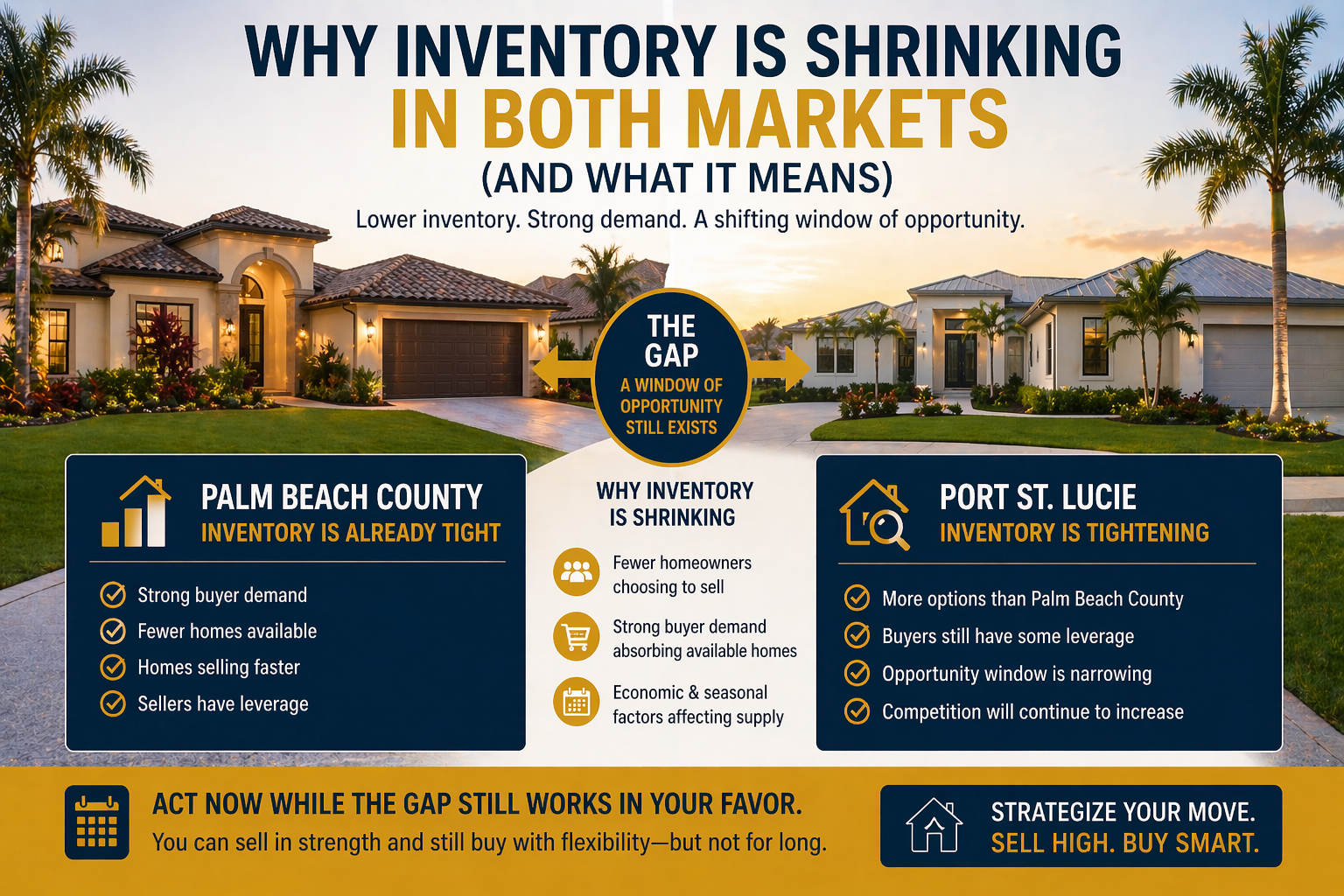
Why Inventory Is Shrinking in Both Markets (And What It Means)

Inventory does not tighten all at once. It contracts gradually, then suddenly starts changing how every decision feels.

At first, buyers still believe they have options. Sellers still believe they can wait. Then the market reaches the point where flexibility quietly begins disappearing from both sides at the same time.

That is where Palm Beach County and Port St. Lucie are now—except the two markets are moving through that transition at different speeds.

What Shrinking Inventory Actually Changes

Most homeowners think shrinking inventory simply means fewer homes for sale. In reality, the larger effect is reduced negotiating flexibility.

As supply tightens, timing becomes less forgiving. Buyers lose the ability to wait comfortably. Sellers gain leverage, but only while enough demand still exists underneath the market.

That is why understanding what changes if you wait to sell and buy matters before assuming the current window will remain stable.

The shift usually starts subtly:

  • Homes with strong positioning attract faster activity
  • Negotiation windows narrow
  • Buyer hesitation becomes more expensive
  • Replacement inventory becomes harder to secure

Once those patterns accelerate, the same move often requires more pressure to accomplish.

Why Palm Beach County Is Already Feeling It

Palm Beach County has already moved into a tighter phase of the cycle.

Well-positioned homes still attract strong attention because buyers competing for lifestyle markets, coastal access, school zones, and established communities are now working from a smaller pool of available inventory.

This does not mean every seller automatically wins. It means the market has already shifted enough that seller leverage exists more consistently than buyer leverage.

That distinction matters because many homeowners still assume conditions will remain equally favorable later. Inventory cycles rarely work that way.

Why Port St. Lucie Still Looks Different

Port St. Lucie is following the same path, but the market has not fully tightened yet.

That lag is what currently creates the opportunity gap between selling in Palm Beach County and buying farther north.

Some buyers can still negotiate selectively. Certain listings still experience longer market exposure. Some sellers are still adjusting pricing or expectations before competition fully compresses available inventory.

A closer look at why buyers still have flexibility in Port St. Lucie helps explain why that gap still exists—and why it may not remain open indefinitely.

Why the Difference Between the Markets Matters

The opportunity is not simply that inventory is shrinking.

The opportunity is that the two markets have not tightened at the same speed.

Palm Beach County sellers may still operate from relative strength while Port St. Lucie buyers can still find selective flexibility.

That overlap creates the foundation of the entire move.

Once both markets fully tighten at the same time, the advantage begins compressing from both directions. Sellers face more competition for replacement housing while buyers lose negotiating room on the purchase side.

This is why timing matters more than many homeowners initially realize. The move becomes harder when leverage disappears simultaneously.

How Inventory Tightening Quietly Changes Buyer Behavior

Buyers rarely become aggressive immediately.

What usually changes first is decision speed.

Homes that would have sat longer begin moving faster. Buyers become less comfortable waiting. Financing timelines become more sensitive. Properties with strong condition or location advantages attract quicker offers because buyers recognize fewer alternatives exist.

That behavioral shift matters because it changes how leverage works.

In earlier stages, buyers negotiate from patience. In later stages, buyers negotiate from fear of losing the opportunity altogether.

Why This Directly Affects Equity Strategy

Shrinking inventory does not just affect availability. It affects what your current equity can still accomplish.

If your home continues appreciating while replacement inventory becomes harder to secure, the raw number attached to your equity may still rise while the flexibility attached to it quietly declines.

That is where homeowners often misread the situation.

The important question is not whether your home still has value. The important question is whether that value still creates enough room to improve your next position.

Understanding how equity translates into a stronger next move becomes critical once inventory begins tightening on both sides.

How This Starts Showing Up Across Palm Beach County

Different cities feel inventory compression differently.

In markets such as Lake Worth, inventory tightening may affect older homes, insurance-sensitive properties, or condition-driven buyer decisions first.

In stronger lifestyle markets, buyer urgency may increase faster because replacement options become harder to replicate.

The local market matters because it determines how long sellers can maintain leverage before the balance begins shifting again.

What Happens If Inventory Tightens Further

As supply contracts further, flexibility usually disappears before prices make dramatic moves.

That is the part many homeowners miss.

The first loss is not value. The first loss is optionality.

Buyers become more reactive. Sellers become more selective. The transition between selling and buying becomes harder to coordinate cleanly because fewer workable choices exist at the same time.

The earlier phase of shrinking inventory still allows strategic movement. The later phase forces more reactive decision-making.

What This Really Comes Down To

Inventory shifts matter because they change how much control exists inside the move.

Right now, many Palm Beach County homeowners can still:

  • Sell into relatively stronger conditions
  • Transfer equity before replacement inventory fully tightens
  • Buy while selective flexibility still exists farther north

That overlap is where the opportunity lives.

Once the markets tighten together, the same move may still be possible—but often with less flexibility, more pressure, and fewer favorable choices.

Before You Decide What to Do Next

Every move depends on timing, equity, replacement inventory, and how both sides of the transition interact.

Before deciding whether to wait or move forward, it helps to understand how shrinking inventory is affecting your specific position—and whether the current market gap still gives you enough room to use your leverage effectively.

Avoid Getting Caught Between Two Markets

The biggest risk in this move is not the sale—it is the transition.

  • How to avoid selling without a clear next step
  • What happens if inventory tightens further
  • How to protect yourself from timing mismatches
  • How to move without unnecessary pressure

No pressure. Just clarity before you make a move.

Build a Clear Plan

Frequently Asked Questions

Why is inventory shrinking in both Palm Beach County and Port St. Lucie?

Inventory is tightening because buyer demand continues absorbing available homes while fewer homeowners choose to list, reducing the number of properties available across both markets.

How does shrinking inventory affect my ability to move?

As inventory tightens, buyers lose flexibility, negotiation windows narrow, and replacement housing becomes harder to secure. That makes timing more important when coordinating both the sale and purchase sides of a move.

April 22, 2026

Best Port St. Lucie Buyer Opportunities | Sell High Buy Smart

Modern Port St Lucie homes representing buyer opportunities and market leverage before rising competition

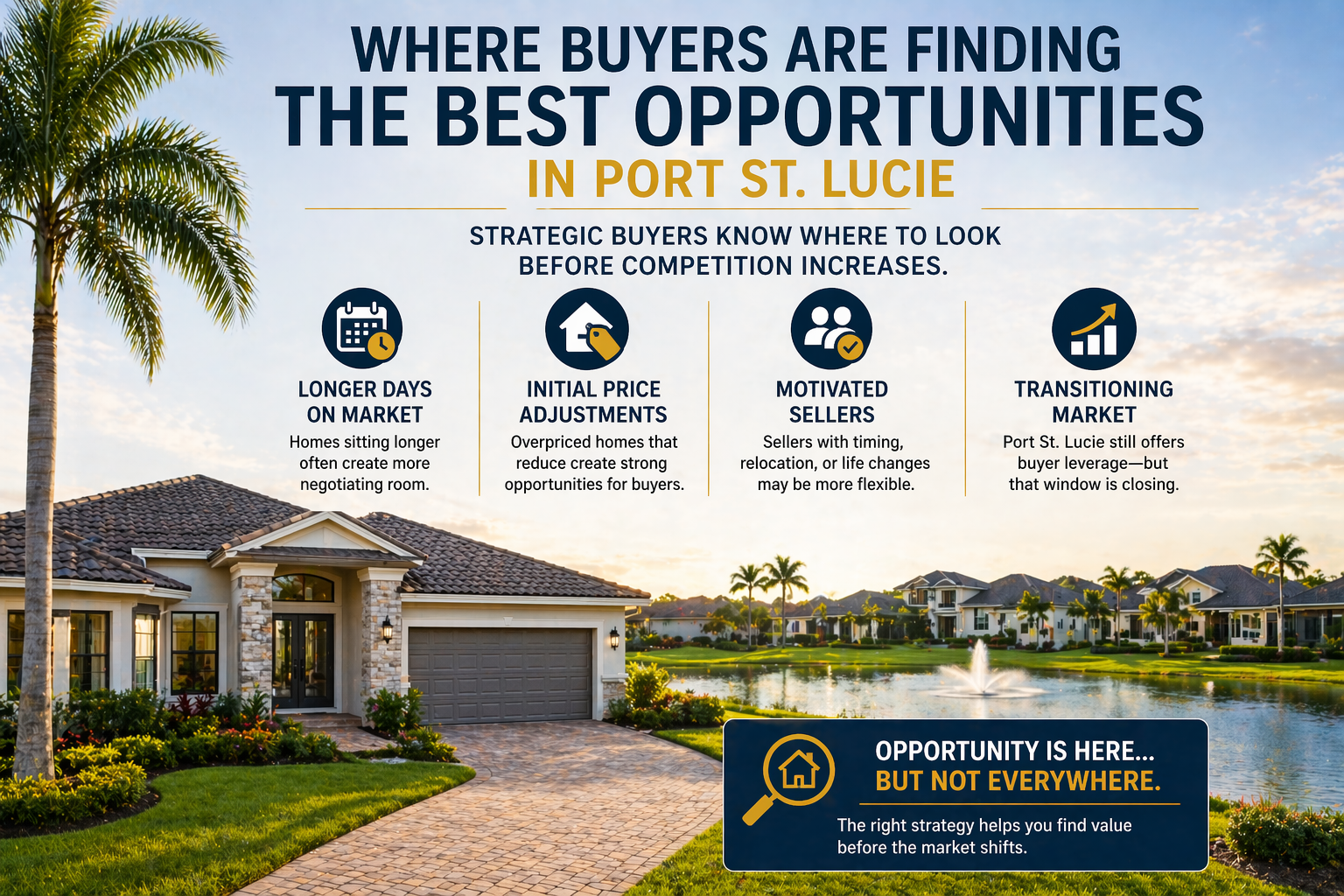
Where Buyers Are Finding the Best Opportunities in Port St. Lucie

Opportunity in Port St. Lucie has not disappeared.

It has become more selective.

That distinction matters because many buyers are still looking for obvious discounts while the better opportunities are showing up in quieter places: timing pressure, misaligned pricing, overlooked presentation, or sellers who need the market to respond faster than it has.

The strongest buyers are not simply searching for cheaper homes. They are looking for situations where flexibility still exists before competition absorbs it.

Where Buyer Leverage Is Still Showing Up

Leverage tends to appear where the market has not fully corrected yet.

That usually means looking past the most obvious listings and studying the places where timing, pricing, condition, or seller expectations have created imbalance.

Understanding why Port St. Lucie still offers buyers an advantage helps explain why some room still exists even as inventory begins tightening.

The most useful opportunity pockets often include:

  • Homes that have remained active longer than the seller expected
  • Listings that entered the market above realistic buyer demand
  • Properties with price reductions that signal seller adjustment
  • Homes with presentation issues but stronger underlying value
  • Sellers facing timing pressure on their own next move

Those situations are not guaranteed discounts. They are openings where a prepared buyer may still negotiate from a position of intelligence instead of urgency.

Why These Opportunities Exist Right Now

Port St. Lucie is not fully loose, and it is not fully compressed.

That middle phase is where opportunity becomes uneven.

Some sellers are already pricing as if the market has tightened completely. Others are still adjusting to buyer behavior that has become more selective. Some homes are attracting strong attention quickly, while others sit long enough for negotiation to become more realistic.

That inconsistency is the opportunity.

Once the market becomes more uniform, buyers usually lose the ability to separate strong leverage situations from average ones.

How This Connects to the Palm Beach County Sale

For many buyers, Port St. Lucie is not a standalone purchase.

It is the second side of a larger transition.

A homeowner selling in Palm Beach County may be trying to convert equity into a newer home, lower maintenance, more predictable costs, or a property that better fits the next stage. The purchase has to protect the strength created by the sale.

That is why Port St. Lucie needs to be evaluated as part of the full strategy, not just as a search area.

Before focusing only on the buy side, it also helps to understand whether current Palm Beach County selling conditions still work in your favor.

The Direction of the Market Matters More Than the Snapshot

A market snapshot tells you what is available today.

Direction tells you how long the advantage may last.

Right now, Port St. Lucie still has selective flexibility, but that flexibility is becoming less predictable. Stronger listings can move faster. Sellers with realistic pricing can draw more attention. Buyers waiting for broad discounts may find that the best-fit homes tighten before the headline market looks fully competitive.

This is why how waiting changes both sides of the move matters. The risk is not only missing a home. The risk is watching negotiation room narrow before the larger market feels urgent.

What Buyers Often Miss in This Phase

Most buyers look for obvious deals.

That is rarely where the best opportunity lives now.

The better advantage is often more subtle:

  • A seller who has reduced once but may still need movement
  • A property with poor photos but a strong layout
  • A listing with longer market time because it was priced incorrectly at launch
  • A home that needs cosmetic work but avoids larger structural concerns
  • A community where inventory gives buyers more choice than the broader numbers suggest

These are not dramatic opportunities. They are practical ones.

In a tightening market, practical leverage is often more valuable than waiting for a perfect discount that never appears.

How to Use Buyer Leverage Without Creating New Risk

Finding leverage is only the first part.

Using it incorrectly can still weaken the move.

A buyer may negotiate a better purchase price but choose the wrong ownership structure. Another may secure a newer home but underestimate carrying costs, commute, maintenance, insurance, or resale considerations. A third may move too slowly because the property does not look like a traditional bargain, even though the structure of the deal is strong.

That is why understanding how equity translates into the next position matters before treating the purchase as isolated from the sale.

Why Inventory Shifts Can Change the Opportunity Quickly

Buyer flexibility usually narrows before buyers fully feel it.

The first sign is not always a dramatic price jump. It may be fewer workable homes, shorter negotiation windows, more competition around clean properties, or sellers becoming less flexible once activity improves.

That is why understanding how inventory shifts affect both markets is important before assuming today’s Port St. Lucie opportunities will remain available later.

The market does not need to close completely for the best leverage to disappear.

What This Really Comes Down To

The question is not whether Port St. Lucie still has opportunity.

It does.

The better question is whether you are positioned to recognize the right opportunity before it becomes more competitive.

Right now, buyers may still find selective negotiation, practical flexibility, and situations where seller expectations have not fully aligned with current demand. But those conditions are transitional.

The advantage belongs to buyers who understand where flexibility still exists and how that purchase fits into the larger move from Palm Beach County.

Before You Decide Where to Focus

Every buyer approaches Port St. Lucie differently because every sale position, equity level, timing need, and risk tolerance is different.

Before making the purchase side active, it helps to understand how the buy-side opportunity connects to the sale-side leverage—and whether today’s market still gives you enough room to move carefully instead of reactively.

Review Where Your Buying Advantage Still Exists

If you are considering a move toward Port St. Lucie, the first step is understanding where buyer flexibility still exists and how that connects to your current equity position.

  • Identify where Port St. Lucie listings still offer practical negotiation room.
  • Understand how your Palm Beach County equity may translate into the next purchase.
  • Review which opportunities are real and which only appear flexible.
  • Structure the purchase before competition narrows your options.

No pressure. Just clarity before you decide where to focus.

Review Your Port St. Lucie Options

Frequently Asked Questions

Where are buyers still finding opportunities in Port St. Lucie?

The risk is assuming opportunity only appears as a large discount. The control principle is looking for practical leverage through longer days on market, price adjustments, seller timing pressure, presentation issues, or inventory pockets with more choice. The execution reality is that the best opportunities are often selective rather than obvious.

Is it still possible to negotiate in Port St. Lucie?

Yes, but the risk is treating negotiation as equally available across the entire market. The control principle is identifying where pricing, timing, condition, and seller motivation still create room. The execution reality is that negotiation is becoming more selective as stronger listings draw faster attention and inventory tightens around the best-fit homes.

April 22, 2026

How To Time Selling And Buying Without Getting Stuck | Florida Strategy

South Florida homes representing coordinated timing strategy for selling and buying without getting stuck

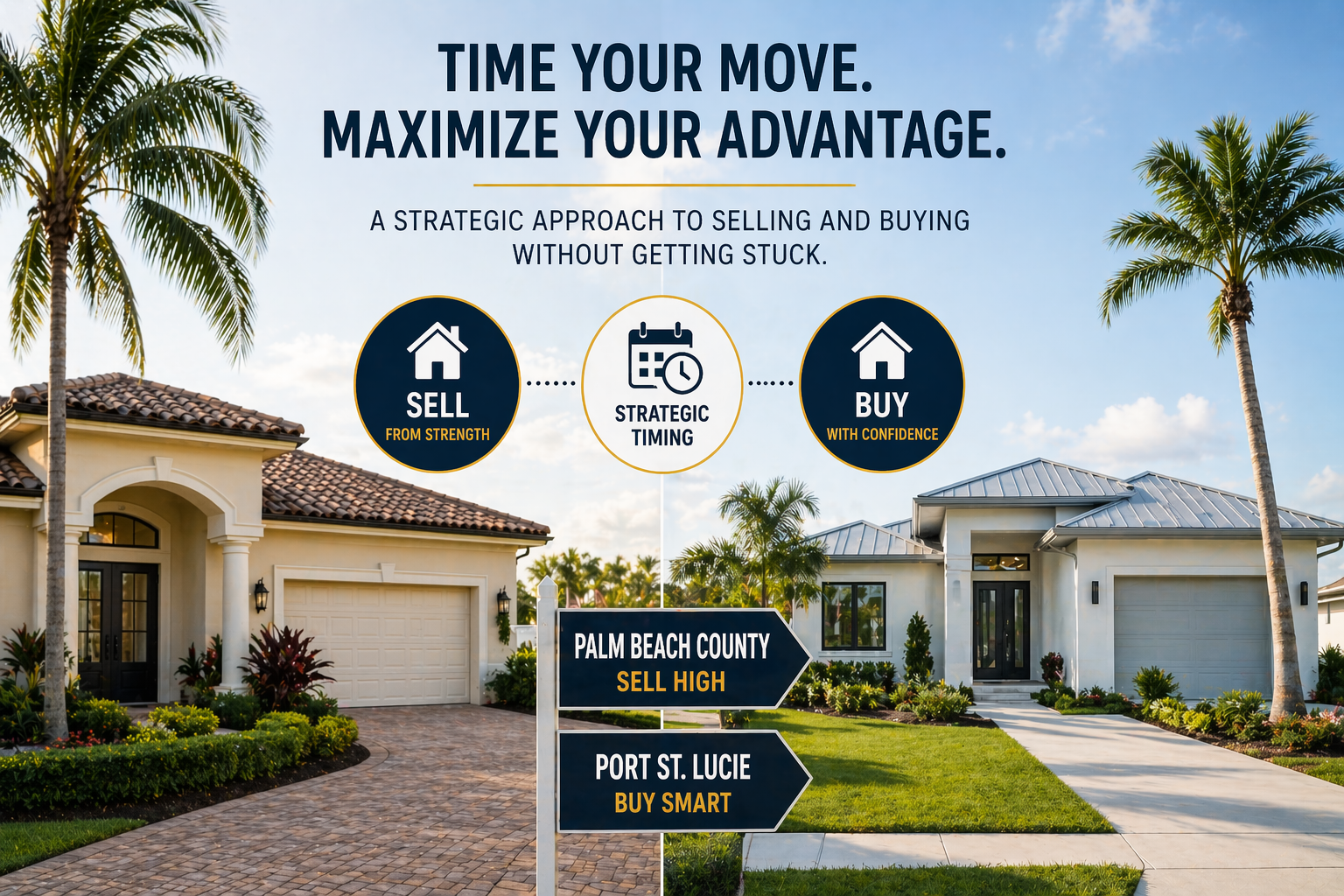
How to Time Selling and Buying Without Getting Stuck

Most homeowners do not struggle with the idea of moving. They struggle with the transition between one home and the next.

The pressure rarely comes from the sale itself. It comes from the space in between—where one side of the move is complete, the other side is uncertain, and timing starts controlling decisions instead of supporting them.

That is why sequencing matters. Not because there is a perfect order, but because the wrong structure can quietly remove flexibility before you realize it.

Why Timing Is No Longer a Simple Scheduling Issue

In balanced markets, timing mistakes can often be corrected without major consequences. In transitioning markets, small sequencing problems can create larger pressure quickly.

Right now, Palm Beach County sellers are still operating from relative strength while many Treasure Coast buying markets are tightening at a different pace.

That imbalance is what creates opportunity.

It is also what creates exposure.

Understanding what changes if the move is delayed into a tighter market cycle helps explain why coordination matters more now than it did even a year ago.

Where Most Moves Quietly Start Losing Control

Most homeowners do not get stuck because they made one catastrophic decision.

They get stuck because pressure develops slowly inside the sequence.

One version happens after selling too early. The homeowner now has certainty on equity, but uncertainty on where they are going next. That urgency can reduce negotiation leverage and narrow purchase choices.

The opposite version happens after buying first. The next home is secured, but now the current home carries a timeline. If the sale takes longer than expected, pressure begins building on financing, carrying costs, and decision-making.

Neither structure is automatically wrong.

The risk comes from how the sequence interacts with current market direction.

Why This Market Makes Coordination More Sensitive

Right now, the two sides of the move are not moving equally.

Palm Beach County still has segments with limited inventory and relatively stable seller positioning. At the same time, northern buying markets are gradually becoming more selective as inventory compresses and buyer activity increases.

That creates a narrowing timing window.

In areas such as Boynton Beach, homeowners may still hold meaningful selling leverage, but that leverage only matters if the next purchase still offers enough flexibility to use it effectively.

The danger is not usually the sale failing.

The danger is the purchase becoming more competitive while the transition is already underway.

Why Market Direction Matters More Than Today’s Conditions

Most homeowners evaluate the market based on current conditions.

The stronger approach is evaluating where conditions are moving.

A market that still feels workable today can become much tighter during the exact period your transition is happening.

That is why deciding whether selling first or buying first protects your position better is not simply a preference decision anymore.

It is a market-direction decision.

The correct sequence depends on which side of the move is becoming less flexible faster.

What a Coordinated Move Actually Looks Like

Coordination is not about predicting the market perfectly.

It is about reducing the number of situations where pressure forces reactive decisions.

That usually means:

  • Understanding how your current home is likely to perform before listing
  • Evaluating realistic purchase options before urgency develops
  • Aligning timing expectations instead of reacting to them mid-transition
  • Keeping flexibility available while both markets continue shifting

This is not about controlling every variable.

It is about making sure one side of the move does not quietly destabilize the other.

Where Buyer Flexibility Still Exists

Even as inventory tightens, selective buyer leverage still exists in certain situations.

Those opportunities are becoming narrower, but they have not disappeared.

They are most likely to appear in:

  • Listings carrying longer days on market
  • Homes positioned too aggressively at launch
  • Sellers operating within timing-sensitive situations
  • Properties where buyer hesitation has created temporary negotiation room

Recognizing those situations matters because they can create breathing room during the transition.

A closer look at where buyers are still finding leverage in Port St. Lucie shows how selective that flexibility is becoming.

How This Fits Into the Larger Sell High, Buy Smart Strategy

The goal is not simply to complete two transactions.

The goal is to move from one position to another without allowing the transition itself to erase your leverage.

The broader Sell High, Buy Smart framework depends on coordinating both sides correctly:

  • Selling while Palm Beach County conditions still support strength
  • Buying before Treasure Coast flexibility narrows further

If those timelines stay aligned, the move can improve your overall position significantly.

If they drift apart, the same move may still happen—but under far more pressure.

What This Decision Really Comes Down To

The real question is not whether to sell first or buy first.

The real question is how to avoid becoming vulnerable between the two.

Right now, both sides of the market are still workable.

But they are not stabilizing at the same speed.

That difference is exactly why timing matters.

Before You Structure the Move

Every homeowner enters this decision with different equity levels, financing flexibility, timelines, and risk tolerance.

That means the correct structure is never universal.

Before choosing a sequence, it helps to understand:

  • how your current home is likely to perform,
  • how much flexibility your equity creates,
  • how competitive the next purchase may become,
  • and how much timing pressure your position can realistically absorb.

The strongest moves are rarely the fastest.

They are the ones where timing, leverage, and flexibility stay aligned long enough to preserve control.

Is Your Timing Working For You—Or Against You?

Most homeowners are not making the wrong move. They are making the right move at the wrong stage of the market cycle.

  • Whether selling now still gives you leverage
  • How waiting could narrow buying flexibility
  • What your timing window realistically looks like
  • How to avoid getting trapped between two moving markets

No pressure. Just clarity before you make a move.

Schedule a Strategy Call

Frequently Asked Questions

How do I avoid getting stuck between selling and buying?

The strongest approach is creating a coordinated structure before either transaction begins. Timing, equity, financing flexibility, and purchase conditions all need to be evaluated together so one side of the move does not create pressure on the other.

Is there a best order for selling and buying?

There is no universal sequence that works for everyone. The better structure depends on how competitive the next purchase may become, how much equity flexibility you have, and how current market conditions affect both sides of the transition.